Jamaica

After a long pirate career, Captain Henry Morgan gets appointed Governor of Jamaica. He’s tasked with ridding the Caribbean of pirates. Instead, Morgan invites his former colleagues to join him in retirement. He institutes a race around Jamaica, where each pirate ship can loot and pillage at their leisure. The first one to make it around the island first, wins.

We’ll get to the race in a little while but first, we have to plunder the technical bits.

The Fiddly Bits

Designer: Malcolm Braff, Bruno Cathala, Sebastien Pauchon
Publisher: Asmodee and GameWorks
Date Released: 2007
Number of Players: 2-6
Age Range: 8 and up
Setup Time: less than 5 minutes
Play Time: around 45 minutes
Game Mechanisms:
Dice Rolling
Simultaneous Action Selection
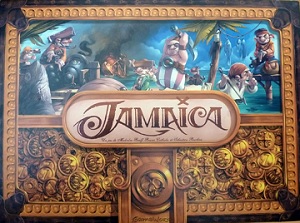
JamaicaBoardGame

Game Flow:

Each player has a hand of three cards and a board depicting the five “holds” of their ship. Each card has two symbols, representing actions, one on the left and one on the right, which you perform on a turn. Players store goods in their holds, and each good serves a purpose. Food provides sustenance for your crew and lets you move from space to space. Gold allows you to pay port costs (also allowing to sometimes) and counts as victory points. Cannonballs beef up your ship’s attack.
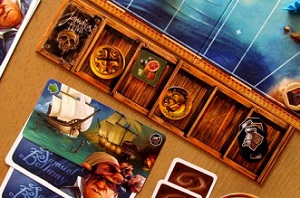
JamaicaCloseUpOfHolds

Close Up of cargo hold and goods

On a turn, one player is designated as “captain,” and the captain rolls two normal D6 dice (six-sided dice that number 1 through 6). After they roll, the captain arranges the dice in an area on the board labeled “day” and “night.” Each player simultaneously selects a card from their hand and places them face down in front of them. Your “day” action is on your card’s left, while your “night” action is on the right. You have to do everything you can do on your card.
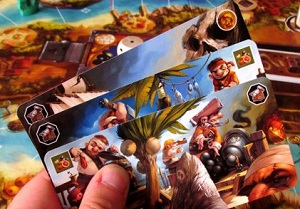
JamaicaCloseUpExampleOfHand

Close Up of a Hand

For example, if the captain rolls a six and a two, places the six on “day” and the two on “night,” whatever action is to the left on your card you do six of and then you do two of whatever action is on the right.

JamaicaCloseUpOfDiceAndDayNightAssignment

Close Up of dice and Day/Night Assignment

Let’s say that I play a card that has “food” for the day action and then “move forward” for the night action.
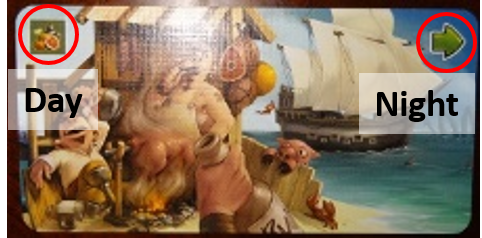
JamaicaCloseUpOfACard

Close Up of Jamaica Card

I would gather six food from the bank and then move forward up to two spaces (however many spaces I can move forward up to two that I can pay for with food).

JamaicaCloseUpOfCargoHoldPlus6Food

Add six food to one hold: Day Action

JamaicaMoveTwoSpaces

Squares on the board denote food needed to move into that space, so I pay five food and move two spaces: Night Action

A turn starts with the captain resolving their actions first, followed by the player to the captain’s left until everyone gets a turn. Once everyone’s cards are resolved, the player to the captain’s left becomes the new captain, and the next turn begins.

There are two uncommon occurrences on a turn: treasure and combat. If a player lands on a treasure space by exact count during one of their turn’s actions, they earn a treasure card. These cards can give you combat bonuses, grant you extra victory points, or even increase your ship’s cargo hold.

JamaicaTreasureCardsCloseUp

Close Up of Treasure Cards

If you land on another player by exact count, the two players fight. You roll a special D6 (a six-sided die with odd numbers on it, except for one automatic win face) and players can add cannonballs to their roll to improve their chances. The winner steals a treasure or goods from the loser, and in the case of a tie, nothing happens.

Play continues until someone crosses the finish line. Players finish their turn—if they haven’t taken them before the player crosses the finish line—and you tally victory points to find the winner.

Game Review:

I love Jamaica. It has elements that remind me of board games past but it etches its own path at the same time. Jamaica works as a great gateway game, a game that’ll get non-gamers into tabletop games. It’s fast and easy-to-learn, and that’s a good thing because it’s also gorgeous.

I’ve taken Jamaica to gaming groups and it attracted onlookers because of its sleek appearance, but people stayed around the table because of how well the game plays. And who doesn’t like playing a pirate?

JamaicaOverview

Overview of Jamaica

I do have one small gripe and you might guess what it is based on the game flow. At its heart, Jamaica is a racing game but the winner is determined by victory points. You can earn victory points by collecting treasure, cashing in your doubloons, and by how far you went around the island. You earn 15 points for passing the finish line and the point value decreases the farther you are from the finish line until you reach a red line on the board. If you’re on the wrong side of the red line, you get negative points.

JamaicaCloseUp

Red line at far left (-5 points)

While I’ve never seen anyone win—yet—that received negative points from the distance they traveled (or didn’t travel), the winner of the race seldom wins the actual game. The winner is usually someone hanging back a few spaces from the finish line with a heap of doubloons and some high point value treasure.

Still, Jamaica’s a wonderful game that you have to try at least once.

Verdict:

A fantastic game by Bruno Cathala, Jamaica provides a beautiful experience.

Ticket to Ride

Take a cross-country train adventure. Collect and play matching train cards to claim railways across North America.

This simple premise and core gameplay has resulted in a new renaissance of U.S. board games. Ticket to Ride exploded into game stores in 2004, ten years prior to this review, spawned over ten spin-offs and expansions to date and fueled its publisher Days of Wonder to become one of the modern board game industry’s giants.

Designer: Alan R. Moon
Publisher: Days of Wonder
Date Released: 2004
Number of Players: 2-5
Age Range: 8 and up
Setup Time: 5-10 minutes
Play Time: 45 minutes or less
Game Mechanics:
Hand Management
Route/Network Building
Set Collection

Game Flow:

Each player begins the game with a collection of colored, plastic train pieces (each player chooses their color), a hand of four train cards (color-coded to match the point-to-point routes between the cities on the game board), and five destination ticket cards. Five train cards are dealt face-up for a draw pile.

TicketToRideOverview
Overview of Ticket to Ride

At the start of the game, players keep which destinations they have in their hand that they think they can complete, and return the rest of the cards to the ticket pile. A destination ticket has two cities printed on it, and if the player chooses to complete the ticket, earning the points indicated on the card, they must construct a continuous route with their plastic train pieces across North America from one of the two cities to the other. Obviously, a route from New York to Los Angeles would be worth more points than a route from Vancouver, Canada to Portland, Oregon. But you lose points, equal to the points you would’ve gained, for every ticket you don’t complete.

TicketToRideDestinationCards
Destination Cards

Each connection between the two cities has a color-coded route, and players must match the colored route with the same colored train cards in their hand. Locomotive cards are wild and extremely valuable.

A player can do one of three things on their turn: claim a route with their train pieces, draw more train cards from either the draw pile or the deck, or draw more destination tickets (they have to keep at least one ticket). Play continues until someone runs out of train pieces.

Game Review:

Ticket to Ride is simple, elegant and difficult to master. Even though other games have overtaken Ticket to Ride as the gateway game (cooperative games have flooded the market and they’re excellent gateways), this game continues to go strong more than ten years after its original release.

TicketToRideTrainCards
Train Cards

Ticket to Ride could be this generation of game’s Monopoly, and what a beautiful Monopoly it makes.

Verdict:

I don’t play this game as often as I once did, but I’ll rarely say no to a game of Ticket to Ride. You can learn the rules in minutes, but it’ll take you a while to master the game, especially if you have the USA 1910 expansion.

Pandemic: The Cure

I’m on the road but still delivering reviews.

Matt Leacock took the disease curing fun of Pandemic and condensed it into a fast paced dice game. I’m sold, but let’s give Pandemic: The Cure a closer look because who knows which of these two games is better or if you should pick up both.

We’ll get to the game review in a bit, but we have to pay homage to the game detail demigods first.

The Fiddly Bits
Designer: Matt Leacock
Publisher: Z-Man Games
Date Released: 2014
Number of Players: 2-5
Age Range: 8 and up
Setup Time: less than 5 minutes
Play Time: around 30 minutes
Game Mechanisms:
Cooperative Play
Dice Rolling
Press Your Luck
Variable Player Powers

Game Flow:

You set up the game with the pandemic track (the ring-shaped, plastic piece) in the middle and six coasters—representing different areas of the world—around it. Area 1 is North America, Area 2 is Europe, and so forth. Pandemic: The Cure has four colored dice (red, blue, yellow, and black) that resemble ordinary six-sided dice, but don’t let them fool you. These dice represent the different diseases you must cure, and they aren’t numbered one through six.

PandemicTheCureCloseupOfDiseaseDice
Close up of disease dice

Whatever number you roll corresponds to the numbered coaster (one of the six areas). For example, South America is Area 6, and you can roll a six with either a blue or red die. No, I didn’t look at the individual dice, the ratio of what you can roll on a die is located by a grid on the bottom of each area coaster. So, you begin the game with thirteen disease dice in play.

PandemicTheCureOverview
Overview of Pandemic: The Cure Setup

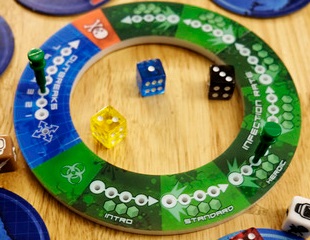
The pandemic track is interesting because you’re keeping score of not only the outbreaks (whenever you would place more than three dice of a color on a coaster) that occur but also the infection rate (you can roll an infection on a player die—more on that later). You track the disease’s progress with green syringe-shaped pegs and every time you trigger an event that creates an outbreak or would increase the infection rate, the pegs move closer to a red space, marked with a skull and crossbones. If either track reaches the skull, you lose.

ResearcherCloseUpOfRoleCardAndDice
Close up of Pandemic: The Cure role card and dice

Players select their role—either at random or by some other means—and each of these roles has its own ability (listed on the card) and its own set of dice. Player dice have various abilities, but most have die faces that allow you to move, treat diseases (removing dice from coasters), bottle cultures so you can find a cure, or increase the infection rate. Players work together to cure all four diseases and if they do so before either green peg reaches the skull, they win.

PandemicTheCureAllDiseasesCured
All diseases cured

Game Review:

The phrases “Extra Strength Dice Game” and “Fast-Acting” grace the game box, but these are more than just tongue-in-cheek references to medication. Pandemic: The Cure does convert all the strategic fun and disease fighting of the original and puts it into a quick dice game.

The randomness of dice rolling prevents the puzzle like quality of the original from showing. Some Pandemic showed how they’d play out in five or six turns and it was only a matter of the players adjusting to the puzzle and solving it. That doesn’t exist in Pandemic: The Cure. The unpredictability of the dice and smaller regions can cause the game to flip on its ear in a single turn. These diseases are stronger but so is the cure.

PandemicTheCureCloseupOfPandemicRing
Close up of pandemic track ring

Okay, that was a bad cure pun, but players do feeling both more in control (because of the improved strength of their roles) and less in control because things can turn bad in a hurry.

Verdict:

I love this game as much as the original. Matt Leacock did a great job capturing the idea of Pandemic in a dice game.

Quarriors!

Take one of the hottest game mechanisms, deck building, add the random mayhem and speed of dice rolling, throw in a lot of Q words that aren’t actually words, and you get one exciting game: Quarriors. Should I throw in the title’s exclamation point? What the heck. Quarriors!

We’ll get to the fun stuff in a bit, but here’s some technical speak that we add into every review.

The Fiddly Bits

Designer: Mike Elliott and Eric M. Lang
Publisher: WizKids Games
Date Released: 2011
Number of Players: 2-4
Age Range: 12 and up (14+ on the box)
Setup Time: About 10 minutes
Play Time: 30 minutes or less

Game Mechanisms:

Deck/Pool Building
Dice Rolling

QuarriorsLogo

Game Flow:

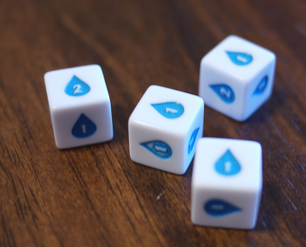
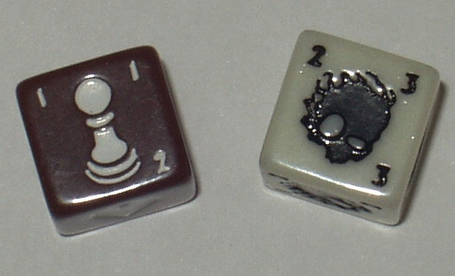
Each player starts the game with a pool of basic dice. These dice aren’t sexy but they even the playing field. We’ll get to what happens on a turn in a bit, but first let’s cover the sides of the dice you’ll see on these basic dice. Quidity, which looks like a raindrop and has a number inside the drop, allows you to pay for other, more impressive dice. Creatures have their own unique die icon and stats like health and attack.

QuarriorsExampleOfQuidityDice
Example of quidity

Here’s what happens on a turn. First, you score glory with the creatures you have in play from the previous turn—bigger creatures garner more glory. Second, you grab five dice from your dice bag and then roll them. Third, you may play the creatures you rolled this turn. Then, you attack your opponents’ creatures with your creatures—your creatures attack strengths are dealt to each of your opponents simultaneously and attacking is not optional. And finally, your turn ends with you purchasing new dice from the wilds, a communal market of dice available to all players. Play then shifts to the player to your left.

QuarriorsExampleOfCreatureDice
Example of creature dice

The first one to reach the necessary victory points—the goal’s different depending on how many players are in the game—wins.

Review:

I wonder if the first time someone combined chocolate and peanut butter felt as good as this combination of deck building and dice rolling. I like both mechanisms a lot and I’m glad Quarriors! happened. The game plays like a dream. Sure, someone can roll into several creatures early in the game and dominate because their opponents can’t roll into anything, but the game’s relatively balanced.

QuarriorsExampleOfCreatureCards
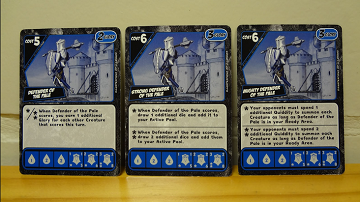
Example of different levels of creature cards

I love the inclusion of multiple cards for the dice. These cards change each die’s effect and leads to some interesting combinations. The sheer volume of these combinations means that you won’t play the same game twice no matter how hard you try, and that’s always a great thing. I’ve also never seen anyone suffer from analysis paralysis—the inability to make a decision because of the sheer volume of options—even though Quarriors! has a lot going on.

QuarriorsOverviewOfATypicalGameLayout
Overview of a Typical Game Layout

But the game does have some balancing issues. Inequality in creature powers happens. The big, bad dragon beats everything no matter what kind of dragon it is. If I’ve played too many games in a row with a dragon, I’ll take him out of the deck. There’s plenty more creatures to choose from. On the small end of the spectrum, the goblin type that adds the number of goblins you have in play to its strength is one of the few smaller creatures that’s worth picking up, but despite this inequity, Quarriors! doesn’t beat down players too much if they don’t have these creatures.

QuarriorsCloseUpOfOriginalDice
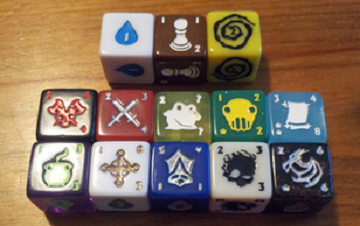
Close-up of Original Set Dice

When I first covered Quarriors!, Marvel: Dice Masters just hit stores and in the last eight months or so, a lot of folks would say that Dice Masters, which now includes Dungeons & Dragons and Yu-Gi-Oh spin offs, has replaced Quarriors! as the dice building game of choice. I say, no.

I like both Dice Masters and Quarriors!, and the two games are different enough to warrant space on your shelf. Even though Dice Masters has a low price point ($1 for a booster and $20 for a base set), it’s still a collectible game and you can sink a lot of money on it. Quarriors! is self-contained. You can choose whether or not to buy the new expansions that come out every quarter or so.

QuarriorsOverviewOfOriginalCollectorsTin
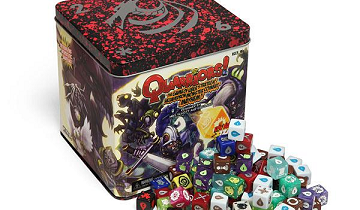
Original collectors tin

Also, Quarriors! speeds up the deck building mechanism, while there are some collectible games that move faster than Dice Masters.

Verdict:

Quarriors! provides a tasty blend of deck building and dice rolling—a great play.

Sentinels of the Multiverse: Vengeance

Adding a fourth major expansion, the Sentinels of the Multiverse’s train continues to plow through the competition. But this expansion goes where no Sentinels of the Multiverse expansion has gone before; a team of superheroes facing off against a team of supervillains.

We’ll get to the superhero action in a bit but first, let’s get to the nitty-gritty.

The Fiddly Bits

Designer: Christopher Badell, Paul Bender, and Adam Rebottaro
Publisher: Greater Than Games, LLC
Date Released: 2014
Number of Players: 2-5
Age Range: 10 and up (13 and up on the box)
Setup Time: less than 10 minute
Play Time: 10-90 minutes

Game Mechanisms: 

Cooperative Play
Hand Management
Variable Player Powers

SentinelsOfTheMultiverseVengeance

Game Flow:

Sentinels of the Multiverse: Vengeance is the fourth expansion for the popular comic book themed card game. I won’t go into detail how the base game usually flows. If you didn’t catch our Sentinels of the Multiverse: Base Game review, you can read it here. In short, Sentinels of the Multiverse is a cooperative card game, where players team up with each other to beat the stuffing out of a super villain—which has a dummy hand similar to Bridge. The major change in Vengeance is the inclusion of supervillain team mechanisms.

Instead of having a villain turn and then the heroes taking all of their turns, Vengeance has one villain take their turn and then a hero and then another villain takes a turn and then another hero and so on, until all villains and heroes have taken their turns. Play then shifts to the environment as usual and after the environment takes its turn, the process begins again.

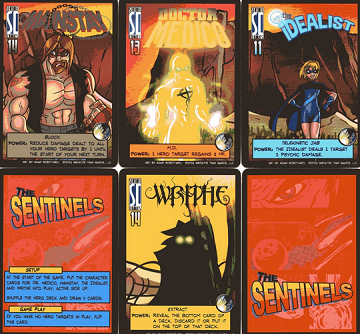
SentinelsOfTheMultiverseVengeanceVillains
Villains from the Sentinels of the Multiverse: Vengeance expansion

Review:

The inclusion of a villain team shakes up Sentinels of the Multiverse more than any other expansion. The mechanisms play smoother and faster than you’d expect, add another level of difficulty missing from previous expansions, and work with the theme of superhero/supervillain fights as many comics have supervillain teams. But don’t be fooled. None of these villains are any good on their own. They’re meant to be played all at once. I would’ve liked some standalone villains, but this is a small gripe.

Another small grievance is that the environments are bland and on the light side. This might be because you need an easier environment when you face five villains, so I dig that, but surprisingly, the heroes in Vengeance shine. I expected great villains in this set, but the heroes add a lot to the overall gameplay.

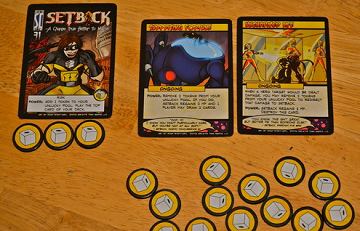
SentinelsOfTheMultiverseVengeanceSetbackAndHisUnluckyTokens
Setback and his unlucky tokens

I love mechanisms that have you sacrifice something in order to get something and ones that press your luck. Setback’s mechanisms fit both of these criteria, so I can see him as one of my new favorite sentinels. And speaking of Sentinels, the mini-team The Sentinels allows you to control a lot of smaller heroes, which gives you plenty of options and options are a great thing to have, but I’ve even played five heroes with three players before and that’s where The Sentinels come in handy.

Three players controlling five heroes used to mean that one person played one hero, while the other two players played two. With The Sentinels you can play the game in this manner and all three players get to play multiple heroes. Greater Than Games must be reading their fan messages, because I’m not the only one who plays the game like this.

SentinelsOfTheMultiverseVengeanceTheSentinelsMiniTeam
The Sentinels mini-team within a team

The other heroes in this set are great as well. The Naturalist has interesting animal form mechanisms—and that fills a common superhero trope—while Parse fulfills another major superhero archetype, the archer. Sentinels had to include an archer with the popularity of Green Arrow and Hawkeye at all-time highs.

Overall, Vengeance is a great expansion that builds on superhero mythos and the game’s mechanisms.

Verdict:

While I’m tempted to say that Vengeance is the best Sentinels expansion, I think Infernal Relics keeps that title by a smidge, but you’ve got to love the direction Sentinels of the Multiverse is headed.

Agricola

Settle the land. Build a farm and a home. Raise animals. Start a family.

If any of these things appeal to you, Agricola will strike your fancy bone. Even if none of the things above sound tempting, Agricola’s solid gameplay, get-you-playing-in-five-minutes rules, and more versatility than you can shake a Swiss army knife at will put a smile on your face.

We’ll get to the review in a bit but we have to feed you some tech speak.

Designer: Uwe Rosenberg
Publisher: Z-Man Games
Date Released: 2007
Number of Players: 1-5
Age Range: 12 and up (14+ on the box; 10 for a family game)
Setup Time: 5-10 minutes
Play Time: 45-60 minutes (less for a family game)
Game Mechanisms:
Area Enclosure
Card Drafting
Hand Management
Worker Placement or Action Drafting

Agricola04
Game Flow:
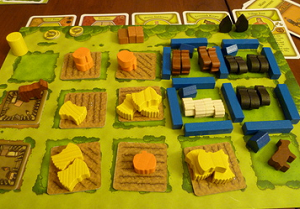
Players start the game with a plot of land, a two room wooden house, two family members (a momma and a papa), and a hand composed of occupation and minor improvement cards. Players take turns improving their homestead with a catalog of actions, available to all the players, and with the cards in their hand. Once a player selects one of the cataloged actions, by placing one of their family member playing piece on the action space, no other player can take that action that round, and there are fourteen rounds.

AgricolaActionSelection
Overview of Possible Actions

Your workers can improve your land by gathering supplies, plowing fields, building fences for pastures, adding more rooms to your house and upgrading the house you have. Animals give you options for food, but you must have fences for your animals. Children give you more actions per turn, but you must have room in your house for the newborn and you have to be able to feed all the members of your family come harvest time.


Every action is tied to multiple other actions. This forces players to plan their farms carefully and allows the player who picks before you the option to screw you over by selecting the action you needed that round.

Review:
There are now two phases to Uwe Rosenberg’s career: pre and post Agricola. Every game of Rosenberg’s prior to Agricola played nothing like a worker placement game, but every game Rosenberg has designed after Agricola plays off the worker placement mechanism. I’m not sure if it’s for better or for worse.

On first play I enjoyed Agricola. I like the farming theme and judging from the millions of people who traded virtual livestock on Farmville several years back, so do others. I also like the worker placement mechanism a lot, so of course I liked Agricola. But the shine has worn off the game for me.

AgricolaOverviewOfAFarm
Overview of a Farm

I feel anxious, struggling to feed my family members every harvest season (the fourth, seventh, ninth, eleventh, thirteenth, and fourteenth rounds), and you can’t specialize in any one thing—you have to have a little bit of everything. So what if I want to be a shepherd and corner the market with cute, wooden sheep. I should be able to specialize in something if I want, but Agricola punishes me for not having boar, cattle, grain, and veggies in addition to sheep. Rosenberg has since corrected some of these issues with Le Havre (specialization) and Caverna (less stressful means of feeding workers), which further tarnishes Agricola.

AgricolaOccupationAndImprovementCards
Examples of Occupation and Improvement Cards

Don’t get me wrong. I still wouldn’t say no to a game of Agricola, but I don’t ask to play the game with any regularity. It still has addictive gameplay and there are so many variants for playing the game that if you enjoy the core mechanics, you’ll find several hours of fun.

If you don’t mind the lack of specialization and the stress of feeding your family, Agricola is still a solid game. But if you want to eliminate one of these detractors, consider Rosenberg’s own Le Havre or Caverna.

Verdict:
Still a strong game, but two Rosenberg games have replaced Agricola as his top worker placement offering.

Fairy Tale

Four mystical faction face off for domination of the fairy tale land: dragons, fairies, knights, and the realm of shadows. You have control of which one will reign supreme by drafting cards, choosing your forces, and affecting the cards your opponents have at their disposal. Who comes out on top of this Fairy Tale? You decide.

We’ll get back to the fantastic in a bit but first, here’s some technical jargon.

The Fiddly Bits
Designer: Satoshi Nakamura
Publisher: Z-Man Games
Date Released: 2004
Number of Players: 2-5
Age Range: 10 and up
Setup Time: minimal
Play Time: around 20 minutes
Game Mechanisms:
Card Drafting
Hand Management
Set Collection
Simultaneous Action Selection

FairyTaleCardDraftingGame
Game Flow:
There are four rounds of card drafting in a game of Fairy Tale and most of the game revolves around card drafting.

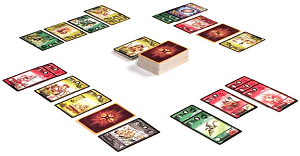
Play begins with a round of drafting and during each round, players are dealt five cards. They pick one card they want to keep, places the card they have chosen face down in front of them and passes the remaining cards to the next player (the player to their left, if it’s the first or third round of drafting, or the player to their right during the second or fourth rounds). You repeat these steps for all five cards in your hand and then you reach the play phase.

Once the play phase begins, you pick up the cards in front of you to form a new hand. You only get to play three of the five cards you chose during the drafting process and each of the cards you play are placed in front of you face up, making your tableau. (A tableau’s a term used in gaming, referring to the area of cards in front of you that you control.)

FairyTaleOverview
Fairy Tale Overview

Every card has a point value that’ll score you points and bring you closer to victory, but some cards have special powers. The most common powers are flipping and unflipping other cards. A card is considered flipped if it’s face down and unflipped if it’s face up. Since face up cards are the only ones that score points, you can prevent some of your opponents from scoring points with the cards in their tableau, while flipping over more cards of your own.

After four rounds have passed, each player tallies the points in front of them and the player with the most points wins.

Review:
I love the card drafting mechanism, and Fairy Tale does a great job of implementing it. By drafting cards you not only dictate which cards you’ll get but influence the cards your opponents choose.

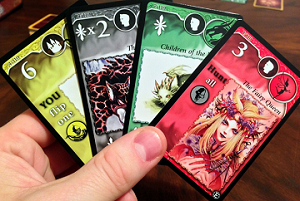
FairyTaleExampleOfAllFourFactions
Example of the four factions

Most of the colored factions score you more points if you’ve collected more of the set of cards—I have seven “Children of the Dragon” in front of me so each of them counts seven points, representing the number of “Children of the Dragon” I own. If you see your opponent stocking up on one of these factions, you can put the kibosh on them in a hurry by either flipping their cards (card powers) or picking up a few of these cards so the cards won’t ever reach their hand. Set collection and card drafting play off each other well in this game. Fairy Tale also has more advanced cards, marked with an “E.”

Advanced cards have additional powers (mainly Hunt and Draw) as well as more set collection possibilities. I prefer the base game without these added goodies, but if you’ve played a lot of Fairy Tale and have gotten bored with it, the advanced cards add just enough spice to keep the game fresh for several more plays.

FairyTaleExampleOfFairyCards
Example of Fairy Cards

My only complaint with Fairy Tale is the same one I have for 7 Wonders, a game that borrowed a lot of the game mechanisms from Fairy Tale. This game has very little theme. It’s a pretty game about dragons and fairies, but you don’t feel like you’re playing dragons and fairies. Even so, Fairy Tale’s a lot of game for fifteen to twenty dollars.

Verdict:
The predecessor of a lot of modern card drafting games, Fairy Tale sets the standard as it marries card drafting with set collection.

If you’re interested in Fairy Tale, you can download the iTunes app and play the basic rules game for free here.

Uno

Add a little color to a standard deck of playing cards, reheat the classic game of Crazy Eights, and you get the game of Uno, a game that dominated the seventies and eighties. Fast forward a couple of decades, and you can’t swing a mongoose in a supermarket’s gaming aisle without hitting an Uno spin-off or derivative.

We’ll get back to Uno in a bit, but first, we have to cover some tech speak.

The Fiddly Bits
Designer: Merle Robbins
Publisher: Mattel
Date Released: 1971
Number of Players: 2-10
Age Range: 6 and up
Setup Time: none
Play Time: as much as 30 minutes
Game Mechanisms:
Hand Management

UnoCardGame
Game Flow:
Players empty their hands and catch opposing players with cards in their hands, which scores the players points. Players take turns, attempting to play a card from their hand that matches, in either color or number, the topmost card on the discard pile. If you’re unable to play, you draw a card from the draw pile, and if you’re still unable to play, you pass your turn. If you have one card in your hand, you have to say “Uno,” or if another player catches you before saying Uno, you have to draw more cards into your hand. Play continues until someone has 100 points, and then the player with the least points wins.

Review:
Did I say Uno is the commercial version of Crazy Eights? I did? Well, it bears repeating. Sure, Uno adds wild and special cards to jazz up the gameplay, but it doesn’t venture too far from the basic rules.

UnoCardGameHandofCards
Sample of a hand of UNO cards

I enjoyed playing Uno as a kid. The gameplay had plenty of gotcha and take that moments, but as a result of those moments, luck played more of a role than anything else. It’s still an okay filler game – or an appetizer game that you can play while you wait for the gaming main course – but it doesn’t hold my interest as it once did.

And if you find yourself on the receiving end of a lot of those gotcha and take that moments, you’ll grumble your way through a game where you don’t get to play much. The game plays you. There’s nothing worse than to get skipped, and you almost get your next turn but don’t because the player in front of you plays a reverse card. Or worse yet, the dreaded Wild, Draw Four card. Thanks.

WildDrawFourUnoCard
Wild Draw Four UNO Card

Uno plays up to ten people, so it could serve as a party game, but there are plenty of other games that have surpassed it. Uno remains a filler game for me. But make sure you rub your lucky rabbit’s foot, hang your horseshoe in the right manner and eat your Lucky Charms. You’re gonna need all the luck you can get.

Verdict:
Like Crazy Eights before it, Uno relies too much on luck to be anything more than a mixed bag of a filler game.

Star Realms

Conquer the galaxy by using a combination of four unique alien factions with this blood-pumping amalgam of Magic: The Gathering’s combat and a deck builder. Designed by Magic Tour Champions Darwin Kastle and Robert Dougherty, this card game zips through the Kessel Run in twenty minutes or less—or your money back. Okay, that last part was from me, not the publishers of Star Realms. To the best of my knowledge, they don’t endorse the money back guarantee.

We’ll warp back to the foreign galaxy in a moment, but first, we have to go through the ubiquitous tech jargon.

The Fiddly Bits
Designer: Robert Dougherty and Darwin Kastle
Publisher: White Wizard Games
Date Released: 2014
Number of Players: 2-6
Age Range: 10 and up (12 and up on the box)
Setup Time: less than a minute
Play Time: up to twenty minutes
Game Mechanisms:
Card Drafting
Deck/Pool Building
Hand Management

StarRealms
Game Flow:
Players start the game with the same weak, boring ten-card decks. Your hand size is five, unless you’re the first player on your first turn, and then your hand size is three—a punishment for going first—but each subsequent turn, your hand size is five. Each player starts the game with fifty authority (a fancy way of saying health) and tries to get their opponent’s authority to zero or less to win.

StarRealmsAuthorityCards
Authority Cards: cards used to keep track of your authority, or health

On your turn, you play all the cards in your hand—there’s no cost to play—and cards grant one of four things: combat, coin, healing, or special effects. And these cards come in two flavors: ships and bases. Ships do most of your attacking. Bases offer special bonuses and some can be used as walls for your opponent to knock down before you can attack them.

You can do all the things on your cards during your turn, so feel free to deal damage, buy new cards to improve your deck, and heal yourself. Whenever you run out of cards in your deck, shuffle your discard to make a new deck.

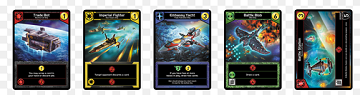
StarRealmsTypicalTradeRow
Typical Trade Row or Communal Offering

Unlike every other deck building game, the communal offering of cards that you can buy changes throughout the game. You only have five available face-up cards, while the rest comprise a draw deck. As soon as one of the five face-up cards are bought and added to a player’s discard pile, a new card takes the old card’s place in the trade offering.

Review:
Two things make Star Realms stand out from all other deck-builders: a variable trade offering and direct combat.

Most deck-builders shy away from players dealing direct damage to each other and this leads to indirect interaction which equates to slower gameplay. There’s nothing slow about Star Realms. Fifty sounds like a lot of hurting you have to deal to your opponents, but my son has dealt me thirty plus damage on a single turn. He had the biggest grin when he saw his ships chain into that much damage. I only put twenty minutes as the game’s play time because there are multiple ways to play—and some of the game variations take longer.

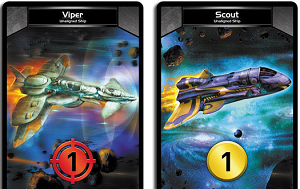
StarRealmsViperAndScout
Viper deals 1 damage, while Scout gives you 1 currency

And it’s no small thing that Star Realms has you change the cards available for purchase. This small tweak to the traditional deck-builder results in no two games playing the same.

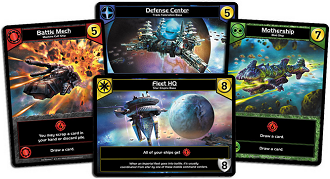
The factions have great balance while coming off as four distinct alien races. The Trade Federation (blue) earns you more money and does the most to heal you. The Robots (red) are efficient and allow you to get rid of the chaff in your discard pile, making your deck run faster. The Royal Family (yellow) collects taxes from the smaller races by making your opponents discard cards. And The Blobs (green) build off each other to great effect, but their favorite trick is to mess with the trade offering.

StarRealmsDifferentFactions
Representative cards for each faction

In short, I love this game. It’s the perfect introductory deck building game. Many other deck-builders have funny triggers and timing issues. I like deck-builders for these quirks, but if I’m teaching someone who’s never played a deck building game before, I’m pulling out Star Realms.

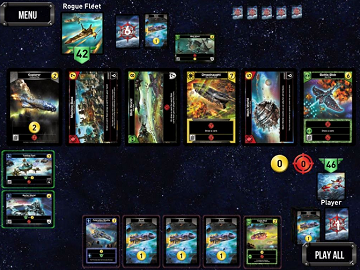
Still not convinced? Try the game for yourself. There’s a free Star Realms app for most digital devices and you can download it here. http://www.starrealms.com/digital-game. I enjoy the digital version almost as much as the physical one because the computer tallies all your bonuses for you, so the play time gets cut to five minutes or less. I don’t know how many times I’ve played ten to twelve games in a row.

StarRealmsDigitalGameScreenShot
Screen shot of the Star Realms Digital Game

Verdict: A true gateway deck building game with great balance, a fast play time, and enough variety to keep you engaged for a long time. And at fifteen bucks, Star Realms is a lot of game for little dough.

Careers

What fulfills you most? Today, we cover a game that hopes to answer that question. It’s no wonder that a sociologist created the game of Careers. Let me clarify. We’ll review the original 1955 version. None of that Computer Science stuff here. We’re talking pre-Space Race. Careers has numerous versions over the past six decades, and often, the “improvements” did not improve the game.

We’ll get to the review in a bit, but first, here’s a word from our technicians. Feel free to scroll down.

The Fiddly Bits
Designer: James Cooke Brown
Publisher: Hasbro
Date Released: 1955
Number of Players: 2-6
Age Range: 8 and up
Setup Time: 5-10 minutes
Play Time: around 60 minutes
Game Mechanisms:
Roll/Spin and Move
Variable Player Powers

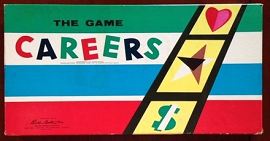
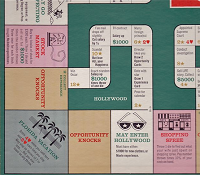
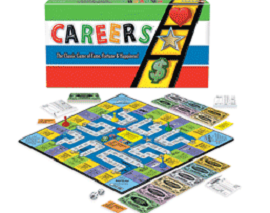
CareersBoardGame
Game Flow:
You start a game of Careers by secretly filling out your goals. You pick numeric values for Fame, Happiness, and Money. Each goal type is evenly weighted and each player has to fulfill the same number of goals—the distribution of which goals you want is the only thing that changes. Similar to Monopoly, players travel around the board’s perimeter, but Careers adds internal tracks on the board, denoting the various “careers” you can have like an engineer or a movie star. The first player to reach all of their secret goals wins.

CareersSuccessFormula
Review:
At first glance, Careers looks like a typical roll/spin and move game. It is. But by adding secret goals, Careers stands out from the rest. Yes, you get bogged down by having to reach certain spaces by exact count, but you can sidestep rolling in the internal career pathways by using experience cards you obtained in the game.

CareersCloseUp
Careers also grants players special abilities (or compensation) if they went through a certain career track once, twice, or three times. That’s how it gets classified as a game using variable player powers. You get a hint of what would become one of my favorite game mechanisms of all time. Better yet, you get to dictate, through the course of your actions, which variable player powers (or compensation) you receive. Do you want more fame? Go through the movie star track multiple times. The abilities stack. Do you need more money? Zip through the business track a time or two.

CareersOverview
Now it sounds like I have nothing but nice things to say about Careers. It does a lot of things right, and for a mass-market game, it does a heck of a lot of things right. But it suffers from the roll/spin and move madness of rolling, then moving the exact number of spaces depicted on the die (or dice), and you have to do exactly what the game tells you to do. So it feels like the game plays you at times, but Careers has to be one of the few roll/spin and move games I don’t mind playing.

Beware: You don’t want a younger version of Careers. Get the fifties version if you can.

Verdict:
An overlooked classic and one of the few roll/spin and move games I like—variable player powers, baby.