Spotlight: Omnitron-X

Omnitron-XFirst Appearance: Sentinels of the Multiverse: Shattered Timelines
Who it is: A humanoid form of Omnitron, the sentient computer of the Multiverse.
Innate Power: Timeshift: Reveal the top card of a deck. Put it into play or into the trash.
Primary Damage Type: Projectile
Secondary Damage Type: Energy, Fire, and Lightning
Nemesis: Omnitron & Omni-Blade
Deck Concept: Omnitron-X fiddles with time. His greatest abilities are the ones that begin with “at the start of your turn,” or “at the end of your turn.” Many of these abilities give him extra draw power or lets him play an additional card, often times giving Omnitron-X multiple turns to everyone else’s one. Slip Through Time and Electro-Deployment Unit are a must start.

Omnitron-XLogo

Technological Advancements can help you find these cards and/or Omnitron-X’s plating cards. Plating cards are Omnitron-X’s best – and pretty much only – form of defense. Each plating card reduces damage Omnitron-X receives from different damage types:
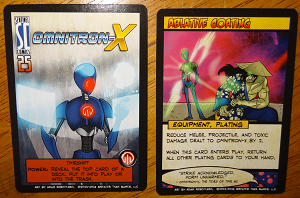
Ablative Coating: Melee, Projectile, Toxic
Elemental Excochassis: Cold, Fire, Lightning, Energy
Temporal Shielding: Psychic, Infernal Radiant, Sonic

Omnitron-XLogo

Keep in mind that environment cards can deal damage to you too, so you’ll have to determine which damage type and source will cause you the most problems in a game.
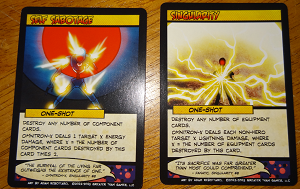
Omnitron-X does a little bit of everything. Disruptive Flechettes discards ongoing cards, Bio-Engineering Beam destroys environment cards, and OX’s innate power Timeshift can dictate the flow of the game. But OX’s main forms of damage, Singularity and Self Sabotage, involve him discarding equipment and component cards. Both of these cards don’t specify whose cards have to be discarded. OX can discard a fellow hero’s equipment, and if it’s facing Omnitron, OX can discard the villain Omnitron’s component cards for Self Sabotage’s effect.

OmnitronXSelfSabotageSingularity
Self Sabotage and Singularity
Deck Strength: A jack of all trades, Omnitron-X can fill a lot of holes a team of Sentinels may otherwise have, but it’s Omnitron-X’s abilities that allow it to draw and play extra cards that stands out.
Best Team Support Card: Disruptive Flechettes: Destroy up to 2 ongoing cards. Omnitron-X deals each non-hero target 2 projectile damage.
Co-Best Personal Support Card: Electro-Deployment Unit: At the start of your turn, either draw a card or play a card. If Omnitron-X is dealt 5 or more damage in one turn, destroy this card.
Co-Best Personal Support Card: Slip Through Time: At the end of your turn, you may play a card and you may use a power. At the start of your turn, destroy this card.

OmnitronXElectroDeploymentUnitSlipThroughTime
Slip Through Time and Electro-Deployment Unit
Best Attack: Singularity: Destroy any number of equipment cards. Omnitron-X deals each non-hero target X lightning damage, where X = the number of equipment cards destroyed by this card.
Deck Weakness: Omnitron-X doesn’t have a lot of HP and little to no defense. Additionally, if Omnitron-X receives 5 or more damage in a single turn, it’ll lose most of its components and equipment, and you’ll have to start its slow build from scratch.
Worst Card: Rocket Punch: Omnitron-X deals 1 target 2 projectile damage. Omnitron-X deals 1 target 1 projectile damage.

OmnitronXAblativeCoating
Omnitron-X and Ablative Coating
Ultimate Team-up: Omnitron-X will need a bullet-sponge. The Scholar and Legacy work well as this type of ally. Bunker is another good ally as Omnitron-X can feed Bunker cards. Unity makes another good partner, since Omnitron-X can place her golems into play. Also try combinations with Chrono Ranger and his bounties, and Nightmist and her spells.

Spotlight: Chrono-Ranger

ChronoRangerPortraitFirst Appearance: Sentinels of the Multiverse: Shattered Timelines
Who he is: The time-traveling gunslinger of the Multiverse
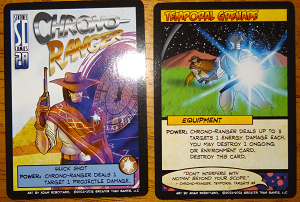
Innate Power: Quick Shot: Chrono-Ranger deals 1 target 1 projectile damage.
Primary Damage Type: Projectile
Secondary Damage Type: Melee, Fire, Toxic
Nemesis: Plague Rat & Doc Tusser
Deck Concept: This deck is all about dealing damage. You need to get Chrono-Ranger’s Jim’s Hat as soon as possible (Displaced Armory is a good way to do this), so you can play multiple cards per turn. More cards per turn = more damage. Also try and get as many bounty cards as you can in play, and there are plenty of cards in Chrono-Ranger’s deck that can do this: Bounty Board, Ranger’s Mark, and Sudden Contract. These bounties will grant Chrono-Ranger and his teammates bonuses and will pump up some of Chrono’s attacks: Hunter and Hunted, Temporal Grenade, and The Masadah.

ChronoRangerLogo

Keep in mind that these bounties get discarded as soon as the target you place the bounties on are discarded. Chrono’s two best attacks The Masadah and Compounded Bow work differently. The Masadah deals large amounts of irreducible damage, according to the number of bounties in play, while the Compounded Bow doesn’t deal as much damage but doesn’t need the same build up as The Masadah. This leads to the Compounded Bow as the better anytime bet, and it gets around those pesky “ignore the first occurrence of damage” abilities villains (like Spite) tend to have.

ChronoRangerCompoundedBowMasadah
The Masadah and Compounded Bow

Deck Strength: Chrono-Ranger deals damage. Lots and lots of damage. He can even play an extra card if he has Jim’s Hat in play.
Best Team Support Card: By Any Means: Play this card next to a non-hero target. Increase damage dealt to that target by 1. When that target leaves play, destroy this card.
Best Personal Support Card: Jim’s Hat: You may play an additional card during your play phase. At the start of your turn, you may destroy a bounty card.
Best Anytime Attack: Compounded Bow: Chrono-Ranger deals 1 target 1 projectile damage and 1 damage of a type of your choice.
Best Situational Attack: The Masadah: Chrono-Ranger deals 1 target x irreducible energy damage, where x = the number of bounty cards in play.

ChronoRangerJimsHatByAnyMeans
Jim’s Hat and By Any Means

Deck Weakness: Outside of damage, Chrono-Ranger has little else in his deck. He can’t deal with environment and ongoing cards, so don’t ask him. He depends on others for card draw and defense. Chrono-Ranger needs to be paired with someone that can shield or heal him.
Worst Card: Just Doin’ My Job: Each player may discard 1 card. Draw X cards, where x = the number of cards discarded this way. Chrono-Ranger may deal 1 target 1 projectile damage.

ChronoRangerTemporalGrenade
Chrono-Ranger and Temporal Grenade
Ultimate Team-up: Chrono-Ranger has boss detail. He’s the one who wails on the main villain, while his teammates help him out any way they can. Legacy can boost Chrono’s damage, and any hero who can redirect or prevent damage (The Visionary and The Scholar to name a couple) or a hero that can heal (Argent Adept) are good choices, too.

Top 5 Superhero Themed Tabletop Games

Folks have made superhero games for decades, but the past few years have had an explosion of men and women in tights contained in little boxes. Just about every major game publisher has some form of superhero offering, so it’s going to be tough picking this list. Before we get started, let’s cover a few games that didn’t quite make the cut.

Richard Borg’s X-Men: Under Siege was a fantastic game. It nailed the theme, and I spent several hours and days playing it, but other games have trumped it due to its lengthy setup and light strategy. Marvel: Overpower is another game that just missed the list. It had solid mechanics, but these same mechanics proved too simplistic. The third near miss would have been an interesting entry, Batman: Gotham City Strategy Game. This games puts you in control of a Batman villain and you have to take over Gotham City’s underworld. It doesn’t quite fit the superhero theme, so that works against it, and you don’t really tango with the Caped Crusader, so that keeps it off the list, too. Still, you should check it out if you can find it.

And now for the superhero themed games that did make the list.

MarvelHeroesBoardGame
5) Marvel Heroes (2006)
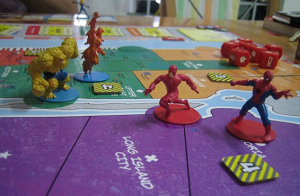
Marvel Heroes is a pretty game. It has gorgeous miniatures made from the high-quality plastic that doesn’t melt in the box. And these miniatures are of four Marvel superhero teams, consisting of four superheroes, but beware, each team has its own nemesis.

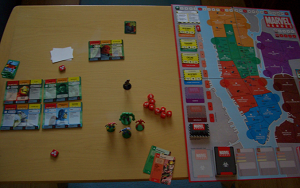
The base game plays just like you’re conducting daily patrols of Marvel’s New York City. I admit the game board, depicting NYC, is blah, and it has to be the least color-blind friendly board on the market. Each region of NYC is color-coded, using the same symbols to denote smaller areas you can travel to within the region. If you’re not familiar with NYC and you’re color-blind, you’ll spend the entire two to three hours hunting and pecking for where you should place your minis.

MarvelHeroesBoardGameOverview
Marvel Heroes Overview

Still, Marvel Heroes institutes a fine combat system that accomplishes the rare feat of using equal levels simplicity and complexity. You use combat dice, but before dice are rolled, you and your opponent choose which attack you want to use. You’re given three possible attacks and each one has its own pros and cons. I wish more games used this type of system. It feels like you control the flow of combat without getting too involved with the nitty gritty.

MarvelHeroesBoardGameCloseUp
Marvel Heroes Close-up

Marvel Heroes smells like roses, and it would be higher on our list, but two issues prevent it from doing so: light on theme and the four nemeses. On the surface, Marvel Heroes looks like it nails the superhero theme. But remember when I said that it feels like you’re conducting daily patrols? You could strip away the superhero theme and slap on an NYPD theme, and I think the game would still work. Then, there’s a game element that allows you to avoid your nemesis. That’s like having a Thor movie with no Tom Hiddleston as Loki.

Heroclix
4) Heroclix (2002)
Our previous entry had twenty miniatures, while Heroclix has hundreds of thousands of them. Volume alone demands that Heroclix has to be on this list. You can pit DC Comics versus Marvel Comics or even go for the smaller, independent press comic book characters like Hellboy.

HeroclixMountainOfFigurines
DC Comics and Marvel Heroclix

I won’t lie. Heroclix gets expensive, and the collective aspect of the game means that you can buy a pack of miniatures and not get the ones you want, but the powers match their comic book counterparts – for the most part – and you don’t need every mini in order to play the game. You’ll just run the risk of wanting more miniatures to complete your ever-growing collection.

MarvelDice01
3) Marvel Dice Masters (2014)
Marvel Dice Masters combines Magic: the Gathering with Quarriors! to great effect. Heroes do tend to attack each other (which can happen in comics but not at the rate this game suggests), power swapping does occur (I didn’t know Jubilee could lift a car and throw it), and some of the hero powers are a little out of place, but you can’t deny Marvel Dice Masters’ appeal.

MarvelDice05
Marvel Dice Masters Close-up

Like Heroclix before it on this list, Marvel Dice Masters has a collectable aspect to it, but the price point is so low ($0.99) that it doesn’t hurt to collect some of the dice, and unlike Heroclix, you’ll be able to use all the dice you get in the pack, so you don’t feel like you’re wasting as much of your money. I hope a lot of other collectable games switch to this tactic.

And the game itself is solid. Yes, it’s an amalgam of Magic and Quarriors!, but it adds enough new elements to the gameplay that it doesn’t feel like a copy of either game. Since Quarriors! is a pool building game, you may not be able to grab all the dice you want. Marvel Dice Masters allows you to cast the heroes you want and craft a winning strategy in advance of chucking dice.

MarvelLegendary
2) Marvel: Legendary (2012)
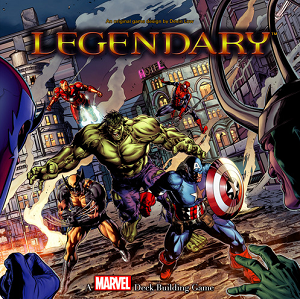
Next we have another deck building game, Marvel: Legendary. I place Marvel: Legendary above Marvel Dice Masters for one main reason—cooperative play.

MarvelLegendaryOverview
Marvel: Legendary Overview

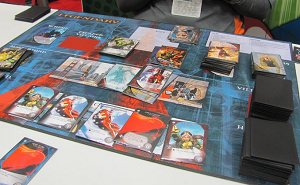
While heroes can fight each other, most of the time they face villains. Marvel: Legendary captures this aspect better than any other deck or pool building game that uses a superhero theme. It’s not perfect of course. You’ll play games where Spider-man has Wolverine’s claws or Professor X has super strength and flight, but cooperative play adds an element missing from so many of other deck building games in general and a game element that needs to be there for a superhero-themed tabletop game.

Sentinels01
1) Sentinels of the Multiverse (2011)
There are plenty of Sentinels of the Multiverse haters out there, but for my buck, Sentinels of the Multiverse delivers on the superhero theme.

Superheroes work together on a team. Check. They fight supervillains. Check. The backdrop is colorful and fitting for a comic book series. Check. I won’t say that Sentinels of the Multiverse is perfect. It does have its issues. There’s a power balancing issue. Some games can last ten or fifteen minutes. Others can take up to two or three hours. That’s not a good thing when you schedule a game night. I’m always playing two or three short games, and then the two hour game rears its ugly head, but I enjoy playing the game. It’s fun.

Sentinels02
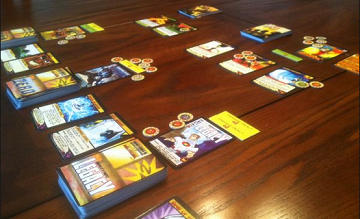
Sentinels of the Multiverse Overview

Every time I play Sentinels of the Multiverse, I feel like I’m a superhero and that my every action can mean life or death for the people I’m trying to protect. Isn’t that the whole purpose of a superhero themed game?

Did we get the list right? Let us know how we did and feel free to give us more ideas for future Top Fives.

Arrow Secrets: February 20, 2015

CreatureCommandosWeirdWarTalesArrow
Beastmaster as General Shrieve
When I saw The Beastmaster’s Marc Singer make an appearance as General Shrieve, the guy who says he’ll debrief Ollie in China, I thought that was an interesting choice. You might remember General Shrieve as the human leader of a group of monsters known in the DC Universe as the Creature Commandos. This team, comprised of a werewolf, a vampire, and Frankenstein’s monster, has kicked evil’s tail since World War II. Could we see these monsters on the streets Starling City? Maybe.

Diggle’s Big Brother
Diggle’s brother Andy makes his first onscreen appearance, but you may have seen him in the original Arrow comics during Season One. Fun fact: Eugene Byrd, who plays Andy Diggle, appeared in Anacondas: The Hunt for the Blood Orchid with Karl Yune, who plays Maseo.

ArrowCaptainBoomerang
There’s Another Prisoner
Was I the only one straining his eyes to catch a glimpse of Captain Boomerang in the corner of my screen when Ollie told Thea that there was another prisoner on the island? Obviously not. Plenty of fans asked where Boomerang was when they found out that Slade would fight Oliver and Thea on Lian Yu. This was yet another shortcoming in Merlyn’s plan. Why not test Oliver and Thea’s limits by unleashing a second psychotic assassin?

Flashback References
Looks like Arrow already had his voice down before returning to Starling City in earnest
Ollie wearing a green hoodie
The cop referring to the death of Jordan the drug dealer as an act of a vigilante
Detective Lance inadvertently naming his daughter a black canary
The grease paint line

Dart back to our Arrow review page here.

Geekly TV: February 20, 2015

TheFlash
The Flash
Jim’s Review
This week’s episode was hit and miss. The continued exploration of future Barry’s time-travel back to the night of his mom’s murder made for some interesting internal conflict. Barry has begun to wrestle with the idea of being destined to fail, and on a more subtle level, they’ve even broached the idea of alternate timelines, which is always a handy concept to turn to when creating a superhero show.

The focus on FIRESTORM made for some good emotional material between Ronnie and Caitlin, and some decent chuckles between Dr. Stein and Ronnie. Their dynamic, at times, kept the episode from getting too dry, and served the sometimes light-hearted tone of the show while Barry’s story took him into more troubled waters.

General Eiling is not a compelling villain. He’s the definition of one-dimensional, and his material is really just a network of evil-military-clichés. His involvement in the episode dragged it down, and forced me to suspend disbelief more than I’m ordinarily comfortable with. Why would people on the run return to their homes? Why wouldn’t the general have people waiting at STAR Labs and Professor Stein’s house? Why would a secret base have its designation on crates in the interrogation room? Why can Barry outrun bullets, and a nuclear explosion, but not some little spikes?

I’ll stop pulling at those threads before I make this episode sound worse than it was, because it really wasn’t all that bad. Iris’ storyline was sort of lost in the shuffle, but that’s probably for the best. Yes, it seems she’s on the case, investigating STAR Labs, but the show has not established her as an intellectual heavyweight, but rather the sorority girl who needs the nerd to do her homework, how much of a threat does she really pose here?

For all this episode didn’t get right, the tag teased some really exciting stuff. We get a look at Harrison being the Harrison that Barry doesn’t know yet, and a huge look at a Flash villain we’ve been teased with already. There’s definitely a lot to look forward to for next week.

Kyle’s Take
Looks like Jim didn’t leave a lot of meat on this bone. Again, I can’t disagree with much of what he’s saying, so I’ll go a different route.

Jim touched on one of The Flash’s greatest strengths: tempering dramatic waters with a touch of comedy. Cisco usually plays the role of comedic relief, but when he’s unable to do it, the rest of the cast can fill in for him. This week’s episode “Fallout” saw Cisco dropping some sweet pop-culture references—who didn’t like how he explained time travel theory to Detective West by means of Terminator and Back to the Future?—and the addition of Firestorm as a dual-personality presented another character capable of filling those light-hearted shoes. With that said I’ll admit that I wasn’t as impressed with half of “Fallout’s” serious elements.

We touched on it months ago that General Eiling doesn’t work as a character, and he still doesn’t. Clancy Brown’s talents are wasted, playing that shuffling cliché. Iris as the reporter who’ll uncover STAR Lab’s secrets doesn’t ring true. Her connection with Barry was the only reason she got Flash stories, and she hasn’t shown that she can do anything without Barry’s help. The only way she blows the STAR Labs story open is if Barry opens the front door for her. But despite the lesser half of dramatic threads, “Fallout’s” other half of drama did ring true.

I enjoyed Caitlin and Ronnie’s star-crossed lover’s story—this made Caitlin relatable and softened her edges, which was nice to see. I also liked the continued Barry’s mother’s murder investigation and time-traveling Barry story threads, but the most exciting part of this week’s episode was the tag. You’ve got to love Harrison as a speedster, and I geeked out at the first real appearance of a major villain.

Verdict:
This episode stumbled, but as long as Barry keeps running, he’ll punch his way to another great episode.

Dash to our The Flash secrets page to learn more about Barry, Firestorm, and more.

Arrow
Arrow
Jim’s Review

I feel like I’ve been saying this a lot lately, but Arrow was up and down. This week featured less Laurel, but still some, which is automatically too much.

The premise of the episode, needing to go back to the island to prepare for a rematch with Ra’s was already shaky. The payoff to it was new material for Slade, and that was the strength of the episode. I was hoping for a much larger and more developed confrontation, but what we got was–if nothing else–a good call-back to the highs of last season. I think the real let-down was that Slade ended up back in the cell. I was hoping this visit to the island would put Deathstroke back in play.

The flashback segments gave us another look at Tommy, and that was a plus, as being reminded of his friendship with Ollie was humanizing for both characters, but some of the attempts to tie the past to the future–or vise versa–were painful. I cringed at the tongue-in-cheek reference to Ollie’s disguise not being enough even if he smeared grease paint over his face. Shoe-horning Diggle and Felicity into the flashback segments didn’t help the awkward factor.

Thea learning about Malcom using her to kill Sara was another overdue development, and it added something to the tension, but this is another case of the writers rushing a story along. Malcolm and Thea’s relationship was never given enough time to build for its destruction to mean much.

There’s still time for this season to end on a strong note, but this week’s episode wasn’t enough of a step in that direction.

Kyle’s Take
I thought and hoped we’d get another Deathstroke sighting but this was not the Deathstroke I wanted. The Joker’s line in The Dark Knight, “If you’re good at something, never do it for free,” fits Deathstroke better than it fits The Joker, and in this episode Slade was nothing more than Merlyn’s free play thing.

Then we find that Ollie and Thea were stupid enough to return to the island at Merlyn’s suggestion. Why would they go without him? I’d keep an eye on that slime and question why the island’s a better training location than the Sierra Nevadas, the Cascades, the Rockies or the Appalachians. Ra’s lives in the mountains. He actually lives on a mountain that’s more than a mile high–I’m looking at you, Denver. You train in a location similar to the one you’ll encounter. Case in point, the US Marines moved their basic training from the Baltimore/Annapolis region to South Carolina because they were preparing to go to Vietnam and Paris Island, SC closely resembled the climate and terrain of southeast Asia.

I did like the flashbacks with Tommy and disliked the scenes with Diggle and Felicity. Tommy acting as Thea’s adopted brother worked and tied into Ollie wanting to protect his sister. Diggle was superfluous, but Felicity’s cameo did nothing more than provide fan service. The most popular form of Arrow fanfiction is Olicity stories. People wanted to see Felicity and Ollie together, and we got a “He’s cute” from Felicity. And I didn’t cringed when I heard the grease paint line. I had an awkward laugh that turned into a groan. This line proved that Team Arrow knows it’s flailing, and they’re trying to tap into something that works on The Flash. Arrow needed to set up a precedent for lines like that in order for them to work.

But worse than awkward flashbacks was watching Arrow’s decision to fast forward nine months between seasons bite them in the behind again this week. Skipping Roy’s training, Detective Lance becoming police Captain, and the Arrow ascending to Starling City’s public defender don’t hurt, they actually helped. But we traded Roy’s training for the new Black Canary’s, so that’s a wash, and missing Thea and Merlyn’s nine months together torpedoed the dramatic turn of Thea denouncing her father.

We were told and not shown Thea and Merlyn’s relationship. If this was the endgame for this season, we should’ve seen these two together in flashbacks (more than the one or two we saw). Even if the flashbacks lasted only a minute or two each week, something (of consequence) would’ve been preferable to nothing. And nothing was what I got out of Thea’s big speech.

Verdict:
Arrow’s uneven writing has bogged down this season, and this week best illustrated how.

Take aim at our Arrow secrets page.

MarvelAgentCarter
Marvel’s Agent Carter
Kyle’s Review
This week’s episode “SNAFU” put a fine point on why Agent Carter erred when it insisted on shoving chauvinist references down our throats. Up to this point Peggy figuratively wagged her finger at her viewer’s pigheadedness (or their parent’s or grandparent’s pigheadedness), but this episode had her literally chewing out the audience. Yes, there were SSR agents in the room with her, but when the camera zoomed in on Peggy, the scene was framed in such a way that she let us have it. What did we do, Peggy? We watched you and listened to you for seven 40-minute episodes.

The message against misogyny is an important one, but a modicum of subtly goes a long way. Saturday Night Live—who celebrated their 40th anniversary this past week—worked best when the humor left enough to the audience that they could be in on the joke. Agent Carter bashed us over the head with its social commentary so many times that there’s nothing to get. And what’s worse is that one can walk away from this show thinking that at least we don’t act like that anymore and that these viewpoints don’t persist today. Newsflash: they do, but Agent Carter presents these issues in a way that’s counterproductive. SNAFU is right.

Fortunately, events occurred in “SNAFU” that should put this caveman club of a message aside. The director of the SSR, Roger Dooley, pulled his best Qui-Gon Jinn (a pivotal character introduced in a prequel that makes you wonder why they aren’t mentioned later in a series) and sacrifices himself for the greater good (and then you find out why they aren’t mentioned later). But my favorite moments involved Bridget Regan as Dottie Underwood. She has enough stage presence that she’ll make you forget that the show’s named Agent Carter at times. Plus, you’ve gotta love that staircase sequence.

Verdict:
This episode put to rest any desire for an extended series.

The Flash Secrets: February 20, 2015

CoastCityDCComics
You’re in Coast City

This episode of The Flash mentioned a lot of important DC Universe cities. First up is beautiful Coast City. It’s located in California, and it’s the place the Silver Age Hal Jordan called home. If you also watch Arrow, you may have heard that show reference Ferris Aircraft from time to time. Ferris Aircraft has their headquarters in Coast City. And if you’re a comic book fan, you’ll know that Coast City got leveled during an alien attack in the 1990s, but has since been rebuilt. Who wants to go on a road trip?

MidwayCityDCComics
You’re in Midway City
If you drive by the real-life Detroit, Michigan, you might find yourself near the DCU’s Midway City. This might give you a point of reference to Caitlin’s saying Midway City instead of Coast City. She made a huge blunder as there’s a little difference between sunny California and Detroit. And how many people drive out of their way through Detroit to get to Los Angeles/San Diego?

When you’re in Midway City, swing by the legendary Midway City Museum, which is one of the DCU USA’s largest. And when you’re there, say hello to the museum’s curators, Carter and Shiera Hall—but you might know them better as Hawkman and Hawkgirl. Stick around too long and you might even run into The Doom Patrol, the superhero team that introduced Beast Boy among others.

PittsburghPenguinsDCComics
You’re in Pittsburgh
Pittsburgh is home to a popular football team. Okay, that’s real world and in the DC Universe.

But Pittsburgh does play a role in Firestorm’s story. Dr. Stein did teach at a university in Pittsburgh, and one of his colleagues—possibly the one Stein mentioned in this week’s episode—still works there: Rip Hunter (AKA Time Master). Hunter could factor into the time traveling element, too, but Pittsburgh is also the home of Daniel Carter, and Daniel Carter is an ancestor of Booster Gold. Weren’t we promised Booster Gold before the series began?

But this could all be a huge tease. Both Stein and Ronnie Raymond lived in Pittsburgh for a time, and early Firestorm stories had him—them?—fighting baddies in the Steel City.

If you want to learn more about the DC Universe’s cities, check out our map here.

Solo-Dialogues
We didn’t hear Stein and Ronnie jack-jawing at each other last time, but we got to hear their internal banter this time. It’s a long-standing story in DC Comics that the people inside the Firestorm matrix don’t get along most of the time.

FirestormArrowAndDCComics
Those Piercing White Eyes
Superhero comics often have protagonists with no pupils, just white eyes. This week’s episode showed Firestorm with those same eyes. It might be a first for a live-action superhero, but it worked well.

Time-travel Movie References
This week’s episode stopped short of Hot Tub Time-Machine, but we did get some time-travel movie love. When Detective West didn’t quite understand time travel theory, Cisco name dropped some beloved movies: Terminator and Back to the Future.

Other References
This episode had plenty of other pop culture references. Most of which came from Cisco.
Dothraki: a wink and a nod to the language from Game of Thrones
Ross and Rachel: not another Friends reference
“Smash a hole in the space-time continuum”: could be a nudge-nudge, wink-wink to Superboy Prime’s infamous wall punch
“Dude, that was week three”: was Barry’s joke about The Flash’s third episode villain of the week
“Run, Barry, run”: was what Harrison Wells said in the manner he said it in The Flash’s pilot—sounds like Barry running really fast is the answer to everything

GorillaGroddTheFlash
Enter Grodd
We saw full-blown Grodd this week. I loved the telepathy angle—and that is something explored in the comics. It works for the show. Was I the only one geeking out at Grodd’s cameo?

Head back to our Flash review here.

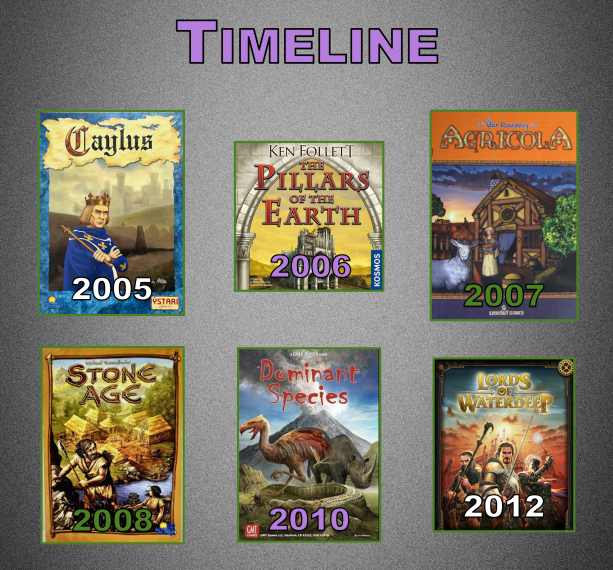
Timeline: Worker Placement Games
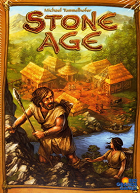
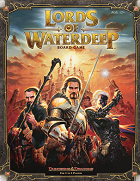
One of the hottest game mechanisms in Eurogames today is the worker placement mechanism. Can you name the following games that use the worker placement mechanism in the order they were released?

Agricola04  CaylusBoardGame  PillarsOfTheEarthBoardGame

LordsOfWaterdeepBoardGame  StoneAgeBoardGame  DominantSpeciesBoardGame

GeeklyAnswers

Quiz Answers: Worker Placement Game Timeline

CaylusBoardGame02  PillarsOfTheEarthBoardGame02  Agricola05


StoneAgeBoardGame02  DominantSpeciesBoardGame02  LordsOfWaterdeepBoardGame02

Hi ho, hi ho, it’s off to work we go. How did we do?

All 6 correct) You’re the best. Cross your arms and scowl at the camera.

4-5 correct) You’re not atop the food chain but at least you’re not an insect

2-3 correct) You bought the version of Agricola without animeeples–for shame.

0-1 correct) The water was a little too deep.

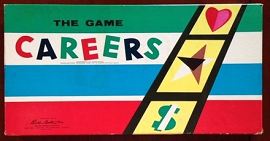
Careers

What fulfills you most? Today, we cover a game that hopes to answer that question. It’s no wonder that a sociologist created the game of Careers. Let me clarify. We’ll review the original 1955 version. None of that Computer Science stuff here. We’re talking pre-Space Race. Careers has numerous versions over the past six decades, and often, the “improvements” did not improve the game.

We’ll get to the review in a bit, but first, here’s a word from our technicians. Feel free to scroll down.

The Fiddly Bits
Designer: James Cooke Brown
Publisher: Hasbro
Date Released: 1955
Number of Players: 2-6
Age Range: 8 and up
Setup Time: 5-10 minutes
Play Time: around 60 minutes
Game Mechanisms:
Roll/Spin and Move
Variable Player Powers

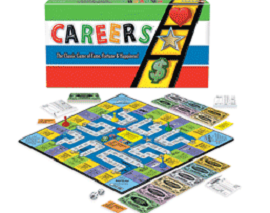
CareersBoardGame
Game Flow:
You start a game of Careers by secretly filling out your goals. You pick numeric values for Fame, Happiness, and Money. Each goal type is evenly weighted and each player has to fulfill the same number of goals—the distribution of which goals you want is the only thing that changes. Similar to Monopoly, players travel around the board’s perimeter, but Careers adds internal tracks on the board, denoting the various “careers” you can have like an engineer or a movie star. The first player to reach all of their secret goals wins.

CareersSuccessFormula
Review:
At first glance, Careers looks like a typical roll/spin and move game. It is. But by adding secret goals, Careers stands out from the rest. Yes, you get bogged down by having to reach certain spaces by exact count, but you can sidestep rolling in the internal career pathways by using experience cards you obtained in the game.

CareersCloseUp
Careers also grants players special abilities (or compensation) if they went through a certain career track once, twice, or three times. That’s how it gets classified as a game using variable player powers. You get a hint of what would become one of my favorite game mechanisms of all time. Better yet, you get to dictate, through the course of your actions, which variable player powers (or compensation) you receive. Do you want more fame? Go through the movie star track multiple times. The abilities stack. Do you need more money? Zip through the business track a time or two.

CareersOverview
Now it sounds like I have nothing but nice things to say about Careers. It does a lot of things right, and for a mass-market game, it does a heck of a lot of things right. But it suffers from the roll/spin and move madness of rolling, then moving the exact number of spaces depicted on the die (or dice), and you have to do exactly what the game tells you to do. So it feels like the game plays you at times, but Careers has to be one of the few roll/spin and move games I don’t mind playing.

Beware: You don’t want a younger version of Careers. Get the fifties version if you can.

Verdict:
An overlooked classic and one of the few roll/spin and move games I like—variable player powers, baby.