What Makes a Great Tabletop Game?

Of course the game needs to be fun and fun is in the eye of the beholder. Or is it in the gut? Anyway, we won’t go too far down that rabbit hole today. Specificity is key, so let’s narrow the question. What makes a great competitive game versus what makes a great cooperative game? Great competitive games need multiple ways for the player to win, while great cooperative games need multiple ways for the players to lose.
Sure. You can find fun in a non-complicated game with only one way to win or lose, and there are many games of this ilk. In fact, I enjoy countless simple, fast, and fun games, but we’re getting real specific with this question. Let’s say you have thirty minutes or more to play a game. You’ll want something with some complexity. In that case, you’ll want your competitive games to have multiple ways—or at least multiple strategies—for you to win.

I’m a fan of the Civilization video game series, and this series boasts the multiple ways to win banner. While Civilization: The Board Game (produced by Fantasy Flight Games) did a great job of converting the video game to the tabletop (perhaps too well as it takes at least three hours to play), I prefer Antoine Bauza’s 7 Wonders. 7 Wonders is a great example of a competitive game with multiple ways to win. You can dominate by means of culture, technology, economy, and military as well as eke out a victory with a combination of some or all four. Since you have so many ways to win the game, each time you play 7 Wonders changes, depending on how you intend to win and how your opponents choose to play.

The first time I played 7 Wonders I tried for a cultural victory. Quickly, I found that I needed a military as my peace-loving city-state was surrounded by Carthage and Sparta. If you’re thinking of the 300 movie just now, so was my son who was playing Sparta. I hemorrhaged victory points as Ty screamed, “This…Is…Sparta!”

It didn’t end well. I was too focused on how I intended to win going into the game than see that Ty was sitting next to me rocking Sparta and Alexander the Great. It really didn’t end well. Almost everyone at the table tripled my score. But that didn’t stop me from enjoying the game. 7 Wonders beats the pants off a game with only one way to win. But what about the competitive games that have one way to win but multiple strategies? These are the games that I tend to describe as deceptively complex.

Another Bauza game, Takenoko, does a great job of giving only one way to win a competitive game but countless strategies to accomplish the one goal. You still get variety in gameplay. I’ve played games of Takenoko where plot tiles went fast but not much of anything else, and other games where the community runs out of irrigation sticks but still has plenty of plot tiles. It works because of its variety. And this need for variety of gameplay extends to cooperative games.

Great cooperative games need multiple ways for the players to lose. How much of an accomplishment is a game where the stakes aren’t high? Not very. If you have more ways for players to lose in a cooperative game, victory tastes a lot sweeter, and you gain more variety in gameplay as you try to avoid the various ways of losing. Bauza has designed plenty of great cooperative games, but let’s concentrate on another great co-op game: Forbidden Desert.

 
Forbidden Desert buys into its theme of a relentless desert, and the players can die in many ways: thirst, massive sand storm, or getting buried by sand. Each player has a variable ability to help mitigate these ways of losing, but almost every game devolves into players adapting to what poses the biggest threat. If the sand dumps on you, start digging. If you don’t have a lot of time before the big sand storm hits, excavate fast. If you start to run out of water, dash to the nearest well. Since there are so many variables, no game plays the same twice, and the many ways to lose the game feed into those variables.
If variety is the spice of life, then multiple win or loss conditions are the spice of tabletop games.

Why Games should Reward instead of Punish Players

Tabletop games reward their players with intricate gameplay, but some games insist on punishing their players for things they don’t do or don’t do well as opposed to rewarding them for things they do or do well. Most people enjoy rewards. Getting rewarded for good deeds is a positive thing, and tabletop games work best when they reward their players instead of dole out punishment.

Often times you can turn a negative into a positive by a simple word change. I’ll use a common occurrence in pencil and paper RPGs as an example:

You’re an archer. You have a bow and arrow that has a max range of let’s say 100 yards (you can’t hit anything beyond 100 yards, so don’t even try—you’ll fail every time), and an optimum range of 20 yards. Now let’s say that you have to roll so many fives or sixes on a standard six-sided die (d6) to hit a target. You could express the effectiveness of your bow and arrow, and your skill by saying that you roll ten d6s if you’re within 20 yards of your target, but you’d lose two dice if you travel beyond 20 yards. Wording the ability this way punishes the player for not being 20 yards from their target.

Now let’s use the same example and make it a reward:

You’re the same archer with the same bow and arrow, and you still have to roll so many fives or sixes on a standard d6 to hit a target. But this time your base attack is eight d6s, and you gain two dice if you move within 20 yards of your target.

You still roll the same number of dice in both scenarios, but you’d be surprised by how many gamers would complain about losing two dice in the first version versus gamers who read the second version and think of it as a challenge. Now I have to sneak toward my target to gain two dice. But it’s the same thing. That’s the power of staying positive.

I’m not saying that there aren’t any good games that use punishment instead of rewards. Agricola comes to mind, and it’s an excellent game. But why do I have to lose points for not having a type of animal on my farm? Can’t you reward me for each type of animal I do have on my farm and give me a zero for each animal I don’t? Give us a pat on the back, not a boot in the rear.

Why I Like Tabletop Games

We stay connected more than ever through the internet and smart phones and other smart gadgets, but we have lost touch with people. Tabletop games are a fun and educational way to get back to human interaction and discovery.

With tabletop games you have to be with the people seated around the table in both body and mind or else you’ll miss an important play or cannonball your team’s chances of meeting their goal. Try texting someone while playing a game of Hanabi. This cooperative game will not go well, and the fact that Hanabi is a cooperative game means that it builds teamwork and allows you to problem solve, fostering cognitive development. Okay. You learn as you play and have fun as a group. And recently, people have found plenty of tabletop games to gather around and play in groups.

We’ve had a smorgasbord of fantastic tabletop games of all shapes and sizes in the past twenty years or so, beginning with Magic: The Gathering (the first collectible card game) and Settlers of Catan (the game that put German or designer games on the map), and we get introduced to an exciting and different game mechanic every few years: the living card game, the variable player power/ability in Hero Clix for miniatures enthusiasts, deck/pool building, and worker placement to name a few. If you don’t care for one game mechanic, you’re sure to find one that suits you. Heck, there’s probably someone working on your new favorite game mechanic right now. But each one of these games trains their players in certain skills.

You have to know or learn algebra for collectible card games—for example: your strength is equal to X, where X is the number of creatures you control times two (and this is a very simple example)—while you tune your mind toward strategy with most designer games, and even manage resources whether those resources are wood, clay, and wheat or they’re soldiers, workers, and time. You can even learn history with tabletop games. Bryce Journey, an Omaha game designer, created Aguirre, a game about the most insane Spanish conquistador who murdered most of his crew looking for the Lost Cities of Gold. You play as one of Aguirre’s crew and try to survive the expedition that’s steeped in historical accuracy. You can learn just about anything with tabletop games and learn more about the people you’re sitting with at the table.

When you play tabletop games, you find out real quick what kind of player someone is and how their mind works. I played a game of Ticket to Ride with my Uncle Paul, and he gobbled up the Eastern seaboard with his trains. Everyone at the table questioned whether or not Uncle Paul even had a ticket for the East Coast. We all thought he just wanted to block everyone else from getting a route, and sure enough when the game ended, Uncle Paul revealed his tickets and the closest ticket he had to the East Coast was Houston to Kansas City. And that was with a designer game with no bidding or bartering.

If you add bidding or bartering to any game, you get plenty of people batting their eyes at other people, asking them pretty please or they start offering real-life favors—like washing dishes for a week, not that other things aren’t offered—for help in a game. All of this is done in good fun, and that’s the main reason why I like tabletop games. They’re fun.

Twas the Night before Nuke-Con

Sorry, but while I’m excited for Omaha’s gaming convention, I’m not going to break out in rhyme.

Nuke-Con isn’t nearly the same size event as Gen-Con in Indianapolis, but it’s not too shabby for Omaha’s own gaming convention. There are a lot of products to sample and booths to visit, but here are some of the games JK Geekly plans to playtest over the next three days and nights.

Friday Night

Bang01

Bang!

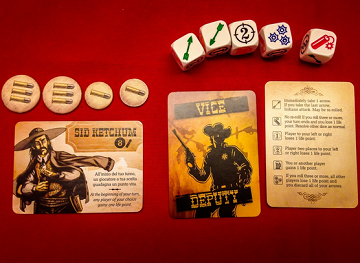
Yes. It’s a slightly older title—heck, there’s even an iOS version of this popular wild, Wild West shoot ‘em up game—but there isn’t that much going on Friday night. We’ll be checking in, gaining our bearings and sampling some of the games that aren’t on the menu. I’m still looking forward to a good old fashioned show down with Bang!

Saturday Morning


Cubist01Cubist

A new title produced by Gryphon Games, Cubist has players building their own modern art museums. The concept may sound a bit dull, but the colorful design, easy to learn rules, and quick gameplay have garnered strong reviews. Bring on the help of Juan Gris, Franz Marc, and Olga Rozanova.

7Wonders01

7 Wonders

7 Wonders may not be a new title (released originally in 2010), but let’s hope they have some of the newer expansions like Babel, which was released earlier this year. Players control an ancient civilization and try to construct wonders of the world—one of my favorite aspects of the Civilization video game series.

Saturday Afternoon

SamuraiSpirit01Samurai Spirit

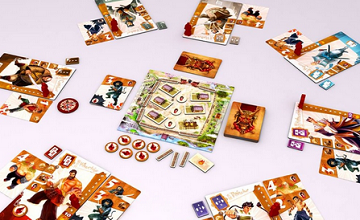
Personally, this is one of the new games I’m looking forward to the most. Designed by France’s own Antoine Bauza, who views himself as a compulsive board game designer, old-fashion book lover, and lazy writer, Samurai Spirit marks another entry in Bauza’s wonderful line of cooperative board games. This game borrows from Kurosawa’s Seven Samurai—in fact there can be up to seven participants—and has the players take on the responsibilities of a team of samurai sworn to protect a village from marauders.

KrashKarts01

Krash Karts

Another new title, designer Sean Dallas McDonald revamps Mad Rush Rally with this Kickstarter funded tile placement game. Descriptions of this game have it mimicking the classic Mario Kart video game series. Let’s see if Krash Karts can measure up.

Sunday Morning

LegendaryVillainsMarvel01

Legendary: Villains – Marvel Deck Building Game

The latest entry in the Marvel Deck Building Game, Villains features everyone’s favorite Marvel villains from Magneto to Green Goblin. While the main game received mostly favorable reviews two years ago, this year’s Villains expansion has had its early critics. Still, I can’t wait to get behind Doc Doom’s mask.

Sunday Afternoon

AStudyInEmerald01

A Study in Emerald

I’ll be upfront with this one. There may be a slight scheduling conflict between this game and the Marvel deck building game. Villains ends thirty minutes after this game begins, so I hope the demo for Villains lets out early—thirty minutes early to be exact—and I’ll try to make this a deck building two-step. A Study in Emerald takes its name and subject matter from the Neil Gaiman short story of the same name. The story follows Sherlock Holmes doing his thing in the world of H.P. Lovecraft.

DCComicsDeckBuilding01

DC Deck Building Game

If I can make A Study in Emerald, I’ll still be able to make the DC Deck Building Game and therefore make a back-to-back-to-back deck building romp of JK geekiest proportions. While the Marvel deck building game sticks to major expansions, the DC Deck building game mixes in some smaller expansions: Crisis Expansions (I can’t wait for a Zero Hour expansion—jk), individual character expansions, and rivals like Batman versus the Joker. I’m not sure how many of these expansions—large and small—will find their way on the table on Sunday, but any expansions they give us will spice up gameplay. I haven’t played much of either comic book based deck building game, so I’ll be playing each one with a fairly blank slate.

So, we have eight games on the docket. These are by no means the only ones at Nuke-Con. They’re the only ones that have scheduled demos. I’ll have a list of the games I’ll be looking for on the trade tables. Maybe we can sneak a demo or two of those, too.

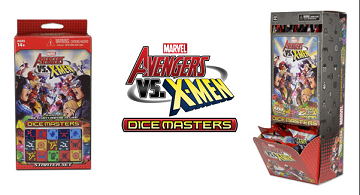
Sealed Marvel Dice Masters Tournament Tonight


Four more hours until Omaha’s first Marvel Dice Masters tournament at the Game Shoppe. It’ll be a sealed tournament so some dice carry more value than others and more value than they normally would.

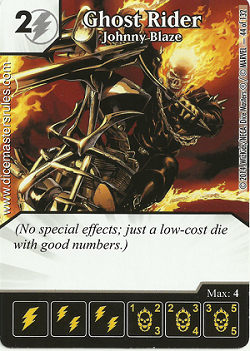
Yes. We’re hoping for rares and super rares in our haul–the rarer the card the more likely the die will have a lower cost and better ability–but there are two common dice/card combos we should mention, especially for sealed play: Ghost Rider (Johnny Blaze) and Green Goblin (Goblin Lord).

MarvelDiceMasters03    MarvelDiceMasters04

As the text on his card suggests, Ghost Rider has no special effects. He just has good stats for a cheap price (2 energy), which is key during a sealed tournament. A cheaper cost means you have several options per turn. If you roll into nothing but energy, you can purchase two Ghost Riders in one turn or you could purchase a Ghost Rider and a cheap action.

The common Green Goblin costs more (3 energy) than Ghost Rider, but his ability makes up the difference. He buffs (increases the stats of) the Sidekick characters you have in play, and sidekicks don’t cost any energy. You get enough of the small fries in play, and your opponents are toast.

Of course these two dice/card combos won’t be as good when compared to a dice pool you can create ahead of tournament time: a constructed pool tournament. You’ll have a lot more great combos at your disposal. But for tonight’s sealed tournament, we’re looking for these two commons to go with our uncommons, rares, and super rares.

We’ve had a chance to play this game, and it’s a tasty blend of Quarriors! and Magic: the Gathering. But some of the powers don’t make a lot of sense for the character’s who own them. Why is Mr. Fantastic the defensive member of the Fantastic Four? Shouldn’t that be the Invisible Woman with her force fields? Why’s Wolverine throwing cars? Where are you Colossus? Still, Marvel Dice Masters is worth a look.

We’ll have a full Marvel Dice Masters review Early next month. Until then, keep rolling.

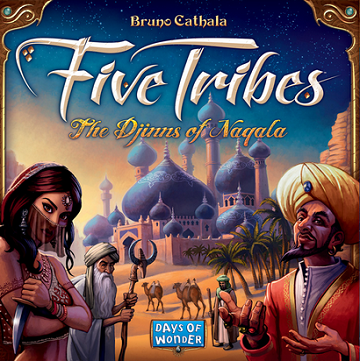
Five Tribes

Hey All,

The last time Bruno Cathala teamed up with Days of Wonder resulted in Shadows over Camelot, a phenomenal game worthy of all the game of the year awards it won. Cathala has a strong following and his fans have been waiting for his foray in the worker management game genre. The wait is over. Five Tribes is out.

While we can’t wait to review Cathala’s and Days of Wonder’s latest, we have several games in the queue ahead of Five Tribes. We’ll have that review in the next few weeks.

FiveTribes