5 Strange or Head Scratching Tabletop Game Mechanisms

Your uncle Geekly had an issue staying on task with this write-up—perhaps he needs a mind recalibration. When thinking of some of the oddest game mechanisms in tabletop, the first four came to mind right away as unique at this point, but the fifth mechanism has made its way in plenty of games and it always made me scratch my head. So here are 5 game mechanisms that are strange or head scratchers.

Terra

We’re not talking about Bezier Games trivia game Terra, this is Days of Wonder’s Terra that’s a semi-cooperative game where players try to save the world. A self-destruct button available to all players rests within reach of everyone at the table. While the main goal is to earn a collective win by saving the planet in Terra, the player with the most points gets a solo win. What’s keeping someone with no chance of winning from pressing that button? Good old, uncle Geekly comes from a long line of sore losers. I don’t suspect we’d ever win a game.

Mamma Mia!

While Terra has a questionable game mechanism, Mamma Mia’s is just off. Gamers play cards face up from their hands to a discard pile. Once all the cards in the deck have been played, the deck is flipped over and players gain the points indicated on the cards. It’s a simple twist to a common game mechanism, but it’s difficult to wrap your head around it or come up with a good strategy. It almost makes you want to say, Mamma Mia, here I go again.

Filthy Rich

Ah! It wouldn’t be a strange tabletop game mechanism list without including Richard Garfield. Filthy Rich may be the oddest game in Garfield’s repertoire. It’s played with a binder and 4 pages of Ultra Pro card protector pages (the kind you use to showcase collectible cards). Players add cards that represent billboards in their binder and score points if the numbers on their cards get rolled. I don’t know if I’ve ever heard of another billboard game, let alone one that uses a binder. I’m half tempted to use my Magic cards.

Graphic Novel Adventures

It’s too bad this one’s only available on Kickstarter and the campaign finished several months ago. Van Ryder Games’ five graphic novel series combines elements of escape rooms and choose your own adventure stories with comics. These books could start a new trend, and there’s also no way that comic book and gaming stores won’t carry them in the next six months or so. Be on the lookout.

Witch of Salem

Witch of Salem represents a game mechanism that doesn’t make sense in any game: keeping information to yourself in a cooperative game. In Witch of Salem, players deal with forces of evil coming through gates and if I find out whether the evil originates from a specific gate, I can’t tell you that it’s coming from that gate, even though we may be on the same space and I can save my teammate the trip. Why wouldn’t I tell them? We’re working together.

Shadows Over Camelot does a similar thing with cards and the values on them. The cards range from 1-5, but players can’t say what’s in their hand and this leads to people saying things like “I have a big card in my hand.” That would be a 5. “I have a middle card.” That’s a 3. “I have a below middle card.” Two. That’s a two. Why not just say, two?

I could’ve added more than these five, but your uncle Geekly wants to hear your thoughts. Are there any other mechanisms that make you scratch your head? Let us know in comments.

Unpopular Opinion: Women Only Board Game Design Contests Are Good for the Hobby

When Alderac Entertainment Group (AEG) listed a women’s only board game design contest in July 2018 (here’s the link), the contest was shared by multiple websites and game design forums. I’m a member of several of these forums, and the backlash was eye-opening.

Heated discussions on social media can turn ugly. Many of the people who shared this contest—not expressing that they supported it or why, even though sharing the contest was a form of support—had to delete their posts within hours. Some reshared and disabled comments so internet trolls couldn’t respond. A lot of what these trolls said isn’t repeatable, but there were some sentiments—that weren’t overtly sexist—that occurred frequently and here are two of the most prominent.

1) Women should challenge themselves and submit to board game design contests that are open to everyone.

2) Contest or Design Group “Fill-in-the-blank” is better because it’s truly inclusive.

Let’s start with the first comment. Who says that women aren’t participating in other board game design contests? There aren’t as many women game designers as men board game designers, it’s a male dominated field, but I’ve heard of at least a handful of women board game designers who submit to plenty of other design challenges and contests. There have been several women who’ve won. There have been a few female designers who were part of blockbuster tabletop games like T.I.M.E. Stories. These voices are unique in part because they have different life experiences, and the board game community could and should do more to give these voices a platform to be heard.

I don’t just design board games. I also write fiction, non-fiction, and poetry and submit to various literary journals. Many of these journals will have calls for submissions from minorities, and a similar backlash can occur. I’m not sure why. There are countless journals to submit to that will accept entries from anyone. If I see a listing for one that doesn’t apply to me, I skip it or if I know someone that the listing would apply to, I let them know about it. It costs me nothing. But the opportunity for someone else, especially someone who belongs to a minority, could be invaluable.

I know of hundreds of board game design contests. AEG’s Women Game Designers Wanted listing is the first time I’ve seen a woman specific challenge. It costs nothing to support this contest, but a lot can be gained.

The second comment type is more insidious. It accuses the contest of not being inclusive and devalues it, but the people who made this type of comment never have to worry that Design Group “Fill-in-the-blank” has no one else at the table who looks like them. Sure, everyone is welcome in Design Group “Fill-in-the-blank,” but some people feel more welcome than others. There’s a reason contests that encourage minorities to participate exist. They’re needed.

Most people in the board game community would agree that more women designers are needed, but despite what the backlash would suggest, a contest like AEG’s might bring more women to the table and make the hobby more inclusive. It helps to normalize women tabletop game designers. The more women who join the table, the less contests like AEG’s needs to exist. But even if minority contests persist, what does it cost someone to ignore the contest if it doesn’t apply to them or send the listing to a friend?

That second type of comment might do more damage to distance women game designers from the hobby. The writer of that type of comment doesn’t understand the obstacles for a woman designer or doesn’t care. If one doesn’t have someone like one’s self at Design Group “Fill-in-the-blank,” one is less likely to join. It’s intimidating. Having a minority specific design contest is more inclusive. It leads to a minority being less of a minority by positive normalization.

As of this write-up, AEG’s Women Game Designers Wanted is still open (until the end of November 2018). I encourage everyone who can apply to apply. And if the listing doesn’t apply to you, share it with a friend.

Worker Placement Starter Games

Good old uncle Geekly likes to put little pawns to work with worker placement games. These games tend to get strategic as players place their pawns on spaces to claim an action during a turn and prevent other players from taking that action for a turn. That’s where the fun of most worker placement games derives. The tension of not wanting someone to take the action you need can get intense, and the ability to choose something you need before someone can block you is a great feeling.

But worker placement games can get nasty as some folks will take actions to keep someone else from taking them, not because they need to take them. These games can get convoluted too when more elements are added.

Fortunately, your good old uncle Geekly has some worker placement games that aren’t as cutthroat–for the most part–and are easy to learn. These are some great starter worker placement games.

StoneAge.jpg

Stone Age

Caylus may be the first game to use worker placement, but Stone Age is by far, more approachable. Players control cave people who are trying to build a rudimentary village in three phases. During the first phase, player’s pawns (or workers) are sent out to various areas to collect stone or wood or make new workers in the local hut. Brown chicken, brown cow.

The second phase has players roll dice equal to the number of workers they placed in areas to see how many of that resource they collected. The more workers in the area, the more dice a player gets to roll. In the third phase, players must have enough food to feed their population or they lose resources or points. Gamers will find feeding workers as a common thread in worker placement games. These designers must be hungry when they’re making these games.

Stone Age does a good job of introducing new gamers to a lot of the core concepts of worker placement—even the use of dice, because dice placement is a thing that we’ll see real soon. The theme is easy to get into and the mechanisms make sense for what the players are doing in the game. I don’t know how many games have me go to a quarry to make bread. Really? How many bread-making quarries do you know?

DoughnutDrive-Thru

Doughnut Drive-Thru

Stone Age may be obsessed with feeding people, but Doughnut Drive-Thru has food as its theme. Yeah, give me a Coated Baby. That’s a glazed doughnut, sicko.

Doughnut Drive-Thru also happens to be the smallest game by far on this list and calling it a worker placement game is a little bit of a misnomer. It’s more of an action selection game, but the challenge of taking an action so your opponent can’t is still at the heart of any worker placement game, and that’s the center of Doughnut Drive-Thru.

On their turn, players are trying to learn new doughnut recipes, preparing a donut, or serving a donut. To take any of these actions a player places one of two wooden doughnut pieces they begin the game with on one of these actions. The trick is to time when you want to take these actions because when an action has no further spaces with which to place a wooden doughnut, players can’t take that action. You’re left with the choice of taking a different one of the two actions or taking all the wooden doughnuts—or taking enough doughnuts so their total doughnuts equal two—and waiting until next turn to take the action they want.

Doughnut Drive-Thru is fast-paced. Very fast-paced. It may even be the better game to begin with for a simple worker placement game. But it is a bit of a cheat. Don’t worry. Uncle Geekly eats plenty of doughnuts on his cheat day.

FabledFruit.jpg

Fabled Fruit

Ah. This is another more recent game. I like Friedemann Friese’s style and not just his love of green and his wanting to use the letter F in as many game titles as he can. Fable Fruit keeps things light and simple but also adds legacy and dual-purpose cards to the genre. Players only have one worker in Fabled Fruit, an animeeple (a wooden animal pawn) to place on a group of six action cards. These action cards serve two purposes—they’re dual-purpose after all—and players either complete the juice action located on the bottom of the card (by turning in the fruit required, pictured) or they can claim the action on the top of the card like “draw two fruit.”

Man, what is with all the food in worker placement games?

Players go through a deck of 60 or so unique action cards (four of each action) and as soon as an action card is claimed in any game, it’s taken out of the deck. You’ll have to play the game a second time to ever see that card again and that’s where the legacy aspect comes into play. Prior games affect what happens in future games. Don’t use the “draw two fruit” action as a juice card too many times, or you won’t be able to draw two fruit again.

Fabled Fruit is clever and adds a splash of other popular game types and mechanisms, but also happens to be the easiest game on this list to learn. In short, it’s a tasty blend.

Great. Now I’m thirsty.

Final Thoughts

It’s difficult to come up with easy to learn worker placement games with depth. I had to go with slightly more complicated games than usual, but they still have some wide appeal. Stone Age, Doughnut Drive-Thru, and Fable Fruit explore different aspects of worker placement. I just wished they didn’t focus on food so much.

Know of any other great beginner worker placement games? Hold a rally and tell it to the workers, or you could let us know in the comments.

Tabletop Games for Fall 2018

As you may know, good old uncle Geekly likes tabletop games, so we couldn’t go too long without making a three list of three for board games.

We’ll get the game rolling with Worker Placement games.

The first list of these lists of three took the most time. I started from the bottom of boardgamegeek (BGG) and searched for a game that I liked. It took about an hour to find my first one, so here it goes.

DoughnutDrive-Thru.jpg

Underrated Tabletop Games

 Doughnut Drive-Thru (6.25 out of 10 on BGG)

I couldn’t believe Doughnut Drive-Thru was as low as 6096 on BGG. Okay, I can believe it. Die rolls to determine whether you can prepare a specialty doughnut or serve one doesn’t sit well with many modern board gamers, but despite the rampant use of luck, there’s plenty of tactical choices with Doughnut Drive-Thru, and it’s a great, simple game to introduce new gamers to the worker placement mechanism. Plus, I like the fun art. Kawaii!

Starfall (6.36 out of 10 on BGG)

Starfall is most likely 5464 on BGG because it’s less about star gazing and more about finding constellations and somehow purchasing them with stardust. Finally, I have some way of unloading my spare stardust.

The game makes little to no sense with its subject matter, but it’s a solid game. I like it a lot and there may be other games in the overrated list that get away with not holding their theme as closely as they should. Starfall is also another pretty game and at $20-$25, it goes for a nice price. Unless that’s 25 stardust. I’m not sure of the stardust to US dollar exchange rate.

Batman: Gotham City Strategy Game (6.08 out of 10 on BGG)

Yep, there’s a trend. Batman: Gotham City Strategy Game is much lower at 4066 on BGG than it should be because it has a misleading title. Players don’t take on the guise of Batman, they’re members of Batman’s rogues gallery like the Joker, Penguin, and Two Face. That’s not a bad thing. I can do the Joker.

If you listen real closely, you can almost hear Harley Quinn outside my window.

The game can also become too much of a brain burner as the “strategy” in the game’s title alludes to, and some elements in the game step a little bit away from the source material. If a player gets too strong, Batman—who is a non-player-controlled element of the game—will target the leader. It gives the game balance, but players may feel a little less super. Still, Batman: Gotham City Strategy Game is solid, and being evil can put a smile on your face.
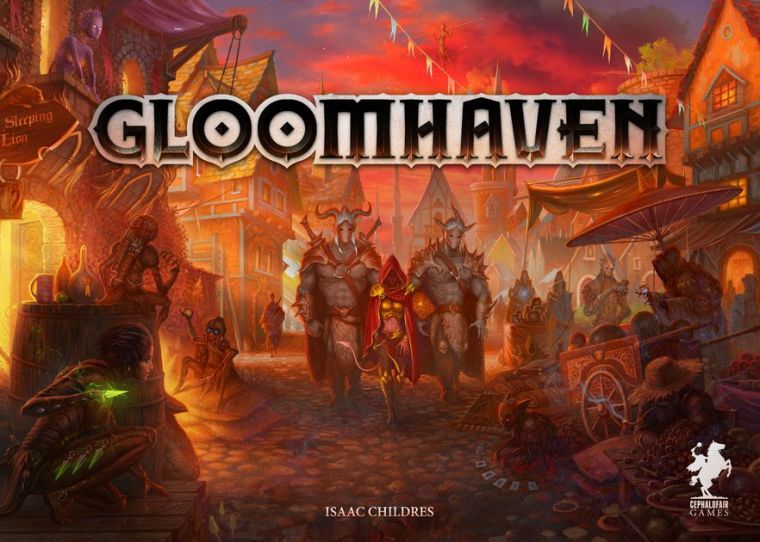
Gloomhaven

Overrated Tabletop Games

Gloomhaven (8.97 out of 10 on BGG)

It’s easy to pick the top-rated game on BGG as overrated, but it doesn’t mean that Gloomhaven isn’t at least a bit overrated. It’s certainly not for everyone. It destroys any other dungeon crawl—Descent can hardly be found on many people’s top 10 lists since Gloomhaven’s release—but the hype around Gloomhaven colored the game as having more of a story and being more character-driven than it ended up being. So, I guess I’d blame the hype, even though any game could use a hype man.

Agricola (8.02 out of 10 on BGG)

I liked Agricola when it first came out, but there have been countless games—including Uwe Rosenberg’s follow-up Caverna: The Cave Farmers—that do a better job than Agricola at scratching a worker placement/farming game itch and yet, Agricola is still well in the top 20 of all tabletop games on BGG. My biggest pet peeve is that Agricola insists that everyone play the game the same way and do everything that’s in the game. So what if I want to be the best pig farmer in the game? That’s my prerogative and don’t ask questions about my pig fetish. Squee!

Eclipse (7.97 out of 10 on BGG)

Eclipse is another case of hype and mistaken identity. Many folks claimed it was a short Twilight Imperium, but it’s too much of a Euro game—games that are obsessed with balance and don’t have enough of a “this is awesome” vibe—to be a quick TI. Further still, the game can get needlessly fiddly. There are too many rules for a game that isn’t supposed to take as long as TI. I don’t care what Appendix IX, Paragraph 12, Line 31 says. Help!
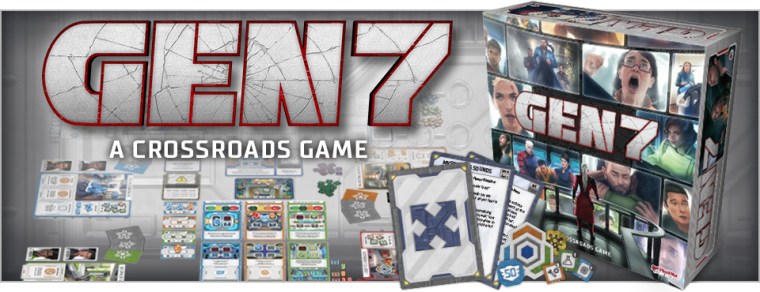
Gen7ACrossroadsGame

Anticipated Upcoming Tabletop Games

Gen7: A Crossroads Game (TBD)

There isn’t a release date for Gen7: A Crossroads Game yet, but the inclusion of the words “A Crossroads Game” got me excited in a special place—of my heart, you sickos. Plaid Hat Games promised years ago of a gaming series featuring the Crossroads story-based system that originated in Dead of Winter (2014). All they’ve done so far has been pumping expansions for the tabletop juggernaut, but it looks as if there will be a true sequel no later than early 2019. Gen7 is a lost in space game, which could be interesting, and a lot different from Dead of Winter’s zombie theme. Another Crossroads Game would be far out.

KeyForge (Holidays 2018)

While Gen7 is part of a series I like, KeyForge is the latest game by a designer I like Richard Garfield (of Magic: the Gathering fame). Recently, I’ve had a chance to pre-game release demo KeyForge, so this write up will change as a result. I’m still interested in this game, so it qualifies for this list. KeyForge hits many of the same notes as Magic, but players are forging keys, hence in the name, instead of defeating their opponents. The game is also sold by the deck, not by boosters, and each deck is unique.

 KeyForge does its best to streamline Magic game mechanisms as players draw cards and ready (or untap) at the end of their turns. This does enough to make this game difficult for a Magic veteran to wrap their brain around—I had issues keeping things straight—and it cleans up some of Magic’s timing.

KeyForge won’t be for everyone. Preconstructed decks mean that players won’t have the option of building their own decks, but I’m sure the community will push back on this and there may be a way for players to merge decks. And I love the game’s price point. I tend to buy Magic starter decks and a few boosters per set. KeyForge’s business model mirrors this type of consumption. It’s a more cost-effective Magic.

Guardians Chronicles (October 2018)

Ah, we come to one of my favorite game types: shuffle building (combining small decks or pods to form a large one). Come to think of it, I have a lot of favorite game types. Anyway, Guardians Chronicles is another Plaid Hat Games release and I may be just as excited for it as I am for Gen7. I also like the superhero theme—there aren’t enough games with this theme—but I’m a little considered about the game being competitive. So long as the superheroes attack villains, I’m okay, but if the superheroes attack each other, that may defeat the purpose of superheroes. We’ll have to see how Guardians Chronicles plays out, but I’m definitely playing a game or two.

Are there any tabletop games you think are overrated or underrated? Which tabletop games do you look forward to in the coming months? And which ones of those games would you like to lose to your uncle Geekly? Mwah-ha-ha! Let us know in the comments.

Forbidden Desert FAQ: Terrascope

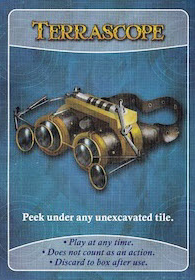
We’ve received a couple of questions about Forbidden Desert’s Terrascope equipment card, and at the risk of incurring Game Zeus’s wrath, we’ll answer your questions.

ForbiddenDesertTerrascope

1) Does a desert tile need to be devoid of sand markers on top of it in order to peek at the tile?

A) No. The great thing about the Terrascope is that you can figure out where you need to go and whether ridding the desert tile of sand markers and excavating it is worthwhile.

2) Do you need to excavate the desert tile you used the Terrascope on?

A) No. Think of the Terrascope as getting a sneak peek of the desert tile without the mess of having to excavate the tile. Now if the tile in question is one you want to excavate after seeing it, feel free to clear the tile of sand markers and excavate it. But the helpful Terrascope can let you narrow the number of tiles you need to worry about. And time is a valuable commodity in Forbidden Desert. It might be the single most important commodity.

We welcome any other questions about other tabletop games you may have and if you haven’t seen our review of Forbidden Desert, here’s a link.

Hope your 2015 is off to a fantastic start.

Stay Warm, Play a Game

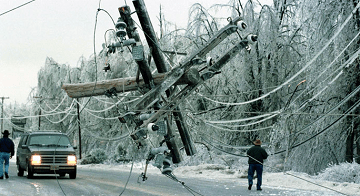
Winter wipes its cold feet on our doorsteps next week, and the arctic chills have already arrived. To me, cold weather conjures thoughts of a particularly nasty Mississippi ice storm in the nineties, one that knocked out my family’s electricity for almost two weeks. We had to stay warm. We had to take our minds off how miserable we were without hot water, light, and heat. So naturally, we played a tabletop game.

X-Men had a cartoon on Saturday mornings, the comics sold record amounts of copies, and one tabletop game capitalized on the mania: X-Men: Under Siege. So, under the glow of a few flashlights, my parents, my brother, and I would hunker around a card table and play as our favorite mutants and sometimes our not-so-favorite mutants.
We’d play marathons. We’d track statistics for each mutant to see which one was the best. We’d find out later that the stats were skewed because we liked a certain character more than another, and it had nothing to do with who was the better X-Man. We played the game for hours on end until we had to climb into our frigid beds. We may have been cold, but we reconnected as a family.

So what if we didn’t have electricity? You don’t have to plug-in a tabletop game. Lack of electricity may have deprived us of conveniences most of us take for granted, but it also forced us to not watch television ad nauseam. We couldn’t spend all our time playing video games either. We had to sit and talk.

We found out what my brother wanted to study when he went to college. We made plans for summer break, which was the first time my brother or I had any real inputs. Dad told us he feared that he’d lose his job—which did happen the next year—and Mom said that if that happened, she’d go back to work, which she did. We learned more than everyone’s favorite X-Man. We learned more about each other.

If you find yourself needing to get warm, you could do a lot worse than playing a tabletop game.

Get a New One Out

“Get a new one out,” my grandmother—I call her Oma—screams in her thick Dutch accent and slaps the side of my wife Jen’s head. Jen drops her marble and it bounces on the kitchen floor before it rolls beneath my seat. “I’m sorry,” Oma says. She stands behind a seated Jen and her Asiatic eyes barely clear the top of Jen’s head. She pats Jen on the back. “I just get so excited.”

I almost tell Jen, “Welcome to the family. You haven’t been indoctrinated until Oma slaps you while you play Wahoo.” But I think better of it and give her a wink. I hand Jen her missing marble, and she almost puts it back in her starting area. She flinches, expecting Oma to hit her again, and then heeds Oma’s advice and places her marble on the board’s track.

Jen rolls another six and picks up the marble she just placed on the board, but she gets slapped again before she can move it. “No. Kill him!” Oma points to another one of Jen’s marbles that’s farther down the board.

“You don’t have to help her,” I say. “She’s played Sorry and other games like Wahoo. She knows what she’s doing.”

“You’re only saying that because that’s one of your pieces, Kyle,” Oma says. She waddles around the table and stands behind me. “Maybe I should help you.”

My grin turns to a grimace, but Oma’s threat is short-lived. On the next turn, my cousin Corey doesn’t make the best move. Oma slaps the table and yells no, no, no.

We spend the rest of the game watching Oma—an Indonesian woman at least half the size of anyone else at the table—more than the game itself. She helicopters around everyone, shouting out the best plays and usually remembering that she shouldn’t slap people.

Jen was shocked when Oma first hit her. She had to have thought what did I marry into and what kind of demon seed grows in me, but after a few rounds, she joins the laughter, making sure she ducks every time Oma passes her chair. And we love Oma for that. She can turn a board game into a spectator sport, and she wasn’t going to let a new family member stop her from being herself.

That’s something I love about tabletop games too. You can try to hide who you are for a while, but eventually, your true personality shines through. Sure, you might not be as open or as much of a fiery ball of energy like Oma, but games can reveal the way you think, the way you problem solve, and the way you read situations.

I’m sure Oma’s still in Port Arthur, Texas slapping tables—I hope she still is—and my Aunt Sjonneke gave us a homemade Wahoo board for Christmas last year. My kids still slap the table and yell at each other to get a new one out.

Never Judge a Game by Its Cover

Most of us have heard that you shouldn’t judge a book by its cover, but the axiom holds true for tabletop games, too. Let me take it back to the early to mid-Nineties. I went to a Mississippi high school, and my family and I saw every one of the traveling displays at Memphis’s Pink Palace.
One year we took in the Sultans of the Ottoman Empire exhibit. My brother Ben—after much poking and prodding of our mother about how much he’d wear it—convinced our mother to buy him an Ottoman hat. The hat cost $30. I didn’t see anything that I liked at the Pink Palace, so my mother told me I could get something at Waldenbooks (back when there was a Waldenbooks). It didn’t take long before I found a board game for $30. I showed the game to my mother, and she told me that the game looked boring, put it back. I ended up not getting anything, but that’s not important. What’s important is that the game I showed her was Settlers of Catan.

 
Yes. The same Settlers of Catan that introduced a lot of Americans to the German board game industry. The same Settlers of Catan with game mechanics so inspired that it sparked a tabletop game renaissance. Settlers of Catan the game that my aunt—my mother’s sister, Sjonneke—would call her favorite game of all time fifteen years later. Settlers of Catan the name my mother would drop every Christmas time phone call and say, you know your Aunt Sjonneke has played a game that she really likes, and you should try it. It’s called Pioneers of Qatar or something.

 
I wouldn’t mind playing a game titled Pioneers of Qatar, and I don’t judge a game by its cover and neither should you. And you shouldn’t be scared of playing games that have premises that sound boring either. Power Grid may have its players constructing utility poles and laying electric lines, but it’s a heck of a fun game—the same goes for the trains in Ticket to Ride.

 
A tabletop game can look cute but have devilish strategy components like Antoine Bauza’s Takenoko. Don’t let the fluffy panda fool you; it’s a fun game, but it can be tough. And movie or TV show tie-ins like in video games—think of the E.T. the Extra Terrestrial game that almost doomed the industry in 1983—often fall way short of the original source material. If you’re wondering what that fetid smell is, it’s The Walking Dead Board Game.

 
Never judge a game by its cover. A game can look great but stink or look like a snooze, and it’s anything but a bore. You should always leave yourself open to new experiences. When you do, you let the fun in.

What Makes a Great Tabletop Game?

Of course the game needs to be fun and fun is in the eye of the beholder. Or is it in the gut? Anyway, we won’t go too far down that rabbit hole today. Specificity is key, so let’s narrow the question. What makes a great competitive game versus what makes a great cooperative game? Great competitive games need multiple ways for the player to win, while great cooperative games need multiple ways for the players to lose.
Sure. You can find fun in a non-complicated game with only one way to win or lose, and there are many games of this ilk. In fact, I enjoy countless simple, fast, and fun games, but we’re getting real specific with this question. Let’s say you have thirty minutes or more to play a game. You’ll want something with some complexity. In that case, you’ll want your competitive games to have multiple ways—or at least multiple strategies—for you to win.

I’m a fan of the Civilization video game series, and this series boasts the multiple ways to win banner. While Civilization: The Board Game (produced by Fantasy Flight Games) did a great job of converting the video game to the tabletop (perhaps too well as it takes at least three hours to play), I prefer Antoine Bauza’s 7 Wonders. 7 Wonders is a great example of a competitive game with multiple ways to win. You can dominate by means of culture, technology, economy, and military as well as eke out a victory with a combination of some or all four. Since you have so many ways to win the game, each time you play 7 Wonders changes, depending on how you intend to win and how your opponents choose to play.

The first time I played 7 Wonders I tried for a cultural victory. Quickly, I found that I needed a military as my peace-loving city-state was surrounded by Carthage and Sparta. If you’re thinking of the 300 movie just now, so was my son who was playing Sparta. I hemorrhaged victory points as Ty screamed, “This…Is…Sparta!”

It didn’t end well. I was too focused on how I intended to win going into the game than see that Ty was sitting next to me rocking Sparta and Alexander the Great. It really didn’t end well. Almost everyone at the table tripled my score. But that didn’t stop me from enjoying the game. 7 Wonders beats the pants off a game with only one way to win. But what about the competitive games that have one way to win but multiple strategies? These are the games that I tend to describe as deceptively complex.

Another Bauza game, Takenoko, does a great job of giving only one way to win a competitive game but countless strategies to accomplish the one goal. You still get variety in gameplay. I’ve played games of Takenoko where plot tiles went fast but not much of anything else, and other games where the community runs out of irrigation sticks but still has plenty of plot tiles. It works because of its variety. And this need for variety of gameplay extends to cooperative games.

Great cooperative games need multiple ways for the players to lose. How much of an accomplishment is a game where the stakes aren’t high? Not very. If you have more ways for players to lose in a cooperative game, victory tastes a lot sweeter, and you gain more variety in gameplay as you try to avoid the various ways of losing. Bauza has designed plenty of great cooperative games, but let’s concentrate on another great co-op game: Forbidden Desert.

 
Forbidden Desert buys into its theme of a relentless desert, and the players can die in many ways: thirst, massive sand storm, or getting buried by sand. Each player has a variable ability to help mitigate these ways of losing, but almost every game devolves into players adapting to what poses the biggest threat. If the sand dumps on you, start digging. If you don’t have a lot of time before the big sand storm hits, excavate fast. If you start to run out of water, dash to the nearest well. Since there are so many variables, no game plays the same twice, and the many ways to lose the game feed into those variables.
If variety is the spice of life, then multiple win or loss conditions are the spice of tabletop games.

Why Games should Reward instead of Punish Players

Tabletop games reward their players with intricate gameplay, but some games insist on punishing their players for things they don’t do or don’t do well as opposed to rewarding them for things they do or do well. Most people enjoy rewards. Getting rewarded for good deeds is a positive thing, and tabletop games work best when they reward their players instead of dole out punishment.

Often times you can turn a negative into a positive by a simple word change. I’ll use a common occurrence in pencil and paper RPGs as an example:

You’re an archer. You have a bow and arrow that has a max range of let’s say 100 yards (you can’t hit anything beyond 100 yards, so don’t even try—you’ll fail every time), and an optimum range of 20 yards. Now let’s say that you have to roll so many fives or sixes on a standard six-sided die (d6) to hit a target. You could express the effectiveness of your bow and arrow, and your skill by saying that you roll ten d6s if you’re within 20 yards of your target, but you’d lose two dice if you travel beyond 20 yards. Wording the ability this way punishes the player for not being 20 yards from their target.

Now let’s use the same example and make it a reward:

You’re the same archer with the same bow and arrow, and you still have to roll so many fives or sixes on a standard d6 to hit a target. But this time your base attack is eight d6s, and you gain two dice if you move within 20 yards of your target.

You still roll the same number of dice in both scenarios, but you’d be surprised by how many gamers would complain about losing two dice in the first version versus gamers who read the second version and think of it as a challenge. Now I have to sneak toward my target to gain two dice. But it’s the same thing. That’s the power of staying positive.

I’m not saying that there aren’t any good games that use punishment instead of rewards. Agricola comes to mind, and it’s an excellent game. But why do I have to lose points for not having a type of animal on my farm? Can’t you reward me for each type of animal I do have on my farm and give me a zero for each animal I don’t? Give us a pat on the back, not a boot in the rear.