Board Game Design Brain Dump: April 24, 2026

Happy Friday, Geekly Gang! Kyra Kyle here. I’ve been silent on the board game design brain dumps over the past several weeks. It’s been busy. Earlier this month, I attended the Great Plains Gaming Festival (GPGF). We’ll discuss soon, but before we get into that, I’m getting to the fun part: Submitting.

Sell Sheet

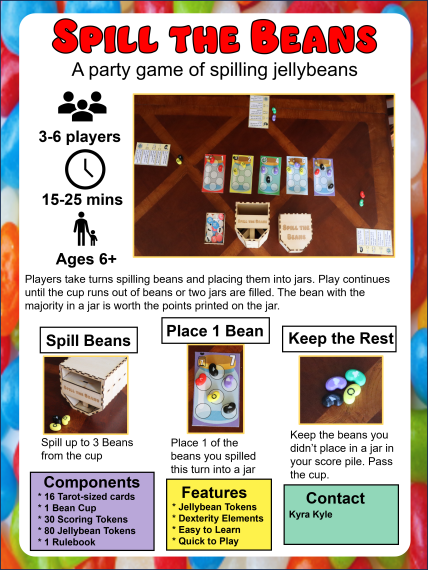
Almost every publisher requires a sell sheet, so I guess I’ll kick off this game design dump with sell sheets. Sell sheets remind the publisher what your game is all about. Below is a sell sheet for Spill the Beans (I omitted my contact information).

This sell sheet could use some more work. I always second-guess my pictures and layout. But this sell sheet contains what it needs: the name of the game, contact info, the hook (what makes the game unique), demographics (age, player count, and time), a list of components, a brief overview, and quick rundown (with visuals) of how the game is played during a turn.

The background picture (of jellybeans) is obscured by a white backdrop, making the text and pictures on top of the white backdrop legible. You don’t need a fancy background or a colored backdrop. I did so here to add a little extra color. Frankly, I may have overdone it a little. Legible text and images (of the game) are key. I like having a logo, but you don’t need one. And the tagline does enough to let publishers know what kind of game Spill the Beans is.

Next, we have an overview picture of the game. Always a plus to have in a sell sheet. Publishers need to see all–or at least most of–the game’s components. Demographics are shown to the left of the overview pic. Again, publishers need to know who the game is for, how many players the game accommodates, and how long the game takes to play. I settled on 15-25 minutes because I noticed some players strategize more than others (sending the game to 25 minutes), but I didn’t include plays of first-time gamers. The time on the sell sheet should reflect the average time it takes to play a game, not teaching the game to new players. So, of course, Spill the Beans will take a few extra minutes when someone first learns the rules. It really doesn’t take long to learn this game.

Under the overview and demographics, we find a brief (three to four sentence) description of the game, and beneath that we find what players will do (mostly) on their turns, giving publishers an idea of the game’s flow. Each turn action has a header, a picture, and a very brief explanation of each action underneath the pics. Do not include too many of the rules. That’s for the rulebook.

Finally, we get components, features, and contact info. Typically, the components section doesn’t need a detailed breakdown of each item. For instance, if your game includes 110 standard cards, potential publishers don’t need to know that half the cards are of one type and the other half is a different type. Publishers are only interested total number of cards and size. In Spill the Beans, I mention 18 Tarot-sized cards. I don’t say that eight of them are player reference cards and the other 10 are jar cards. That’s for the rulebook to explain further. Features are what make your game standout, and contact info should include your name, e-mail address, and phone number. You can see why I didn’t share that here. Lol

Sometimes, the things that aren’t included are just as important as the ones you do include. I don’t include a thorough rules explanation. I’ve seen game designers try to squeeze in their entire rulebook on a sell sheet. No! Don’t do that. Consequently, you don’t want walls of text. They’re intimidating. I don’t believe I included any flowery market language or buzz words in this sell sheet, words like unique, fun, exciting, or sustainigizing.

Wait. That last one wasn’t a word. And I didn’t mention how long I’ve been working on this game. First off, publishers don’t need to know that. It may even hurt your pitch if a publisher finds out you’ve been working on a game for years. Second, I share those details on this blog. If a publisher wants to know the story behind some of these games, they could look them up on this website. Eek!

Overview Video

Years ago, overview videos were nice to have. They are now–almost–industry standard. You can still get away with only have a sell sheet. But even the publishers who don’t require an overview video highly recommend one.

Above is Spill the Beans’ Overview Video. It’s bare bones, but I believe it’s effective. One of our writers, Season, narrates, and you’ll see similarities between the Overview Video and Sell Sheet. Sure, Season goes into the rules in a little more detail, but she really only adds what triggers the end of the game and scoring. Honestly, overview videos help folks who may be more visual learners. A Sell Sheet can only do so much. Overview Videos take the concept further.

A special shoutout to Kenneth Turner at Nerds Making Nerdy Things. Kenneth made the physical design for Spill the Beans’ spilling cup. Nerds Making Nerdy Things takes special orders. If you have an idea for a board game peripheral or even an art project like a shadowbox, feel free to contact Nerds.

I thought of Kenneth while looking at Season handling the Spill the Beans cup. Getting back to the Overview Video, you’ll need several of the same elements you’ll find in a Sell Sheet: the name of your game, the player count and approximate length (like you’ll find in demographics), the theme, the roles players take (if any), the objective, and what players do on their turn and throughout the game, which can include what triggers the end of the game and scoring. Again, we don’t include the full rules. For the fourth or fifth time, that’s why we have a rulebook. You don’t need to include fancy animations or cut-ins. The video above is simple. You also don’t want to talk too much. Show, don’t tell. Season did a good job of avoiding wordiness.

I’ve submitted Spill the Beans to board game publishers. I don’t know if I can share the names of those publishers here yet or not, so they’ll remain anonymous–for now. I’d prefer a program for board game submission that’s similar to Duotrope in the literary world, where submitters share their experiences with publishers (how long the publisher took to give a response, if they ever gave a response) in an attempt to catalogue publishers and their tendencies. I may just create one. But that’s a problem for future Kyra.

Great Plains Gaming Festival

I was triple-booked the weekend of Great Plains Gaming Festival (GPGF), so I didn’t show up for much of the convention. Friday was my big day. But my games attended GPGF all three days as part of the Playtest to Win event. In short, I was a little disappointed. My games didn’t get checked out as much as I would’ve liked. But I can honestly say Spill the Beans, Whirligig Pets, and No Kings were blind playtested. Gamers played these games by reading the rules.

I wasn’t there to explain anything. Heck! I couldn’t be there to explain anything. Spill the Beans and Whirligig Pets are ready for publication. Will they see tweaks in the future? Sure, but the core games are solid. And except for No Kings, the rulebooks make sense. No Kings needs some work to put it mildly. But yay! I can submit the other two with confidence.

My Future Events

I have so many upcoming gaming events in the coming months. You can stop by at any of these and say hi or convince me to play a game or a dozen.

Nuke-Con’s Aftershock Event: May 16, 2026 (I’ll be working one of the tables)
Omaha Gaming Convention: July 10-12, 2026 (I won’t be working this one, but I will be in attendance; let’s get our game on)
Omaha Pride: July 17, 2026 (I’ll be running games for Pride)
O-Con: July 17-19, 2026 (at the Extra Life table; I double-booked myself again, oops–I can’t calendar)

And I think that’s it for the coming months. It’s a little early to advertise Nuke-Con in October. But that’s all I have for today’s Board Game Design Brain Dump. Hopefully, this means I’m back to doing these on a more regular basis. Thank you for reading, and wherever you are, I hope you’re having a great day.
Game Design Brain Dump: March 6, 2026

Hey, hey, Geekly Gang! Kyra Kyle here with another brain dump. Today’s post will be about board game design, but these brain dumps have a nasty habit of crossing over from writing to game design and back again. I may have found my stride. We’re averaging a brain dump (alternating between game design and writing) every other week. That feels good, so the next writing brain dump should occur on March 20, 2026. Yay! But let’s go to a macro look at game design. That’s right. We’re zooming out and potentially talking about the creative process as a whole.

I read another game designer’s (Ann Journey’s) game diary. She likened her design technique to her writing process, and it rang true. There’s a lot of crossover between game design and writing as both are creative endeavors. She would brainstorm, create an outline, and build her board game based on the outline. This resembles the Plotter approach to writing. Plotters are at one extreme end of the writing spectrum.

Yes. Like most things in life, writing can be depicted as a spectrum. In fact, the opposite extreme ends of the writing spectrum tend to get as hotly debated as political factions. When I say Plotters are at one end of the writing spectrum, we’re talking Ultra Conservative or Wacky Liberal levels of extreme. Plotters like JK Rowling insist that writing without an outline would be like taking a trip without a map. You’ll get lost. That makes sense. Pantsers are at the other end of the spectrum. They never use outlines. Stephen King may be the most famous Pantser. King wrote in On Writing, “Outlines are the last resource of bad fiction writers.” King suggests outlines limit inspiration and the joy of creativity. This also makes sense.

And like most things (like gender identity and sexual orientation), I fall somewhere in the middle. Pantsing and Plotting aren’t the only ways to write or design games. They’re the ones that get all the attention.

I’m somewhere in the purple. I like purple. Yay! We discussed how Plotting works within board game design. Ann Journey uses this method to great effect in Cretaceous Rails. Brainstorm, create an outline, and build a game based on the outline. Euro Games may insist on this method of board game design. Euros lend themselves to following a well-crafted outline and often feature distinct beginnings, middles, and ends.

But you could Pants your way to a good game. In the past, Molly Johnson, Robert Melvin, and Shawn Stankewich shared that they threw various ideas at the wall while designing Point Salad. If it’s cool, it rules, and if it rules, it makes it into the rulebook. That sounds akin to Pantsing. The Point Salad series of games (which also includes Point City and Point Galaxy) tends to be adaptable and demands that players remain flexible. This could be a feature of this method of board game design. I’m just throwing something against the wall here.

Then we get to two alternatives to Pantsing and Plotting: Lighthousing and Blotting. Are these two methods in the purple, or is there a Y-axis to this spectrum that I don’t see? I’m unsure, but I do know that Lighthousing and Blotting are two major alternatives to Pantsing and Plotting. There may be others.

While writing, whenever I Lighthouse, I usually know where my story begins (the opening scene), and I know a Lighthouse scene for the future, a poignant scene I know will make the final story, but I don’t know how to get there yet. This Lighthouse scene informs my decisions, but it also gives me leeway to explore. Early into Mysterium’s development, Oleksandr Nevskiy and Oleg Sidorenko knew how the game would begin and the game’s final turn. Most–if not all–of Mysterium’s design choices were in service of the game flowing from its beginning to that final turn. Lighthousing may be the method you’ll want to use if you have planned an epic final turn or series of turns.

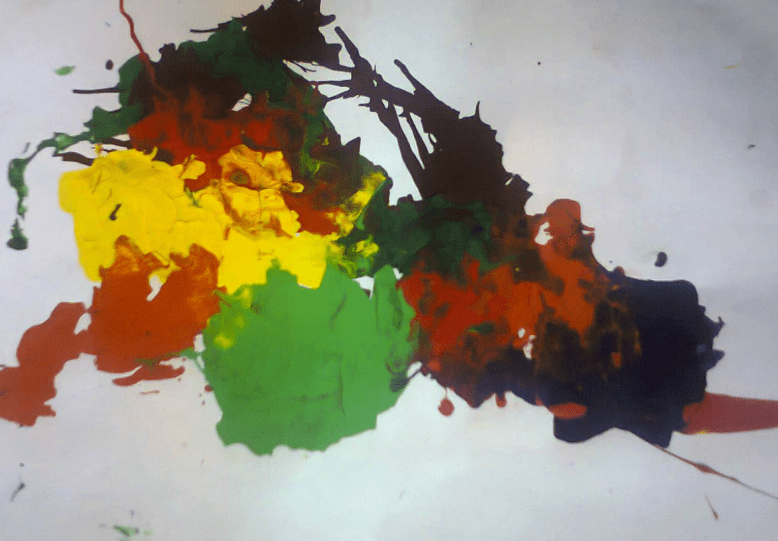
Finally, we get to Blotting. I picture myself with a blank canvas whenever I Blot while writing. In my hand, I have a sopping wet paintbrush, like Bob Ross and his wet-on-wet painting method. I slap a scene on the blank canvas, and it causes a blot. Then I add another and another, and after I’m finished, I have to make sense of the mess by molding these Blots into a cohesive whole. While designing Marvel United, Eric Lang suggested that he knew his theme (Marvel Comics, obviously) and a handful of the game’s mechanisms. He just needed to take those elements and sculpt them into a cohesive gaming experience. Sounds like Blotting to me. Blotting can lead to fun and exciting fusions of disparate elements.

Word of caution for Blotting (and for designing games in general): One can add too many elements to a game. Typically, the fewer gaming elements, the better. The old adage “Less is More” is key.

I’ve used all of these methods for game design and writing. There are some I prefer and others I don’t. I wouldn’t say one method for a creative endeavor always trumps another. Your goal is to find which method works best for you and for your project.

And just because you Pants or Lighthouse your way to a story or game, doesn’t mean you can’t use a reverse outline. Have I talked about reverse outlines? Yes, in a previous writing brain dump. I’ll leave that link right here.

Remember, Stephen King subscribes to Pantsing. He has suggested that one’s reader won’t be surprised if you’re not surprised as the writer. Pantsing induces moments of surprise in King whenever he writes. But King is also known for horror fiction. The element of surprise is important for horror stories. There may be a reason Stephen King chooses the Pantsing method.

If you’ve made it through my rambling, you’re awesome. We all know it. Thank you for reading, and wherever you are, I hope you’re having a great day.