I said last week I expected to see Norman Osborn as Green Goblin within the next few episodes. Now, I’m kind of hoping that’ll be the Season 1 finale. Without watching Episodes 4 and 5 prior to this review, let’s swing into “Secret Identity Crisis.”
We didn’t linger too long on Peter’s mental crisis after Norman revealed that he knew of Peter’s identity as Spider-Man. Normally, I’d like to explore this a bit more but, for this show, it would feel out of place. That said, we got to learn a bit about Nico’s situation during this segment. She’s in foster care. If they’re going to lean into a variant of the Runaways narrative, I’m digging this backstory.
I’m not sure I cared too much for Lonnie’s kid brother joining a gang. He seemed disgruntled but, overall, a good kid. It wasn’t entirely unexpected since we saw how Lonnie was followed by the cops (among other things) in “Amazing Fantasy.” This felt a bit forced. However, Lonnie turning himself over to the gang to save his brother does make sense for his character. I’m curious to see how he’ll become Tombstone later.
One last thing. I thought it was endearing to see Peter save Uncle Ben’s camera. The camera backstory isn’t something I’ve seen much of. I found myself saying, “Aw.”
Skye’s Take
While I started having doubts in the last episode, the show is back on track with this one. At first, I thought the show was moving too fast and I couldn’t tell where they wanted to take the show. Their intentions are now clear. In fact, this episode was kinda cute.
I latched onto each character. Not gonna lie, I was surprised to see how caring and positive each character is, especially Norman Osborn. Considering how the previous episode ended, I expected him to go into full Goblin mode real soon. However, he’s far from that. Norman seems genuinely pleasant and willing to help Spider-Man after learning his identity, and that’s a nice spin on the idea. The Spider-Man stuff is getting more interesting as Spider-Man’s “Guy in the Chair” is literally the Green Goblin.
I agree with Season on the Lonnie stuff. His brother Andre joining a gang was out of left field, but the show needed to get Lonnie into a gang somehow. It also makes Lonnie a more complex character. Knowing his future as Tombstone, seeing him vulnerable around his family sets him up as a tragic character. I’m looking forward to the episode when they rip my heart out with him becoming Tombstone.
With minimal gripes on this episode, and prior to watching the other two, I’m back on board. Let’s keep this Spider-Train a rollin’ with more great episodes.
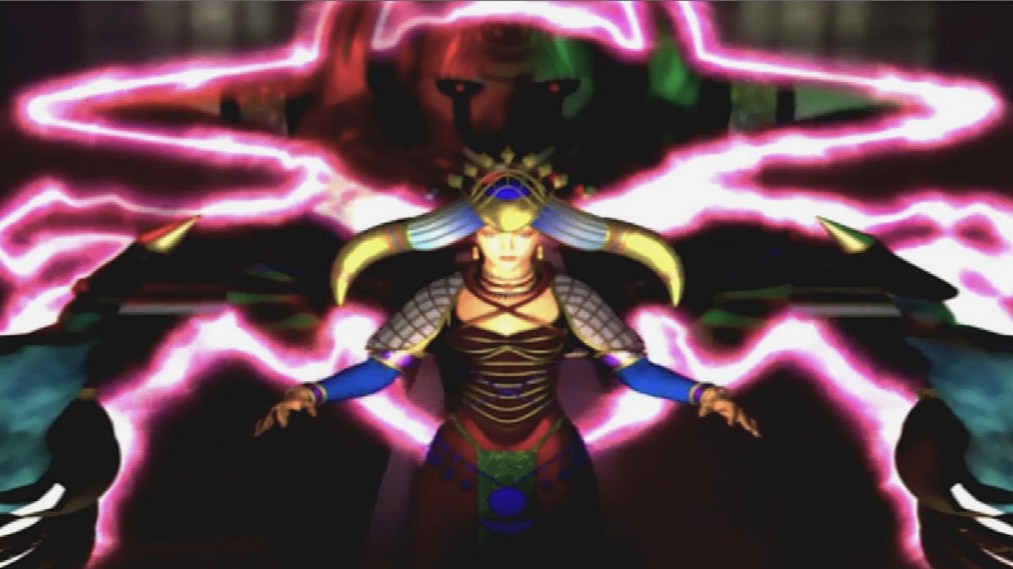
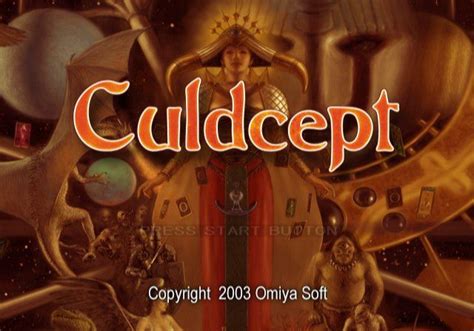
Culdcept has titles spanning nearly two decades. It has a manga series. It’s difficult to find Western copies. Discard your card and let’s play a round of Culdcept.
Hey, everyone! Season here. We’re trying something new this week with Video Game Cult Classics. This week, we’re focusing on Culdcept (or Karudoseputo in Japanese). The basic premise of Culdcept is Monopoly meets Magic: The Gathering in video game form. The first installment was developed in 1997 by Omiya Soft. For a video game to make this series, we’re going to consider its reception, relevance, and accessibility. Since Culdcept is predominantly a deck construction game, we’ll start with the different types of cards before jumping into gameplay.
Note: Most of the images are from the Culdcept Revolt wiki, but some will be from Culdcept Second (which will be labeled).
Card Types
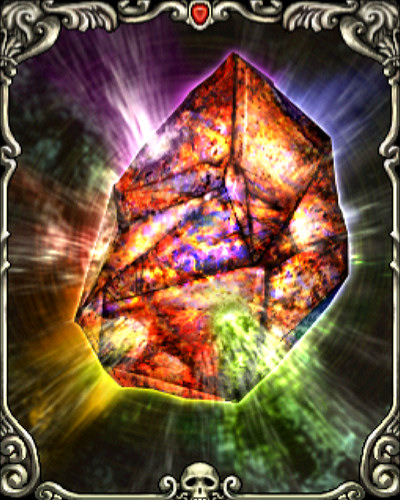
Before we jump into card types, Culdcept has a card rating system (how easy cards are to obtain). After a match, cepters (players) receive “card packs.” The number of cards contained in each pack varies depending on whether the cepter won or lost. In Culdcept Revolt, cepters may also purchase card packs outside of matches. The different ratings a card can have are normal (common), strange (uncommon), rare, and extra (ultra rare). Extra cards are powerful and may only be obtained after meeting certain conditions within the game.
Below, we have “Rainbow Piece,” an extra item card obtained after defeating a specific cepter in story mode of Culdcept Second.
Now that we’ve got obtaining cards and their rarities down pat, let’s take a look at the categories of cards. Culdcept has three basic categories of cards: creatures, spells, and items. We’ll start with creature cards.
Creature Cards
Creatures claim/defend land and attack/defend against other players. They’re essential for collecting tolls and fending off your opponents. Each creature card will have ST (strength), HP (health), MHP (max health), and G (cost). Some creatures will also have an element symbol or card symbol as part of their G. This means you must own the number of required land and/or discard a card from your hand to place that creature.
Some creatures will have “land limits” (types of lands they can’t be placed on) and “item limits” (items they’re unable to use in battle). Each creature card will have a different colored border, denoting their element. If the cepter places a creature on a land of their element, they’ll receive a land effect, meaning they’ll get bonus HP and ST from that land during battle. This excludes neutral (gray) creatures unless they have an effect that states otherwise.
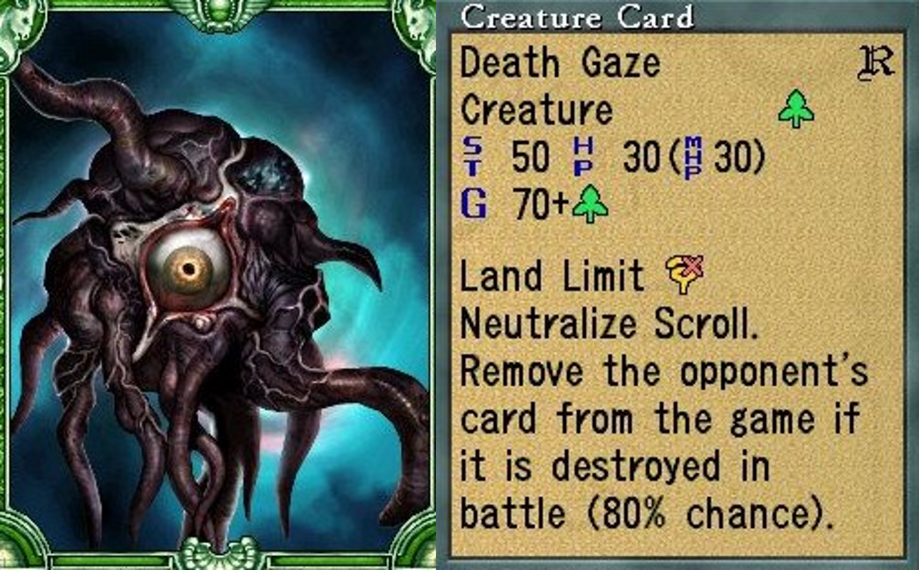
Below, we have a “Death Gaze.” It’s a rare earth creature. It has ST: 50, HP: 30, MHP: 30, and G: 70+ you must own at least one more earth land to place “Death Gaze.” The printed “Land Limit” shows that “Death Gaze” cannot be placed on a wind land. The “Neutralize Scroll” effect means that it’s impervious to scroll attacks.
Credit: gamerinfo.net, Culdcept Second
Spell Cards
Spells can either help or harm the casting cepter. They can be used offensively to steal magic (more on magic during “Gameplay”) from other cepters and harm their creatures or defensively to protect the casting cepter and their creatures from their opponents. Some spells have area effects, alter lands, and affect movement. Spells may have different symbols that denote which aspects of the game they affect. In Culdcept Revolt, there are “secret” spells, which aren’t revealed until they’re played. More on that later.
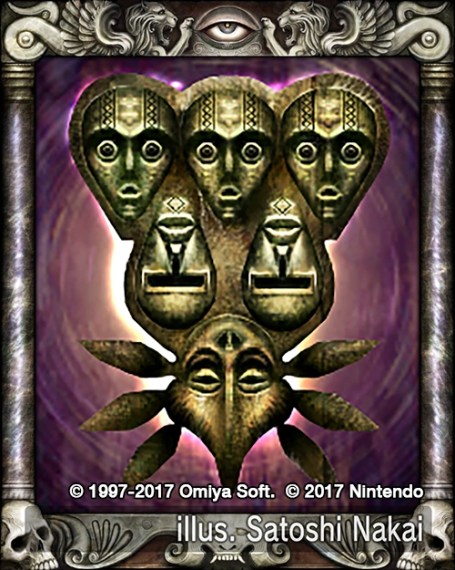
The spell below is “Holy Word 6,” which allows a cepter of the caster’s choice to have a fixed die roll of 6 on their next roll phase.
Item Cards
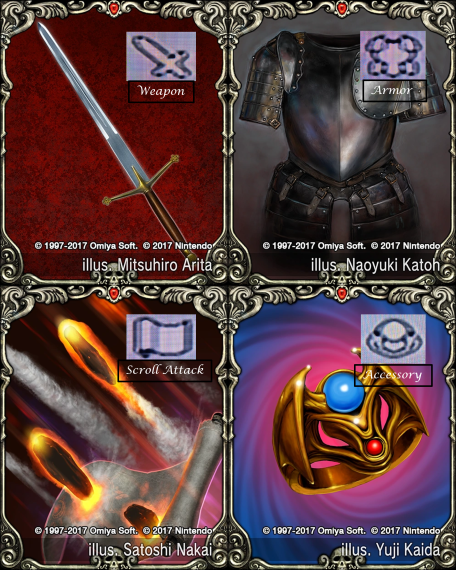
Items can be broken down into four types: weapons, armor, scroll attacks, and tools/accessories. Weapons and armor can both affect a creature’s ST and HP stat. Weapons tend to provide more strength and armor tends to provide more HP. Scroll attacks give a creature a fixed strength and can have different effects, such as critical hits to certain types of creatures and can ignore items that neutralize attacks. Tools/accessories can do a variety of things. They can neutralize attacks, penetrate (remove land effect buffs from creatures), give a creature first attack, and destroy/steal the opponent’s item. There are probably more effects we’re forgetting. Some creatures may also double as items, which is described in their effect text.
Gameplay Overview
Cepters (players) draw a card, roll two 6-sided dice, and move around a board, placing creatures and paying/collecting tolls as they go. Each installment of Culdcept has different variations and add new mechanics. For this write-up, we’re going to focus on Culdcept Revolt (2016), since it’s the most recent installment.
At the beginning of a cepter’s turn, they draw one card from their book (deck). Each cepter can hold a maximum of six cards in their hand and must discard down if they draw a seventh. If they are holding any spell cards in their hand, they may play one per turn if they have enough G (cost). Culdcept is played with player hands revealed except for “secret” spells, which aren’t revealed until they’re played.
Credit: videochums.com
Next, the cepter rolls the dice and moves the number of spaces on the dice. If the cepter rolls a symbol on one of the dice, it equals zero. Rolling symbols on both dice equals twelve. Land tiles are elemental and may be either vacant or occupied. The different types of land tiles are air (yellow), fire (red), earth (green), water (blue), morph, and multi-elemental. The former four are more common and provide land effects to creatures corresponding with their matching element. Morph is a neutral land tile that transforms into the element of whichever creature is placed there. In Culdcept Second, these are neutral tiles and remain neutral even after a creature is placed there. Multi-elemental provides land effects to creatures of any type but won’t provide a chain effect. More on chain effects later.
Credit: videogamesuncovered.com
Special Tiles
There are also many types of special tiles cepters may land on. We won’t go in depth here, but we will give a brief overview of them.
Gates are represented by N, S, E, and W. They must be passed to collect magic to win the game.
Warp and Bridge tiles are similar since they send cepters to another location on the map.
Fortune Teller lets cepters choose creature, item, or spell, and gives the cepter one of the selected options at random from their book.
Spell Circle allows cepters to choose one of two spells presented, which is cast instantly, free of charge.
Card Shop allows cepters to purchase one of four cards for 20G.
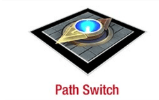
Path Switch alters the path on the board for cepters, like a mine cart junction.
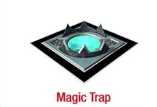
Magic Trap with either steal magic from cepters or give cepters all of the magic it has depending on what the cepter who landed on the tile rolls (1-6).
Siege Tower allows cepters to invade any land or occupy any vacant land with a creature from their hand.
Gem Store allows cepters to sell, buy, or steal Element Gems from one another, which can be used to enhance the element they’re assigned to. This increases the value of an element for a player. Cepters choose one element for the Element Gem’s rival (this element’s value decreases) and one element for the Element Gem’s ally (this element’s value increases). Element Gems are one of the more complex aspects of Culdcept Revolt and could be an article on their own.
Metro Bridge Map, Culdcept Revolt
Once a cepter lands on a tile, they will either perform the effect of the special tile, place a creature on the land tile if it’s vacant, summon a creature to battle on the land tile if it’s occupied, or use territory commands.
Chaining
If a cepter places a creature on a vacant land of an element they already own, a chain happens. Chaining raises the toll of that cepter’s lands if the lands occupied are the same element. So, if a cepter has two water lands and one fire land, the two water lands will be chained, raising the toll fee of that cepter’s water lands. The fire land will not be affected until that cepter places a creature on another vacant fire land. Chains don’t apply to multi-element lands.
Battles
Battles are fairly straightforward. If a cepter lands on a land tile occupied by another cepter, they may summon a creature to invade the opposing cepter’s land. The creature chosen must have its requirements met before being summoned, such as G, discarding a card, the number of adequate lands are occupied by the summoning cepter, and land limits.
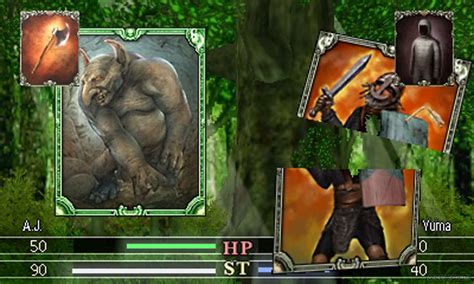
The invading creature attacks first (unless the defending creature has the “first attack” effect), dealing damage equal to its ST to the defending creature’s HP. Each cepter has the option to choose an item to use in battle. Even if an item isn’t used the backside of a blank card will lay in the upper left or right-hand corner of either creature card until the battle commences.
Credit: hak271828, YouTube, Culdcept Second
If an item is used it will remain in the upper left or right-hand corner of its respective creature card and its effect will occur. If a creature has a pre-battle effect, such as critical hit, that will go into effect. If a creature survives the battle and has an effect post-battle, that will go into effect before exiting the battle screen and returning to the board. If the invading creature wins, the land will be taken over. If the defending creature wins, the cepter who landed on the land will pay the toll. If both creatures get destroyed, the land becomes vacant.
Credit: videochums.com
Territory Commands
Territory commands can range from leveling up lands to doing a myriad of things with creatures. They may only be available for territories the cepter has passed during their move phase. All may be accessed if the cepter lands on a gate. Lands can be level one through five—five being the highest. Cepters must pay the appropriate cost in G before a land can be leveled up. Cepters may also exchange the creature currently occupying a land with one from their hand or move a creature to an adjacent land (except for defense creatures that can’t be moved). If the adjacent land is occupied, a battle ensues. Otherwise, the creature occupies a new land. If a creature has a territory ability, the ability may be used. The game ends when whichever cepter collects the required magic power first.
Phew! That wasn’t nearly as in depth as it could have gotten, but I’ll spare you the nitty gritty. The game itself teaches new players more slowly, so it’s not nearly as much of an info dump as my breakdown.
Reception
Culdcept was more of a hit in Japan than in Western countries. The original Culdcept doesn’t have an official translation. However, Culdcept did get released as Culdcept DS in 2008. Culdcept also released during the middle of the collectible card game (CCG) boom of the ‘90s. It came out one year after the Pokémon Trading Card Game (1996) and two years before the Yu-Gi-Oh! Trading Card Game (1999). CuldceptSecond got an official translation and was released in North America in 2003 for PS2. This is the iteration of Culdcept I’m most familiar with. However, Culdcept Second still wasn’t very popular and sold roughly around sixty-five thousand copies globally. Culdcept 3DS released in 2012 in Japan, but this is similar to Culdcept Second.Culdcept Revolt incorporated an online element. This garnered Culdcept Revolt more popularity than its predecessors and it included elements to streamline the game.
Credit: Vysethedetermined2, YouTube, Culdcept Second
Relevance
Since Culdcept released as a video game hybrid of popular tabletop games, you’d think it’d have a wider fanbase. I’m not sure why it’s an obscure series, but I can hazard a guess. OmiyaSoft wanted to jump on the CCG bandwagon with a video game resembling a CCG. Culdcept got sandwiched between two popular titles during that time. Yu-Gi-Oh! (the manga) began serializing in 1996 and Pokémon (the anime) started airing in 1997. Culdcept likely got overshadowed by these two titans and faded into obscurity.
The publisher, Omiya Soft, is a small, not well-known publisher outside of Culdcept. To their credit, Culdcept lasted for almost twenty years. They had enough dedicated fans to continue producing games. On their website, they advertise themselves as a variety publisher. They haven’t released anything since Clash! Hani World in 2017, which is only available in Japan.
Credit: mobygames.com, Culdcept Second
I mentioned the manga at the beginning of this write-up, so I’ll cover the manga’s reception here. The Culdcept manga was serialized from 2004-2006, between the releases of Culdcept Second and Culdcept Saga, shortly after Culdcept Second became available in North America. I didn’t know it had a manga even though it was published in English by Tokyopop, which is a well-known English manga publishing company. Regardless, even the manga had a short shelf life.
Accessibility
If you’ve read this far and are thinking about picking up a copy of Culdcept, you’re probably asking, “Where can I find it?” Your local used video game store likely won’t have it unless you luck out. Folks sell used copies of various Culdcept titles on eBay and Amazon. The downside to getting these titles online is that they could be damaged, and you’d have to take the disc to get refurbished. Culdcept Revolt still has some new copies on the market, but their numbers are dwindling. If you want to get your hands on the original Culdcept, I recommend having a Japanese PS1 or PS2 to go with it if you’re able to find one. These aren’t the easiest games to find and the prices for English copies vary between $25-$200 USD. Maybe more, depending on where you look.
Credit: listal.com, Culdcept Second
Final Thoughts
If you’re a fan of strategy and card games, I highly recommend Culdcept. I find the game charming and enjoy the different playstyles of each CPU within the game. That’s right. Unlike games like Yu-Gi-Oh! Duel Links, where each CPU has different decks, but employs a similar playstyle, CPU cepters have their unique playstyles that match their personalities and deck type. Some of them take over every land they see while others invade when they’re certain they can win. They can be predictable if you’re used to facing the same cepter, but they’ll sometimes leave you scratching your head.
Much of the information regarding Culdcept Revolt was found on Culdcept Central. If you want more in-depth guides for each game and deck strategies, please check them out.
What’s your favorite deck/strategy in Culdcept? If there are any cult classics you’d like to see covered in future posts, let us know in the comments. Thanks for reading and have an amazing rest of your day.
Last week, I thought Ivy’s secrecy would come back to bite her. Boy. It really came back to bite her this week. Ready to enter the Green?
As denoted by the title, Dr. Woodrue (Floronic Man), chose to enact his revenge on Poison Ivy. This was foreshadowed at the end of “Back to School,” but I wasn’t sure if they were going to focus on a different story in Episode 3 and circle back to Floronic Man. This episode also incorporated dramatic shifts from the darker parts of the story with Ivy and ridiculousness with Clayface.
Clayface going to Metropolis after getting a negative review from the Daily Planet made the episode for me. I enjoy Ivy’s edgy backstory, but, like, it’s Clayface. Harley Quinn does a good job of shifting the narrative drastically throughout an episode while keeping the audience engaged. I try to avoid spoilers, but I do have one here. Harley “killed” Floronic Man at the end of the episode. I say “killed” in quotes because Ivy thought she killed him at the end of “Back to School.” I feel like he’d need to be burned or something. Then again, Scarecrow didn’t make it past Season 1. End of spoilers.
We’ve gotten some more foreshadowing for the next episode. Will the big baddie who made an appearance at the end of “The Big Apricot” be featured or will we have to wait a bit longer? Personally, I’d like to see him at the season finale.
Kyra’s Take
While I could also wait a bit longer for this season’s big bad to make a full appearance, I don’t think Harley Quinn will stay in Metropolis for more than one season. And this season’s big bad makes little sense outside of Metropolis. I’ll stop avoiding spoilers and just name the season’s big bad: Brainiac. Brainiac needs Metropolis, and Superman must feature in the story.
Harley Quinn has taken its time to move characters from Gotham to Metropolis. I love a good Clayface B Story, and this week’s Clayface B Story delivered. It doesn’t hurt that Bane joined in on the Clayface goofiness. This story thread does more than offer the laughs, while Ivy’s story grew dark. Clayface promotes his career. He does so in the most Clayface way possible, over-the-top. He kidnaps the Daily Planet’s editor-in-chief Perry White, and infiltrates the newspaper disguised as White. This was a clever way for Harley Quinn to introduce larger story elements. The big bad makes moves in Metropolis. We learn about some of these machinations through pitched Daily Planet headlines, but Clayface only cares about his review. Love this. It’s brilliant.
Ivy’s backstory gets a satisfying end. Floronic Man may be little more than a villain of the week. I got Arrowverse vibes from how Harley Quinn treated him, but that works in an animated series like Harley Quinn. As Season said, Harley Quinn killed off Scarecrow in Season 1. It did the same to multiple major Batman villains. I like how no one’s safe, not even someone who usually factors into one of the main cast’s origins.
The show does a good job of maintaining forward momentum and giving the impression that there’s a satisfying ending for this season’s story while keeping the audience guessing. I like how the show could go in multiple directions. Heck, Harley Quinn could stay in Metropolis for a second season. There are plenty of Superman villains to explore.
Two episodes in one day? Did I win the lottery? Disney decided to give us big bucks this week. Joking aside, “The Parker Luck” kept the momentum of “Amazing Fantasy” and catapulted the story forward.
There was a recap at the beginning of “The Parker Luck,” which I normally wouldn’t mind if I knew the episodes were aired one week after the other. “The Parker Luck” and “Amazing Fantasy” dropped on the same day, so the recap felt unnecessary. It also needlessly padded the runtime (which is three minutes shorter than “Amazing Fantasy”) with this addition. That said, I’m digging the intro. I refuse to skip that intro.
Since he was introduced at the end of Episode 1, I’ll name drop him here. I’m loving the arc of Norman Osborn approaching Peter to offer him an internship, followed by another turn at the end of the episode. Once again, they wasted no time in propelling the story forward. However, I wasn’t a fan of Peter making plans with Nico then not showing up because of his other obligations. It’s overdone and trope-y. This is a kids’ show, so I won’t nitpick too much, but that trope gets old real fast.
I’m expecting to see Norman Osborn as the Green Goblin within the next few episodes, if not Episode 3 next week. We may see the counterparts of other characters during that time, too.
Skye’s Take
While the pilot episode proved to be a solid opening, this second episode got more mixed feelings out of me. “The Parker Luck” does have good things in it, but it left me asking “What’s the goal of this show?”
Since the episode ended with one of the main characters discovering Peter’s identity, I’m not sure where else this show can go from here. Sure, Spider-Man: No Way Home also dealt with Peter living with his identity going public, but at least that Spider-Man had been established for some time. Once again, I’m still not sure if I like this Spider-Man yet. It seems to me that the show is throwing a lot of major plot developments in the first few episodes to encourage viewers to keep watching. Given the show is still in its infancy, it’s moving way too fast.
However, I still feel satisfied with the relationship between Peter and his friends. Despite my other complaints, I enjoy seeing Peter hang out with Nico and Lonnie. This is also why it was so frustrating when he didn’t make it to the party in the episode. Believe it or not, this Spider-Man show is hooking me with its Peter Parker content more than its Spider-Man content. There were a few characters that appeared in the episode which are clearly being set up for future episodes. Dr. Connors and, of course, Norman Osborn who’re soon to be The Lizard and The Green Goblin respectively, but there’re undoubtedly more to come. As a Spider-Man fan, I can’t deny that there’s a novel feeling to seeing these characters appear knowing what they’ll eventually become.
Despite some reservations, I’m excited for this show and look forward to more surprises.
Whoa! Spider-Man got aged down again in his new show on Disney+. Not going to lie, the thirty-one minute runtime intimidated me at first. Despite this, the episode didn’t feel like a thirty-one minute long pilot. Grab your web shooters and let’s swing through Episode 1 of Your Friendly Neighborhood Spider-Man.
First impression: the art style. This was jarring for me when I looked at promotional materials for the show. I don’t dislike it, but it does take some getting used to. There were a few scenes at the beginning of the show depicting Peter getting ready through animated comic book panels, which was cute. I hope they do more of this in future episodes.
In the opening paragraph, I mentioned the runtime. I anticipated the spider bite scene to be at the end of the episode, but they wasted no time getting into it. The opening sequence of Peter getting ready/being late on his first day of school dragged a bit. He spent a lot of time telling Aunt May how much he appreciated her, which was heartwarming, but I don’t think it warranted two separate scenes within the first ten minutes. There were several characters who got introduced right off the bat, some of whom will likely become villains later on down the line. I won’t name drop, but there is a major Spider-Man villain who gets introduced at the end of “Amazing Fantasy.”
One last thing before I let Skye take the wheel—toward the end of “Amazing Fantasy,” real-world problems were showcased. The most notable examples are Lonnie getting followed by a cop on his walk home and someone who stole cash after losing their job. I won’t hang on this for long, I appreciated the inclusion of these moments. It makes the show more grounded.
Skye’s Take
Thank you for the stirring introduction, Season. I must say, after watching the first episode of this new Spider-Man series, I was pleasantly entertained. For the most part, it seemed to combine both old and new concepts we’ve seen in Spider-Man stories before. In the process, it created a world that looks familiar yet still feels fresh.
Regarding Season’s comment on the animation, I thought it was good with some noticeable imperfections. Overall, it’s pleasing to the eye, but it isn’t as good as Into or Across the Spider Verse. Part of me wonders if the animators were attempting to imitate that style by blending hand-drawn and CG animation similar to what those films did.
Despite that, this show proved to me that it was on the right track. The action was energetic and well-paced. We were introduced to a bunch of characters, but each of them seems likable with room to grow. Even the voice acting was pretty solid. There were some notable exceptions with some of the extraneous characters, but what can you do? If I were to harp on anything: the jokes aren’t that funny. The jokes got no more than a chuckle out of me, but comedy is subjective.
I’ll piggyback off another of Season’s comments. While I’m not opposed to including a moment like Lonnie getting racially profiled in a kid’s show, the moment comes out of nowhere. Suddenly, we’re supposed to feel bad for a character we barely know, and it comes across as Disney just trying to earn brownie points with minorities. Disney has a history of pandering to minorities on-screen, while behind closed doors, it’s a different story. If this story beat returns, I may have different thoughts.
Ultimately, this was a good start to a (potentially) good series.
Last week’s episode had some darker moments, but was fairly lighthearted. This week’s episode got gritty, gory, and introduced another new adversary in the final scene. Contrary to “The Big Apricot,” “Back to School” didn’t have as many slice-of-life moments. It either swung into the dark details of Poison Ivy’s origin or went full goofball with Harley and the baby sharks.
I didn’t mind the extreme shifts in “Back to School” since it was engaging and had good pacing. Ivy not telling Harley about her day will probably come back to bite her later given what we learn at the end of the episode. So far, Harley Quinn has had good continuity.
“Back to School” introduced more new characters, but I count the baby sharks (aside from Shaun) as one entity. Harley Quinn has introduced several new characters consecutively in the past, but not all of them stick around. I’m curious to see which characters they decide to keep for Season Five. Harley Quinn isn’t shy about killing off characters.
Speaking of characters, this is the first time we see King Shark in Season Five. He’s moved to Metropolis. I had a feeling they’d find a way to incorporate him in Metropolis since he’s featured in the artwork for Season Five. However, his appearance with his kids on Harley and Ivy’s doorstep did feel a bit forced. Since it’s the only thing that slightly annoyed me in this episode, I’ll give it a pass.
Kyra’s Take
This week’s episode of Harley Quinn, “Back to School,” added some deep cuts into DC Comics lore and Harley Quinn’s spin-off series Kite Man: Hell Yeah!. While these inclusions can be a lot as Season mentioned, they work within the fabric of Harley Quinn and the greater DC Comics. I like that about Harley Quinn. It reinterprets DC Comics characters while staying true to their roots.
Bane and Goldilocks return from Kite Man: Hell Yeah!. I just finished watching Harley Quinn’s spin-off series. It doesn’t hold up as well, but Bane was one of the show’s standout characters and it’s nice seeing him return to Harley Quinn. I could do without Goldilocks. There’s a reason Queen of Fables doesn’t like her. The third thing of a set one gives Goldilocks will usually be “just right.” Ugh! You don’t need to know much more about the character (or watch Kite Man: Hell Yeah! before watching this episode), and you can imagine the long-suffering Bane having to please this petulant child.
This next section could be considered spoilers. Season avoided mentioning this character. If you’d like to see the episode yourself before reading this take, skip to “end of spoilers.” You’ve been warned.
It didn’t don on me that Harley Quinn has gone four seasons without mentioning Dr. Woodrue until I heard his name. Floronic Man (Dr. Woodrue) frequently serves as a foil to Poison Ivy. “Back to School” casts him as Ivy’s college professor and that works. Woodrue attempting to steal Ivy’s life’s work (namely her plant-sidekick Frank) and claim it as his own has plenty of dark undertones. Harley Quinn doesn’t play it off for laughs either. That’s why these scenes get cut by kid shark antics. As soon as I heard Dr. Woodrue’s name, I got excited. “Back to School” does the character justice.
End of spoilers. I agree with Season that “Back to School” had a lot of severe shifts in tone, but these shifts worked. Harley’s kid shark antics undercut the Ivy’s brooding narrative. “Back to School” does a good job of weaving old Harley Quinn characters into the Metropolis setting while setting up a juicy antagonist for the season.
It sounds as if Anime Season will take a break for the foreseeable future but before she leaves for an extended Otaku O’clock, she agreed to share her list of some good starter Shōjo anime. For those of you not in the know, Shōjo roughly translates to girl and Shōnen means boy, so we’ll be trading some ninjas wielding oversized swords for romance and slice of life stories with this list. Take it away, Anime Season.
My other write ups tend to explore Shōnen anime more than Shōjo anime. Shōjo isn’t a genre I watch as frequently but the following series are accessible in most legal streaming services (because, you know, Japan is cracking the whip on those illegal services, man).
Fruits Basket (2001-2003)
When it comes to starter Shōjo anime, Fruits Basket was one of the first ones I thought of. It has the basic Shōjo structure: Girl must live with—or near—a bunch of guys for plot related reasons, girl befriends the guys and doesn’t want to leave them, and a love triangle ensues. This structure sets up romance that most Shōjo series are known for.
However, in the case of Fruits Basket, there is a strange element that sets it apart from other Shōjo anime. I’ll spare the details since it’s included in every synopsis one can find about Fruits Basket. Since a lot of Shōjo have that romance structure there are some that added in an extra element to make themselves more unique. Fruits Basket incorporates the Chinese Zodiac, teaching viewers what each Zodiac is and encouraging them to learn more about it. It’s also pretty accessible and can be found through multiple streaming services. It’s easy to get into and helps one get accustomed to the Shōjo genre.
Fruits Basket has a straightforward story and continuity. For those who are just getting into anime and want to explore the Shōjo genre, Fruits Basket is one I’d recommend.
My Love Story!!/Ore Monogatari!! (2015)
If one is interested in cute plots featuring role reversal, My Love Story!! is a good start. It has an easy-to-follow storyline featuring the stereotypical best friend character in Shōjo anime as the lead. The main character Takeo wants focuses on getting a girlfriend, but none of the girls like him. His best friend Makoto has zero interest in girls, but every girl falls for him. Forget girls. Makoto has zero interest in anything. I don’t know how many times I’ve wanted to smack that bored look off his face.
Eventually, Gōda finds a girlfriend, Rinko Yamato, and a series of events follow. Gōda performs chivalrous acts and Rinko’s friends don’t approve of him because of his looks. The story is full of cute character moments (such as Rinko baking sweets for Gōda and him gushing over her baking) and takes the time developing each character. I’d recommend it for those looking for something that has a simplistic structure and good storyline.
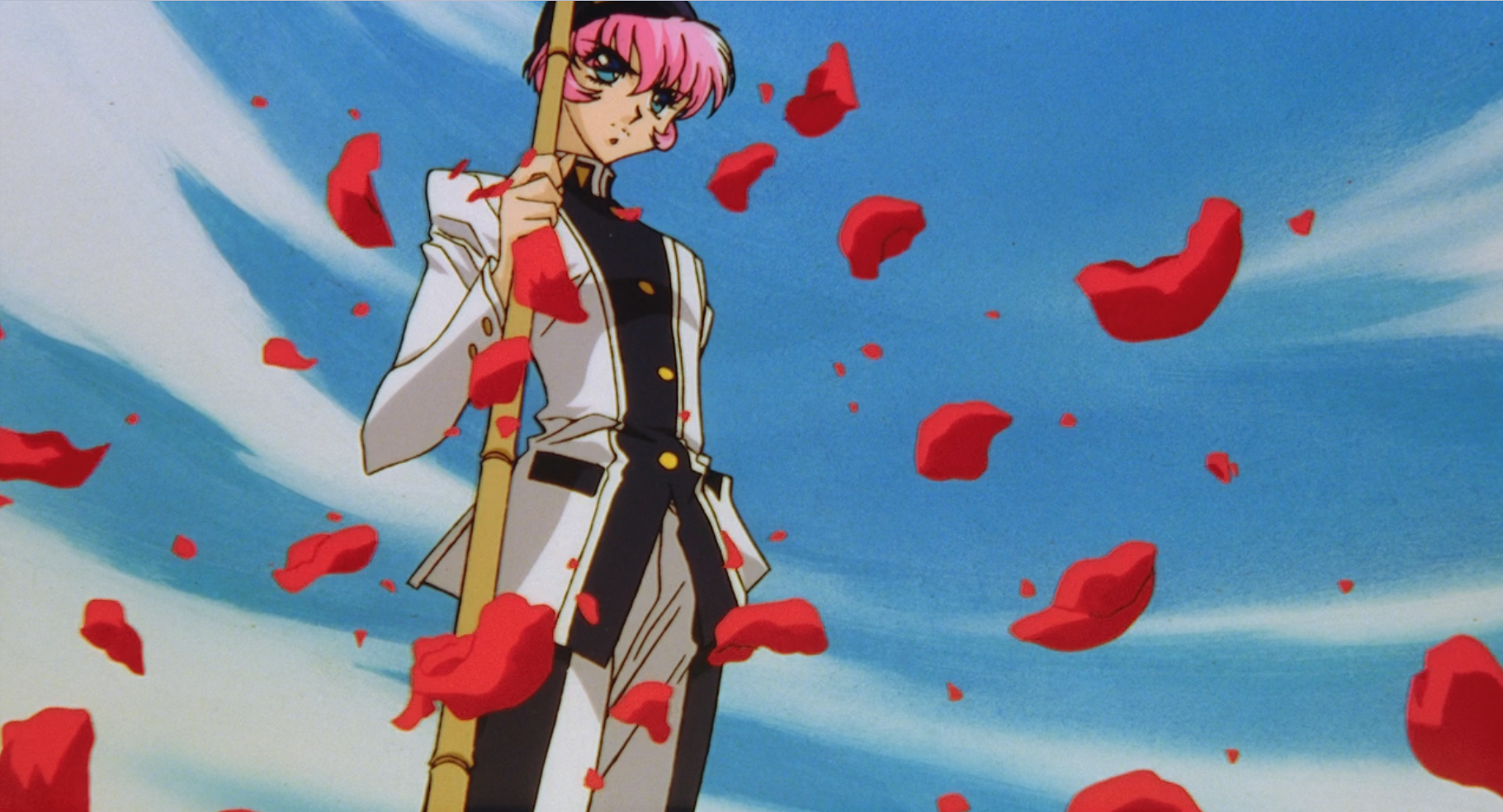
Who wants to be a prince? In the case of Utena Tenjō, that’s all she’s dreamed about since she was rescued by a prince at age eight. Eventually, she joins Ohtori Academy where she gets into the Dueling Game (challenges to possess the Rose Bride—Anthy—to “revolutionize the world”). Throughout the series Utena duels to protect Anthy while making friends along the way.
This series is a blend of Shōjo and Shōnen elements (such as the action scenes and the protagonist rising to be the strongest character). The series focuses on Utena’s nobility and features her aiding other characters. It has good character development and isn’t too long, spanning thirty-nine episodes. If nothing else, Revolutionary Girl Utena is worth the watch since it features a strong female protagonist who beats all the guys. I’d recommend it not only for those looking into the Shōjo genre but for those who enjoy strong female progatonists.
Final Thoughts
Not only are Fruits Basket,My Love Story!!, and Revolutionary Girl Utena great for those who are just getting into the Shōjo genre, but they’re rewatchable. I’ve found myself turning on Fruits Basket in the background on my tube TV I had mounted on a metal folding chair while doing my freshman science homework. Maybe that was more than you needed to know about my high school life.
Know of any other good Shōjo starter anime? Let us know in the comments.
Is there snow in forecast or is it Anime Season? I’m sure our resident anime/manga geek Season appreciates the joke at her name’s expense. She’s going to break down why the Death Note anime is better than the manga. Take it away, Anime Season.
Usually, it’s the other way around, right? The manga typically doesn’t include huge filler arcs and has a more consistent flow than the anime. Typically. In the case of Death Note, not only does the format in which it’s presented in the anime suit it better, the ending has a more accurate depiction of a certain character in the anime than the manga. Spoiler alert. Let’s get started.
The first issue with the Death Note manga is the type of storytelling Ohba is presenting. Death Note is a detective story with supernatural elements and is dialogue heavy. I mean very dialogue heavy. Page after page of the Death Note manga contains blocks of text as each of the characters expresses their thoughts. This doesn’t allow for good flow in the manga since it’s easy to zone out in the sea of text. I had to go back on several occasions just to appreciate the artwork (which Obata did an amazing job of). In Death Note 13: How to Read, Ohba states that he cut down on a lot of the text. Dude, what did you originally have? Never mind. I don’t want to know.
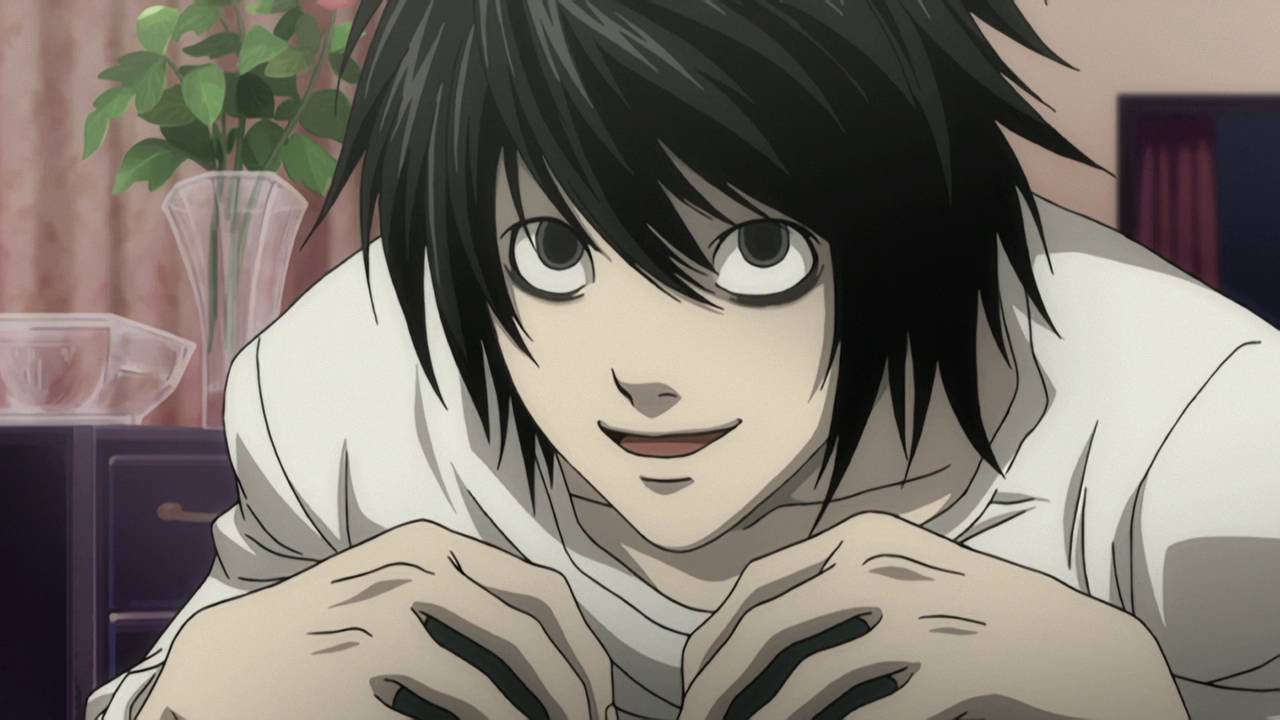
As far as the anime goes with the dialogue, that much of it is fine. As a viewer, one doesn’t have to read the text (unless you’re watching it subbed) and can just listen and watch the characters’ reactions. Since it’s animated in this format, even if the characters talk a lot, they’re also moving and doing other things. For instance, L is always stacking or making something out of, say, coffee creamer pods, while he talks. This keeps the viewer engaged while progressing the story. The manga does show this, but since it’s depicted in a panel and the reader is focused on what L is saying, it gets lost. There is a segment in the manga (I believe it’s in volume 11—don’t quote me on that) that has several panels of pictures, showing what each of the characters is doing. More of that should have been included.
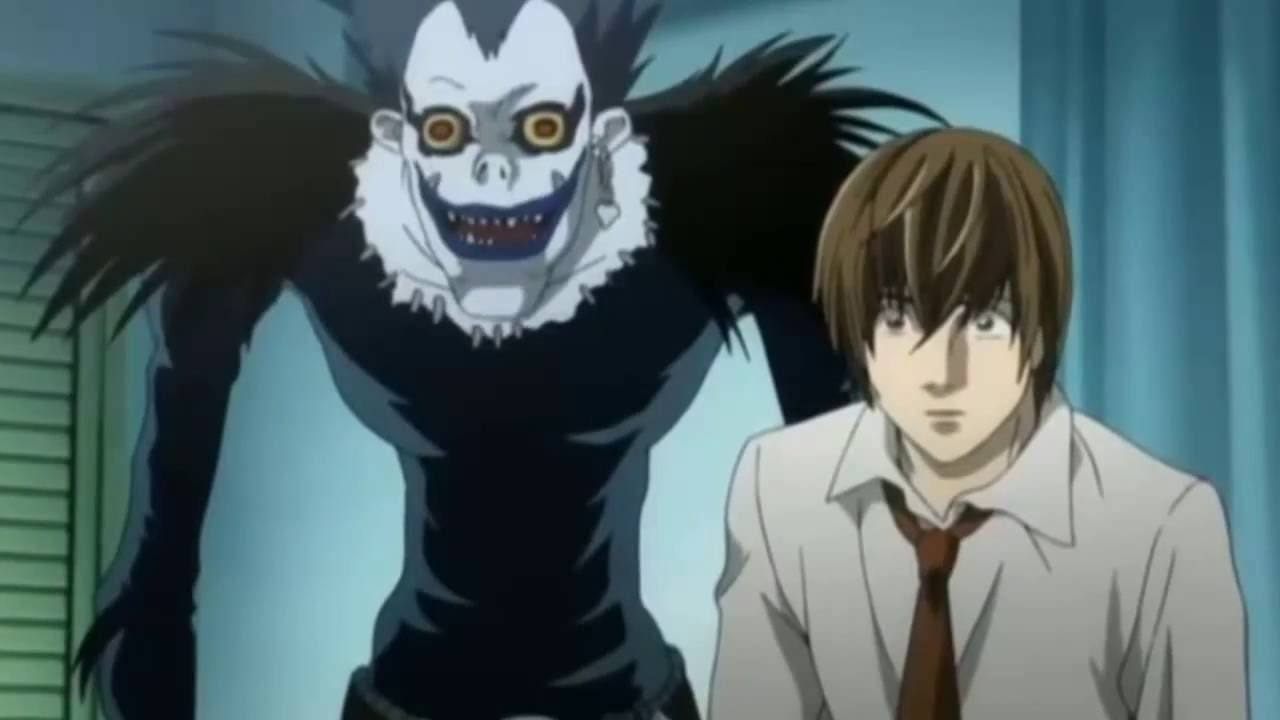
My second point contains major spoilers. Read at your own discretion. The ending in the anime made way more sense than the ending in the manga. For those who have seen Death Note in both formats and disagree with me, hear me out. In the anime, Light runs away, wounded, and collapses on a staircase in a warehouse, with Ryuk writing Light’s name down in his Death Note, killing him. In the manga, Light has a panic attack after getting shot several times and begs Ryuk to save him. Ryuk still writes Light’s name down in his Death Note and kills him. Ryuk killing Light was foreshadowed in both the manga and anime versions, so that was fine. Light freaking out in the manga and begging Ryuk for his life was not. That isn’t Light’s character. In Death Note 13: How to Read, Obata states that he wanted to express all of Light’s pent up emotions in one huge psychological breakdown. Basically, he wanted to draw Light in anguish just because he could. Again. That isn’t Light’s character.
A cult dedicated to Light (Kira) was also shown at the tail end of the manga. Why? I can understand that people still worship his ideals, but this makes it look like there’s going to be a part two to the story. I don’t think there will be twelve years after the final volume was published, but this is unnecessary. This is something the reader can infer based on the general public’s reception to Light throughout the series.
I’d recommend the Death Note anime over the manga, but that doesn’t mean the manga is horrible. I don’t think the Death Note concept suits the manga as well as it does the anime. For those who have seen the anime and are looking for something to read the manga will definitely keep you occupied for a while.
Did we miss anything? Do you agree with our arguments? Do you prefer the Death Note anime or the manga? Let us know in the comments.
Hi, everyone. It’s been a while since this anime geek has gone on a tangent about anime and she’s raring to dive in with a three lists of three. This week’s three lists of three will look at various anime. All three lists of three will have similar themes, but look at different aspects of that theme.
Spoiler alert: some endings may be revealed. Ready to geek out over anime?
Overlooked anime
Paranoia Agent (2005)
Paranoia Agent may be a bit of a mixed bag since most of the reviews online are fan-made. That being said, Satoshi Kon is better known for his movie, Paprika. Paranoia Agent may seem nonsensical and weird for the sake of being weird at first, but as the series progresses, the audience learns that everything happens for a reason. Each occurrence in Paranoia Agent bears significance to future events, and eventually, the end of the series. The continuity in this series is detailed. If this one doesn’t sound appealing, the “happy” opening theme is certainly memorable.
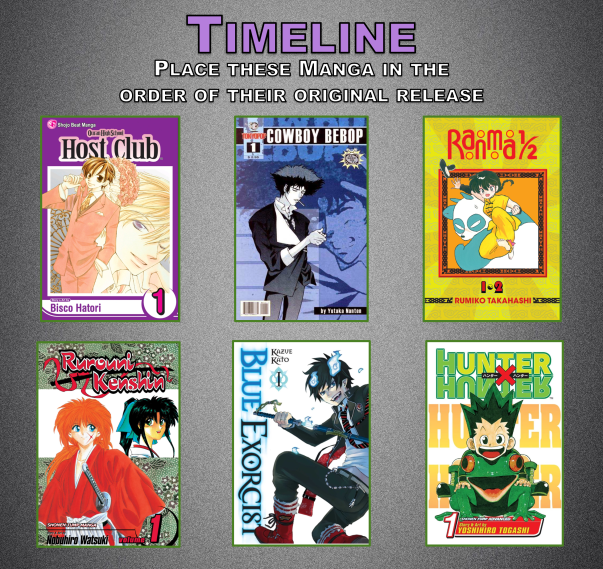
Ranma ½ (1989)
Rumiko Takahashi is best known for her series Inuyasha. While Inuyasha isn’t a bad series, it contains a lot of tropes, and, wrap me in a straitjacket, but I don’t remember much of the story. Ranma ½ uses some of these tropes while taking a comedic spin on them (such as Akane being a tsundere (kind-hearted but beats up the object of her affection) and Ryoga constantly getting lost). Since Ranma switches between male and female, the series puts traditional gender roles to the forefront. The characters find themselves in hilarious situations and I think the series deserves more credit.
Mushi-Shi (2005)
Mushi-Shi is one of the stranger series out there. The main character, Ginko, travels from town to town, dispelling supernatural/fantastical occurrences that are causing problems. Mushi-Shi is easy to get lost in with its unique stories and visuals, and calming sound effects. This series is a good escape from reality and doesn’t receive a lot of attention.
Overrated anime
Sword Art Online (2012)
This one seems like it should be obvious, right? Depending on who you ask, Sword Art Online is either their favorite anime or their least favorite. I’ve heard someone say they like the light novels (books that have manga images but read like chapter books) as opposed to the anime, which I’m willing to give a go, since I’ve heard the original source material has better writing. Regardless, Sword Art Online has an inconsistent storyline that had an unnecessary number of episodes in the beginning. They should have condensed most of Season 1 into a couple of episodes as opposed to nine or ten. There are some things Sword Art Online does well, such as having the characters grow attached to an AI, which questions values. On the other hand, it doesn’t show the psychological effects of being trapped in an artificial world, not knowing who your true allies are. An anime that does a better job of this is Btooom!, which one of the characters has a mental breakdown.
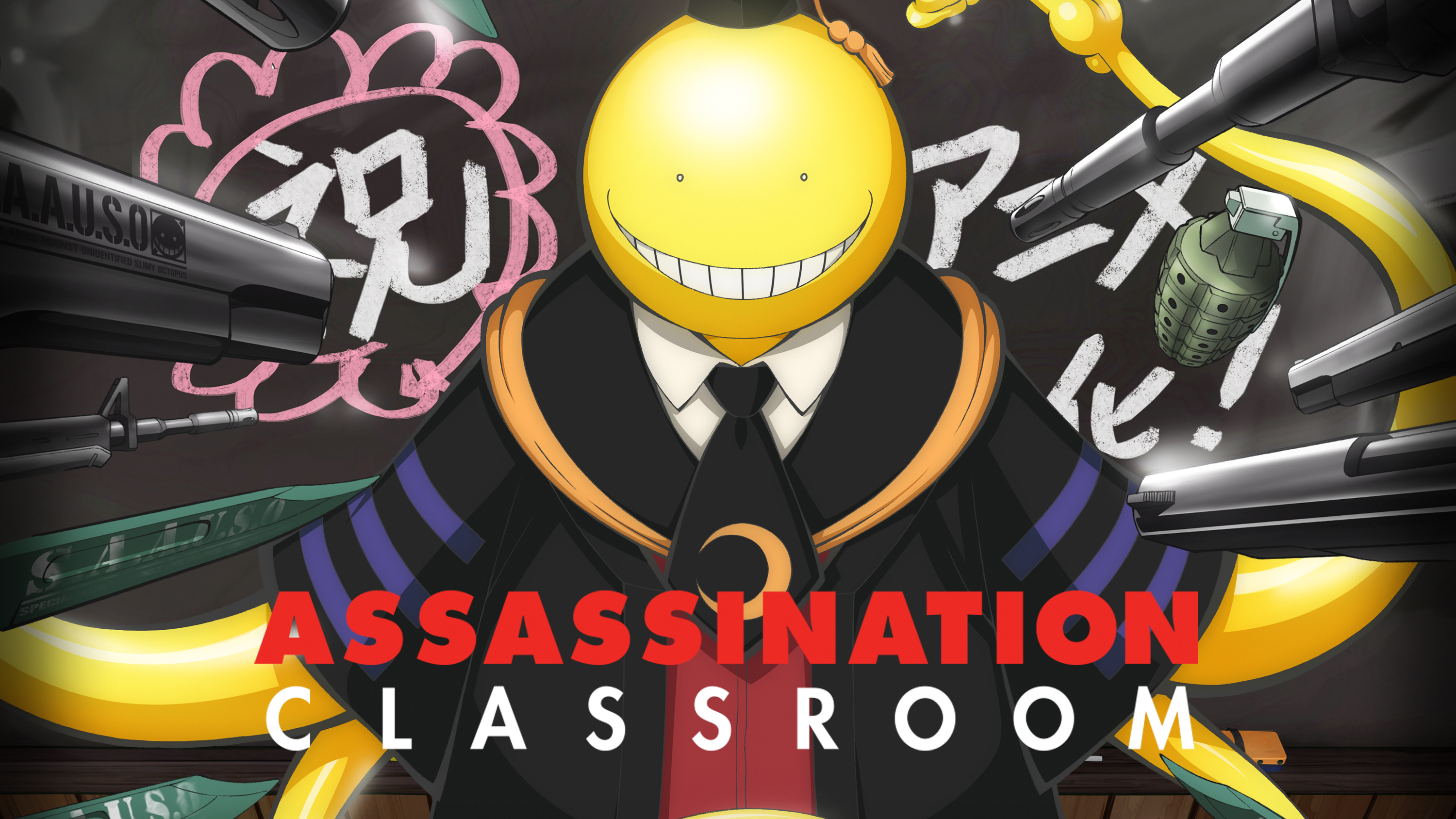
I’m going to be honest. I love Assassination Classroom. I even have a Nagisa hat and tee shirt of the gang. The reason Assassination Classroom made this list is primarily because of Koro-Sensei. He says he wants to educate the kids and asks them to kill him while simultaneously saying they’ll never be able to kill them and dampening their self-esteem, which is contradictory. Why would he build their confidence and smother it at the same time? On top of that he’s threatening to blow up the world. It isn’t clear throughout most of the series whether he cares about these kids and wants them to aspire to something, or if he’s busying himself with being a teacher so he won’t get bored. Granted, they explain his motivation toward the end of the series, but it isn’t timed well. This is right before—spoilers—Koro-Sensei dies. Despite this, they do an excellent job of giving each of the characters an adequate amount of screen time, which is difficult to do with twenty plus characters.
Ouran High School Host Club (2006)
Chances are if you’re into Shojo anime, there’s a good chance that this series has either been trafficked to you from streaming services or is one of the top results from an online search. It certainly was one of my favorite Shojo anime for several years. I watched the series five or six times, listened to the soundtrack, and looked up fanart. Yeah, I went a little crazy. The point of it was to break down Shojo tropes and make fun of them. This didn’t get across well in the anime and it ended up fortifying those tropes. The manga did a better job of deconstructing the Shojo genre, but not by much. It had a lot of editor’s notes to explain what was going on. Anyway, back to the anime, which did have some good episodes, one example being episode fifteen: “The Refreshing Battle of Karuizawa!” This episode gives the audience some much needed character development, but the series is already more than halfway over by this point. Most of the other episodes stuck to character stereotypes and overused themes. We don’t need another Alice in Wonderland parody.
Anime that were popular when they came out but haven’t withstood the test of time
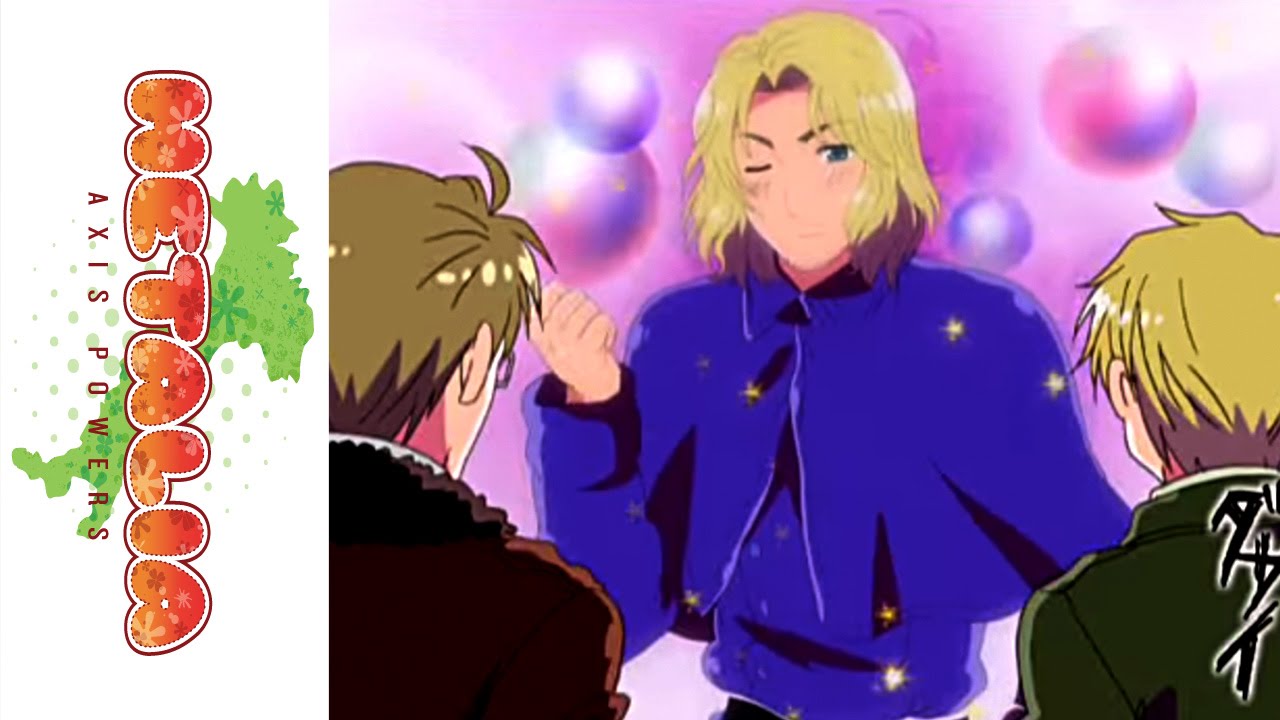
Hetalia: Axis Powers (2009)
Remember that time when Hetalia: Axis Powers had a slew of fanart and doujins being published on a daily basis? What happened between the early to mid-2010s that sent this series downhill? So, what happened? Maybe the gimmick got old. Maybe people started to realize what they thought was cute was actually offensive to a lot of people. Whatever the reason, Hetalia: Axis Powers isn’t nearly as popular as it once was.
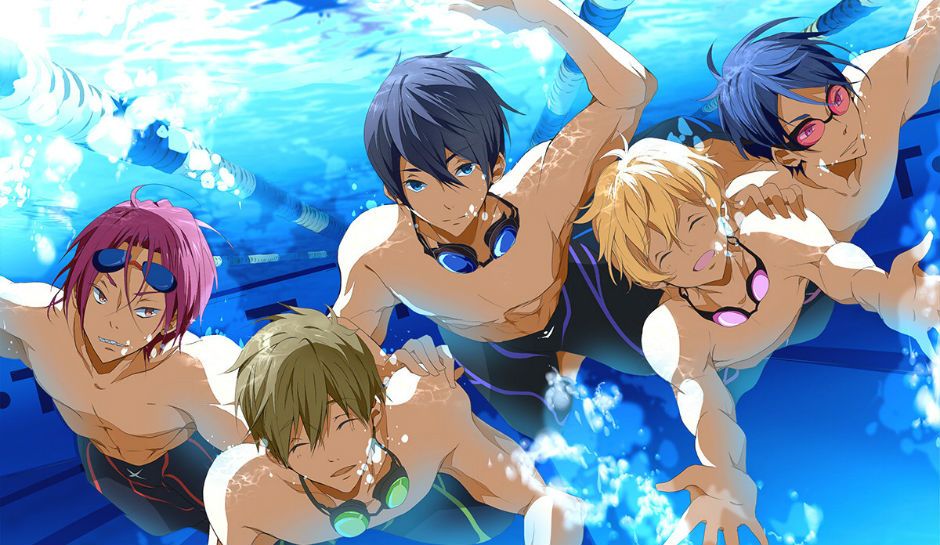
Free! (2013)
When Free! came out it was hyped by gals and made fun of by guys due to the main characters being sexy high school boys in Speedos. I’m not joking. Its popularity lasted for a few years, even spawning another season, titled Free! Eternal Summer. The series itself was okay and didn’t have as much fanservice as I’d anticipated. They took the time to develop the characters to some degree. However, Free! dropped off the map a couple of years ago.
Bleach (2004)
I know. Bleach is still a popular series, but it isn’t nearly as popular as it used to be. Neither is Naruto for that matter. In fact, Naruto was originally going to make this list due to its poorly placed filler, but after looking at several polls, Naruto was the clear winner in the vast majority of them. Bleach had a lot of filler too, but the timing of the filler was better than Naruto, so it was easier to watch. The writing got progressively worse after the Arrancar arc and ended up being an endless cycle of Ichigo losing and regaining his powers. If they decided to end the series after the Arrancar arc, I think Bleach would have left a better legacy.
There are a lot of anime out there that could make these lists. Do you agree with the ones chosen? Which anime do you think should be included in these lists? Let us know in the comments.
























 jkgeekly.com