
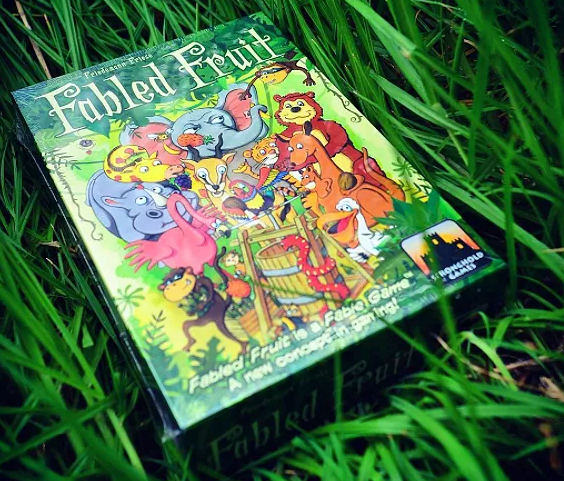
Hey, hey, Geekly Gang! Kyra Kyle here with another board game review. Today, we’re discussing Fabled Fruit.
Fabled Fruit is a “fable” game. Gameplay starts simple and evolves after each game. Most of the new rules introduced in Fabled Fruit come on the 240 Location Cards. Players place their animal meeple (animeeple, if you will) on an action they want to take, and take that action, or if they have enough fruit, they can juice (by turning in enough fruit cards to the bank) at that Location, flipping over the Location Card and turning it into a Juice Card. Juice enough Location Cards, and you could win.
Since Fabled Fruit evolves after each play, it’s great to have a dedicated game group. Fortunately, for me, I have such a game group, and we’ve been playing through Fabled Fruit’s mountain of Location Cards. We’ll get to game setup and game flow in a bit, but first, let’s take a look at Fabled Fruit’s fine print.
The Fiddly Bits
Designer: Friedemann Friese
Publisher: Stronghold Games
Date Released: 2016
Number of Players: 2-5
Age Range: 8 and up
Setup Time: Less than 5 minutes
Play Time: 20-30 minutes
Game Mechanisms
Set Collection
Worker Placement
Game Setup
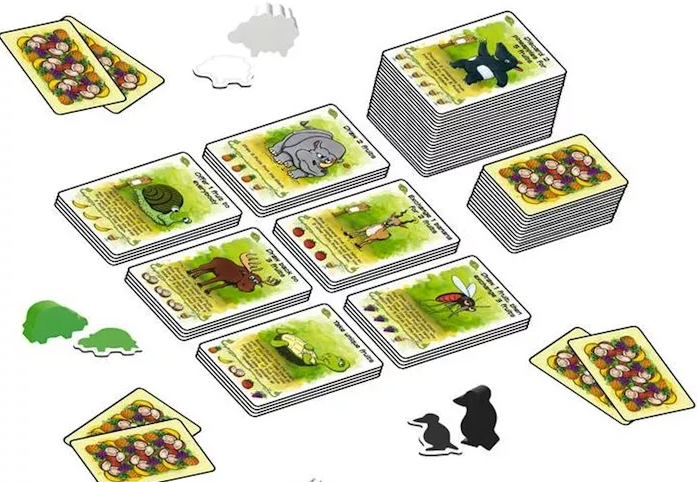
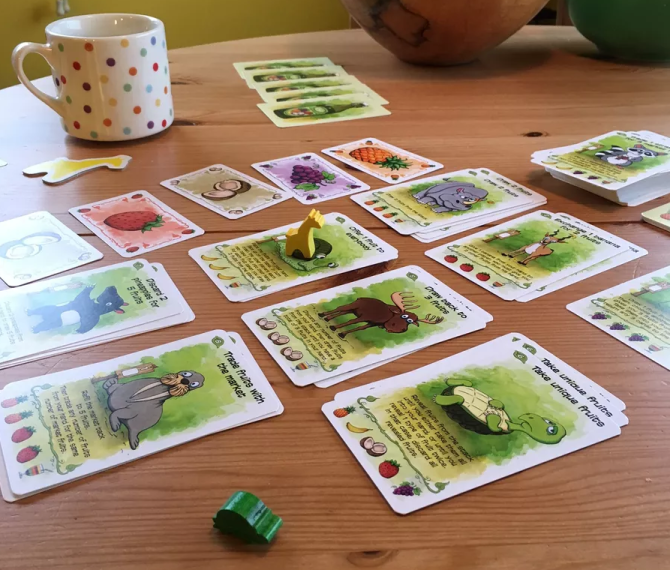
Game setup changes slightly after each game of Fabled Fruit. We’ll begin with a version of the first game setup rules, printed in the rulebook. Just know that the top 24 cards of the Location deck will be used in each game. Whenever a player “Juices” a Location Card, it acts as end-game scoring, and the card gets removed for the next game, forcing players to dig deeper into Fabled Fruit’s Location Deck.
1) Do Not Shuffle These Locations! All Locations are presorted, so you only need to place the huge Locations stack in the center of the table, with Location #1 visible on top and #59 on the bottom.
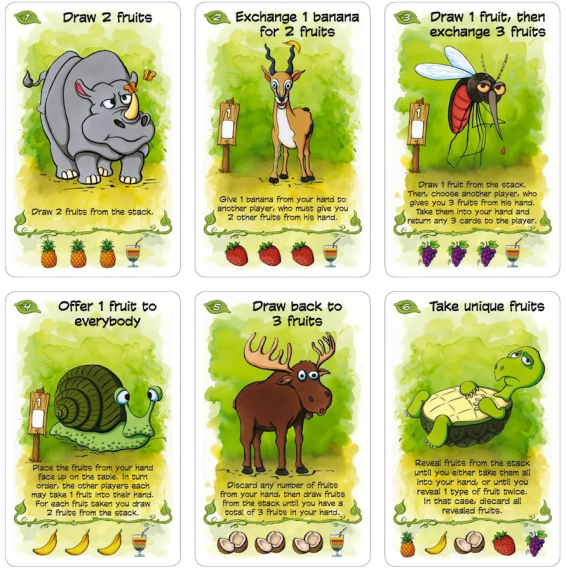
2) Draw all cards of Locations #1-#6 (which will be 24 cards) and place them in separate stacks next to the Location Deck. Each of these small stacks contains four cards all with the same Location number.
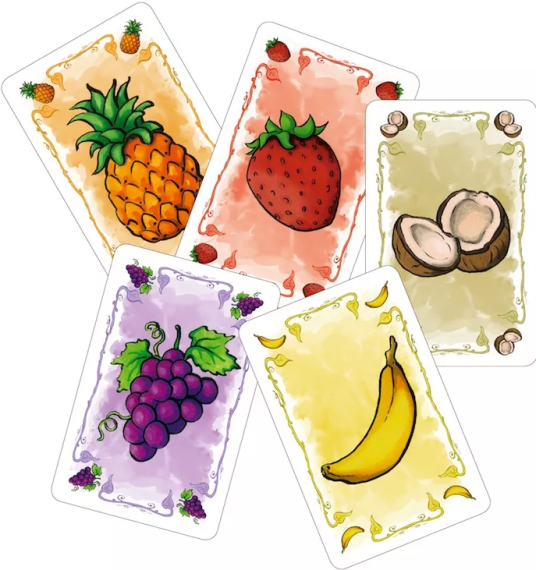
3) Shuffle all 60 fruit cards. We will now call them “fruits.” Deal two cards to each player, which they take into their hands. Place the remaining fruits in a face-down deck next to the huge Locations Deck. You will need some space for a discard pile.
4) All players choose an animal piece along with its matching cardboard token. The game comes with six different animals, so you could have the opportunity to find your favorite animal.
5) Place all remaining game components for the moment to the side: the thief, the five fruit tokens, the double turn tokens, the three wild tokens, and the ten fruit-mix cards. They are not used during the first game. You will play with them in later games, as new Locations will appear.
6) Choose a start player.
Game Flow
On your turn, you will move your animal piece to a new Location, and take one of two actions: Use the Location’s action, or Juice at the Location.
Moving to a new Location.
On your turn, you must move your animal to a new Location. No staying at the same Location. Place your animal on any available Location.
If one or more of the other players are already at your new Location, you must give one fruit of your choice from your hand face down to each of them, which they take into their hands. If you don’t have enough fruits in your hand for all players, you must give away all your remaining fruits but choose the players who will each receive a fruit. If you don’t have any fruits in your hand, you can move to any new Location occupied by other players without giving them fruits.
Use the Location’s Action
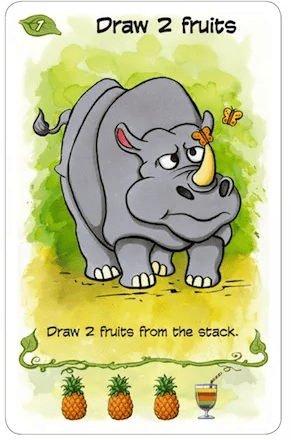
After moving, you use the action as explained on the Location card. All of these actions help you collect a lot of fruits. There is no hand limit, so you can collect any number of fruits.

Juice at the Location
If you have the required fruits needed to “juice” at the Location (fruits pictured at the bottom of the Location card), you can discard the required fruits, flip the Location over to its Juice side, and add it to your score pile. After a Location is “Juiced”
After every time a player juices a Location card, draw a new Location card from the top of the Location deck. If this Location doesn’t match a Location already in play, create a new stack for this Location number.
Game End
As soon as the first player has the required number of Fabled Juices (the number varies depending on player count), you finish the current round, so all players have the same number of turns. The player to the right of the start player receives the last turn.
The player with the most Fabled Juices wins the game. In case of a tie, the tied player with more remaining fruits in their hand wins the game. If there is still a tie, these tied players share the victory.
Review
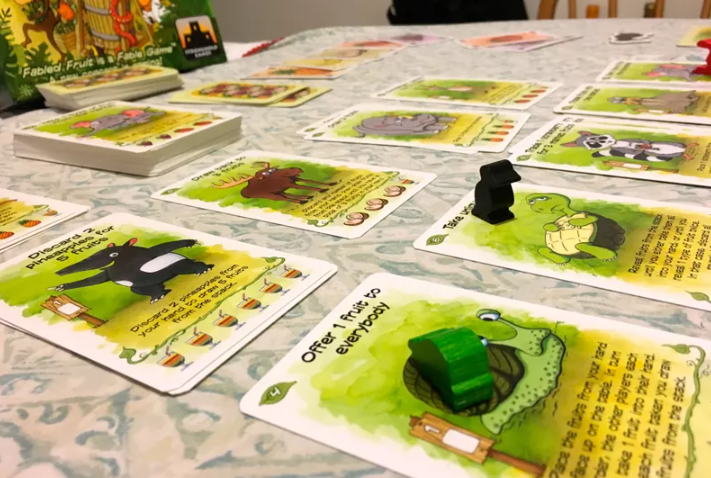
Fabled Fruit is one of those games where you want to play one more round. Digging through the Location deck can be a joy. Friedmann Friese does a great job of presenting easy-to-understand rules for the starting Locations and then introducing more complicated Locations deeper in the deck. What does the thief token do? You’ll have to find out. Which Location introduces the fruit-mix cards? It’s closer to #59 than #1. Fabled Fruit’s evolving ruleset reminds me of Fluxx, but it has a more measured cadence. The rules change only after a player “juices” enough of one Location.
And some Locations will live in the ruleset for countless games. My game group avoided juicing the Rhino Location (Location #1) that lets players draw two fruits from the deck. I asked why most players avoided juicing at that Location. Their answer was simple. How else will I gain a lot of fruits quickly? Yeah, there is a little bit of a logjam problem with Fabled Fruit. I believe the Walrus Location establishes “The Market,” a set of five cards from the fruits deck that are drawn face up, and players can then interact with the market using other Locations. But you need a Location or two before that becomes a viable strategy.
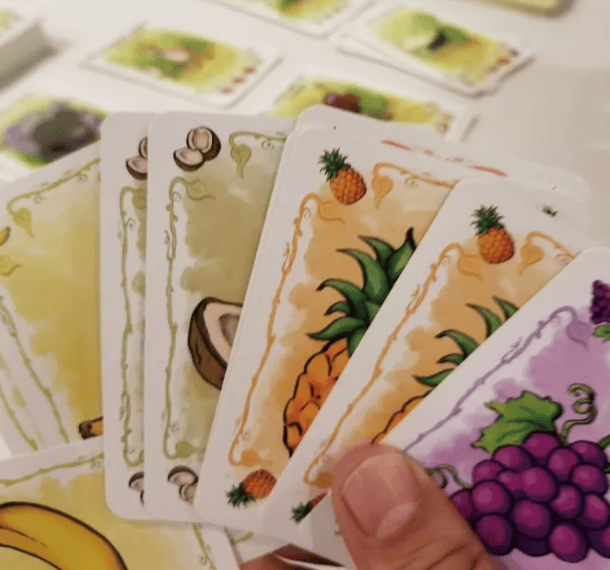
But oh, do I love these evolving rules. I glossed over the “measured cadence” of Fabled Fruit’s ruleset. This is a slow, satisfying burn. Sure, the first new Location occurs after the very first Location a player juices, but every Location after that will need four juiced Locations before they make an appearance. The new combinations that develop during a single game, after several games, keep Fabled Fruit a fresh gaming experience. I love the agonizing choice of having enough fruits to juice at a Location, but the Location is one of my favorites. I also love the idea of purposefully juicing a Location another player has been exploiting. Hate juicing for the win.
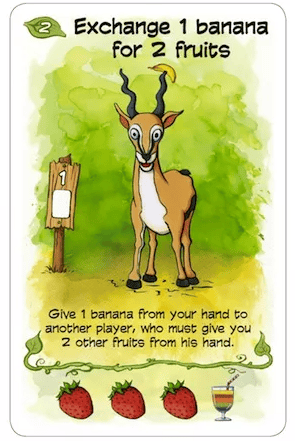
Some of the rules can be confusing. I screwed up on a Location’s rules on more than one occasion. It took me three or four games to figure out the give a Banana to an opponent (not the bank) and then receive two fruits in return. Basically, in the game, I finally figured out that rule, the fourth Location of that type got juiced, and it left play forever. Great.
Fabled Fruit suffers from some edge case issues. These are problems that crop up with an unexpected combination of Locations reveal themselves. Heck, the Locations that interact with the Market get weakened after the Walrus Location disappears. Seriously, the Walrus Location sets up the Market. If it leaves play completely, there isn’t a Market for the remaining cards. Fortunately, numerous cards have a card sign printed on them. These Locations allow players to forgo the Location’s ability and draw a card from the fruits deck. A lot of the Market Locations have this secondary ability.
I love Fabled Fruit. It’s easy to get into and learn. It scratches a similar itch as a legacy game, without the card or board destruction. You can always reset the game to its original state and begin again. Exploring the Location deck is exciting. Discovering new Location combos is fantastic. But Fabled Fruit won’t be for everyone. You’ll need a dedicated game group to get the full experience or to even to get through half of the Location deck. I didn’t always have that group, and I’ve had Fabled Fruit in my collection for years. I’m only now reviewing the game, because I was finally able to log in enough plays.
If you have the game group, dig into Fabled Fruit’s Locations and thank me later.
Too Long; Didn’t Read
Fabled Fruit is easy to get into and learn. It scratches a similar itch as a legacy game, without the card or board destruction. Its evolving ruleset reminds me of Fluxx, but Fabled Fruit has a more measured cadence that allows for interesting action combos to emerge. But you will need a dedicated game group to see more of what Fabled Fruit has to offer.

