

Earth is doomed. The leaders of the world’s most powerful nations have created a scenario where humans need to escape in a rocket ship before the planet implodes. You play the role of one of the world’s leaders. That’s the premise of today’s tabletop game review, We’re Doomed!.
Hey, hey! Kyra Kyle here. Geekly hasn’t had a new board game review in quite some time. Today’s game is a silly party game with a quirky theme. Played in a real-time 15 minutes (the game includes a 15-minute hourglass), We’re Doomed! tasks players with generating enough resources to build a rocket ship big enough for all the players at the table or if you have the most influence and there’s only seating for one player, you become the only one to board the rocket ship. The choice is yours. Work together or backstab the other players.
Before we go any further, let’s prepare this rocket for takeoff and discuss We’re Doomed!’s details.
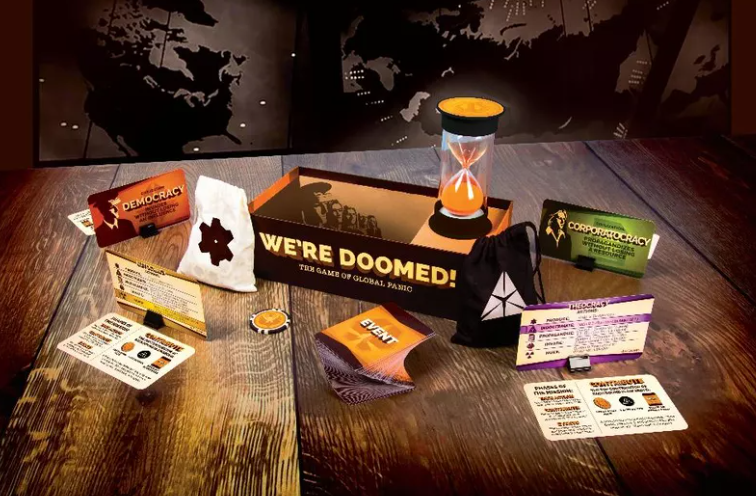
The Fiddly Bits
Designer: Mike Horton
Publisher: Breaking Games; Magellan
Date Released: 2019
Number of Players: 4-10
Age Range: 12 and up
Setup Time: Less than a minute
Play Time: 15 minutes (timed)
Game Mechanisms
Party Game
Card Game
Negotiation
Player Elimination
Variable Player Powers
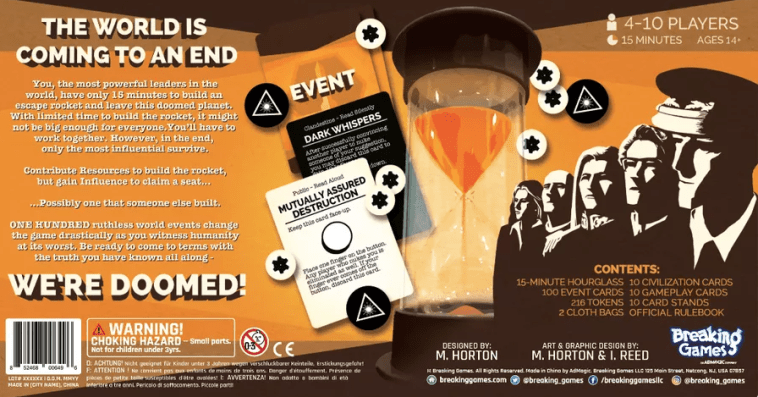
Game Setup
We’re Doomed! has a minimal setup. Each player receives one Leader card that they display for others to see. Form piles of influence and resource tokens so every player can access them. The hourglass is set up so that all the sand is on the bottom (before it gets flipped), and the first player token rests on top of the hourglass.
Randomly select one player to go first, or someone could flip over the hourglass and claim the first-player token for themselves. You have 15 minutes before time runs out. Go!
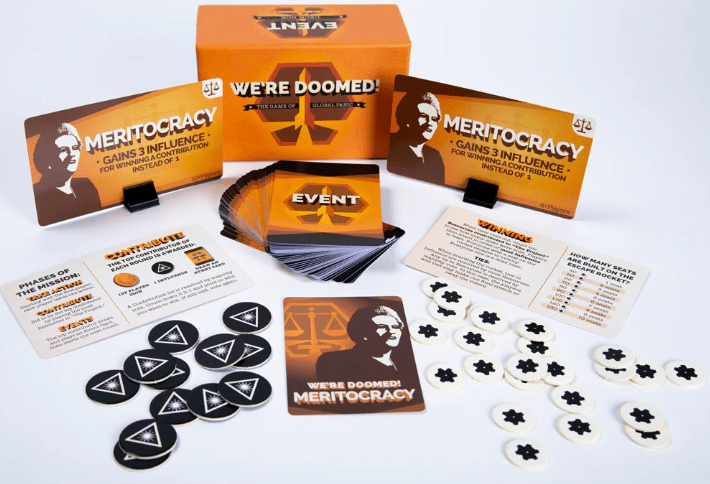
Game Flow
We’re Doomed! is played in rounds until time runs out. Each round is split into two phases: Actions and Contribution. The action phase is played in turn order, starting with the first player. Unless the rules (which can evolve) say otherwise, each player has access to the same five actions: Produce, Indoctrinate, Propagandize, Invade, and Nuke. The first four actions revolve around gaining resources, which can be used to build seats on the rocket ship or gain influence, denoting who’s first to board the ship. The first two (Produce and Indoctrinate) allow players to take resources or influence from the supply. The second set of two (Propagandize and Invade) lets players steal those tokens from other players. The Nuke action allows players to spend resources to eliminate a player.
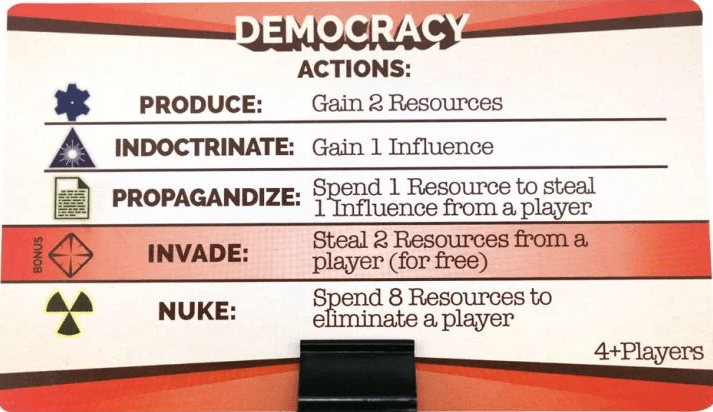
Each nation’s leader has a bonus for one of these five actions. For example, whenever the Democracy “Invades” they steal 2 Resources from another player for free instead of having to spend an influence token. The Theocracy gets a bonus Influence whenever they “Indoctrinate,” and the Technocracy gains an additional resource whenever they “Produce.”

After each player chooses one of the five actions, play moves to the Contribution Phase. In this phase, players simultaneously choose how many of their resources they donate to the Project, building a bigger rocket ship. The player who donates the most for the round gains the first player token (and will begin the Action phase next round), earns an influence token from the supply, and draws an event card.
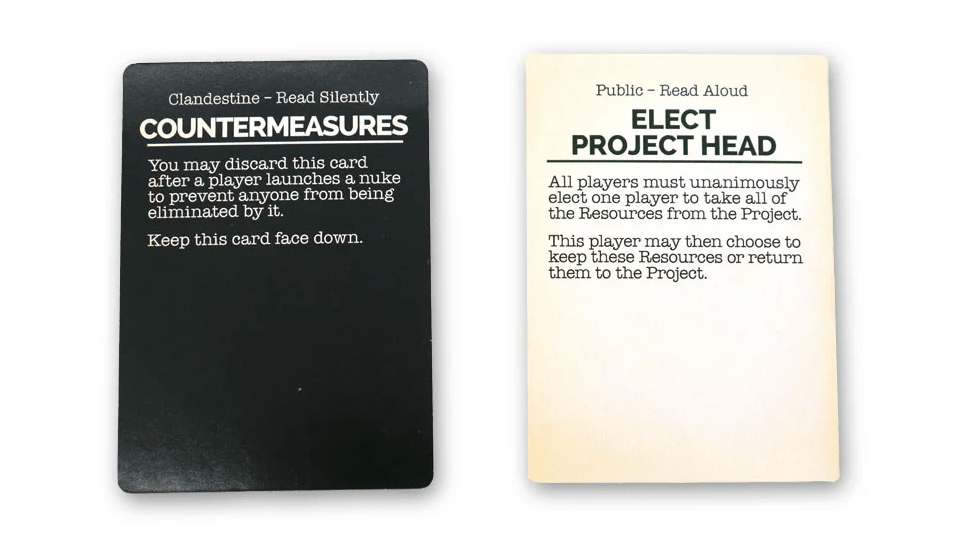
There are two types of event cards: ones read aloud and ones read privately. Follow the rules on the card (reading aloud if you are told to read aloud) and after the event is resolved, the new round begins. Keep going until time runs out.

Review
If you’re anything like me, seeing the “player elimination” game mechanism waved a red flag, but remember, We’re Doomed! is a real-time game that lasts exactly 15 minutes. I don’t mind player elimination as a game mechanism if the game is short. And the idea that you can nuke another player is fun and thematic. We’re Doomed! is a fun and thematic game.
Given the proper gaming group, that’d be gamers who don’t mind backstabbing, negotiating, and loose alliances, We’re Doomed! can be a hit. Quick and tense turns are a feature. We didn’t mention this in the game flow, but there is an additional rule where players can claim another player is taking too long (or stalling). If this happens, everyone takes a vote, counting to three, and votes thumbs up or down to eliminate the player. This makes sense because time is of the essence in We’re Doomed. A similar voting system is used whenever there’s a tie during an event card.
Speaking of the event cards, they can swing the game wildly, making We’re Doomed! a fragile game. Fragile in the sense that the wrong combination of event cards can break the game in an unintended manner. During one playthrough, the first event negated influence. The player who became “The Executor” dictated the sequence of who boarded the rocket ship. Then, the very next event “Too Big To Fail” gave one player (I was voted to be that player) six resources at the beginning of the round if they had no resources. Since I was the Technocracy, that meant that I produced nine resources each round. I could’ve eliminated players (spend 8 resources) and nuke them all or donate all the resources, rescuing everyone. I chose to do the latter. Even though we played a five-player game, we had enough resources for ten.
Typically, I don’t care for games that can be this fragile, but We’re Doomed! isn’t meant to be taken seriously. It’s great for some dumb—and I mean dumb—fun. As I said before, with the proper gaming group, We’re Doomed! can be a hit. But with the wrong gaming group, it can be doomed to fail. We’re Doomed! isn’t a game for everyone. Heck. I must be in the right headspace for the game to land, but when it does land, it’s good for a laugh. One of my favorite chuckles came from someone drawing the “Trickle Down Economics” event card that reads, take six resources from The Project. You may choose to keep the resources or distribute them with any number of players. The person who drew the card asked, why wouldn’t I just pocket the resources? This card’s effect doesn’t seem right. Another player responded that’s why the card name is “Trickle Down Economics.” That sounds like Reagan. We’re Doomed!’s strength is that it doesn’t take itself too seriously.
Verdict
While not for everyone, We’re Doomed! can be a bunch of fun with the right gaming group. The game takes no more than 15 minutes (timed with an hourglass). Your gaming group must like backstabbing, negotiating, and loose alliances…and like games that don’t take themselves too seriously.















































 jkgeekly.com