

Hey, hey! Kyra Kyle here. Like I said a few weeks ago, I’ve sprinkled in new posts with the old stuff, but we’re running out of the older posts. This one’s about Breaking Bad and my favorite storytelling elements from that show may be our final older post. Yay!
There are so many places to go in terms of storytelling elements that work in Breaking Bad. The characters grow and change over time. The strong narrative stayed on point, tension increased during each show, it explored concepts of storytelling, and didn’t over stay its welcome like other popular shows during its run. Despite the show’s groundbreaking nature, one of my favorite storytelling elements of Breaking Bad is the show’s adherence to a famous storytelling precept: Chekhov’s Gun.

Essentially, Chekhov’s Gun states that every element in a story must be necessary, irrelevant elements should be removed, and no element should appear to make false promises. Everything must have a purpose. Chekhov used a gun for his analogy. If a gun is mounted on the wall during a play’s first act, it must go off in the second act. Otherwise, why have the gun?
I’m all for subverting traditional storytelling precepts, but there is a reason they exist, and storytellers should know the time and manner to subvert these practices. Readers and viewers will assign meaning to something a storyteller shows them. The more elements a storyteller shows that don’t matter, the more likely they’ll lose their audience because their audience will start assigning meaning to things that don’t matter. The best example of a Chekhov’s Gun fail is Star Wars: The Last Jedi.

The bit of dialogue in the previous Star Wars film (The Force Awakens) concerning the origin of Rey’s lightsaber dubbed it Luke Skywalker’s and his father’s before his. This suggest that Rey is part of the Skywalker bloodline. If she was Luke’s former pupil (a popular fan theory prior to The Last Jedi), the line could include Luke, but not his father. If Rey had no connection at all to the Skywalkers, then don’t mention the Skywalker name.
Okay. Let’s get back to Breaking Bad and how it uses and subverts Chekhov’s Gun.

Breaking Bad is brilliant at assigning meaning to elements it shows. Viewers may find an odd camera angle that brings an electrical outlet into the forefront. Don’t worry there’s a reason to show said electrical outlet. A bit a dialogue that feels like it should be throw away banter will make an impact later in the episode or series. Why are they beginning an episode with a crawl space? There’s a reason. Even a Roomba has purpose.
But Breaking Bad subverts Chekhov’s Gun as well. Up to this point I’ve stayed as vague as I could. I’ll try not to spoil anything with this next example, but it’s difficult not to with this type of write-up. Consider yourself warned.

Let’s talk about the Ricin Incident of season 4. We’ll start with a rundown of what happened. Walter White plans to have Jesse give Gus a ricin-laced cigarette. Walt chooses the nerve agent ricin because it’s difficult to detect. Jesse chooses not to poison Gus because he doesn’t trust Walt at this point and has grown closer to Gus. Later, Brock (the son of Jesse’s girlfriend) falls ill from an unknown cause. Jesse finds that he had lost the ricin cigarette and blames Walt for giving the poison to Brock. Walt convinces Jesse that he couldn’t have poisoned Brock; it was Gus. Eventually, doctors find out that Brock ingested the berries of a Lily of the Valley. At the end of the episode, the camera zooms in on a Lily of the Valley in Walt’s backyard.
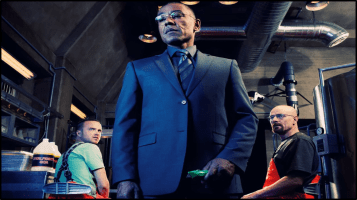
Phew! That’s a lot to get through. The upshot is that Walt poisoned Brock and turned Jesse against Gus. Breaking Bad uses Chekhov’s Gun the entire time, but it layers each element and nests them together like Matryoshka dolls. The lilies were mentioned in dialogue earlier while Walt and his wife Skyler discussed landscaping. It’s banter that most viewers dismissed, but there’s a reason for everything in Breaking Bad. Viewers could also dismiss the ricin cigarette as a red herring, and it was to a point, but it returns later in the series and serves in this episode (or two episodes) as character motivation. It also does a lot for character development. If there was any lingering hope for Walt’s soul, and it’s debatable, it was lost here.
Oh, man. That ricin vial got around in this series. That Roomba makes an appearance as does the electrical outlet. I won’t say how, even though I’ve spoiled quite a bit already. Oh, well. You should watch Breaking Bad.
If you’ve watched Breaking Bad, what are your favorite storytelling elements? You could pass it to me, hidden in a marzipan strawberry or you could let me know in comments. And wherever you are, I hope you’re having a great day.

 jkgeekly.com