Happy Friday, Geekly Gang! Kyra Kyle here with another writing brain dump. I haven’t done one of these in a few weeks, because I was trying out some writing exercises, seeing which ones stuck, and I may have found one. I’m still editing the novel based on the Rustbucket Riots. This novel is set years after the events of the Rustbucket Riots, the same ones mentioned in the board game of the same name, but I had written a series of short stories two years ago set during the game’s timeline. I haven’t touched these stories since then and decided to try something new. I noticed similarities in some of these short stories with Shakespearean plays. I’ve been rereading Shakespeare tragedies and comedies over the past month or two and figured I could combine steampunk robots and Shakespeare.
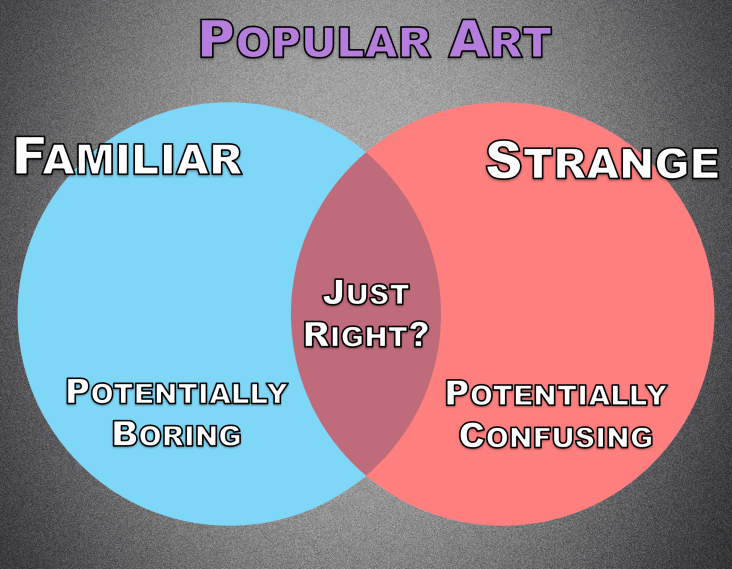
I’m having fun. I don’t know if anything will come of this project, but Robot Shakespeare is a hoot. And this exercise got me thinking of art as a whole. Or at least popular art (pop art). Forgive me for using a Venn diagram.
I found the above to be especially true in board game design. If you follow game design brain dumps, you may see this Venn diagram again. As the diagram illustrates, when elements within the art (in question) veer toward the familiar, they tend to be boring, and when elements venture too far toward the strange, one can find confusion. I’m trying to find the balance. The Rustbucket Riots game teeters toward being too strange. But I have another design, Wildflowers, that may play it too safe. But Spill the Beans (a third design) adds familiar elements while maintaining a fun twist. And that’s what I hope these Robot Shakespeare short stories will accomplish.
I can’t say what these short stories will yield, but I’m having fun. And who knows? I may find a story element or two to explore with the Rustbucket Riots novel.
What’re your thoughts on popular art and art in general? Let me know in the comments. Thank you for reading, and wherever you are, I hope you’re having a great day.
Hey, hey, Geekly Gang! Kyra Kyle here. Last week, we began a series called–for the time being–Writing Brain Dump, and this week is the time to roll out Game Design Brain Dump. The title is a work in progress. Let’s hope I can express my board game design process with this series. Fingers crossed for a cogent thought or two. Strap in for a Board Game Design Brain Dump.
Rustbucket Riots Origins
I’m going a different route from last week’s writing brain dump. Recently, I attended a panel about board game design at Nuke-Con (Omaha’s board game convention) and figured we could begin with what prompted me to begin designing Rustbucket Riots.
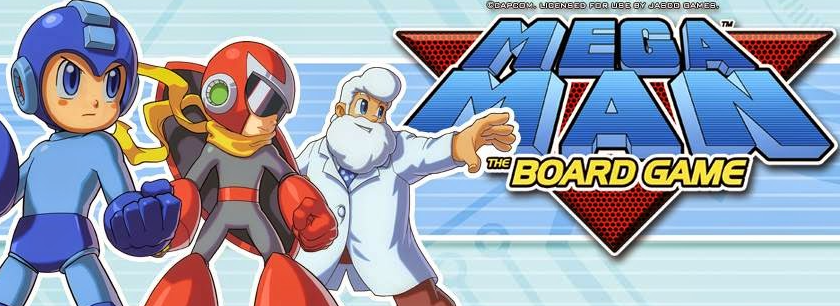
I knew Mega Man: The Board Game by Jasco Games wasn’t the best when I purchased it at a severe discount. Honestly, I wanted the bits. Jasco Games did an amazing job with Mega Man’s miniatures and the look of the game. But good luck finishing a game of Mega Man in under 10 hours. Each robot stage plays like five games of Munchkin played back-to-back, with every other player doing their best to prevent you from completing the stage. And you need to complete multiple boss stages. 10 hours may be too few hours to complete this game. You may need to dedicate a table to preserve your month-long game of Mega Man.
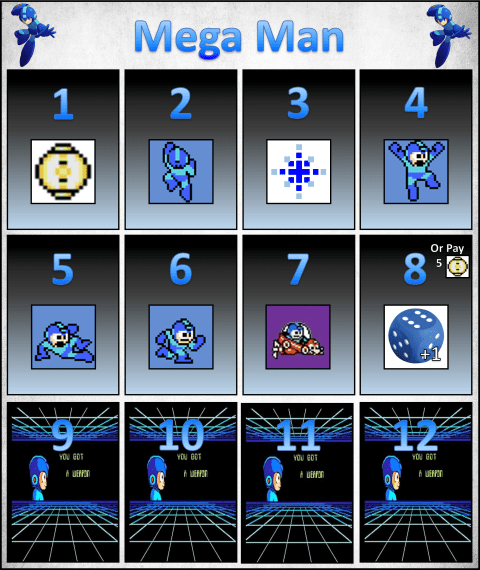
I hope I won’t get copyright claimed for any images. Eek! I began with a simple dice chucker of a game. Players would roll standard six-sided dice (I don’t recall the exact number, but it was likely around four or five) and then place the dice on their player boards. Each space on the player board would grant different abilities, with the final four slots variable for powers obtained by defeating robot bosses. Players could place multiple dice in a single space to combine the rolled result. A six may be played with a single die showing a six or with a two and a four or any other combination of six.
I chose dice chucking because rolling dice and placing them with predetermined spaces made for quick turns. Quick turns lead to a game that one can finish within ten hours. This game worked well. Heck, I even tried it as a real-time game, and it worked extremely well. Games lasted less than 15 minutes. I even saw this Mega Man variant as a game that could be played in tournaments of speed runs. Now that I think about it, I may revisit this variant in the future and give it a reskin. Sorry, the ADHD took the wheel for a second.
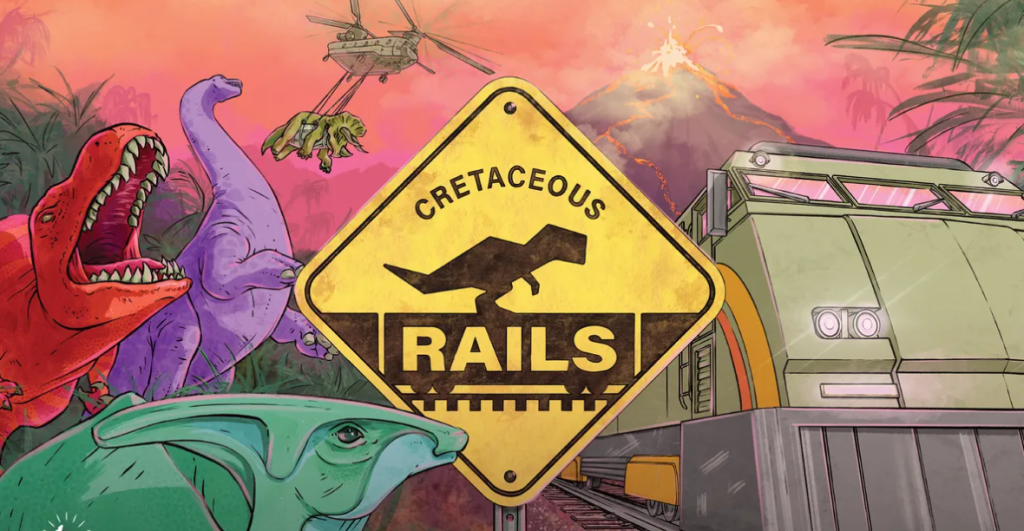
For some reason, I abandoned the above game concept and went in a different direction. I love Cretaceous Rails. Unlike Jasco’s Mega Man, there isn’t much I’d change with this title. Cretaceous Rails makes this list because I wanted to try using one of its core game mechanisms: dual action selection. I even asked Cretaceous Rails’ designer, Ann Journey, if it’d be okay if I borrowed this game mechanism before trying the next Mega Man remix iteration. The result was a game I nicknamed Rondelande.
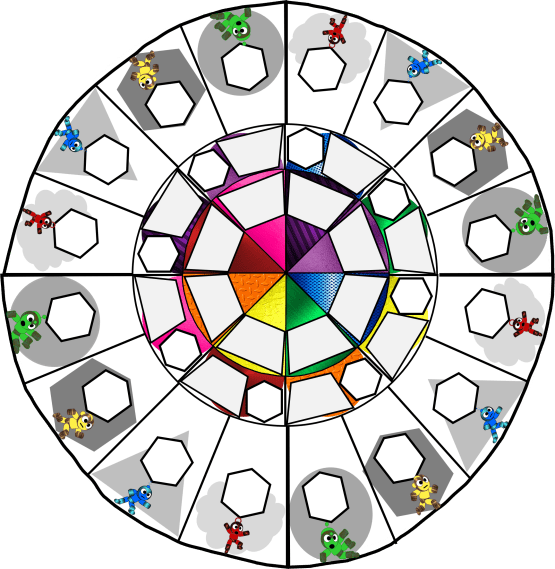
Oh my goodness. This game wasn’t just a different direction from my first Mega Man remix; it was different in every possible way. I didn’t keep any of Rondelande’s hardcopy versions. I only have the digital files, and it’s difficult to recreate what the game looked like without a physical copy. But I’ll try my best.
That’s a lot of color going on. Those are supposed to be three rondels (a circular game mechanism with pie wedges representing which actions one may take) stacked on top of one another. Each turn, players would place their gear tokens on one of the hexagon-shaped spaces and take the actions indicated. But before placing gears, players could play up to two cards (depicting one of the actions run, slide, jump, shoot, or climb) underneath the spaces on the outer edge. Players would then be able to take all the actions, including actions on cards, during their turn.
Note: The trapezoid spaces had different actions like draw cards or oil cans (that functioned as wild actions) or even rotating one of the top two rondels, so the action selection could vary.
Rondelande was a lot of fun. It ventured far from what I had originally intended to make. That’s the ADHD brain taking the wheel again. Unfortunately, Rondelande was a space hog. The image above is at least a twentieth of the size of the original game. Despite its size, Rondelande may have been a great game if I had stuck with it. I liked how players could build up the board as they went, benefiting themselves for a turn, but also allowing an opponent to take the same action in a future turn. Players could even refresh (take back their gear tokens) or choose not to refresh for a turn to prevent someone from taking an action their token is currently occupying. Rondelande was great. But something felt off. I wanted interlocking gears for the board because it made sense for a robot theme. I had chosen rondels because they were easier to build. And then I found gears that would work.
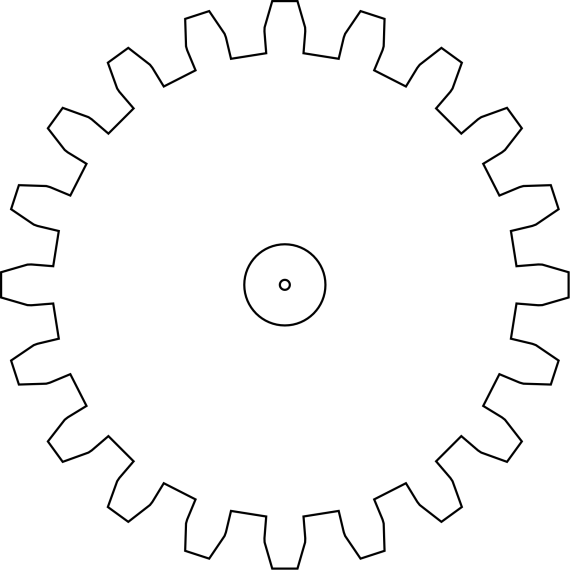
I found a file that could work for interlocking gears. Yay! As an aside, I was working on making this file work while producing my Mega Man variant and Rondelande, so a lot of what we’re about to discuss happened concurrently with the previous two games.
At first, I was using a lot of memory foam. Rondelande’s rondels were comprised of foam. I’d print out the digital files (of that rainbow nightmare above) onto full sheet labels and then sticker them over the foam and cut them out. I tried the same concept with the gear pictured above. And it worked…for like one playthrough of the game. Foam likes to shred under friction. Who knew? So, I put the interlocking gears aside until I found a set of wooden gears on Amazon.
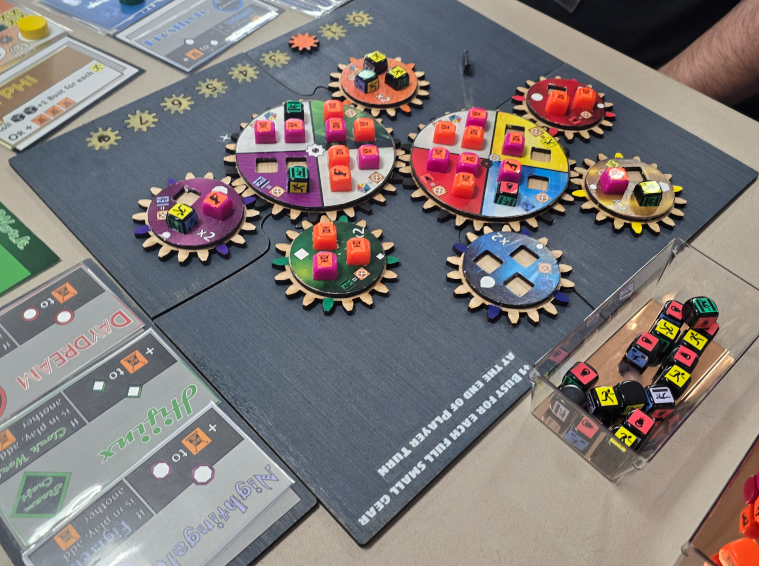
Yes! I was in business. I could continue with Rustbucket Riots. The picture above is a modern version of the game; the first version still used foam for its board (the gears haven’t changed too much). I still have a version of the first game and will include a picture of it in a future post. Rustbucket Riots combines multiple ideas. I brought back dice chucking from Mega Man, only this time, I used specialty dice that included run, slide, climb, shoot, and jump. And I always thought Tzolk’in’s gears didn’t move enough. I could fix two issues I saw in other games. Jasco’s Mega Man took too long, and Tzolk’in (Tzolk’in is an amazing game that earns its spot in BGG; I’m nitpicking) could have gears that frequently turn.
The name Rustbucket Riots came swiftly. Originally, I wanted to make a better Mega Man board game, but I couldn’t copy Mega Man exactly. So, I wondered if I could make the player characters villainous. The Boss Robots attempt to free themselves from an oppressive corporocracy and the humans using them as cheap labor, while the players assume the role of corporate robots tasked with bringing the rogue robots under control. Even though the Boss Robots would view what’s happening as a revolution, we’re playing this game from the viewpoint of corporate robots, and they’d see it as riots. Throw in a slur, and you get Rustbucket Riots.
I think that’s everything up to the idea of Rustbucket Riots materialized. We’ll cover early iterations of the game in the next board game design brain dump. If you’ve made it this far through my rambling, you’re awesome. You know it. Thank you for reading, and wherever you are, I hope you’re having a great day.



 jkgeekly.com