Terra Nil flips the city/civilization builder on its head. The world has been sapped of its resources, and it’s up to the player to return the world to its former lush landscapes, complete with wildlife, and then leave without a trace, allowing life to begin anew. Can you bring the world back to life Hey, hey! Kyra Kyle here. Today’s cozy video game is Terra Nil. I wish listed this one on Steam when its demo dropped, and then forgot about it. It wasn’t until Terra Nil popped up on Netflix, of all places, that I tried the full game. Terra Nil doesn’t have much of a story, so I’ll merge those two elements. Let’s see how Terra Nil rates on our review criteria.
Game Mechanisms: 9/10
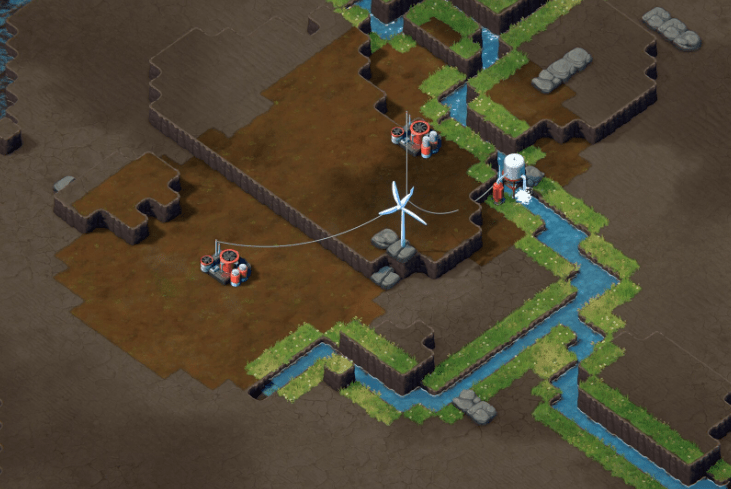
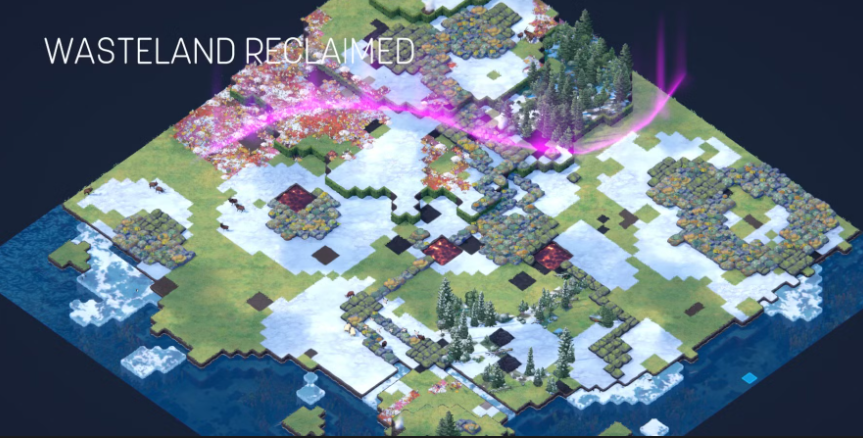
Like I said in the introduction, Terra Nil deconstructs the city/civilization builder video game genre. Players start with a barren wasteland (similar to the picture above), and they must clean the (nuclear?) waste with items like scrubbers and then replenish the Earth using various gadgets like propagators, seeders, and hydroponics. Each stage of Terra Nil plays out like an elaborate puzzle. Depending on the climate you’re trying to achieve, you may need to lower or raise the region’s temperature. Balance between biomes is crucial, and you can monitor animals and the animals’ desires when they return.
This game loop is satisfying and familiar. For being the opposite of a city builder, Terra Nil uses plenty of city builder game tropes. This makes the game easier to get into, even if what you’re doing is the exact opposite of a city builder. Finding the right balance between biomes gets tricky–Who am I kidding? It can be rage-inducing. I lost count of the number of times I was off on a certain biome and had to add an acorn to a tree to create more forest, or I had to burn more green area with a solar panel incinerator. Ugh!
And just when you’ve almost figured out how one region works, Terra Nil will add a twist like adding tundra and lava floes to the mix. I binged Terra Nil on Steam and Netflix (I still can’t get over how Netflix has a video game of Terra Nil’s caliber), and it only took about forty or fifty hours to complete the game. There was a lot of trial and error. Terra Nil’s tutorial level teaches the basics, but you’re on your own after that level, and I got stuck. A lot. But Terra Nil made getting stuck fun.
Above Image from GameDesigning.Org
Gameplay Loop: 7/10
The frustration Terra Nil can create at higher levels keeps the Gameplay Loop score from claiming top honors, but outside of that, it’s fantastic. Terra Nil shuffles the gameplay enough to keep gamers on their toes for a good forty to fifty hours. Later levels combine elements of former levels in intriguing ways, building a super puzzle. Unlocking as many animals as you can for each region is a mini-game unto itself. I forget how many times I was rooting for a frog or otter to populate.
Terra Nil is a good, chill time. I would crank up the sound effects to hear the sounds of the forests, streams, and lakes. Perhaps Terra Nil is a new way to Netflix and chill.
Narrative/Storytelling: 3/10
Because Terra Nil doesn’t have much of a story, I’m lumping Narrative and Storytelling into one element. Despite being mostly a straightforward building a green space game, Terra Nil’s premise suggests a greater story. That keeps this score from being any lower than a three. Terra Nil gives hints to what happened to the planet and drives home the idea that humans should be stewards of the environment.
User Interface: 7/10
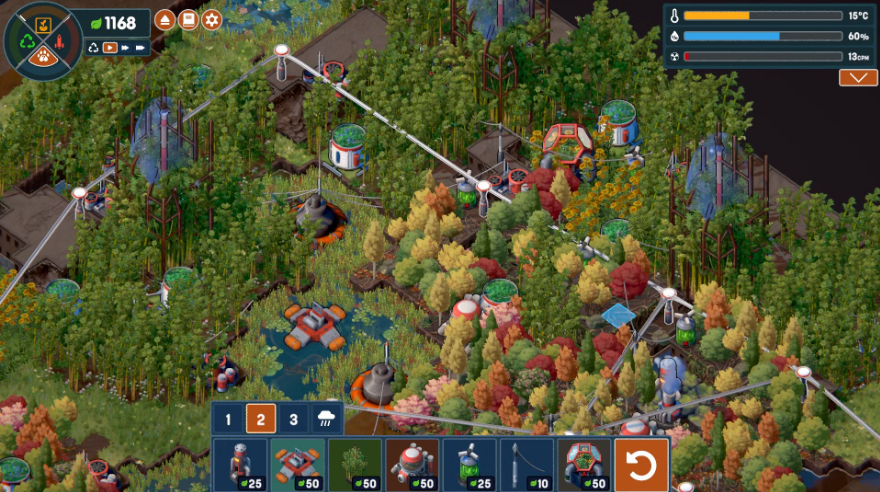
Terra Nil’s volume of information causes the game to falter with its user interface. Despite an easy-to-navigate heads-up display and well-crafted menus, I got lost in Terra Nil’s mountains of options and data I needed to parse. The game does a good job of easing players into its cavernous menus at first, but after the first three regions, you’re thrown to the wolves. Good luck.
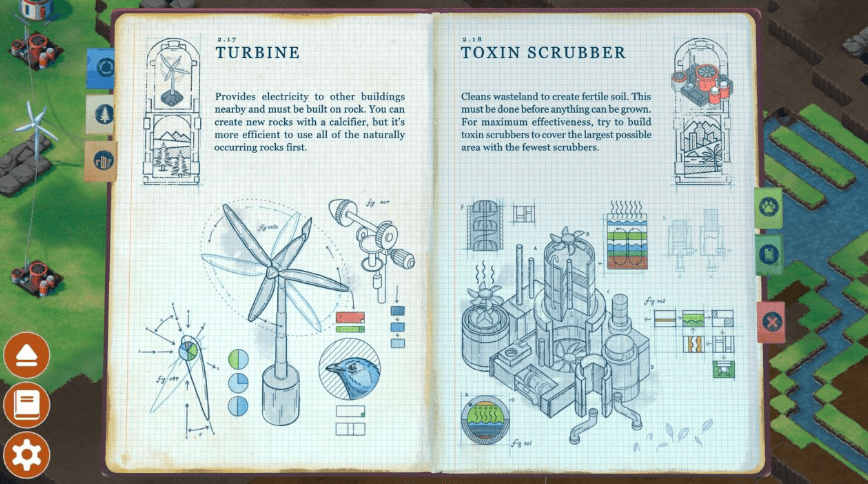
Terra Nil offers a detailed rulebook with phenomenal detail. I would flip through this rulebook even if I weren’t lost on what to do. The page above does a great job of showing and telling gamers how a turbine and a toxin scrubber work. I love Terra Nil’s attention to detail.
Graphics: 8/10
For what it is (a city builder game where you’re not building a city), Terra Nil’s graphics are on point. Despite how pretty Terra Nil can be, it still uses an isometric, top-down view of the environment. Sure, there’s an option to view your creation at the ground level, and that’s fun, but Terra Nil’s graphics stop shy of top marks.
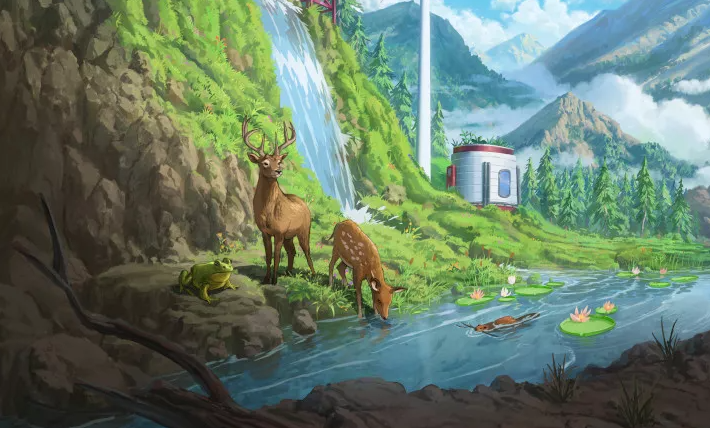
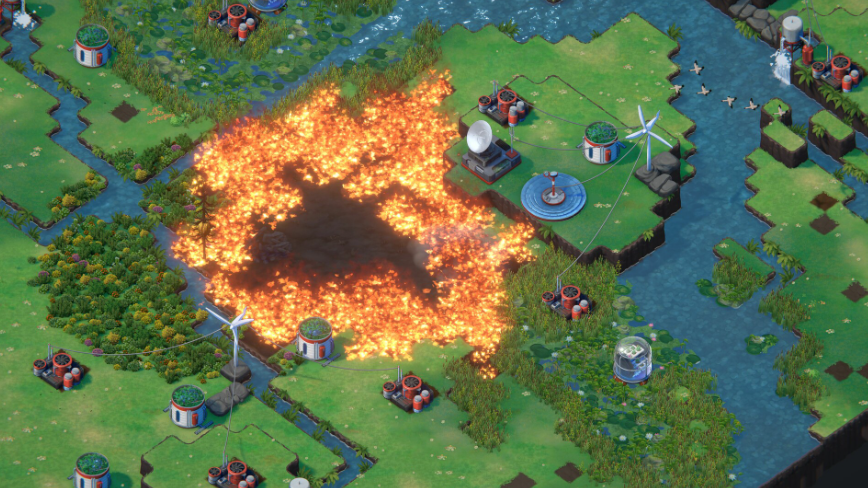
Terra Nil pours in a lot of detail. The geese in the picture above are geese who reinhabited the area. If you look closely at wetlands, you can spot a frog hopping. You can find deer, bears, and wolves roaming the forests and mountains. You don’t even need to zoom in at the ground level, even though I love doing this after I finish a region. Terra Nil works as an interactive background. It’s soothing, cozy.
Audio: 10/10
Terra Nil is one of the few games I will always play with the sound. While the game’s soundtrack is relaxing and memorable in its own way, the sound effects of the environment give Terra Nil a high score. Even the noises the gadgets (like the scrubbers and terraformers) make satisfy. Putting down a ditch borer and listening to it create a future river feels great. The crackling of fire as it makes way for new growth makes me smile.
Terra Nil spares no expense with its audio effects. From the animals to the wind and snow, I’ve spent hours listening to one of my regions, trying to pinpoint which sounds I’m hearing. In short, Terra Nil may have some of the best sound editing I’ve ever heard in a video game.
Replay Factor: 7/10
Even though Terra Nil plays like a puzzle, it’s one of those games I can see replaying after multiple months or years have passed. It won’t take long for me to forget how to complete each region. In fact, I played Terra Nil within the last couple of months, and I’m pretty sure it would take me a couple of playthroughs before remembering how each gadget works and when best to use them. Terra Nil also includes scenarios, variable difficulties, and each region is randomly generated during each playthrough. That last point alone gives Terra Nil better than average replay value. I enjoyed my time with Terra Nil and look forward to playing it again.
Aggregated Score: 8
Even though I gave Terra Nil a story/narrative score, I’m omitting that score from its aggregated score. Terra Nil offers dozens of hours of calming gameplay. It functions like an interactive desktop background. I’m shocked Netflix picked up the rights to Terra Nil. Perhaps this is a sign of things to come for the streaming giant.
Organ Trail gives a zombie apocalypse twist to the classic Oregon Trail. Not to be confused with the 2023 film of the same name, Organ Trail was developed by Men Who Wear Many Hats in 2010. 2010! That makes this game a decade and a half old. Yikes! Organ Trail began as a web game before a 2012 Kickstarter campaign expanded its release to Steam and iOS. Organ Trail has gone on to sell over half a million copies.
Hey, hey, Geekly Gang! Kyra Kyle here. Today, we’re reviewing the 2013 Organ Trail: Director’s Cut. The developer claims that this version moves past the original’s pure parody of Oregon Trail to become a game in its own right. Trade in your Conestoga wagon for a station wagon. It’s time to see how Organ Trail rates against our criteria.
Game Mechanisms: 8/10
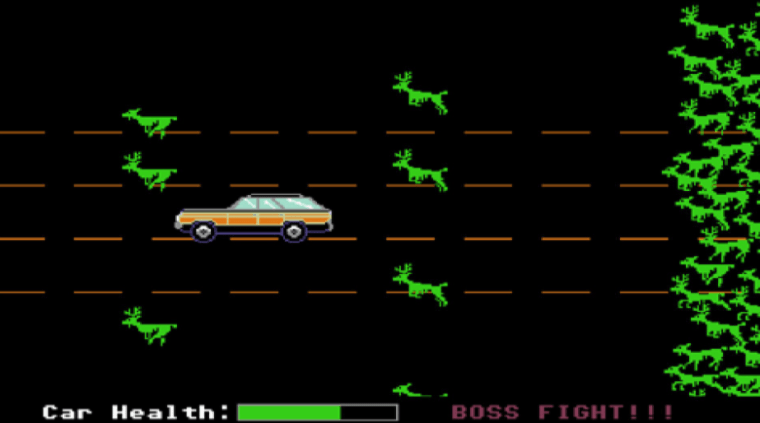
Organ Trail follows its inspiration’s lead (Oregon Trail) with its game mechanisms, but it differs enough to warrant a higher than average score. The Director’s Cut adds Choose Your Own Adventure aspects to the original’s release. Fighting off biker gangs and avoiding zombie deer stampedes are nice touches. But the bulk of the game (at least for me) was with scavenging. Honestly, I spent most of Oregon Trail hunting, so spending a lot of time scavenging (Organ Trail’s version of hunting) makes sense.
Despite being essentially the same mini-game, scavenging (in Organ Trail) feels far different from hunting (in Oregon Trail). First, the zombies are heading toward you. While you may find the occasional wild animal that will attack you (like a bear), animals like deer in (Oregon Trail) run away from you. Organ Trail even references the bear by having a bear be a boss fight, so there is a tip of the cap there. Second, killing zombies doesn’t give you any resources. Instead, you must pick up randomly generated items in the wilderness. While this makes thematic sense, I kind of miss the push and pull of do I use bullets to kill animals for food, trading one resource for another. But ultimately, the zombies are fun.
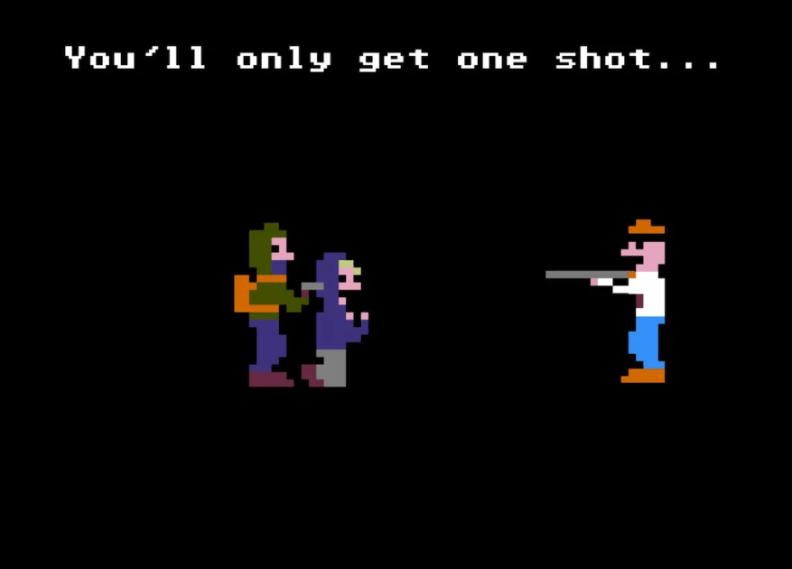
I do my best to dodge zombies, which is easy to do if you don’t face a horde. Zombies in the scavenging mini-game will follow your movements, so you can trap them behind fences, walls, trees, and other obstacles. The other mini-games, like avoiding a zombie deer stampede, shake up the doldrums, but repairing your station wagon is the most pervasive mini-game outside of scavenging. Repairing your car is a timing mini-game, and I stink at it. Looks like I’ll have to carry plenty of extra scrap. Even so, the trickiest mini-game to master is the one where a bandit randomly picks one of your friends/family members to kidnap. You’ll only get one shot to shoot the bandit in the head. Don’t miss.
There are 20 stops before you reach your destination, Safe Haven (in the Pacific Northwest), and each stop has some combination of an Auto Shop, Combat Training, and supplies for you to purchase, but every stop has a Job Board. Jobs add even more mini-games. These jobs become more important at higher difficulty settings. If you begin on “Easy” mode, you won’t need to do them beyond the halfway point on your trip. Player choice is paramount in Organ Trail.
Note: I’ve played the PlayStation4 and Steam versions. The PlayStation version is better than Steam’s. Unfortunately, players have fewer options if they play on Steam, so I’d lower the rating by a point for the Steam version.
Gameplay Loop: 9/10
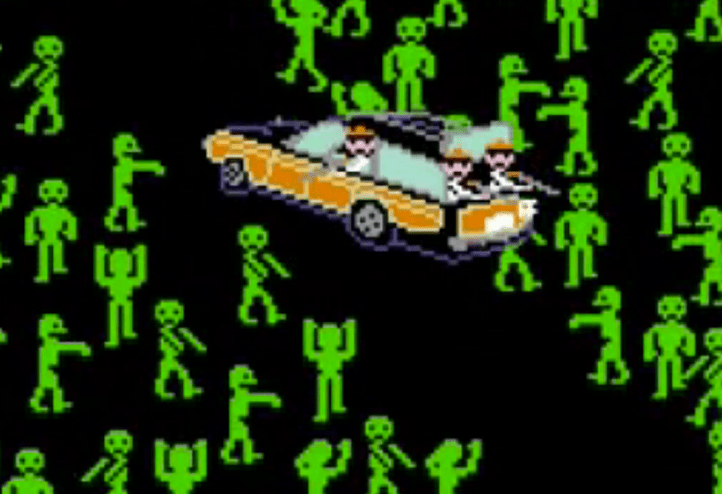
Organ Trail’s core gameplay loop of scavenge, repair, shop, rest, and travel is a satisfying one, especially when you throw in the day/night cycle. You may want to rest or repair during the evening, when zombie activity is higher. This is a consideration when leaving a stop. There’s a percentage chance you’ll encounter a zombie horde, but player choice comes into play. You can sneak past the horde, floor the gas and try to speed past them, or bust out your shotguns and shoot while you drive. Even with a set gameplay, Organ Trail offers micro choices that have a profound impact.
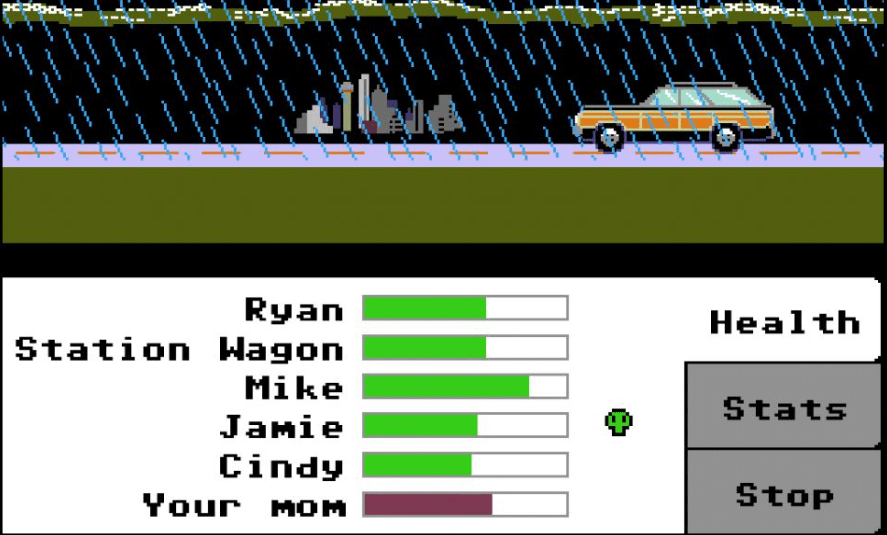
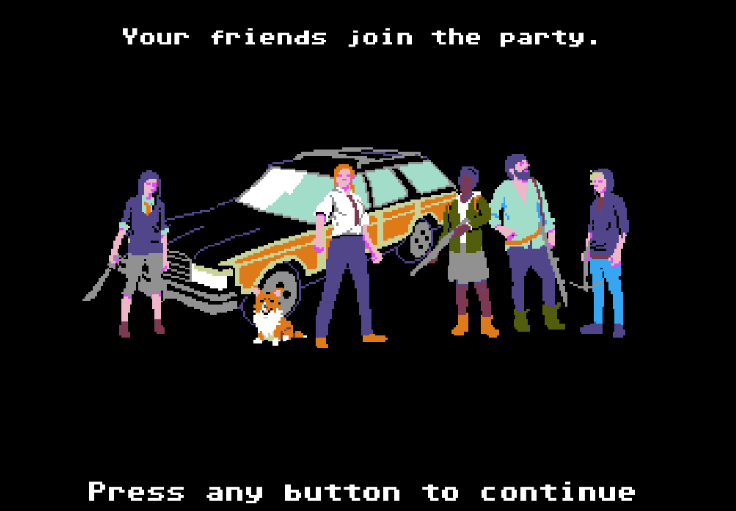
Just like Oregon Trail, random events occur while you drive. Some are silly, like “Mike gets bored and starts making an annoying noise.” Others are more serious, like “Your mom has dysentery,” and you may need to stop and rest or risk her dying. And since Organ Trail is set in a zombie apocalypse, someone, like Jamie, could be bitten by a zombie (which is indicated by a green skull). So long as you keep them healthy with med packs, which aren’t cheap, they won’t turn. I hear there’s a weirdo at Safe Haven who pays for someone who’s infected.
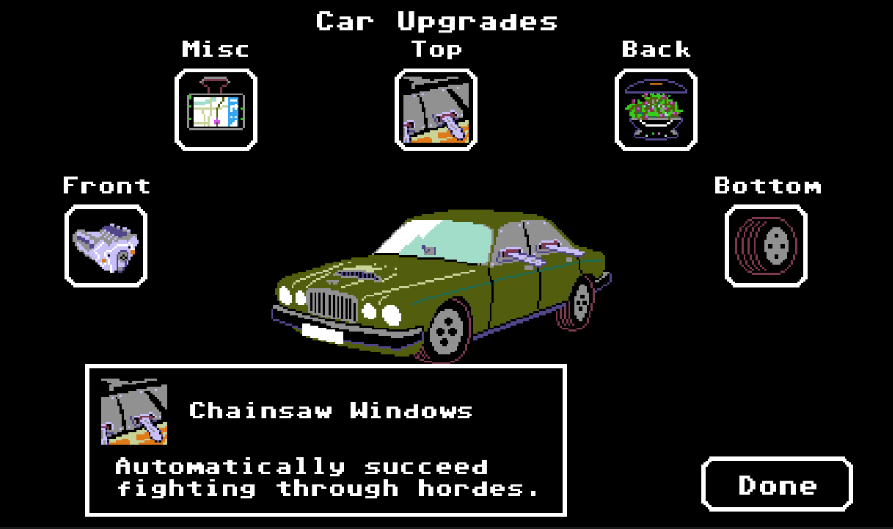
Add in some combat upgrades for yourself and some car upgrades, and Organ Trail has plenty of options for you to explore. This improves Organ Trail’s already stellar gameplay loop.
Narrative/Storytelling: 8/10
Organ Trail has a simple but effective narrative. You’re traveling from one side of the United States to the other. The game uses liminal space to tell its story. I could see plenty of gamers missing Organ Trail’s story. To get the most out of Organ Trail (from a narrative perspective), it’s best to talk to strangers at each stop. They fill in the gaps by asking why the government thought nuking its people would “solve” the zombie crisis.
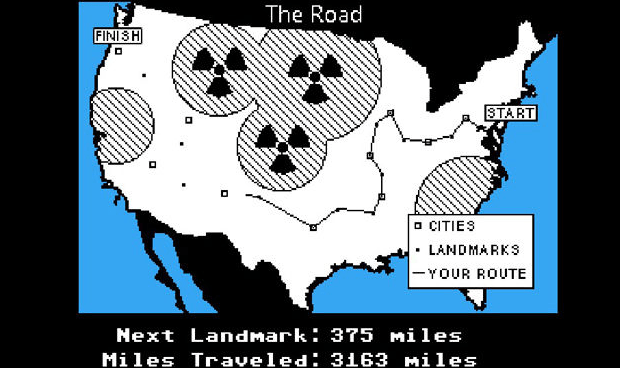
Nuclear strikes are the reason why you must take an indirect route to make it from Washington DC to Safe Haven. Other tidbits of information are sprinkled during these interactions. Organ Trail manages to add in a few more with merchants and the random bandits who abduct your passengers. Organ Trail has an interesting world. How did the disease (if zombism is a disease) cross over from humans to deer and bears?
User Interface: 8/10
While clunky (or outdated) at times, Organ Trail has a simple-to-understand and navigate user interface. If you’ve ever played Oregon Trail, you’ll know how to play Organ Trail. The game keeps players informed with specific details about their party. You can check the map and see how many stops you have remaining, and if you know anything about geography, you can plan when you may need certain upgrades like snow tires. Hint: most likely when you’re traveling through the Rockies.
Notifications will pop up on the main screen if any major issues occur. The tabs work and are self-explanatory. I have few issues with Organ Trail’s user interface.
Graphics: 6/10
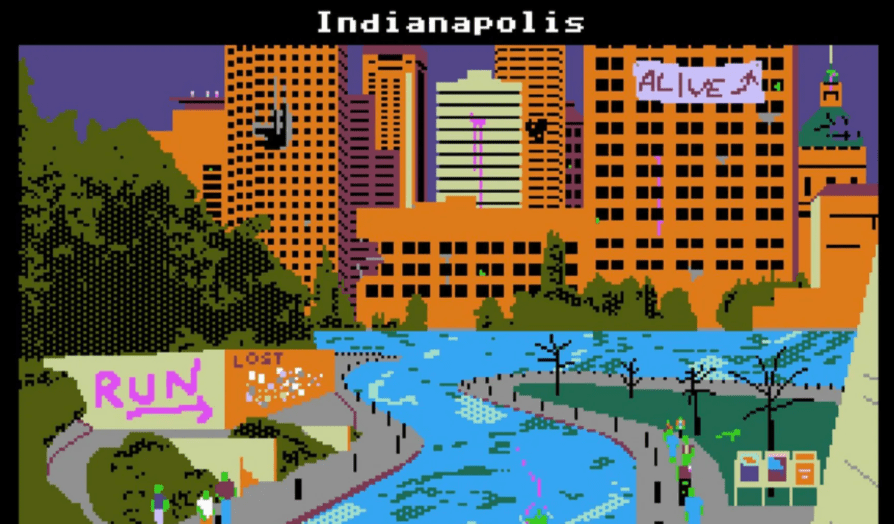
I struggled with scoring Organ Trail’s graphics. Yes. The graphics aren’t the best, but they’re not meant to be the best. Organ Trail is a retro game, parodying a video game released in the mid-80s. And yet, Organ Trail finds ways to make its graphics unsettling. This works to steep the game in atmosphere.
Audio: 8/10
Organ Trail has a good mix of sound effects meant to mimic Oregon Trail (like clinks and bloops after a stage is complete) and others that subtly suggest a game with a darker subject matter (like splattering brains and cocking a gun). Organ Trail’s soundtrack, by Ben Crossbones, does a lot of heavy lifting. I often play video games on mute; I didn’t with Organ Trail. Crossbones does a great job of capturing the game’s mood and theme without going too over the top. Organ Trail’s soundtrack is the right level of creepy.
Replay Factor: 7/10
Organ Trail plays quickly, no less than five hours, so it’s easy to replay this title. It offers multiple difficulty settings, and the higher ones offer a good challenge. There’s even a leaderboard (Organ Trail grades your accomplishments during each playthrough). I even like the addition of finding your tombstone from a previous playthrough. All of this is fantastic, but I don’t see gamers playing Organ Trail more than a handful of times. I could see replaying it after several years. I sure have. I can only give this game a slightly above-average replay factor.
Organ Trail is typically sold for $5-10. That’s a steal for the amount of game you get. I recommend giving it a try, especially if you like zombie apocalypses and the original Oregon Trail.
Hey, hey, Geekly Gang! Kyra Kyle here. We’re keeping the theme of Spooky Season alive with today’s post, but we’ll be taking horror or dark themes in a different direction. I’ll be up front, this post may meander more than usual. I didn’t know what to call these types of video games at first. Some of these video games could fall under the term “empathy games.” I mentioned some of these games in a previous post, but the prevailing term for the type of video game we’ll cover today is Walking Simulator. That name doesn’t do these games justice.
In fact, the Walking Simulator term is beyond reductive. It’s demeaning. All you’re doing is walking. This pejorative name reminds me of the terms Euro-Trash or Ameri-Trash board game from a decade or two ago. We’ll use the modern, friendlier terms for these board game types. Euro board games focus on mechanisms and balanced gameplay, while Amerithrash–they’re totally metal and they “thrash”–board games place more emphasis on theme. If you used the negative terms, you’re thumbing your nose at the other board game type. Many “hardcore” video gamers despise “Walking Simulators.”
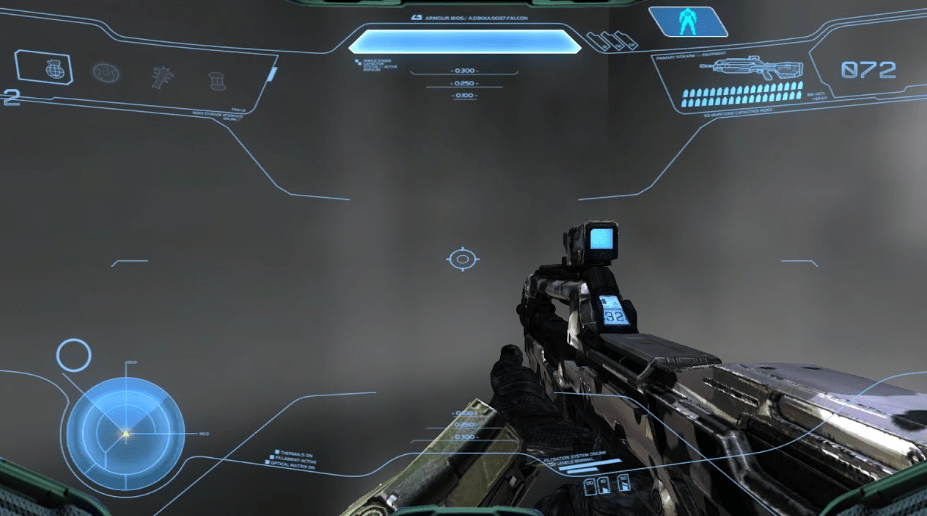
“Hardcore” video gamers not liking “Walking Simulators” makes sense. Video games sprang from the Military Industrial Complex. The first video games came from military facilities. Many “hardcore” video games promote wanton violence where the player kills countless enemies, feature “heads-up displays” one might find in a fighter jet, and some video games are even military recruitment tools. Of course, something quieter and geared toward empathy would ruffle the feathers of “hardcore” video gamers.
Getting back to Euro and Amerithrash board games, modern board games often blur the lines between these two game types. I reviewed Cretaceous Rails a couple of months ago, and it’s equal parts interlocking mechanisms and heavy on theme. Death Stranding notwithstanding, I don’t know if AAA video games have adopted enough from indie Walking Simulators, but that’s another topic. I told you I would meander. Despite the negative connotation (all you’re doing is walking), Walking Simulator is the term most people use. We’ll use that one. Since we’ll be dealing with psychological horror and/or darker themes, let’s call these games Dark Walking Simulators. Let’s cover a brief history with some of my favorite Dark Walking Simulators.
Prior to 2012: [domestic]
Point and click games could and sometimes do fall under the heading of a Walking Simulator, because they involve movement and interacting with the game world’s environment (which are hallmarks of Walking Simulators), and point and click games have been around since the early 80s. But we’ll begin this quick history with 2003’s [domestic] by Mary Flanagan. Flanagan repurposed the Unreal gaming engine to recreate a childhood memory of a house fire. One look at [domestic], and you can see why many consider it the first modern Walking Simulator.
In fact, the term Walking Simulator gained prominence in the late 2000s, perhaps as a direct result of [domestic]’s release. When you have the chance, you should check out Mary Flanagan’s website. She discusses at length her artistic choices while designing [domestic]. While she doesn’t have a link for a playable version of the game, Flanagan provides a two and a half minute video of [domestic]’s gameplay. There are so many innovative choices, like family photos and text constructing the walls of this 3D space, that we’ll see in future Walking Sims.
Dear Esther (February 2012)
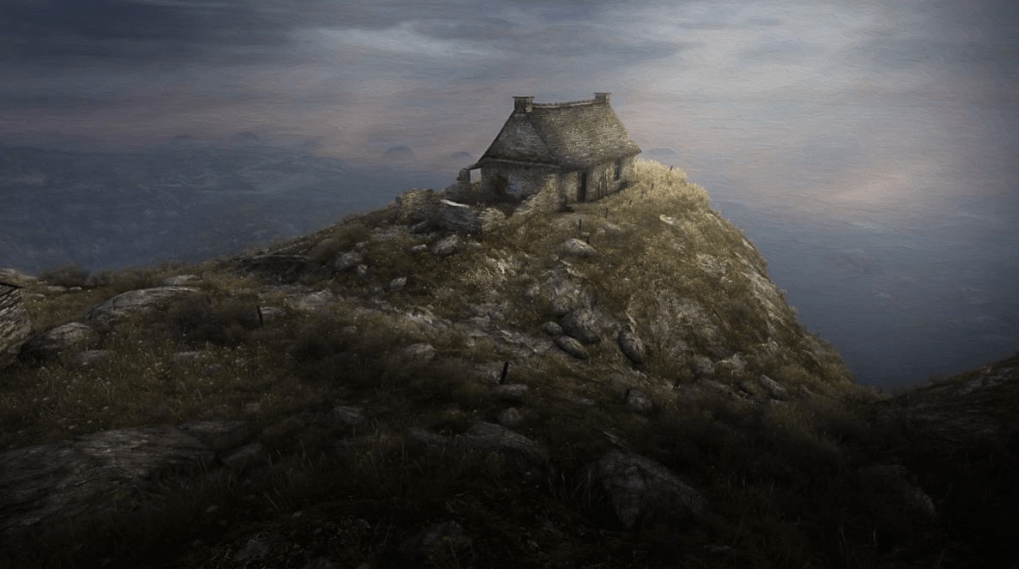
First, Dear Esther is gorgeous. Look at that uninhabited Hebridean island. My partner and I made our way to one of the Inner Hebridean islands in Scotland, and this looks close. I could smell the salt air and the heather on the wind. Second, Dear Esther’s gameplay is minimal. I would almost classify this game as a Walking Simulator, but in the best possible way. An anonymous man reads a series of letter fragments to his deceased wife, Esther. Each location on the island reveals a new letter fragment. Players can unlock different audio fragments with each playthrough of the game, leading to a different narrative each time you play Dear Esther.
So, you’re literally walking from one area of the island to the next and listening to various letters, but the letters reveal more about the titular Esther’s life. Esther has passed under mysterious circumstances, and her husband is looking for answers. Dear Esther has a gripping narrative, but the tension comes from internal struggles. The Chinese Room developed this Walking Simulation classic, and this won’t be the last time we’ll see one of their games on this list.
The Unfinished Swan (October 2012)
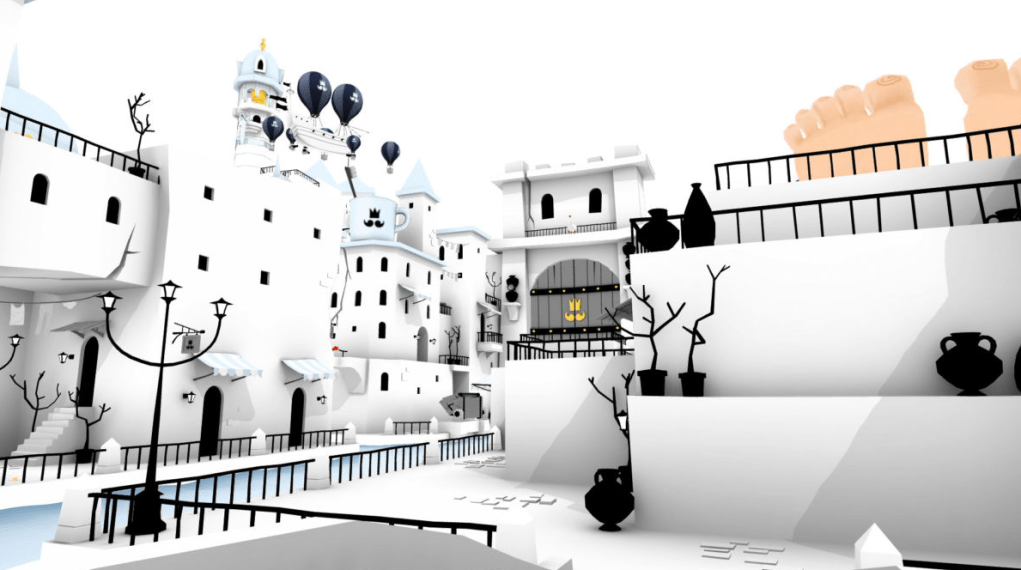
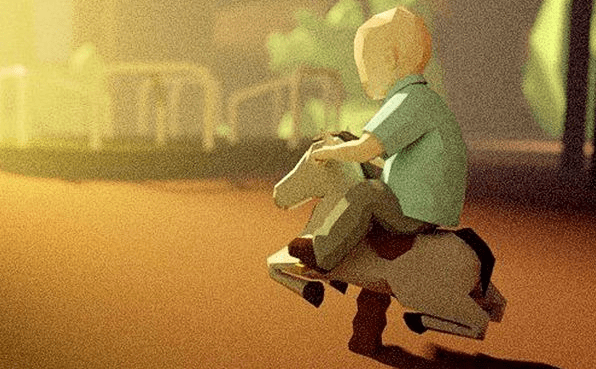
The Unfinished Swan marks Giant Sparrow’s first major release. It has a simple premise. Monroe is a young boy whose mother recently died. Monroe’s mother was a painter famous for never finishing a painting. Over 300 paintings and not one of them complete. The orphanage tells Monroe he can keep only one of his mother’s paintings, so he chooses his favorite, a swan missing its neck. The swan escapes, and Monroe follows it. Armed with his mother’s silver paintbrush, Monroe explores the painted world.
As you can guess, The Unfinished Swan ventures into magical realism. It tackles themes of loss. It puts players into the shoes of a young child, making sense of the world without their parents. The Unfinished Swan is the first of Giant Sparrow’s games to make this list. It showcases the studio’s knack for eclectic settings and its flair for the dramatic.
Gone Home (August 2013)
Gone Home puts the player in the role of a young woman returning from overseas to her rural Oregon family home to find her family absent and the house empty. She must piece together recent events to determine why her family’s home is empty. Gone Home is similar to the previous year’s Dear Esther, but the anonymous protagonist in Dear Esther knew that his wife had died. Katie, Gone Home’s protagonist, has no clue why her family is missing.
Dark Walking Simulators do a great job of presenting mysteries. In fact, I’d wager most great video game mysteries have large elements of Walking Simulators. Even the AAA titles that lean more into the mystery genre borrow heavily from Walking Simulators. Traveling in someone else’s shoes and interacting with your environment can make for a great mystery premise.
The Stanley Parable (October 2013)
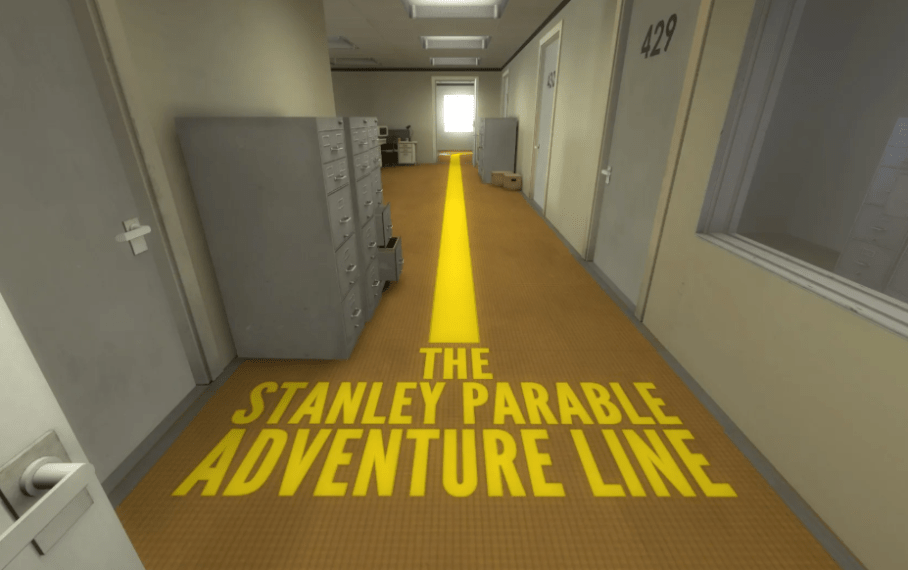
The Stanley Parable stands out in a group of video games that stand out. This Walking Simulator challenges preconceived notions about video games with a thick coat of sarcasm. Developed by Davey Wreden and William Pugh, The Stanley Parable tackles themes like choice in video games and fate/pre-destination. British actor Kevan Brighting narrates while the silent protagonist (Stanley) conducts a day at the office. As you can see in the image above, Stanley may follow the adventure’s line, or he may contradict The Narrator’s directions, which, if disobeyed, will be incorporated into the story. Depending on the choices made, the player will encounter different endings before the game resets to the beginning.
The Stanley Parable proves that Walking Simulators can strike a chord with “hardcore” gamers. The Stanley Parable crossed over into mainstream video game culture. Developer Davey Wreden has gained a following, and his follow-up game, The Beginner’s Guide, actually deals (in part) with Wreden’s struggles with success. Showrunner Dan Erickson cited The Stanley Parable as an inspiration for Apple+’s Severance.
The Static Speaks My Name (August 10, 2015)
While the previous games on this list have dark themes, The Static Speaks My Name is the first true horror video game.
Quick trigger warning: The Static Speaks My Name includes self-harm. If you’re sensitive to the subject of self-harm, feel free to skip this entry to our next one.
In The Static Speaks My Name, players assume the role of Jacob Ernholtz, a man who has committed suicide by hanging at the age of 31. We start as an amorphous blob in a dark void until we inhabit Ernholtz during his last day. We awake in his dimly-lit apartment with boarded-up windows and doors as he performs a series of menial tasks, including using the restroom, eating breakfast, and chatting with online friends. Exploring Ernholtz’s apartment reveals that he’s obsessed with a painting of two palm trees and its painter, Jason Malone. Locked behind a bookcase, we find Malone in a cage. The player has the option to unlock the cage or electrocute Malone. We’re finally presented with the task to go to a small closet with a noose.
Yowza! The Static Speaks My Name is trippy in every sense of the word. Jesse Barksdale developed The Static Speaks My Name in a 48-hour game jam. I’ve participated in a few board game jams, and you can encounter some messed-up concepts during one of these events. I would’ve liked to have seen Barksdale’s creative process for The Static Speaks My Name during these 48 hours. This is a haunting game. I’ve only chosen the electrocute option once, and Malone’s blood-curdling screams invaded my dreams for a few days. Yikes!
We included the exact date The Static Speaks My Name was first released because our next entry in this list was released the next day. This week in August was a great week for Walking Simulators.
Everybody’s Gone to the Rapture (August 11, 2015)
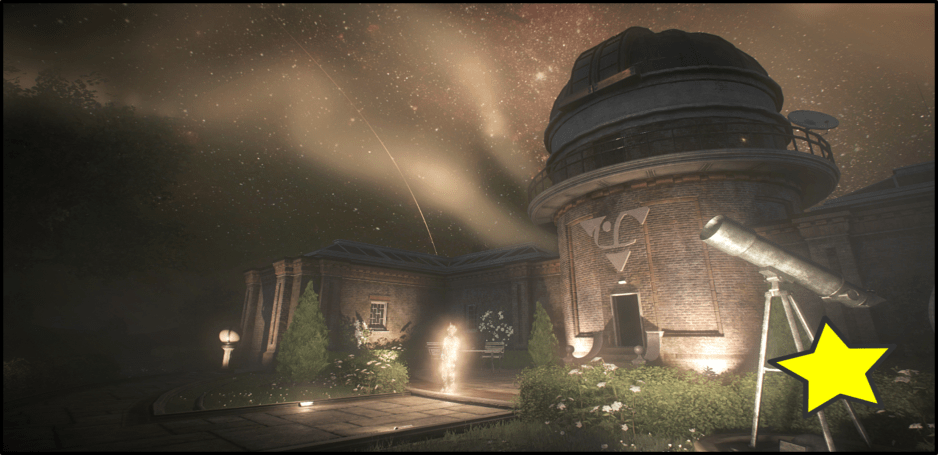
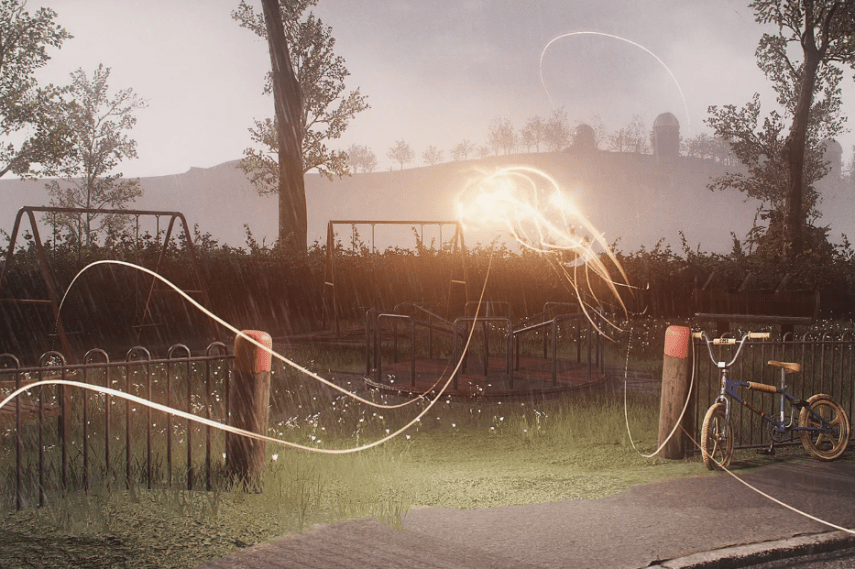
Fresh off their hit Dear Esther, The Chinese Room takes the mysterious disappearance of people from the scope of a family in Gone Home to that of an entire English village’s citizens in Everybody’s Gone to the Rapture. Players assume the role of Katherine “Kate” Collins, which is funny because Gone Home’s protagonist was named Katie. Set in 1984, Dr. Kate Collins and her husband travel to the fictional Shropshire village of Yaughton. Players can interact with floating lights throughout the world, most of which reveal parts of the story.
Feel free to turn on radios, answer the phone, and test the power switches as you unearth why an entire English village’s people vanished. Could this be the beginning of the Rapture and the end of days? Or has some mysterious fate only affected this one village? You’ll have to play Everybody’s Gone to the Rapture to find out.
That Dragon, Cancer (January 2016)
Get ready to reach for the tissues. This next entry is a tear-jerker. Created by Ryan and Amy Green, Josh Larson, and a small team under the name Numinous Games, That Dragon, Cancer is an autobiography based on the Greens’ experience raising their son Joel, who was diagnosed with terminal cancer at twelve months old. Though given a short time to live (four months tops), Joel survived for four more years before succumbing to cancer in March 2014. That Dragon, Cancer harkens to the age of point and click games–see, point and click games are closely related to Walking Simulators–and uses the medium of pointing and clicking to experience the Greens’ lives through interactive storytelling.
That Dragon, Cancer illustrates a video game’s storytelling potential. At first, Ryan and Amy developed the game to relay their personal experience with Joel while they were uncertain of his health, but following his death, the Greens reworked much of That Dragon, Cancer to memorialize and personalize their time and interactions with Joel for the player. Joel Green may have had a short life, but That Dragon, Cancer ensures he won’t be forgotten.
it’s always monday (November 2016)
I’ll start this write-up by commenting on it’s always monday’s title. I love its use of all lowercase letters. Yes, Monday is supposed to be capitalized, but the lack of capital letters gives the impression of words in the middle of a sentence. Brilliant. I debated including it’s always monday on this list. To put it mildly, it’s always monday is surreal.
Players assume the role of an office worker who, as the game’s title implies, is stuck in a loop of perpetual Mondays. My bad…mondays. Frequently, you’ll find moments where a coworker is cut into slices. The player character will freak out–naturally–and then notice a pizza on the conference table and comment, Today’s a pizza day. Score! What? I often wonder what it’s always monday’s overall message is supposed to be. Perhaps we’re supposed to feel trapped in a malaise where we want the character to feel something. Anything. But it’s always monday’s workplace offers plenty of bizarre occurrences that run counter to the mundane.
What Remains of Edith Finch (April 2017)
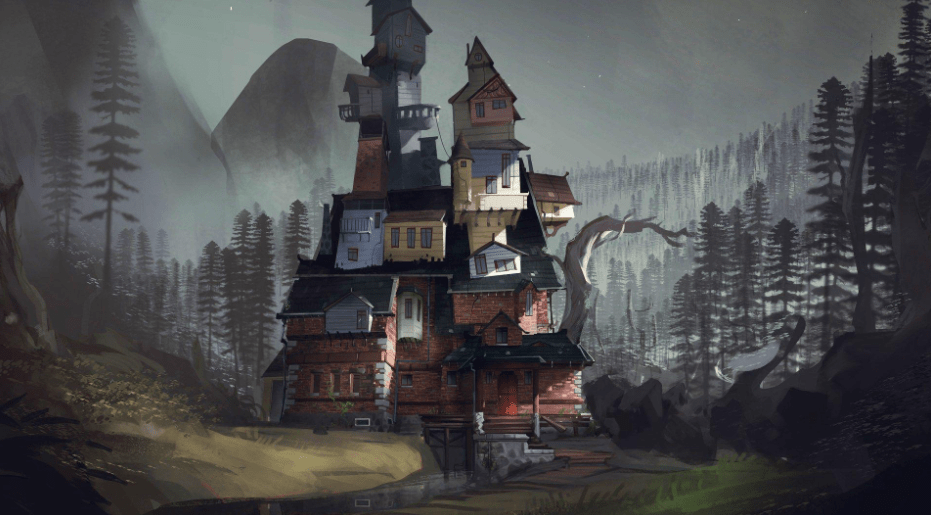
What Remains of Edith Finch borrows concepts from Gabriel Garcia Marquez’s One Hundred Years of Solitude and applies them to an interactive video game where we follow the titular Edith Finch explores her family home. Like Marquez’s work, What Remains of Edith Finch ventures into magical realism. The game’s narrative works as an interconnected anthology series, and it’s all the better for it. I don’t know which member of the Finch family’s stories I like best. What Remains of Edith Finch is a triumph of video game storytelling. Giant Sparrow took everything they learned from The Unfinished Swan to create a singular gaming experience.
Walking Simulators fizzled out after 2017. I don’t know if the backlash of these games reached a fevered pitch or if the designers who make these games needed time to create something new. Death Stranding was released in 2019. To date, it may be the closest a AAA game has come to a Walking Simulator. It certainly incorporates a lot of Walking Simulator concepts into its gameplay. But our lack of Walking Simulators in the early 2020s can be attributed to the pandemic.
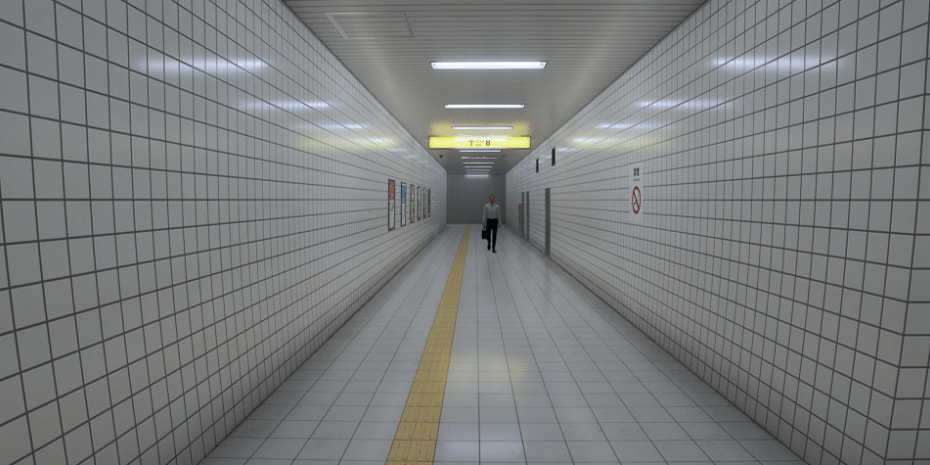
All video game struggles in the early 2020s, but we’ve seen a resurgence of Walking Simulators since 2022. Exit 8 has a premise similar to the Backrooms. Players explore the liminal space of Japanese subways. I’m writing this post in June, but by the time this post goes live, a live-action film based on Exit 8 should have been released. Walking Simulators have gripping stories and an avid fan base. I can’t wait to see what this video game genre has in store over the next decade.
If you’ve made it this far, you’re awesome. We all know it. Be sure to comment on your favorite Walking Simulator or an idea of a better name for this video game type. Thank you for reading, and wherever you are, I hope you’re having a nice day.
Happy Labor Day for those of you who celebrate and have the day off. For those of you who don’t celebrate Labor Day or have to work in an office environment, you can secretly play plenty of video games at work. Hey, hey! Kyra Kyle here. We will be a little naughty with today’s list in honor of Labor Day and share five great video games you can secretly play at work.
Never mind that the first board games I designed were solo-player games that fit inside school folders and could be played in the middle of class. I would never condone playing video games while at work. Wink, wink.
5: Desktop Tower Defense
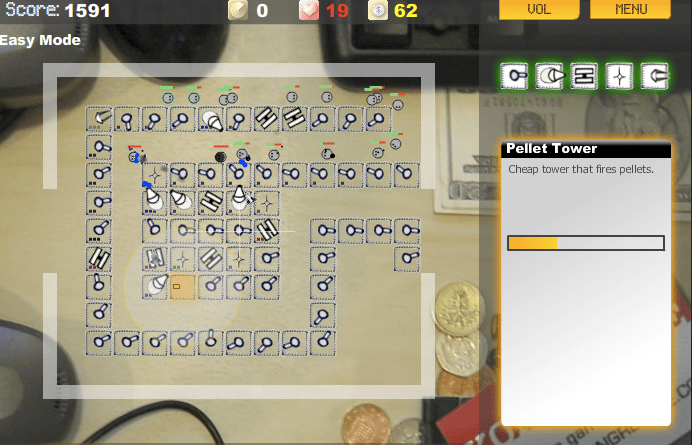
We’re kicking this list off old school. The tower defense genre is crazy popular. One of the genre’s first breakout hits was the 2007 Flash game, Desktop Tower Defense. This browser game was my introduction to the tower defense video game genre. Even though I never played Desktop Tower Defense while at work (yeah, right), the game scores extra points for recreating the aesthetics of an office desktop. That’s the trick to games one can play while at work. They need to be easily concealed, like in a school folder.
Like the name implies, players must set up tower defenses to prevent enemies called “Creeps” from reaching portions of the playfield. Desktop Tower Defense further differentiates itself from competitors by using mazes as a game mechanism. Rather than players being at the mercy of the Creeps moving in a predetermined path, players created paths for the enemies to travel. So, while Desktop Tower Defense may have found an early audience by being easy to conceal at work, its unique maze mechanism made it more than just a “game you can play at work.” Desktop Tower Defense is a good game. It even earned a port for the Nintendo DS.
4: GeoGuessr
GeoGuessr uses Google Maps to make an interesting game. GeoGuessr is another browser game, which will be a trend because we’re trying not to get caught playing video games at work. When players load into GeoGuessr, they’ll receive a random street view. The player must use their surroundings to figure out where they are. It’s like Where in the World is Carmen Sandiego?, only you’re Carmen Sandiego and you don’t know where you are.
Google is ubiquitous in workplaces, so it’s easy to load up a game of GeoGuessr without raising suspicions. The game can be played without time limits, which makes it a casual game, and players can play GeoGuessr in between other tasks. If you want to work, you can. GeoGuessr is also a great way to figure out where you want to take your next vacation or holiday. You’re being productive.
3: Arena XLSM
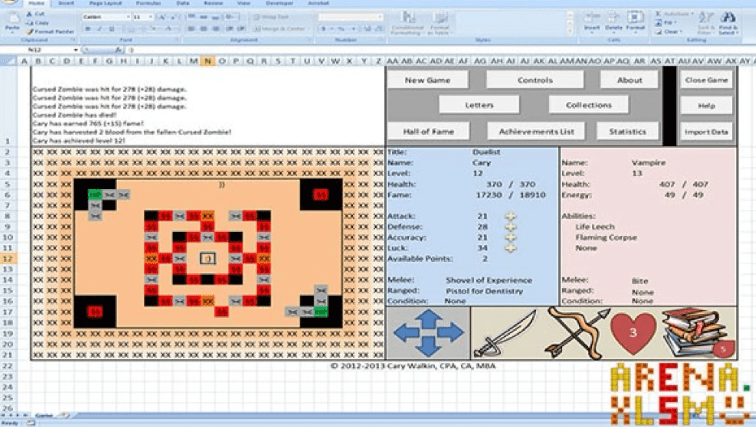
Arena XLSM may do a better job than Desktop Tower Defense at pretending to be work. In fact, Arena XLSM is a free RPG made in Microsoft Excel. It works in Excel’s 2007, 2010, and 2013 versions, but hasn’t yet been updated for later versions. Like all good RPGs, Arena XLSM is story-driven. The player has been captured after rebelling against an emperor. He’s imprisoned in the titular arena and must fight waves of enemies to survive. Arena XLSM features thousands of enemies and a story told through notes the player receives from their wife, leading to several possible endings.
I was tempted to put Arena XLSM higher on this list, but the game’s availability knocks it down a spot or two. If your company’s PC runs older versions of Windows and the Microsoft Office suite of products, you may be in luck.
2: Paperclips
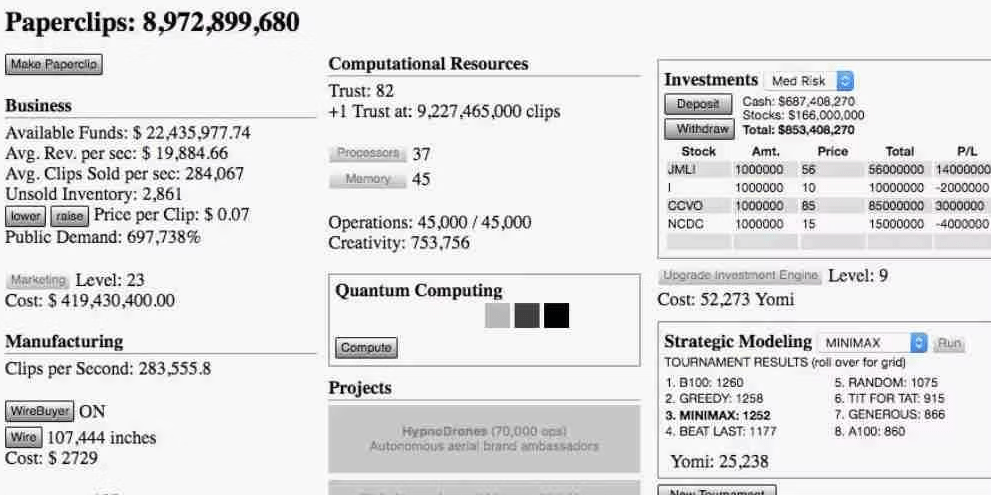
Oh, ho ho! Paperclips is yet another video game masquerading as work. Except for one other game on this list (our top spot), Paperclips may be the best video game to disguise itself as work. Also known as Universal Paperclips, Paperclips is a clicker game that looks like a calculator program. Clicker games may not be my first choice, but they can have a lot of complexity. After clicking a button to create a paperclip, the player gains the ability to automate, and then they can focus on resource allocation. Resource allocation is what makes clicker games so addictive. Paperclips is a ton of fun and happens to look like something you may have on your computer screen while working. Those numbers aren’t going to click themselves.
1: Leadership
Leadership takes our top spot because it’s the sneakiest.If you couldn’t tell by now, I love it when video games one secretly plays at work are disguised. Leadership looks like a boring line graph, but look closely, and you’ll find a tiny spaceship between the lines. Leadership is a secret lunar lander clone from a group of Danish developers. Leadership must be fun because Danish people tend to be voted the happiest. Just saying. During Leadership, players must guide their spacecraft from point A to point B, and they have a set amount of fuel to reach their goal.
Like other games on this list, Leadership is a browser game, so it’s easy to conceal. But Leadership’s appeal runs deeper than its skin. It’s another fun game. There’s even a leaderboard. You can compete with fellow slackers, I mean, otherwise motivated people from around the world.
That’s our list. I would include more, but I had a lot of other “research” I needed to conduct. Pay no attention to the line graph on my computer. What video games do you like to “not play at work?” Let us know in the comments. Thank you for reading, and wherever you are, I hope you’re having a great day.
Kitaria Fables by Indonesian indie game studio Twin Hearts combines a farming sim like Stardew Valley with a mild adventure game. Players assume the role of a cat hero Nyanza (or Nyan for short), hence the name Kitaria, as Nyan upgrades his weapons and armor and learns new abilities to save the Empire.
Hey, hey! Kyra Kyle here. We’re covering a video game today that’s unlike most we’ve covered in the past. Kitaria Fables is a cozy game. Full disclosure: I’ve picked up this game on sale for multiple systems (Steam, Switch, and PlayStation 4), but I’ve played the most on PS4. Cozy games have taken off in the past few years, and I’m here for it. I love a good cozy game. But how does Kitaria Fables stack up against our review criteria?
Mechanisms: 7/10
Kitaria Fables has solid game mechanisms, but there’s a reason it’s often compared to Stardew Valley—I compared Kitaria Fables to Stardew Valley in the opening paragraph of this review. Kitaria Fables borrows many mechanisms, its graphic design, and some of its perspective from Stardew Valley. All of the mechanisms Kitaria Fables borrows are well done. But I can’t give it top marks.
Still, Kitaria Fables adds a few things to the Stardew Valley formula to make it stand out. Not the least of which is the adventure aspects. Gone are the procedurally generated mines. In their place are regions to explore and enemies to vanquish. Enemies will drop items to use for upgrade materials. So far, this sounds like a typical adventure game, but Kitaria Fables opts to go with ability upgrades instead of leveling.
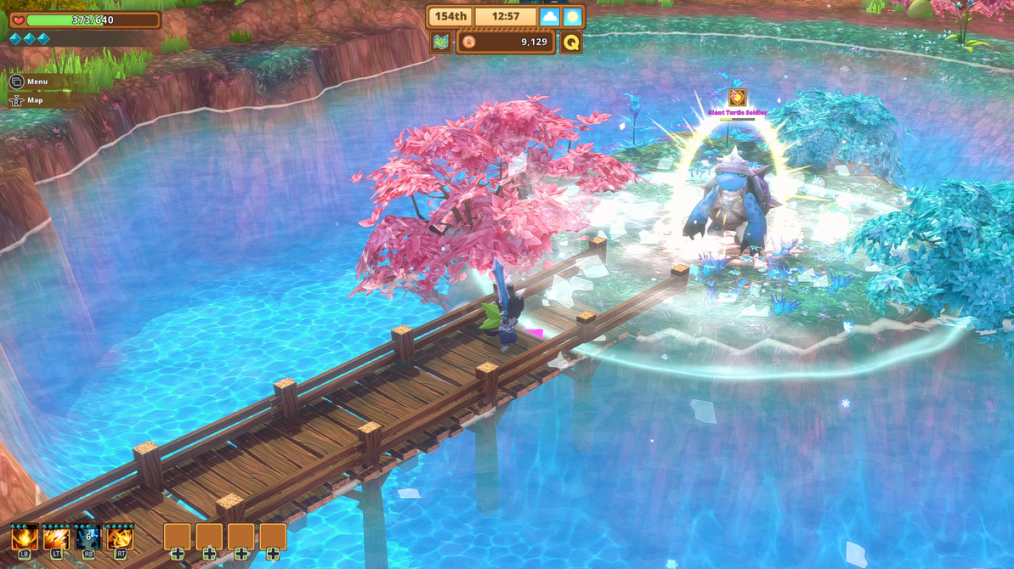
Players can trade out Nyan’s magic abilities at any time. The only downside is that more powerful spells usually cost more magic gems. In the top left-hand corner, you’ll see Nyan’s health. Magic gems are displayed below Nyan’s health bar. Nyan can gain more magic gems by physically attacking enemies, so there’s a push-pull with varying Nyan’s combat style.
I’ve seen other games use custom move-sets similar to Kitaria Fables’ setup (like the Cat Quest series), but Kitaria Fables does just enough to separate itself from its competition. But not enough to escape a slightly above average score.
Gameplay Loop: 8/10
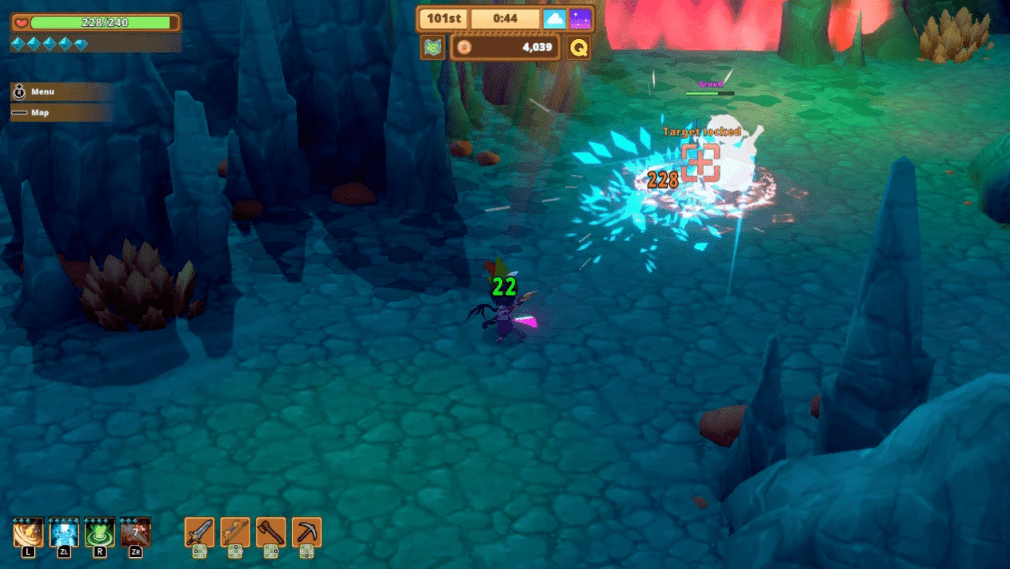
This score should come as no surprise. Kitaria Fables combines Stardew Valley and Cat Quest. I didn’t think of Cat Quest before writing this review (funny how both games have cat protagonists). With Stardew Valley and Cat Quest as inspiration, Kitaria Fables has a high gameplay loop score. All enemies (including bosses like the one pictured above) respawn at the beginning of each day, so it’s easy to grind Nyan to god-like powers.
Kitaria Fables has a couple of obtuse missions. I was stuck a handful of times and used trial and error to figure out what the game meant for me to do. But those moments were few and didn’t detract from the overall experience. And the NPCs rebooted their routine every in-game day in addition to the enemies respawning. If I couldn’t figure out something one day, I could try again the next. This is one of the reasons why Kitaria Fables is a cozy game. It induces little to no stress.
Narrative: 3/10
The Empire, the Calamity, Capital City, and other generic terms left me wanting. Kitaria Fables doesn’t have much of a story, and the story it has can get grown-inducing. I’m unsure if this lack of story comes from poor localization or if Kitaria Fables wanted generic names and storylines to make it easy for people from different backgrounds to follow. Either way, I’m unimpressed. Kitaria Fables has one big twist. I won’t spoil it here, even though that’s unnecessary. The big reveal is obvious.
Storytelling: 5/10
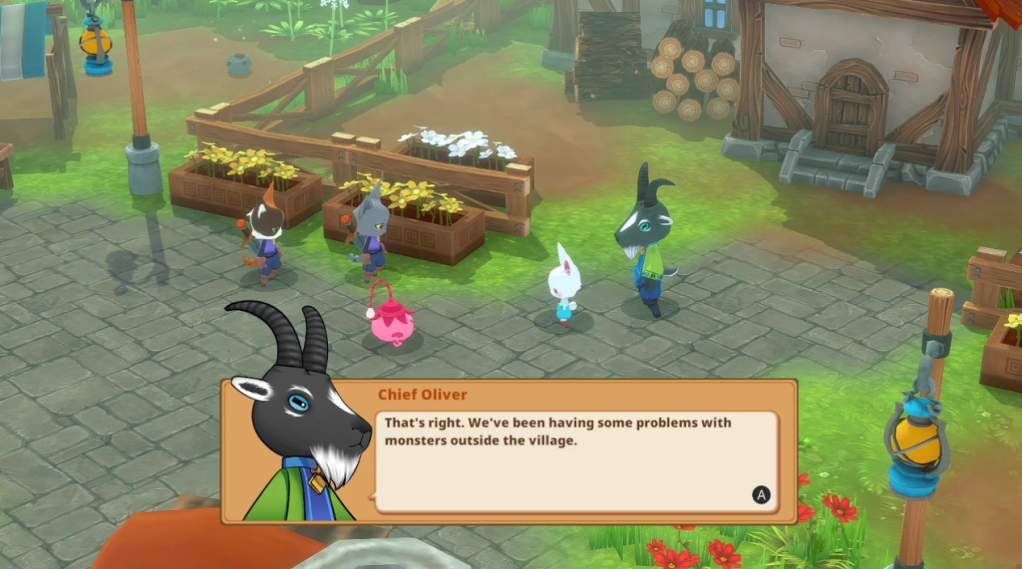
I can’t tell which score should be higher, narrative or storytelling. I’m giving storytelling an average score. That seems right. Kitaria Fables does a good job of executing its story, but it just has a forgettable story. Still, look at the adorable animal people. I love characters like Caramel, a brown furred mouse child who lives in Paw Village. Caramel will ask Nyan for a piece of candy. If you give him candy, you’ll unlock a mission. If you refuse to give him candy, you’ll unlock a different mission. This happens to be one of the obtuse story branches I mentioned in the gameplay loop section. You can unlock both missions. All you must do is interact with Caramel on two different occasions.
User Interface: 8/10
Kitaria Fables has an easy-to-use interface. During combat, Nyan will have items (to include healing items) and spells/moves assigned to hot keys. While not in combat, Nyan can pull up a menu (on the left-hand side of the screen) that will have clearly marked tabs. Players will receive different options depending on whether Nyan interacts with an NPC or an object (like a mirror to change Nyan’s appearance) or doesn’t interact with anything.
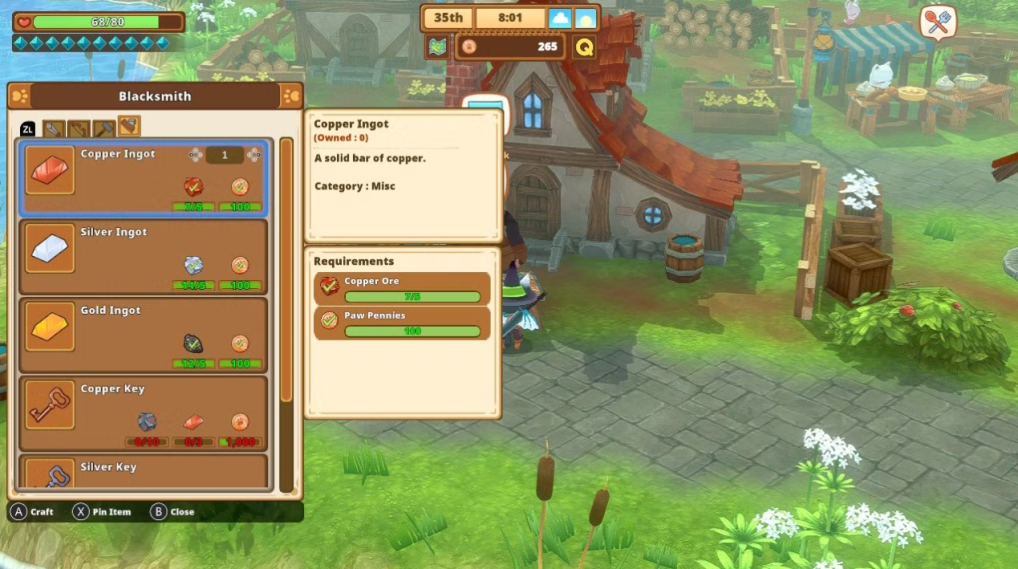
Players can pin items (if they find them in a store) to know how much of an item they need for an upgrade. This is standard stuff, but you’d be surprised how many games forget to include a pin object option. Kitaria Fables does a great job of incorporating good practices from other games with its user interface. The only reason I knock the game down a point is the Switch version. If you pick up Kitaria Fables on PlayStation 4 or Steam, go ahead and raise this score. The Switch version isn’t too difficult to navigate, but it’s lacking.
Graphics: 8/10
Kitaria Fables features charming graphics, but it doesn’t take top marks because Twin Hearts may have lowered the graphic quality to fit on the Switch. Honestly, if Kitaria Fables exclusively came out for the Switch 2 and PlayStation 5 (three or four years later), the graphics score could be even higher. Older systems may have held back the graphics, but that doesn’t mean that Kitaria Fables’ look is anything but enchanting.
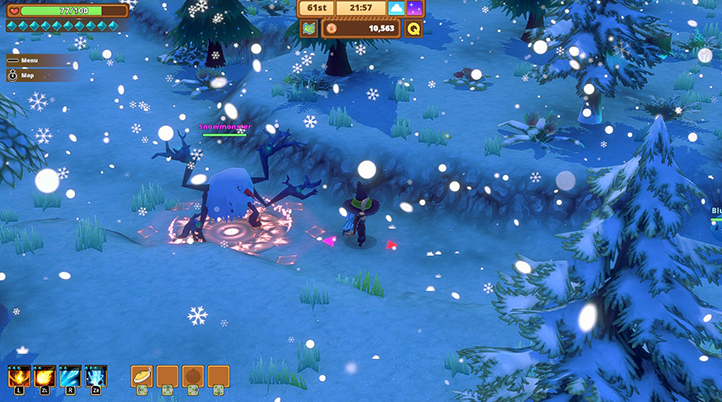
I also love Kitaria Fables’ colorful world. Each zone feels unique: lush forests, dank swamps, and barren deserts. Kitaria Fables mixes up its enemies in quirky ways to match the various biomes. Despite some technical limitations, Kitaria Fables has gorgeous graphics.
Audio: 8/10
When I first booted Kitaria Fables, the music didn’t grab me. It was there and pleasant. But the more I played, the more Kitaria Fables’ soundtrack grew on me. Kitaria Fables’ soundtrack isn’t one of those wow you when you first hear it soundtracks. It’s one of those slow-burning soundtracks. I wasn’t surprised to see the Kitaria Fables’ soundtrack available on vinyl. It can be infectious.
Replay Factor: 6/10
I enjoyed my time with Kitaria Fables. Heck, I blew through the game in a few days and picked it up on multiple platforms. But I wouldn’t call Kitaria Fables a game with high replay value. I can hope that I’ll forget specifics about Kitaria Fables and return to the game in several years. While a solid game, Kitaria Fables’ linear story (with no alternative storylines) makes it a one-time play game. And that’s okay.
Aggregated Score: 6.6
Kitaria Fables delivers a well-constructed video game that combines elements of Stardew Valley and Cat Quest. I enjoyed a lot of the colorful characters and the gorgeous set pieces. And cats, who doesn’t love cat people? While I wouldn’t expect a game with a ton of replay value, Kitaria Fables is a great one-time play game, especially if it’s on sale.
Happy Indigenous Peoples’ Day! Geekly is marking the occasion by listing some of our favorite indigenous video game characters. Hey, hey! Kyra Kyle here. This list was a little more difficult to compile than one would first expect. There are plenty of indigenous people in video games. Unfortunately, many of them lean into cultural stereotypes. We’ll do our best to avoid stereotypical indigenous video game characters. With that disclaimer in place, let’s get to our list of 5 famous indigenous video game characters.
Honorable Mention: Poundmaker (Civilization 6)
Pîhtokahanapiwiyi, better known by the title of “Poundmaker,” doesn’t quite make our list because he was an actual Cree leader during the late 19th Century. Poundmaker advocated the rights of indigenous people at a time when the Canadian government was starving them and encroaching on their land. Though he didn’t hold his position for long, Poundmaker would be arrested for alleged treason. He was exonerated in 2019. Poundmaker earned the respect of the indigenous community. When Civilization 6 added the Cree as a playable civilization, they gave the honor of Cree leader to Poundmaker, a real-life Cree hero.
5) Connor (Assassin’s Creed Franchise)
Ubisoft didn’t play it safe when they moved the Assassin’s Creed story to the American Revolution. Instead of glorifying the colonists, Assassin’s Creed 3 shifted the focus toward how indigenous people were affected by a morally ambiguous war that had nothing to do with them. Ratonhnhaké:ton (aka Connor) is an assassin who worked tirelessly to defend his people from colonial oppression. Connor is divided between two worlds, which provides an interesting and unexplored perspective in video games for one of the most significant wars in American history.
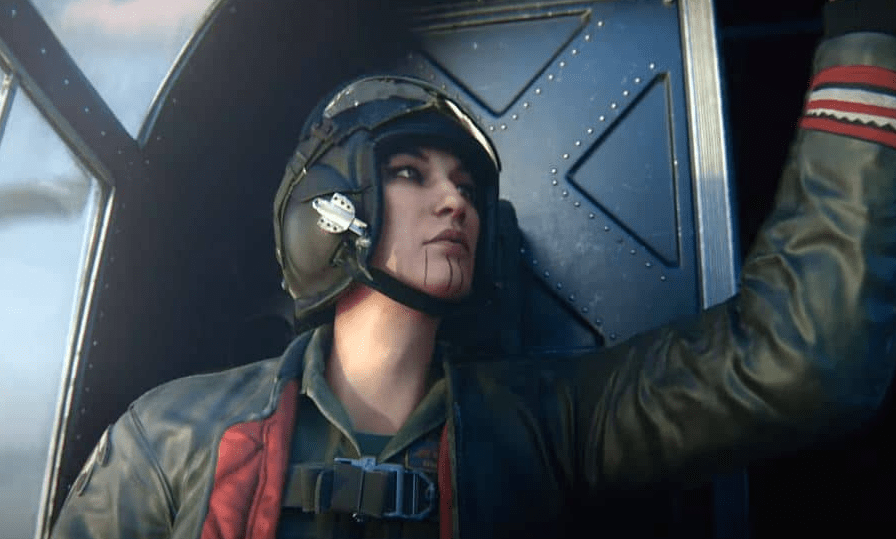
4) Mina “Thunderbird” Sky (Rainbow Six Siege)
Video games don’t tend to feature indigenous characters. This trend goes double for indigenous women, so Rainbow Six Siege‘s introduction of Mina “Thunderbird” Sky was a boon. Mina Sky is a Canadian Air Force pilot originally from the Nakota tribe of Saskatchewan. She proudly wears traditional facial tattoos of her people. Her codename “Thunderbird” derives from an old legend about a powerful bird that often protected the Nakota people. Thunderbird is a fitting name for an operator who protects her Nakota and Rainbow Six families.
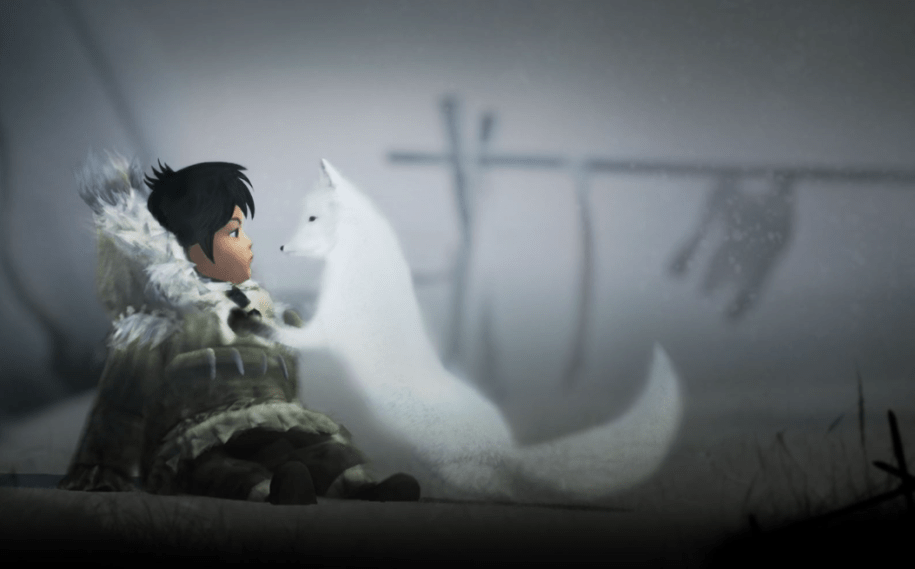
3) Nuna (Never Alone)
Upper One Games’ Never Alone takes inspiration from a famous Inuit legend. The hero seeks an end to perpetual winter. While traditionally the hero is portrayed as a man, Never Alone casts the role to a young girl. Nuna has to face harsh Arctic weather with only a white fox for company. She faces trials from puzzles to combat, but proves resilient. Rather than using skill points, Never Alone doles out progression through the telling of Inuit stories. This is fitting with the game’s theme of keeping cultural stories alive.
2) Thunderbird (Thunderbird Strike)
The Thunderbird is a mythological creature for various indigenous cultures. Often portrayed as an eagle-like creature, the thunderbird has immense power and serves as a guardian of the natural order. Game designer Elizabeth LaPensée takes this setup for her game Thunderbird Strike, where players control the legendary bird as it defends the land from the oil industry and restores life. Thunderbird Strike modernizes a famous legend and addresses real-life issues of industrial encroachment on indigenous land.
1) Tommy Towadi (Prey)
The original Prey (2006)–not Bethesda’s 2017 spiritual successor, also called Prey–had a story built around an odd mix of indigenous spiritual beliefs and science fiction. It shouldn’t come as a surprise that the game has an indigenous protagonist. “Tommy” Towaldi can spiritually reach places others can’t. He often uses this skill to evade death and outwit his alien captors. Interestingly, a game in 2006 featured an indigenous protagonist. Most games that included indigenous characters in 2006 would’ve put them in stereotypical clothes. Tommy wears a leather jacket and jeans. He happens to be indigenous, and Prey (2006) explores his culture well. Almost two decades later, and Tommy still resonates with gamers.
So, what do you think? Who are your favorite indigenous video game characters? Are there any games that feature indigenous characters we should try? Let us know in the comments. Thank you for reading, and wherever you are, I hope you’re having a great day.
August 2nd just happens to be International Beer Day. Who knew? Hey, hey! Kyra Kyle here. To celebrate this holiday (or observance) that I just found out about, we’ll be breaking down the Top 5 fictional beers in video games.
Quick content warning: We’ve noticed that video games that name fictional beers often travel into crude territory. We tried to tone down the gross-out humor and sexual content, but there may be a few mentions in this post.
After applying the restriction of one fictional beer per video game franchise, I found this list difficult to compile. Numerous video games include beer, but they often give it the generic name “beer” or have a sponsorship with a real-world beer brand. The games that create their own beer brands typically have more than one fictional beer brand, and then there are near beers. Nuka-Cola Dark is the Fallout universe’s favorite soft drink, blended with rum. That’s not exactly a beer. With that said, we were able to find five of the tastiest fictional beers in video games.
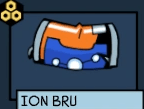
5) Ion Bru (Void Bastards)
Void Bastards is a well-received sci-fi first-person shooter inspired by BioShock. If nothing else, I may be finding more video games to put on my to-be-played list. Void Bastards has some interesting game mechanisms I’d like to try. Ion Bru pokes fun at Scotland’s second national beverage (second only to Scotch), Irn-Bru.
Unfortunately, I don’t believe anyone drinks Ion Bru within Void Bastards. The can pictured before this entry is used as an upgrade material. Ion Bru is included in the following recipes: air freshener, colon cleanser, and germspiker. Germspiker and colon cleanser? Are we sure we should be drinking Ion Bru?
4) Mazte (Elder Scrolls Series)
Typically, the Elder Scrolls series calls its beers by a generic name, or it replaces beer with mead. But the Elder Scrolls does have a beer from Morrowind: Mazte. I know. I know. Mazte may be the Dunmer name for beer, but it’s unique enough to make this list. And we’re striking out on beer brands for this list. Ion Bru may not be a drink people consume, matze may not be a brand, and I don’t know about the next entry. I love Morrowind, so mazte takes the fourth spot.
According to its entry in the Morrowind guide, Mazte is a local beer brewed from fermented saltrice. Cheap, plentiful, and invigorating, this beverage is popular, despite its dulling effect of wit and judgement. For the price, folks are willing to feel dumb and weak-willed, so long as they feel strong. Sounds like beer to me, but fermented saltrice? I don’t know about that. It might raise my blood pressure.
3) Pißwasser (Grand Theft Auto Series)
Grand Theft Auto is one of those video game series with plenty of beer brands. Even Sprunk Cola has its own alcohol variant, which may venture into Nuka-Cola Dark territory. So, we decided to go with Pißwasser. I know. I promised tasty fictional beers. Pißwasser may not fit that bill.
Pißwasser (or Pisswasser) made its first appearance in Grand Theft Auto IV and has been a staple in the series ever since. The German import lager is advertised everywhere. You’ll hear about it on the in-game radio and see it on television or billboards (many of which have suggestive themes; I didn’t include one billboard that may show a woman recycling what she drank–ew). The name suggests that Pisswasser doesn’t taste great, but everyone in the GTA universe loves it. You can even purchase stocks of the brand and try to get rich.
You may be in for a good time. Whoops! I butchered the tagline. You’re in for a good time with Pisswasser. Yuck. Just make sure you don’t drink too much, or else you’ll stumble and lose your bearings and maybe worse.
2) Gamma Gulp Beer (Fallout Series)
While Gwinnett has an entire line of beers in Fallout 4, they don’t capture the imagination as much as Gamma Gulp Beer from Fallout 2 and Fallout Tactics. This beer hasn’t been seen much in the series since, but that could change. I would love to see an updated Gamma Gulp in Fallout 5 or even Fallout 76. Make it happen, Bethesda.
Just look at the happy ghoul in the picture above. How can you resist a sip of Gamma Gulp? Come to think of it, the Fallout universe must’ve started brewing Gamma Gulp after the bombs fell. That or they predicted ghouls. Interesting.
1) Poseidon Pilsner (BioShock Series)
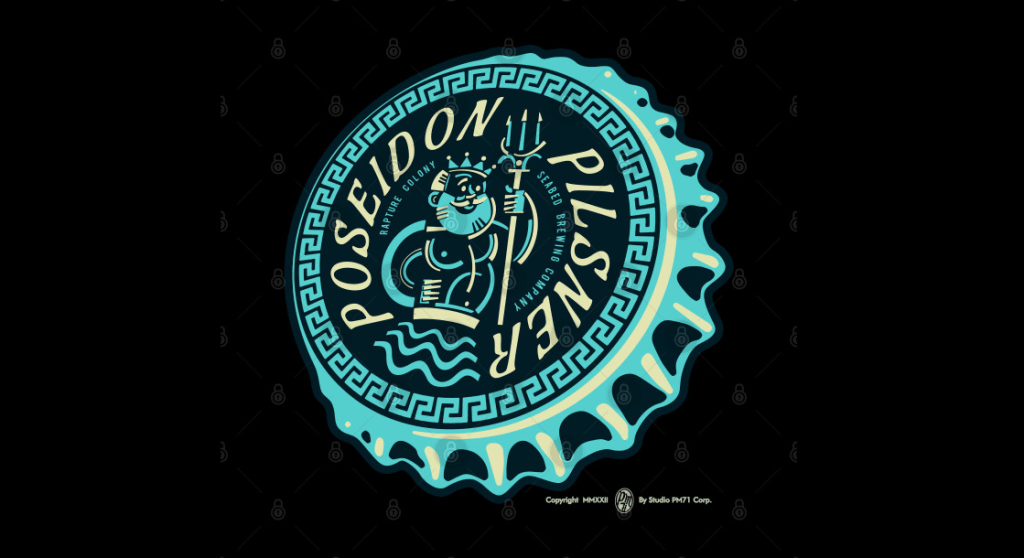
Poseidon Pilsner had to take the top spot because it inspired a brewery in California of the same name. Poseidon Pilsner made its first appearance in BioShock. Most of Rapture’s bars sports the pils; there are even bars named after the beer.
I like how BioShock layered the above Poseidon poster over an advertisement for 123 Beer, which is another beer that could’ve made this list if we didn’t have our pesky one beer per franchise. Poseidon gets the nod because it’s the only beer on this list–so far–that has inspired a real-world brewery. I’m going to be honest. If a Pisswasser becomes a thing, I may have to try a sip.
That’s our list. Which video game fictional beers would you include on this list? Let us know in the comments. Thank you for reading, and wherever you are, I hope you’re having a great day.
Today is Shark Awareness Day. Geekly’s celebrating by listing the top five sharks that originated in video games. Things are about to get fishy.
Hey, hey! Kyra Kyle here. With today’s list, we won’t include all sharks in video games. These are the sharks that originated in video games. So, we won’t include King Shark, Jeff the Land Shark, or Jaws, because they started in comic books or in the movies and then made their way over into video games. We’re talking straight video game sharks.
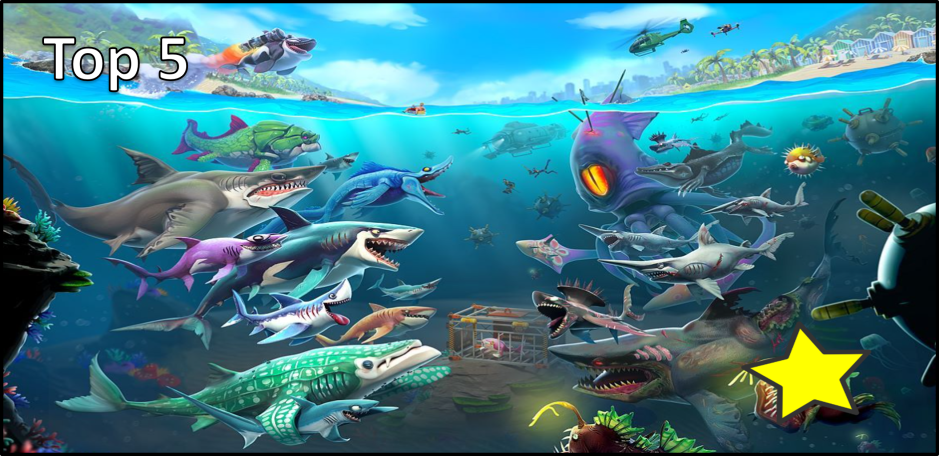
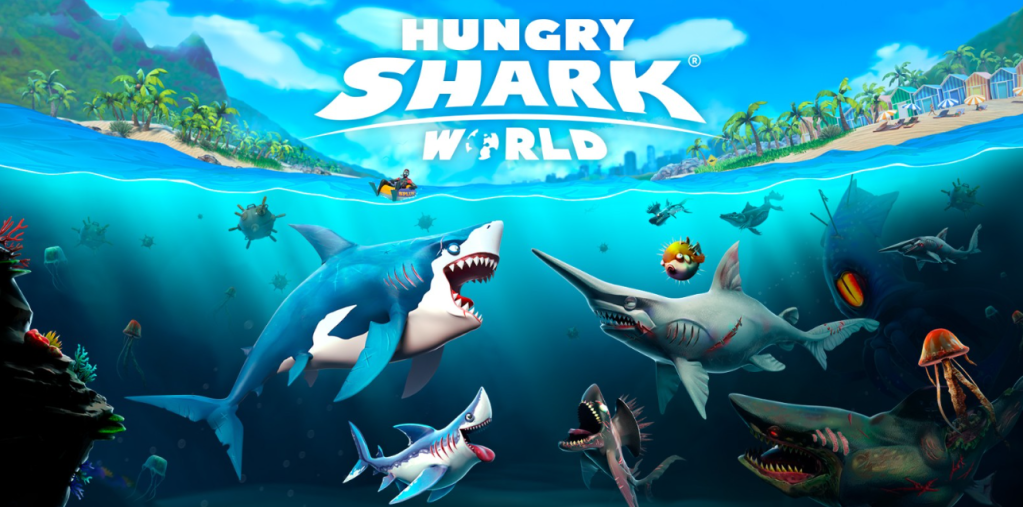
Honorable Mention) Sharks from Hungry Shark World
None of the sharks in Hungry Shark World have names, but this game may be one of the highest-rated games where gamers play as sharks. The game features numerous fun maps and 30 species of sharks that players can customize into their own cuddly predator. Hungry Shark World just misses our list because there isn’t one specific shark to feature. Instead, Hungry Shark World pits gamers’ shark creations against unique enemies.
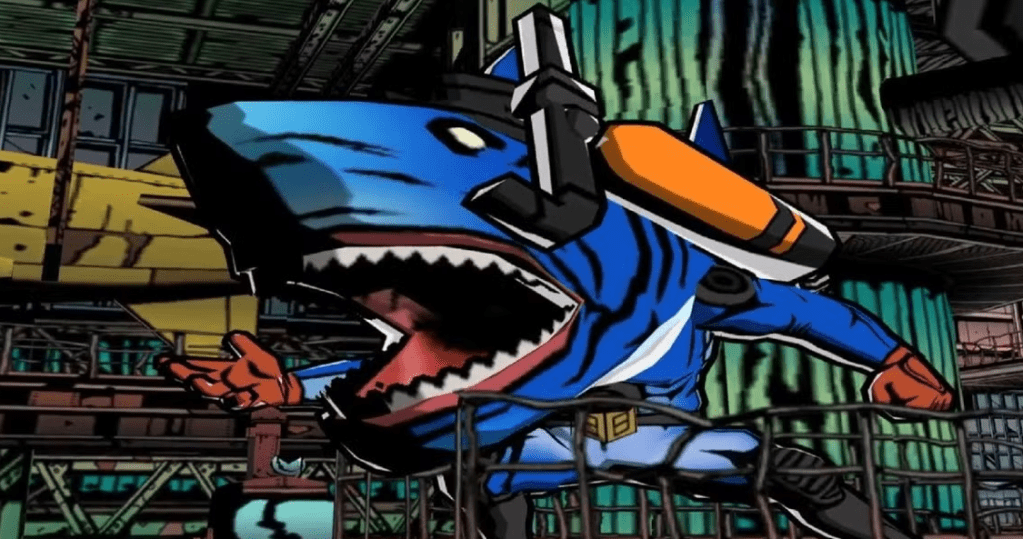
5) Gran Bruce (Viewtiful Joe)
Gran Bruce is one of the many bosses Viewtiful Joe faces. This shark enemy pays homage to the world’s most famous movie shark, Jaws. Steven Spielberg’s crew gave the prop sharks on the set of Jaws the nickname Bruce. Players can even trigger an explosion in Gran Bruce’s mouth, which was how Jaws was defeated at the end of the first film. Gran Bruce may be little more than a dim-witted boss for Joe to slap down in the first game, but he also had a role in the Viewtiful Joe anime, which makes him one of the few gaming sharks to crossover into other media.
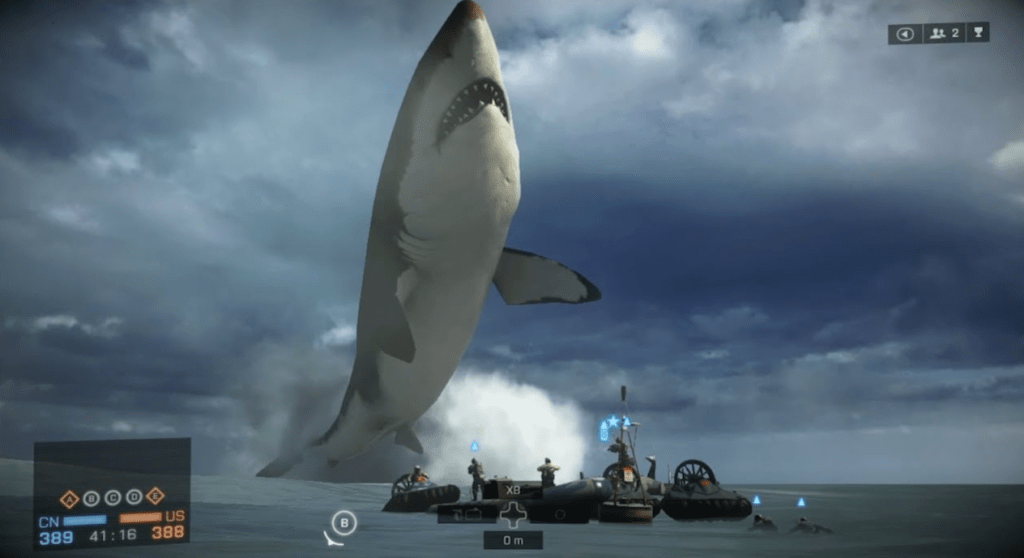
4) Megalodon (Battlefield)
What started as a joke in the Battlefield series became a random appearance of a Megalodon shark in the game. The Megalodon is one of the largest creatures to ever prowl the seas, so of course, this ancient beast lurked in one of Battlefield’s maps. It didn’t help that gamers photoshopped a large shark in some of the gameplay. The gag became reality when Battlefield 1 included a Megalodon in its mission “They Shall Not Pass.” The rest is history. Or prehistory.
3) Lurker Shark (Jak and Daxter)
Many video games during the early 2000s would prevent heroes from swimming beyond the limits of the game world with an invisible wall. Jak and Daxter decided to ward off would-be cross-game-world swimmers by having a shark eat them alive. While the Lurker Shark made its biggest impact in the first game of the Jak and Daxter series, it would return in Daxter in a variety of shapes and sizes. It even has a brief cameo in Jak 2.
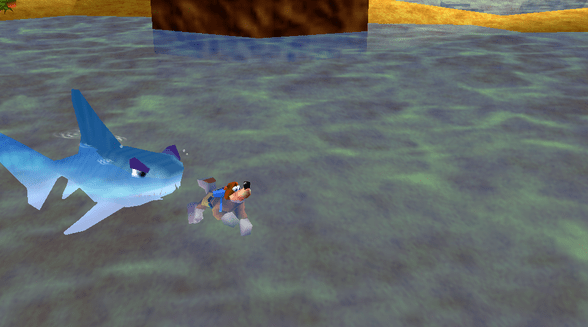
2) Snacker the Shark (Banjo-Kazooie)
Snacker the Shark serves the same purpose as Lurker Shark in Jak and Daxter. Snacker is a clever way to keep Banjo and Kazooie within the limits of their game world. Snacker makes two appearances in the original Banjo-Kazooie, but he made his debut in the Treasure Trove stage, spouting one-liners and taunting players before he eats them. Like Gran Bruce, Snacker also pays homage to Jaws with his Jaws-inspired theme song. He’s cute even while he devours you.
1) Tiny (Batman: Arkham City)
While investigating the Penguin’s lair, Batman runs into a great white shark ironically named Tiny. This encounter is one of the most blood-pumping moments in Batman: Arkham City. Batman must carefully cross a body of water without being eaten alive by Tiny. Looks like Bats forgot the shark repellent. Never leave home without it. Despite a brief appearance in Batman: Arkham City, Tiny made an impact. The series brought him back with a jump-scare sequence in Batman: Arkham Knight.
I may have listened to the Jaws theme song while putting together this list. Which video game shark is your favorite? Let us know in the comments. Thank you for reading, and wherever you are, I hope you’re having a great day.
U-S-A! U-S-A! U-S-A! The United States of America celebrated its Independence Day yesterday, so we’re celebrating belatedly by listing our picks of the top 5 video game characters that use a red, white, and blue color palette.
Hey, hey! Kyra Kyle here. We’re doing something a little different with today’s Top 5. It’s no longer the United States’ Independence Day, but who are we kidding? Someone will be lighting fireworks tonight. We can set off a few of our own with these top 5 red, white, and blue video game characters.
5) King Dedede
Video game designers may have ulterior motives when selecting their characters’ color palettes. Nintendo certainly did with King Dedede when they introduced him to the Kirby franchise. Visually, he combines Santa Claus’s outfit, a bald eagle’s beak, and John Henry’s hammer. Personality-wise, King Dedede is a glutton, selfish, and hostile toward the color pink. In short, he’s all American.
Take that, you pesky amoeba. King Dedede won’t be the only video game villain who wears red, white, and blue. ‘Murica!
4) Blinky (a.k.a. Shadow)
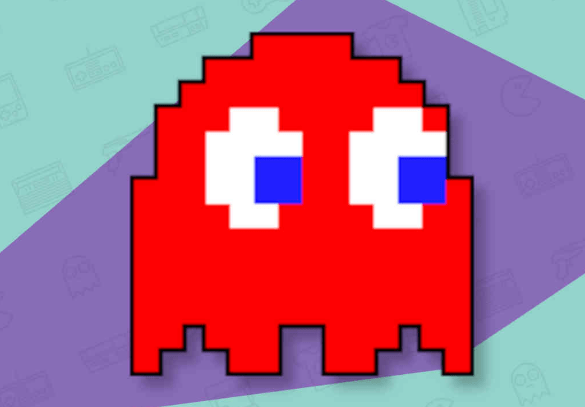
Blinky (from 1980’s Pac-Man) may not be the first character you think of when discussing red, white, and blue video game characters, but he is classic. Shadow is the leader of the team of ghosts (they’re actually monsters) who chase Pac-Man. While Pinky (Pink) and Inky (Cyan) attempt to ambush Pac-Man by taking routes the player doesn’t choose, Blinky chases our protagonist and applies pressure.
Shadow is the most aggressive of all the ghosts (monsters) and the most dangerous. When players get caught, they’re usually caught by Blinky. He has true American vigor. He races to chop down Pac-Man like George Washington chopped down a cherry tree.
3) Dr. Wily
Wow! Are there any video game heroes who use a red, white, and blue color scheme? Yes. They’re next on our list, but we have one final video game villain before we reach them: Mega Man’s Dr. Wily. Before Dark Souls, Dr. Wily pushed gamers to “get gud.” I don’t know how many times I attempted a Mega Man level, only to leave my palms sweaty after countless hours. Thank you for making me a better gamer, Dr. Wily. I salute you.
Dr. Wily also happens to have an advanced degree, adding to a long line of PhDs with nefarious plans. You’d think universities would weed out these bad eggs before they graduate. Oh well. If Wily’s university had expelled him, we may not have gotten a killer robot dragon in Mega Man II.
2) Sonic
Sonic is Sega’s mascot. Ever since the speedy hedgehog raced onto game consoles in 1991, he’s worn red and white shoes, white gloves, and he has blue fur. Very patriotic of you, Sonic. Sonic is ubiquitous with Sega. He’s the first character–and possibly only character–one would think of with Sega Games.
It also doesn’t hurt that Americans are an impatient bunch. Sonic’s speed gets you those rings now. Not later. Now! Hot dogs, muscle cars, and Sonic the Hedgehog. Is there anything more American?
1) Mario
Yeah. We couldn’t go with any other video game character than Mario. You probably read this list and already knew the fictional plumber would top this list. Mario has always featured red and blue. Even in his short stint as “Jumpman” in his Donkey Kong debut (1981), he was always pictured on the video game cabinet to be wearing white gloves, even if the hardware at the time couldn’t effectively render those pixels.
You know you’re a big deal if people know you mononymously. If you utter Mario, most people will picture a plump plumber, wearing a red shirt and hat with blue overalls. Since Mario wears red, white, and blue, he tops this list. It also doesn’t hurt that Mario is often seen with stars. Talk about a Star Spangled hero.
Did we get the list right? Which red, white, and blue color palette video game characters should make this list? Let us know in the comments. Thank you for reading, and wherever you are, I hope you’re having a great day.
Another week and another video game review of a game I’ve played a lot. It’ll be difficult to remain objective while discussing Onirim, but I’ll do my best. Usually, I delete Solitaire from my mobile devices and replace it with Onirim. You can find me in line playing a few games of Onirim. Like I said, I play Onirim a ton.
Hey, hey! Kyra Kyle here. At its core, Onirim is a solitaire game, which is why I replace Solitaire with this title. While this video game is a fun twist on classic Solitaire, Onirim remains a solitaire game, a tabletop card game converted to an app. How will it fare with our review criteria? Let’s find out.
Mechanisms: 10/10
Be honest. You saw this coming. Like I said, Onirim is an interesting twist on classic solitaire. The deck has four suits, each suit has four card types, here’s where the theme comes into play. The player is traveling the dream world (hence the name Onirim, a take on oneiric) and needs to safely escape the land of dreams by opening three doors in each suit. If you draw into a suit’s door and have a matching key, you may open the door. If you don’t have a matching key when you draw a suit’s door, you draw another card and shuffle the door back into the deck. This is where the digital version of Onirim trumps the physical version: shuffling.
During a game of Onirim, you’ll often shuffle the deck. Nightmare cards (which don’t belong to any of the four suits) may be drawn. Bad things will happen when a nightmare appears (it’ll be up to the player what happens exactly), and if the player draws extra nightmares in a turn, any nightmares beyond the first also get shuffled back into the deck. There’s a lot of shuffling, and the digital app does all that shuffling for you. Typically, I prefer a physical tabletop game over a digital version of that same game, but Onirim enhances this already stellar game.
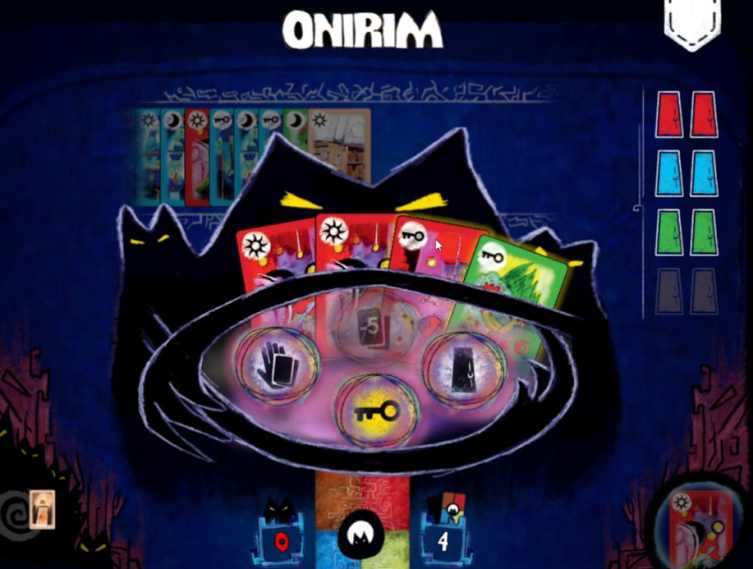
Since the player has choices when a nightmare card gets drawn, Onirim provides player agency and adds a layer of strategy. The remaining two card types (in the base game; there are expansions that we won’t discuss here) are suns and moon cards in all four suits. Suns are the most common card type. Moons are less common. And the rest of the game is playing three cards of the same suit but with different symbols, in the top play area. When that happens, the player searches for a door card in that suit, and then reshuffles the deck. Yes. More shuffling. I love playing the Onirim video game.
Above Image from GameDesigning.Org
Gameplay Loop: 10/10
Onirim games play fast, and each game is unique. The simple premise, the colorful twist on solitaire, and the options a player has once a nightmare card is drawn grant Onirim a high gameplay loop score. I don’t mind waiting in line while playing Onirim. And like I said, I replace Solitaire with Onirim. Obviously, this game’s gameplay loop is fantastic.
Narrative and Storytelling : 3/10
We’re combining narrative and storytelling for Onirim because Solitaire doesn’t have any story. Onirim has an intriguing premise. The nightmare cards and doors needed to escape the dream world, hint at a greater story, but I can’t give Onirim top marks in either of these categories. This is partly why I combined the two. But Onirim does just enough to not get below a three.
User Interface: 8/10
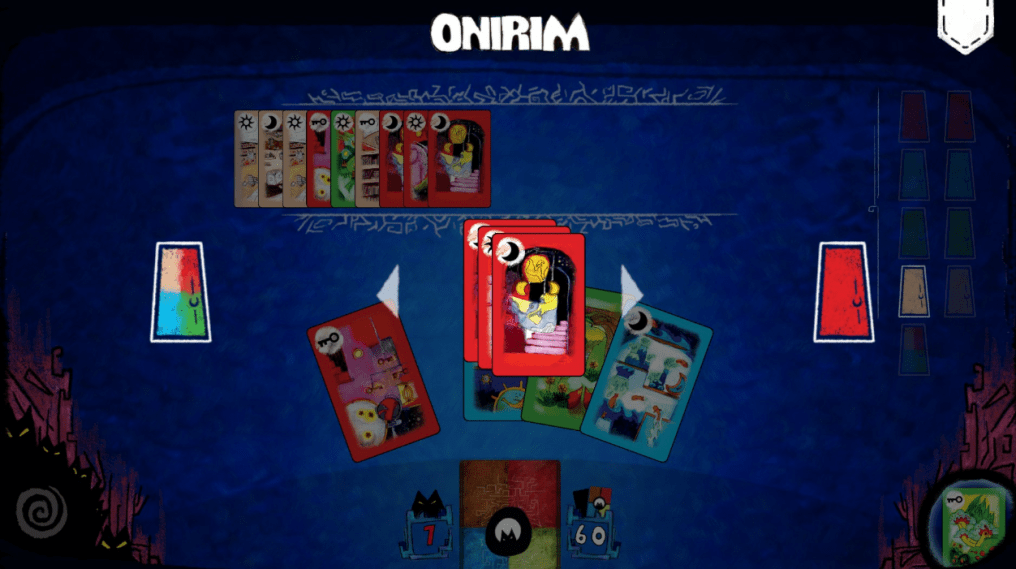
Onirim has a clean look. The play area up top is easy to see (the image above includes an expansion, so there’s a card type, the whirlpool, that I haven’t mentioned). Your hand is visible below the play area. Beneath your hand, you’ll find how many nightmare cards remain (the black demon with the red number on the left, and how many cards remain in the deck; you lose if you run out of cards before opening all twelve doors). The filled-in cards let you know which doors have been opened, and the top right corner is where you can access the main menu. Clean. Easy to read.
I lowered Onirim just a hair for the User Interface because of how difficult it can be to navigate all-time statistics. This isn’t a big deal for a lot of players, but if one becomes invested and explores that rabbit hole, one would want an easier set of menus.
Graphics: 6/10
Onirim has amazing graphics for a solitaire game. But it’s still a solitaire game. Onirim does what it can within the confines of a card game, but no matter how good the cards look, they’re still cards. That said, Onirim may be the prettiest card game I’ve seen. It has to get an above-average score.
Audio: 5/10
Onirim is another game I play with the sound off. The soundtrack is atmospheric, but kind of blends into the background. The sound effects could–and probably should–boost this score even more. But I’m going to stay as objective as I can. While the shuffling effect can be satisfying, you’ll hear it a lot, and it can also detract from the experience. There’s so much shuffling.
Replay Factor: 10/10
Since Onirim is Solitaire with a twist, you’ll find it difficult to play only one game. The app keeps track of your all-time stats, so I end up trying to beat my all-time best, and if that happens, I’ll try raising my overall win percentage or how quickly I typically beat the game. Solitaire with stats. That’s a rabbit hole. It also gives Onirim high marks in replay value.






































 jkgeekly.com