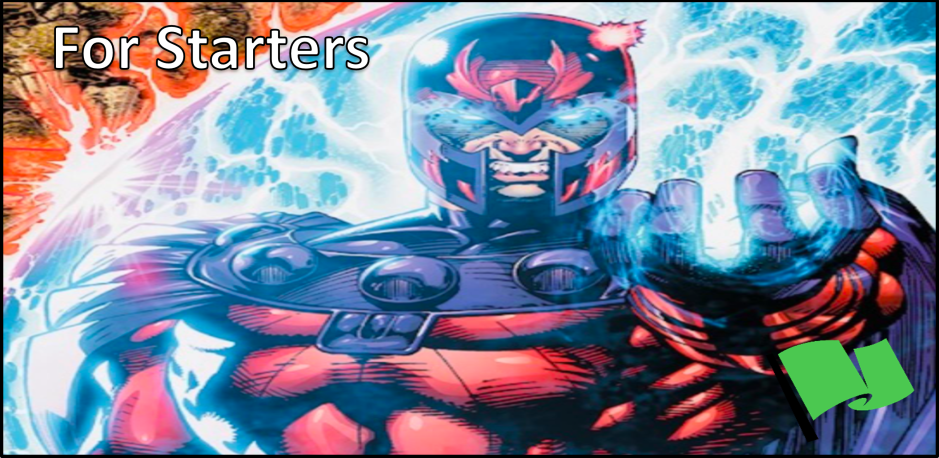
Getting Into Comics: Magneto Starter Stories

Hey, hey! Kyra Kyle here. Today is my youngest daughter’s birthday. Happy 24th birthday! One more year and you can rent a car. Is that still true? Anyway, I wanted to bring back the comic book starter stories and asked her which character she’d like me to cover this week. She answered Magneto.

You heard the girl. Geekly will be covering its first comic book starter stories for a supervillain. We may have some growing pains with this topic. Villains are a little more difficult to recommend starter stories for, but I’ll do my best. The following list should give you an idea of which stories you should read to get to know Magneto better.

Single Issues

We’re doing this list a little differently than prior starter comic book stories. We’ll start with single issues and then move on to story arcs that consist of multiple comic books.

Uncanny X-Men #1

(written by Stan Lee/art by Jack Kirby; 1963)

This first entry cheats a little bit. Uncanny X-Men #1 is the first appearance of Magneto and the X-Men. Since the issue does double duty and sets up Magneto and the X-Men, there’s less of a focus on him as the main villain, but Uncanny X-Men #1 does a great job of showing Magneto as a formidable foe.

You don’t have to break the bank to read the first X-Men story. Marvel has reprinted it plenty of times. You should even be able to read Uncanny X-Men #1 for free online. If you did want to own a physical copy, Uncanny X-Men #1 would cost you hundreds of thousands of dollars. X-Men didn’t have the warmest of receptions when it first launched. This makes the comic rare and valuable. Ka-ching!

I, Magneto

(Uncanny X-Men #150, written by Chris Claremont/art by Glynis Wein, Dave Cockrum, Dan Crespi, and Tom Orzechowski; 1981)

Magneto started out wanting a world where mutants dominated over inferior homo sapiens, but in “I, Magneto,” Magneto sets out for what he wanted all along, to become everyone’s leader. In this story, Magneto wants no less than the planet making him the world’s leader.

Magneto enlists the help of a series of supercomputers, but when those computers begin to explode, Magneto becomes furious. Kitty Pryde has been blowing up his computers by phasing through them. In a fit of rage, Magneto nearly kills her. Magneto sees a lot of himself in Kitty Pryde, since they have a similar heritage. When Magneto sees himself as the monster he’s turned into, he realizes that he isn’t fit to lead the world.

The Trial of Magneto

(Uncanny X-Men #200, written by Chris Claremont/art John Romita Jr.; 1985)

Claremont does a great job with the Uncanny X-Men’s bicentennial issue. As the name suggests (“The Trial of Magneto”), Magneto is on trial for former acts as a “mutant terrorist.” While he stands trial, unknown terrorists leave behind a calling card, “Free Magneto – X-Men.” Professor X sees this message and suddenly falls ill. Cyclops believes Charles is possibly dying.

The terrorist acts serve as a distraction so the Von Strucker twins can attack the court and exact vengeance against Magneto. This puts everyone in the courtroom in danger. Magneto saves everyone in the building. This shows the judge Magneto’s humanity. The scuffle results in Professor X suffering a heart attack. Magneto saves Charles, but Charles insists that he can no longer care for the X-Men. He asks Magneto to take his place.

If you’ve seen the X-Men ’97 cartoon on Disney+, many of these story elements will sound familiar in “The Trial of Magneto.” This story showcases Magneto’s propensity for being a hero.

Story Arcs

X-Men: Magneto Testament #1-5

(written by Greg Pak/art by Carmine DI Giandomenico 2008-2009)

Magneto Testament fleshes out Magneto’s childhood story. This five-issue miniseries doesn’t pull any punches. It shows us Magneto as a young boy surviving the Nazi death machine. As a result, Magneto Testament is one of the bleakest stories Marvel Comics has ever published. It’s also poignant.

Magneto Testament explores what made Magneto the man he is today. X-Men: First Class may dip its toe into this origin, but Magneto Testament digs deeper. This is one of the best Magneto stories ever written and a must if you want to understand Magneto.

X-Men: God Loves, Man Kills

(written by Chris Claremont/art by Brent Anderson; 1982)

I know this story also made our “X-Men Starter Stories” post years ago (here’s a link to that list if you’re interested), but Magneto is an X-Men villain, so there’s bound to be some crossover.

Many consider God Loves, Man Kills the defining X-Men arc, and they may be right. Humanity is the main villain. Humans, through the machinations of William Stryker, launch a scheme to rid the world of mutants. Magneto learns this while investigating the deaths of two mutant children. Magneto then joins forces with the X-Men.

God Loves, Man Kills establishes Magneto’s willingness to do anything to protect mutantkind, even if that means joining forces with his enemies. Stories like God Loves, Man Kills do a lot to deepen Magneto as a character.

Mutant Genesis

(X-Men #1-7, written by John Byrne and Chris Claremont/art by Jim Lee; 1991)

Before Mutant Genesis, Magneto lost his way. He even ran the X-Men and New Mutants for a time. (See the above write-up for “The Trial of Magneto.”) While these storylines helped to humanize the X-Men’s greatest villain, Mutant Genesis brings Magneto back to his roots. He has returned as a powerful villain. During this arc, we see how Magneto’s powers are slowly driving him insane.

But Magneto isn’t alone in his insanity. Mutant Genesis introduces Magneto’s team of Acolytes. These Acolytes pose a huge threat to humanity and even mutant-kind. It also doesn’t help that long-time X-Men begin questioning their loyalty to Professor X’s cause. Mutant Genesis is the final story seminal X-Men scribe Chris Claremont wrote for the series. Without Claremont, the X-Men would not have become the household names they are today.
Planet X

(New X-Men #146-150, written by Grant Morrison/art by Phil Jimenez; 2003-2004)

Magneto disguises himself as Xorn, one of the X-Men’s most trusted members at the time. The X-Men had thought that they had rescued Xorn from a Chinese prison, but it was a ruse. Magneto worked with the Chinese government to infiltrate the X-Men. At the time Magneto was believed dead, making this reveal even more shocking. Planet X shows how clever Magneto can be when putting an elaborate plan into action. This story did a lot for Magneto’s legacy.

As Magneto is the X-Men’s oldest enemy, no one could imagine that he could disguise himself well enough to fool his enemies. In classic mastermind fashion, Magneto didn’t reveal his identity until the time was just right.

There are so many other stories that I could’ve included here. I’m sure I missed one or two, or three hundred. Let me know which Magneto stories you’d choose instead. And wherever you are, I hope you’re having a great day.
Getting Started with Tile Placement Games

Hi, everybody. Kyra’s back with another older write-up that never got posted. This week’s post is a beginner tabletop games. I may add a game or two because there have been countless games that have been published in the six or so years since this write-up was written, but so many people cover newer games. Let’s stick with the older games.

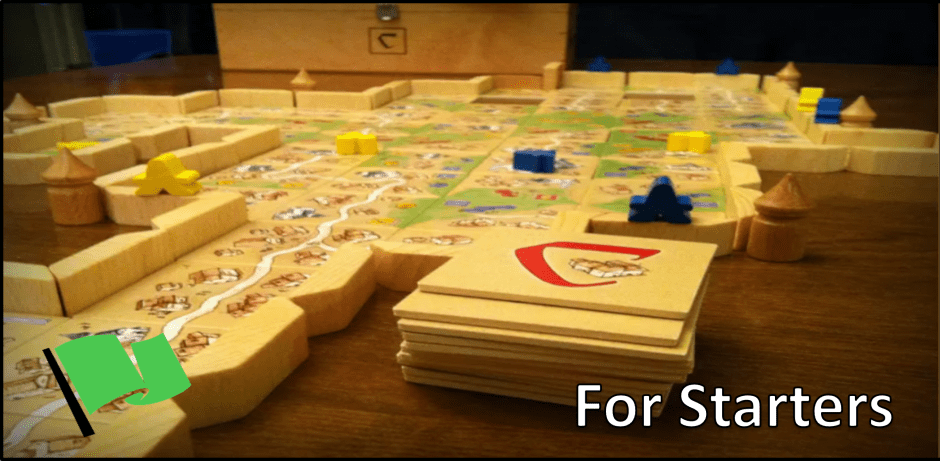
Today we’ll cover tile placement games. A tile placement game is one where players lay or place tiles in groups or patterns to achieve various effects. Usually, but not always, where players lay their tiles will earn them victory points (or just points) needed to win the game.

Okay. The boring part’s over. Let’s get to the games.

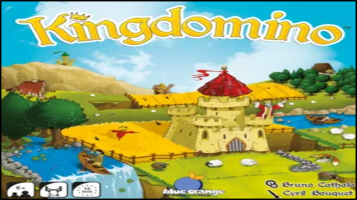
Kingdomino

Kingdomino and not its sister game Queendomino makes this list because Kingdomino is more streamlined and easier to learn. It’s not that Queendomino is all that more difficult to play. If you know how to play Kingdomino, it’s easy to learn how to play Queendomino and progressing from King to Queendomino works with my idea of learning tabletop games with a scaffolding approach. One game that builds on another.

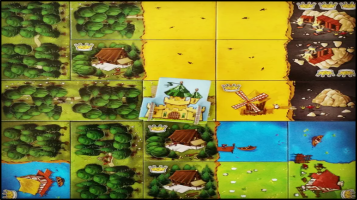
Anyway, in Kingdomino players take on the role of a lord or lady as they try to gain the most land—or the most value tracts of land—by collecting dominos. The dominos in question have numbers on their back denoting how valuable they are and two sections of landscapes on the front (that can be forests, deserts, mines, wastelands, or swamps). Dominos equal to the number of lords or ladies (the players pawns) are placed in number order with the lowest number on top and players take turns selecting dominos and placing them in their kingdom.

I won’t go into much more detail with how Kingdomino balances who picks first each turn, but it’s well done (as one can expect from designer Bruno Cathala). Instead, let’s focus on the tile placement aspect. Players start with a 1×1 tile, their castle tile. All the dominos are 2×1 tiles and when they’re claimed and added to a player’s kingdom, they must share a side with a section of land that shares their type (forests with forests, deserts with deserts and so on); castle tiles count as all land types. Players also can’t exceed a 5×5 kingdom, but their castle doesn’t have to be in their kingdom’s center.

This all makes for some interesting maneuvering, but the scoring mechanism further complicates tile placement. Players count their scores for each region they have in their kingdom. A region is every continuous area of the same land type and there can be more than one region for a land type. Someone could have a forest region of five and another forest region of three. For each of these regions multiply the number of spaces by the region’s number of crowns. Pictures of crowns show up, usually, in higher value tiles. If the forest region with five space has one crown, it’s worth five points, but if there are two crowns in the five-space forest region, it’s worth 10. A region with no crowns yields no points, no matter how big it is, so it’s ideal to get at least one crown in each region.

Kingdomino received the 2017 Spiel des Jahres; it deserved the game of the year.

Tsuro

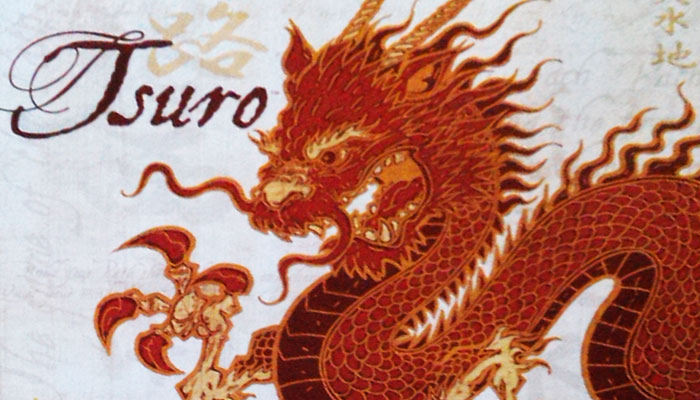
I know I’ve included Tsuro in a previous starter games list (route/network building games), but Tsuro pulls double duty as a great starter tile placement game. Each player has a pawn and their pawns begin the game on the edge of the board (a 6×6 grid). On a player’s turn, they place a tile from their hand—these tiles will have paths on them—on the board continuing the path (or route) their pawn is taking. As soon as a new tile is placed, the player moves their pawn further on the path. The aim is to be the last player with their token on the board.

Players are not only building a route or network in Tsuro, they’re placing tiles to do so, and this simple, elegant game makes for a great introduction to both game mechanisms.

Patchwork

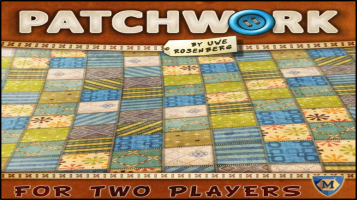
Patchwork remains one of my go to two-player only games to teach people. Sure, the designer Uwe Rosenberg has plenty of games the reimplement the same game mechanisms as Patchwork and other designers have followed suit, but the original Tetris-like tabletop competitive game about making a quilt retains its power.

On a turn, players may spend buttons to buy one of three available polyomino tiles (that are patches shaped like a Tetris piece) and add it to their quilt or pass. It takes time to stitch new patches into a quilt, so players will move their time token closer to the center and when a player’s time token reaches the center, they may take a final turn and the game ends.

There are a few more rules to Patchwork, but it’s a simple, streamlined game that works well with its theme. Who’d think that making a quilt would make a great game? Patchwork’s simplicity masks deep strategies. Do you go for larger patches for more points, but leaving you fewer options with which to place future tiles, or do you go for slow and steady points throughout the game, making sure you fill up as many spaces as possible? The options are endless.

I had to include a polyomino tile placement game on this list. Patchwork may not be as hot of a game as it once was and other games may have taken its place (Bärenpark and even Rosenberg’s own Cottage Garden and A Feast for Odin have even taken Patchwork’s place) for a lot of gamers, but it’s still a great starter tile placement game.

Azul

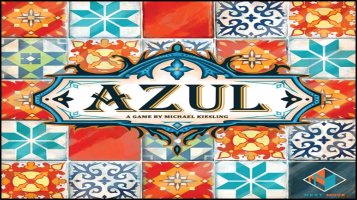
Azul is another game that I included in a previous list of great starter games (Card Drafting Games), but it works for tile laying as well. In fact, Azul’s theme is tile laying a Portuguese wall. Players draw tiles from a bag and four of them are placed on 7 cardboard discs that are accessible to each player. Then, players take turns claiming similar tiles on each disc and adding them to their player boards (that represent the walls the players are tiling). Each board has the same wall pattern and the player to finish a row of tiles initiates the game’s end.

Again, Azul can be classified as card (or tile) drafting and that’s a core ingredient to the game as well as set collection and chain effects, but the combination found is Azul is so unique for a tile placement game that I had to include it on this list.

Chomp

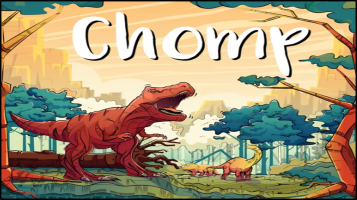
This is the newest game of the list and the only one I added to the original post. I played Chomp a week ago for the first time. Chomp refers to the 2023 Allplay title, not the 2000 food chain card game Chomp! from Gamewright. In Chomp (without the exclamation point), players build a dinosaur biome by laying tiles with dinos, plants, tar pits, and other things you may find in the age of the dinosaurs.

Players must build their land so that herbivores have plants to eat, and carnivores have herbivores their size that they can eat. Dinos of the same type that are placed adjacent to other dinos of their type form a herd. Players can chain as many of these dinos together as they can to form massive herds and potentially earn big points.

Any dinos placed next to tar pits automatically die at the end of nine rounds (I played with 3-players, there may be more or fewer rounds at different player counts), so be careful where you place tar pits. But you may want your dinos to perish. Each tile is double-sided. One side depicts the land you’re placing, while the other gives the player a scoring option. Each game, players must balance whether they want to play or score the tile they pick up that round. Such a great twist.

Final Thoughts

We had a couple more games in this starter board game list than usual, so I hope there’s something here you’ll enjoy.

Know of any other great beginner tile placement games? Are there any games on this list you disagree with? You can place your suggestions and complaints in the comments.

Getting Into Spider-Man: Spider-Man Starter Stories

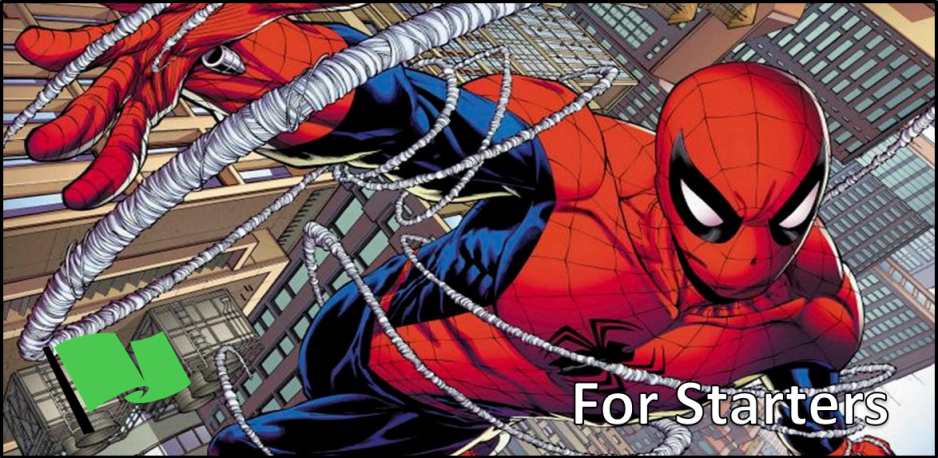
Spider-Man has so many great stories in his history. There are a lot of eras to Spider-Man too, s this can be a hard character for new readers to get into. Do you want to read Spidey as a teenager (as in Spider-Man: Homecoming) or do you prefer a more adult Spidey (one seldom depicted in movies but just as interesting at times)? Your uncle Geekly doesn’t really know. What he does know is that he can narrow this search to at least Peter Parker as Spider-Man.

Yeah, so we’re not covering Miles Morales (Ultimate Spider-Man), Ben Reilly (Spider Clone), Doctor Octavius (Doc Ock in Spidey’s spandex), or Spider-Girl or Gerry Drew (son of Spider-Woman Jessica Drew) or countless others—and there are several others. We’re talking Peter—not Uncle—Benjamin Parker. Yeah!

Let’s see if I can find a middle ground of teen and adult Spidey with a leaning toward young Spidey. Clear as mud? Good. Here we go.

Spider-Man_PowerAndResponsbility

Ultimate Spider-Man #1-7, “Power and Responsibility” (written by Brian Michael Bendis/art by Mark Bagley; 2000-2001)

I know I said that I wouldn’t include Ultimate Spider-Man Miles Morales, but the original Ultimate Spider-Man series featured Peter Parker and the first seven issues titled “Power and Responsibility” retold Spider-Man’s origin in an accessible way. It also happens to be one of the main source materials for Spider-Man: Homecoming, so if you want to learn about this Peter Parker from the ground up, there’s no better place to start.

Spider-Man_Blue

Spider-Man: Blue (written by Jeph Loeb/art by Tim Sale; 2002)

Anytime Loeb and Sale team up there’s usually an origin tale or “before they were stars” story, and Spider-Man: Blue is no exception. Sale’s art takes a nice middle ground to slick, modern comic book style and retro Spidey. Loeb’ writing adds the right kind of depth for retelling the early days of Peter and his love affair with Gwen. Gwen Stacy is the one who was portrayed by Emma Stone in The Amazing Spider-Man film series, not Peter’s better-known love interest Mary Jane.

While one could read the original appearance of Spider-Man, Spider-Man: Blue adds more depth to the character that wasn’t there in the 60s.

Spider-Man_IfThisBeMyDestiny

Amazing Spider-Man #31-33, “If This Be My Destiny” (written by Stan Lee/art by Steve Ditko; 1965-1966)

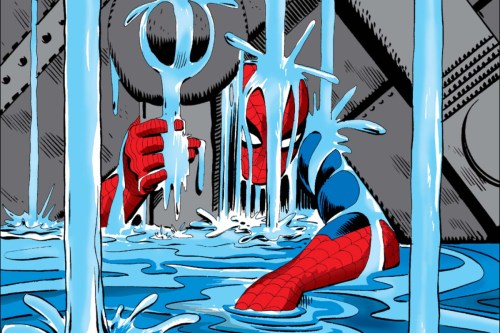
The plot for “If This Be My Destiny” is standard Spider-Man fare. It’s a well-executed Doc Ock story, but most stories of this time by Ditko and Lee were. Where “If This Be My Destiny” shines is when Spidey gets caught beneath some heavy machinery. In this classic scene, which has been duplicated in numerous Spider-Man movies, Peter musters all his willpower to free himself from the heavy load. This act shows what makes Spider-Man the endearing character he is, while his inner monologue brings his demons to light. “If This Be My Destiny” cements Spidey as the everyman hero.

Spider-Man_HowGreenWasMyGoblin

Amazing Spider-Man #39-40, “How Green Was My Goblin” (written by Stan Lee/art by John Romita Sr.; 1966)

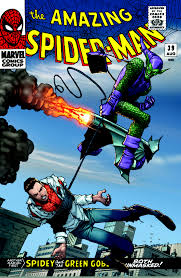
As you might be able to tell with my books I seldom go with the original telling of stories, opting to go with contemporary retellings, but the great Stan Lee does an awesome job of setting up Peter’s nemesis. And I say Peter’s nemesis because Norman Osborne’s Green Goblin has personal attachments to The Wallcrawler.

The first movie version of the Green Goblin showed him as Harry Osborne’s dad, but this reveal was a shock at the time, and this story gets to the essence of these two’s relationship. Batman needs his Joker. Spidey needs his Green Goblin.

Spider-Man_TheNightGwenStacyDied

Amazing Spider-Man #121-122, “The Night Gwen Stacy Died” (written by Gerry Conway/art by Gil Kane; 1973)

This one had to make the list. One of the pivotal moments of Spidey’s life as a hero came in the form of when Gwen Stacy died. It’s a tale that shows that even superheroes can fail.

Failure is a part of life and it’s definitely a part of Spidey’s life. This is one of the things that makes Spidey relatable as a character.

The death of Gwen Stacy also defined Green Goblin as a villain. As the previous entry attests, Green Goblin is Peter Parker’s enemy, not just Spider-Man’s, and “The Night Gwen Stacy Died” does the most to bring home this fact. It’s a must read.

Spider-Man_KravensLastHunt01

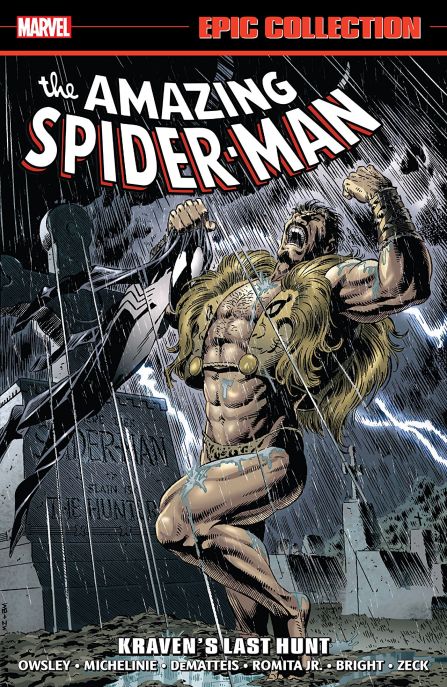
Web of Spider-Man #31-32; The Amazing Spider-Man #293-294; The Spectacular Spider-Man #131-132, “Kraven’s Last Hunt” (written by J. M. DeMatteis/art by Mike Zeck; 1987)

Kraven had been one of Spider-Man’s greatest enemies early in the Wallcrawler’s career, but time had passed him by. “Kraven’s Last Hunt” mirrored this decline, showcased Kraven’s ultimate revenge, and delved into Peter and Mary-Jane’s early marriage. There’s so much going on in this storyline that has defined and will continue to define the character.

It’s a story that asks what makes a hero, and one of the better Spider-Man stories ever written.

Spider-Man_BirthOfVenom

Secret Wars #8; Amazing Spider-Man #252-259; #298-300; #315-317, “Spider-Man: Birth of Venom” (written by various/art by various; 1984-1989)

There’s a lot of time gaps with this story, but “Spider-Man: Birth of Venom” has been collected in various graphic novels—maybe not all these stories, but a great many of them—and to get a good idea of Spider-Man and his relationship with the various symbiotes one should read this story first.

So much of Spider-Man in the 1990s and even in the 2000s revolved around Spidey and the various symbiotes that one should know a little something about them. “Birth of Venom” provides that background knowledge.

That’s my list for readers who are new to Spider-Man comics. There are so many to choose from—decades in fact—and I’m sure I missed more than one, two, or five hundred. Be sure to list some in comments. I’m sure Jim would prefer your picks to mine.

Getting into Shōjo Anime: Some Good Starters

It sounds as if Anime Season will take a break for the foreseeable future but before she leaves for an extended Otaku O’clock, she agreed to share her list of some good starter Shōjo anime. For those of you not in the know, Shōjo roughly translates to girl and Shōnen means boy, so we’ll be trading some ninjas wielding oversized swords for romance and slice of life stories with this list. Take it away, Anime Season.

My other write ups tend to explore Shōnen anime more than Shōjo anime. Shōjo isn’t a genre I watch as frequently but the following series are accessible in most legal streaming services (because, you know, Japan is cracking the whip on those illegal services, man).

FruitsBasket01

Fruits Basket (2001-2003)

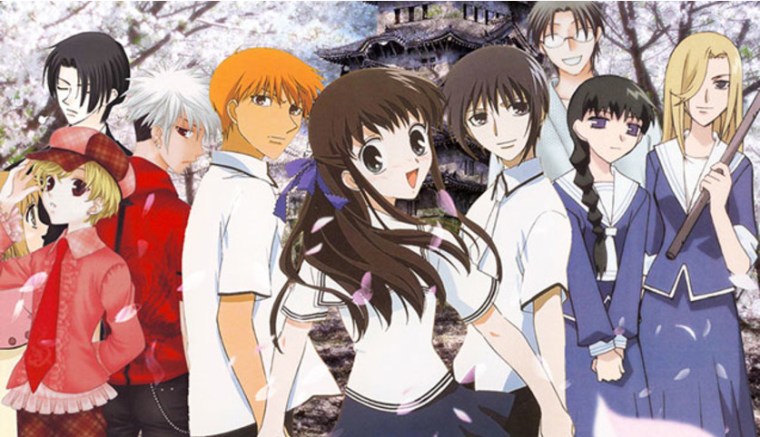
When it comes to starter Shōjo anime, Fruits Basket was one of the first ones I thought of. It has the basic Shōjo structure: Girl must live with—or near—a bunch of guys for plot related reasons, girl befriends the guys and doesn’t want to leave them, and a love triangle ensues. This structure sets up romance that most Shōjo series are known for.

However, in the case of Fruits Basket, there is a strange element that sets it apart from other Shōjo anime. I’ll spare the details since it’s included in every synopsis one can find about Fruits Basket. Since a lot of Shōjo have that romance structure there are some that added in an extra element to make themselves more unique. Fruits Basket incorporates the Chinese Zodiac, teaching viewers what each Zodiac is and encouraging them to learn more about it. It’s also pretty accessible and can be found through multiple streaming services. It’s easy to get into and helps one get accustomed to the Shōjo genre.

Fruits Basket has a straightforward story and continuity. For those who are just getting into anime and want to explore the Shōjo genre, Fruits Basket is one I’d recommend.

MyLoveStory

My Love Story!!/Ore Monogatari!! (2015)

If one is interested in cute plots featuring role reversal, My Love Story!! is a good start. It has an easy-to-follow storyline featuring the stereotypical best friend character in Shōjo anime as the lead. The main character Takeo wants focuses on getting a girlfriend, but none of the girls like him. His best friend Makoto has zero interest in girls, but every girl falls for him. Forget girls. Makoto has zero interest in anything. I don’t know how many times I’ve wanted to smack that bored look off his face.

Eventually, Gōda finds a girlfriend, Rinko Yamato, and a series of events follow. Gōda performs chivalrous acts and Rinko’s friends don’t approve of him because of his looks. The story is full of cute character moments (such as Rinko baking sweets for Gōda and him gushing over her baking) and takes the time developing each character. I’d recommend it for those looking for something that has a simplistic structure and good storyline.

RevolutionaryGirlUtena

Revolutionary Girl Utena/Shojo kakumei Utena (1997)

Who wants to be a prince? In the case of Utena Tenjō, that’s all she’s dreamed about since she was rescued by a prince at age eight. Eventually, she joins Ohtori Academy where she gets into the Dueling Game (challenges to possess the Rose Bride—Anthy—to “revolutionize the world”). Throughout the series Utena duels to protect Anthy while making friends along the way.

This series is a blend of Shōjo and Shōnen elements (such as the action scenes and the protagonist rising to be the strongest character). The series focuses on Utena’s nobility and features her aiding other characters. It has good character development and isn’t too long, spanning thirty-nine episodes. If nothing else, Revolutionary Girl Utena is worth the watch since it features a strong female protagonist who beats all the guys. I’d recommend it not only for those looking into the Shōjo genre but for those who enjoy strong female progatonists.


Final Thoughts

Not only are Fruits Basket, My Love Story!!, and Revolutionary Girl Utena great for those who are just getting into the Shōjo genre, but they’re rewatchable. I’ve found myself turning on Fruits Basket in the background on my tube TV I had mounted on a metal folding chair while doing my freshman science homework. Maybe that was more than you needed to know about my high school life.

Know of any other good Shōjo starter anime? Let us know in the comments.

Getting Started with Pick-Up and Delivery Games

Howdy, folks, Uncle Geekly’s back with another group of starter board games. For those of you who are new to the site, our starter game series takes a common or popular game mechanism and picks some good games that feature that mechanism but are easy to learn. Many of these games on these lists will start easy and work their way to greater complexity.

In today’s list we’ll cover pick-up and delivery games, and this mechanism works like its name suggests: players will pick up items from one place and deliver them to another. It’s a simple mechanism that finds its way to several great games, but there are two issues that came up when compiling this list of starter games.

First, many designers don’t believe in having a straight pick-up and delivery game (it’s too boring), so you won’t find too many games with pick-up and delivery as the only mechanism and only a handful more that will include pick-up and delivery in a group of two or three mechanisms.

The second is that by adding extra game mechanisms, designers make many pick-up and delivery games more complicated, so there will be games like Firefly and Freedom: The Underground Railroad that are excellent pick-up and delivery games (a couple of my favorites) but slightly more complex than a starter game should be for newcomers.

Enough about the games that won’t be on this list. Let’s talk about the ones that made the cut.

DeepSeaAdventure01

Deep Sea Adventure

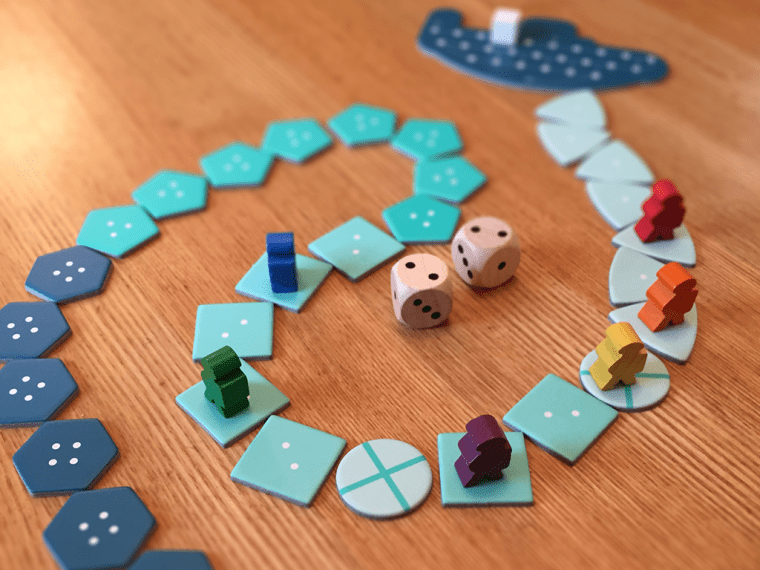
We start with the simplest game of the lot, Deep Sea Adventure. Sure, this game has a push your luck element and uses roll/spin and move, but it’s the closest game to pure pick-up and delivery. Players assume the roles of deep-sea divers. There are four levels of treasure (tokens) with a number (points one can score) printed on the front and the level denoted in dots on the back. The tokens get shuffled and placed in a wavy line protruding from the submarine (where the players pawns start), going from level 1 to level 4.

Players take turns diving into the sea (by rolling two specialty dice numbered from 1-3) and try to go as far as they can, but beware. All players share the same oxygen tank and when the oxygen level reaches zero, the round is over and only those who returned to the submarine with treasure in hand score points that round.

Deep Sea Adventure is charming. It doesn’t look like it would have much strategy, but it’s a lot deeper (pun intended) than first glance. Do you push your luck and go deeper, or do you turn back around with the treasure or two you picked up early on, so you know you’re scoring that round? There’s even a built-in catch-up mechanism where the higher scoring tiles are easier to get to in future rounds, so players who are behind early in the game can score a heap of points in round two or three. I’ve even considered picking up as many level one and two treasures as I can in the first round and since those lost treasure tokens get added to the end of the treasure path in stacks of three, I can claim them later in the game for big points.

Like I said, there are plenty of play styles and stratagems for this easy-to-learn game. Deep Sea Adventure may be marketed toward kids (if you don’t believe me, check out this adorable how to play video by Oink Games) but there’s enough going on to interest adults. You can find Deep Sea Adventure at most Barnes and Nobles but be on the look out for a small package. Oink Games come in small boxes and while I haven’t played all the Oink Game titles, most of the ones I’ve played are at least baseline good.

MyLittleScythe

My Little Scythe

I know that I said this before, but pick-up and delivery games have a knack of being very complicated. Case in point, My Little Scythe is a simplified, or child-friendly, version of Scythe, which happens to be on a lot of people’s best games of all time, but the original Scythe is far too complex for a starter pick-up and delivery game list. Heck. My Little Scythe makes the list by a skosh.

My Little Scythe was designed by a father and daughter, so that the father could play his favorite game with his young daughter, and it follows various animals of the animal kingdom as they prepare for the harvest festival. Players take turns earning trophies by earning specific accomplishments. There’s a lot going on in this game, but no single game mechanism is that complex. That said, I won’t spend too much time with how to play My Little Scythe because this isn’t a “how to play” write-up, it’s a starter game write-up. If you’d like detailed rules explanations, check out Rodney Smith’s video at Watch It Played; Rodney does excellent work. For now, let’s focus on what makes My Little Scythe a good pick-up and delivery starter game.

My Little Scythe takes an interesting look at pick-up and delivery. There’s a strong worker placement element to it—so it would make a nice addition to starter worker placement games—but two of the four trophies needed to trigger the end game (the harvest festival) requires players to pick up four of one kind of resource and drop them off at the castle (centrally located on the board). At least four of the remaining possible six trophies players can earn can be achieved by picking up resources and controlling them. In My Little Scythe, players are considered to have control of resources if their pawns occupy the same space as a resource. If the player controls the resource, they may spend it for other items. That’s a clever distinction that doesn’t show up in any of the other games on this list. So, I guess one could consider My Little Scythe a pick-up and control game.

There are so many other elements going on with My Little Scythe that I won’t mention the rest of them here, but each element works well and the whole is an easy game to learn and teach others. I wanted to include it here because of the interesting twist My Little Scythe makes with the pick-up and delivery mechanism. I know that it’s following Scythe’s lead, but we need more games that add wrinkles to well-established game mechanisms.

ForbiddenDesert08

Forbidden Desert

Forbidden Desert seems to make it on a lot of these lists, but it does fit the pick-up and delivery mechanism requirement and it’s a darn good game, perhaps the best of the Forbidden series, but that’s because I haven’t had the chance of playing Forbidden Sky as of this write-up. In Forbidden Desert players are stranded in an inhospitable desert. They must find and collect (or pick-up) the parts to a flying contraption and deliver the completed machine to the launch pad, so they can escape.

It’s been six years since Forbidden Desert’s initial release, and I still marvel at the way shifting sand is represented by drawing desert cards, shifting land tiles in the direction the cards command, and placing sand tokens atop the land tiles that moved that turn. It feels right. It plays like an unpredictable desert storm.

The way players must uncover both a vertical and horizontal tile for each object to reveal which tile one of the parts resides is brilliant; no game plays the same way twice. This also adds to the storm’s unpredictable nature and the fact that players can get buried in sand adds to the atmosphere of being lost. If the tile your pawn stands on moves, your pawn moves too, and board’s state may be far different from the end of one of your turns to the beginning of your next. Again, this adds to the players’ feeling of hopelessness—at times—or they may find the board moves in their favor and that’s wonderful.

I’ve said it before, but it remains true, Forbidden Desert is an excellent game. It also happens to be an excellent pick-up and delivery starter game. Pick-up and delivery may not play as big of a role in the turn to turn aspects of Forbidden Desert, but the only way players can win this game is by picking up and delivering the flying contraption to the launch pad.

Final Thoughts

Hopefully, we’ve covered some games you either haven’t played or haven’t considered pick-up and delivery games. Uncle Geekly tried to go with a mix of games that use predominantly pick-up and delivery (Deep Sea Adventure), implement pick-up and delivery as the only way to win but doesn’t include it with the turn to turn action (Forbidden Desert), and found one that provides a twist to a popular mechanism (My Little Scythe).

Know of any other great beginner pick-up and delivery games? You can deliver your questions, complaints, and suggestions in the comments.

Shazam! Starter Stories

Solomon, Hercules, Atlas, Zeus, Achilles and Mercury: Shazam!. Billy Batson, or rather his alter ego Captain Marvel, donned the famous—or not so famous—red, gold and white costume. Shazam! wasn’t always a DC Comics property and the history of his rites and identity is a strange one. Uncle Geekly will take a hot minute to recap it for those of you who care to know.

Captain Marvel got his start with Fawcett Comics in the late 1930s and ironically, Fawcett had to stop publishing Captain Marvel and his Marvel family of comics (there were other superheroes in the Marvel line like Captain Marvel Jr. and Mary Marvel) due to a 1953 lawsuit won by DC Comics that claimed he was too similar to Superman. Hmm.

So, Captain Marvel faded into obscurity for a couple of decades until DC licensed the characters from Fawcett (in 1972)—Why bother with just licensing the characters from a defunct publishing house?—and eventually bought them outright in 1991—I guess it takes two more decades for a buyout. DC Comics wanted to reboot the character as Captain Marvel, but by that time another Captain Marvel (Mar-Vell, Marvel Comics rendition of Captain Marvel) already existed and Captain Marvel had to change his name to Shazam. You know, the acronym of the six “immortal elders” who grant Billy his powers.

Wow. I could go on with more domino copyright infringement cases that led to other famous comic book characters changing their name (as a result of the Captain Marvel ruling for Marvel Comics) like Marvelman to Miracleman, but this starter story writeup is for the 14-year-old boy with the body of a jacked Zachary Levi. That’s another odd phrase I never thought I’d say: a jacked Zachary Levi. Shazam! indeed.

ThePowerOfShazamVol1

The Power of Shazam! Vol. 1 (written by Jerry Ordway/art by Jerry Ordway; 1994)

I’ll skip the Fawcett years because DC Comics retconned (changed the origin and details) of the character so many times after Shazam became a DC Comics property and I’ll hop over some of those other abandoned versions of the character(s) to get to a version of Shazam that had a little more staying power, so I’m landing on The Power of Shazam!. While you could pick up the second volume of this series (which was an ongoing title that introduced the rest of the Marvel Family members), the first volume includes an updated retelling of Shazam’s origin with a minor tweak that gives Black Adam and Billy Batson a personal tie. Honestly, it makes them more natural enemies.

Ordway’s story is the closest to the original Fawcett origin story; it also happens to be easy to understand, straightforward and if I was to bet on a story that the upcoming Shazam! movie will pull the most inspiration from, it’d be The Power of Shazam!. All the major players are here.

ShazamTheMonsterSocietyOfEvil

Shazam! The Monster Society of Evil (written by Jeff Smith/art by Jeff Smith; 2007)

I’m not sticking with one Shazam origin story, you can’t make me. Jeff Smith (of Bone fame) retold the story again about a decade later. In this telling, Smith used far less space to show Batson’s origin and focused more on the character dealing with the repercussions of magic on the unsuspecting people of Fawcett City (DC tipping their hat to the original creators). There’re also aspects of government untrustworthiness; it’s subtle, but Dr. Sivana (mad scientist and archnemesis of Shazam) is the Attorney General of the United States. Of course Sivana is secretly behind the horrors of Fawcett City, but it’s a nice twist for the character and Shazam! The Monster Society of Evil does more to develop Billy’s sister Mary (as in Mary Marvel) as a character.

ShazamPowerOfHope

Shazam! Power of Hope (written by Paul Dini and Alex Ross/art by Alex Ross; 2005)

I included Wonder Woman: Spirit of Truth in my “Wonder Woman Starter Stories” write-up a few weeks ago and here’s another selection from the DC oversized graphic novel series that featured Alex Ross’s artwork. Like most of the other stories in this line, Dini and Ross focus more on real world and human issues.

In Shazam! Power of Hope, Billy visits children in a hospital. He gets the impression that one kid in a wheelchair is being beaten by his father and being a kid and knowing how children can feel powerless around adults, Billy attempts to the threaten the kid’s father. By the end, Billy realizes that he’s part of the cycle and learns that he can help just by visiting these children and giving them hope.

Yes. It’s sappy, but Shazam! Power of Hope has some nice character moments. It also reminds readers that Billy is still a kid, even if he looks like Superman. It also shows the character as the inspiring superhero he is.

SupermanShazamFirstThunder.jpg

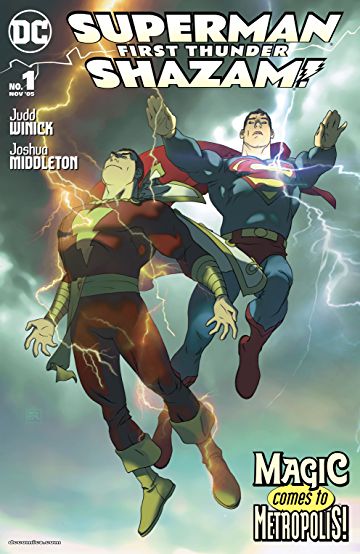
Superman/Shazam: First Thunder (written by Judd Winick/art by Joshua Middleton; 2006)

There’s only one thing to take away from Superman/Shazam: First Thunder and it’s an important one: how Superman and Shazam interact. DC Comics likes to show how these two iconic and most powerful men in their universe differ and this retelling of Superman and Shazam’s first encounter shows what makes these two characters unique and why DC would pay to have two characters with similar—and yet dissimilar—superpowers.

ShazamTheNew52

Shazam! The New 52 (written by Geoff Johns/art by Gary Frank; 2012-2014)

Okay. This is yet another telling of Shazam’s origin story; this character changes origins more frequently than I change underwear. But of course, he’d have another origin story, Uncle Geekly, what would you expect from the alternate Earth of the New 52?

In this tale, Billy Batson is more obnoxious and angsty than his previous incarnations as this is a more reality-based take on a 15-year-old orphan who was stuck in the foster care system for many years and lacks the trust of the adults in his life that the other versions of Billy share. This is also a more modern version of Billy. Don’t expect any “aw shucks” moments.

Shazam! The New 52 delivers on an epic showdown between Shazam and his archnemesis Black Adam (who will be played by The Rock in upcoming DCEU films), and if the DCEU continues its line of edgier superhero films, this may be the film version of Billy Batson.

I thought I’d add a few more stories to this list, but there are too many interpretations of Billy Batson/Captain Marvel/Shazam!/The Other Superman that it could muddy the waters further than I believe is necessary.

Judd Winick’s The Trials of Shazam! is another excellent story, but it casts Billy as the wizard who gave him his powers and Captain Marvel Jr. must assume the role as the new Shazam. There are the original stories and those other DC versions of the character throughout the 70s and 80s and there were some good stories there too, but I think the above stories do the most to ground readers in who this character is.

I’m sure I may have missed a story or two. Let me know of any ones you’d add to this list in the comments.

Wonder Woman Starter Stories

The first lady of comic books Wonder Woman has had an odd history, both in terms of how she came to be and with the path, or more exactly, the paths she’s taken. Hi. Uncle Geekly here and while I could address Wonder Woman’s creation story, we’ll spend today covering some of the greatest Wonder Woman stories for readers new to comic books.

Believe me. There are so many origin stories for Wonder Woman that Greg Rucka in his latest Wonder Woman run addressed them in DC Rebirth (2016-2017). That story just missed the cut, but it’d be a great honorable mention for this list, and I recommend reading that one too if you have the time. Let’s get to the ones that did make the list.

WonderWomanChroniclesVol1

Wonder Woman Chronicles Vol 1. (written by Dr. William Martson/art by Harry G. Peter; 1941-1942)

The writing is dated but Wonder Woman Chronicles Vol. 1 collects the original appearances of Wonder Woman in chronological order, so Steve Trevor makes an appearance–perhaps too much of one. Despite a shaky beginning, this volume shows how Wonder Woman promoted female empowerment long before it became commonplace. Heck. Wonder Woman was the first female superhero and while her origins may be humble (Diana takes on the name Wonder Woman because her mother gives it to her and she does a lot of what she does for Steve, a man she just met), these stories laid the ground work for an icon.

WonderWoman77

Wonder Woman ‘77 (written by various/art by various; 2015-2016)

Following the success of the Batman ’66 series that chronicled the continuing story of the 1966-68 television series starring Adam West and Burt Ward, DC Comics did the same for the 1975-79 Wonder Woman television series that starred Lynda Carter with Wonder Woman ’77.

Initial writer Marc Andreyko wanted to use “under-appreciated” Wonder Woman rogues and include them in the series, since the television series’ limited budget didn’t allow from them. As a result, classic Wonder Woman villains like Cheetah, Silver Swan, and Doctor Psycho received the Wonder Woman TV treatment they never had and Andreyko does such a great job including them that folks won’t remember that they were never in the original series—or maybe they will.

Anyway, Wonder Woman ’77 is a great series for fans of the Lynda Carter TV show or for people who may have missed the original show and don’t want to sit through the dated special effects and again, dated writing. This series does a great job of cleaning up some of the television show’s shortcomings.

WonderWomanGodsAndMortals

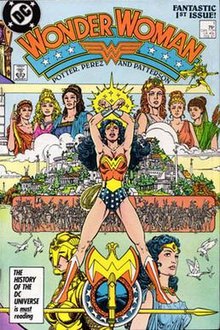
Gods and Mortals (written by George Perez and Len Wien/art by George Perez; 1987)

Gods and Mortals is a quintessential Wonder Woman story. After Marston’s Golden Age run and Crisis on Infinite Earths, the quality of Wonder Woman was—how to do I put this kindly—a mixed bag. George Perez relaunched the Wonder Woman title and he abandoned Diana as a marginalized member of the JLA’s boy’s club. He took Diana back to her feminist roots and made Steve Trevor and Etta Candy (one of Wonder Woman’s closest friends) rich and layered characters. Perez deployed a sense of fatalistic realism as the Amazons put themselves in a self-imposed exile after Queen Hippolyta (Diana’s mother) was put into bondage and raped by Hercules.

As you can see, Gods and Mortals took risks that many in the comics world would’ve taken at the time, but the end result was Diana standing on her own, apart from the Justice Society and Justice League. She didn’t need the male pantheon for support, and it was Gods and Mortals that made Greek gods regular characters in Wonder Woman stories.

WonderWomanSpiritOfTruth

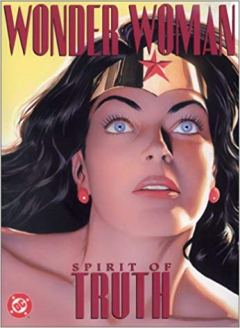
Wonder Woman: Spirit of Truth (written by Paul Dini/art by Alex Ross; 2001)

Paul Dini of Batman: The Animated Series fame crafts an understated moment between Diana and Clark Kent having coffee and swapping tales. Artist Alex Ross does a great job rendering these moments of Clark and Diana enjoying each other’s company one instant and the Amazonian Warrior lifting tanks, taking on armies, and fighting for women’s rights the next. Spirit of Truth may only come in at 64 pages, but it captures what makes Wonder Woman an endearing character.

WonderWomanTheHiketeia

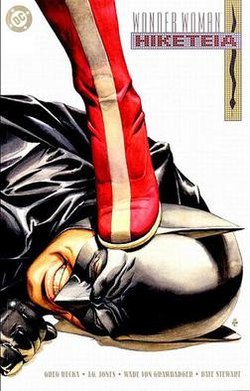
Wonder Woman: The Hiketeia (written by Greg Rucka/art by Drew Johnson, Eric Shanower, and Brian Stelfreeze; 2003)

The Hiketeia takes an intriguing look at the ancient idea of justice in the modern world. When Diana meets Danielle Wellys, Danielle evokes the ancient rite of Hiketeia and bonds herself to Diana as Diana’s supplicant. In return, Diana must ensure Danielle’s protection, but little does Diana know that Danielle has been on a murder spree to avenge her slain sister. Danielle’s actions attract the attention of the Furies of Greek myth, seeking vengeance for the victims, and Batman.

Batman and Wonder Woman’s views on justice differ as Diana marries fairness with justice. The Hiketeia does a great job showing how two thirds of DC’s trinity interact as they have a respectful but adversarial relationship.

WonderWomanDownToEarth

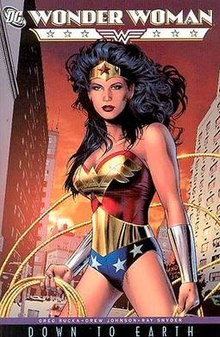
Wonder Woman: Down to Earth (written by Greg Rucka/art by Drew Johnson, Eric Shanower, and Brian Stelfreeze; 2004)

Down to Earth is an unconventional superhero story as Wonder Woman doesn’t stop villains or save the world; she shares her ideals in a book of essays and others try to tear down her philosophies. A lot of this backlash originates with the mysterious Veronica Cale—who functions like a female Lex Luthor—and she pulls all kinds of strings that make Diana’s life difficult. The book even creates tension in Mount Olympus with the gods, which doesn’t end well for Wonder Woman in the long run.

Down to Earth is another great story by Greg Rucka, and it does a lot to set up many of the events in his excellent four year run of Wonder Woman.

WonderWomanTheNew52

Wonder Woman: The New 52 (written by Brian Azzarello/art by Cliff Chiang; 2012-2015)

Brian Azzarello’s run on Wonder Woman: The New 52 was amazing. It embraces Diana’s Greek mythological roots and bends these same classic Greek myths, turning them into something new and exciting. Every step of the way you’ll stop and think that’s so Hades or that’s so Poseidon and Diana the daughter of Hippolyta and Zeus fits right in. The ending doesn’t disappoint. I won’t ruin it here, but Azzarello does a great job of pacing and taking what makes these characters who they are—both Greek myth and comic book characters—and blends them together seamlessly.

That’s my list for readers who are new to Wonder Woman comics. There are so many to choose from—decades after decades in fact—and I’m sure I missed more than one, two, or five hundred. Be sure to list some in comments. I’m sure Jim will prefer your picks to mine.

Captain Marvel Starter Stories

Many characters have gone by the moniker Captain Marvel, so your uncle Geekly will be specific and say that the stories listed here will pertain to Carol Danvers (the Marvel Cinematic Universe’s choice for Captain Marvel). In fact, I’ll throw in some stories that predate Danvers as Captain Marvel so that new readers of the character will have a good baseline.

Wow! There’s a lot of history with both Marvel’s Captain Marvel (not to be confused with DC’s Shazam!) and Carol Danvers as a character. Let’s start with a list of Carol Danvers’ history in the Marvel universe.

As USAF Major Carol Danvers: Marvel Super-Heroes #13 (March 1968)

As Ms. Marvel: Ms. Marvel #1 (January 1977)

As Binary: The Uncanny X-Men #164 (December 1982)

As Warbird: The Avengers #4 (May 1998)

As Captain Marvel: Avenging Spider-Man #9 (July 2012)

The various individuals who have had the title Captain Marvel are many and eclectic. Here’s a quick run down of all of Marvel’s Captain Marvels.

mar-vell.jpg

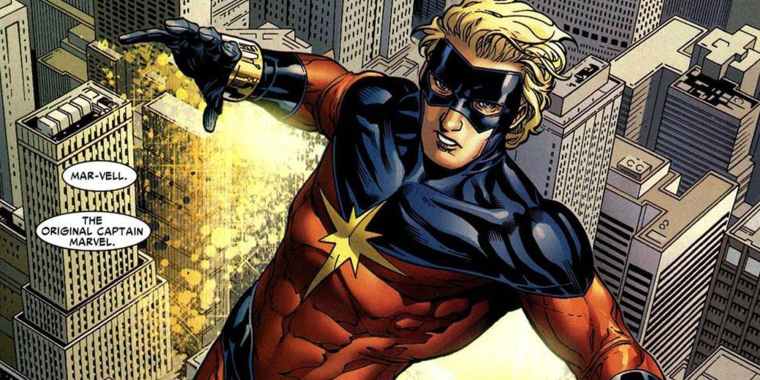
1) Mar-Vell (who will be portrayed by Jude Law in the upcoming Captain Marvel movie), member of the Kree Imperial Militia (1967-1982)

MonicaRambeau_CaptainMarvel.jpg

2) Monica Rambeau, a police lieutenant from New Orleans (1982-1993)

Genis-Vell CaptainMarvel.png

3) Genis-Vell, engineered son of Mar-Vell and his lover Elysius (1993-2004)

Phyla-Vell CaptainMarvel.jpg

4) Phyla-Vell, Genis-Vell’s younger sister (2004-2007)

Khn'nr.jpg

5) Khn’nr, a Skrull sleeper agent (2007-2009)

Noh-Varr CaptainMarvel.png

6) Noh-Varr, Kree ensign and Captain Marvel of The Dark Avengers (2009-2010)

CarolDanvers_CaptainMarvel

7) Carol Danvers (2012-Present)

As you can see, there have been plenty of people who have taken the mantel of Captain Marvel for Marvel, but let’s get back to the current one, the one who’ll be in 2019’s Captain Marvel, Carol Danvers.

There are a lot of ways I could organize this list even though it’ll only contain Carol Danvers, but I’ll start with the comics that’ll do the most to get new readers up to speed with the character for the upcoming movie. Then, I’ll add a background reading section for the completionists who want to know everything that occurred to Carol Danvers before her run as Captain Marvel.

Note: There is a new Ms. Marvel, Kamala Khan.

MsMarvelKamalaKhan02

The above is a picture of Kamala as the new Ms. Marvel. She’s a great character and you should give her a read if you’re interested in Ms. Marvel/Captain Marvel, but she won’t be included in these starter stories.

MsMarvelVol1_BestOfTheBest

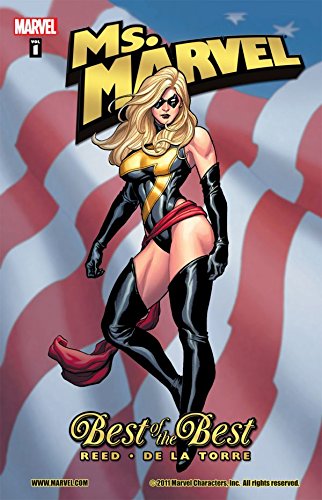
Ms. Marvel Vol. 1.: Best of the Best collecting Ms. Marvel #1-4 and #21-25 (written by Brian Reed/art by Frank Cho; 2006)

This Ms. Marvel reboot does a lot of things right. I like how Ms. Marvel goes out on patrol and what she does with her time when she isn’t being “assembled” for the Avengers. It also tells an important story of Danvers who, having fought the Brood during the “Brood Wars,” must balance the protection of Brood refugees while simultaneously protecting Earth. Alliances can change. Threats can change. Hatred shouldn’t govern one’s actions.

It turns out that a larger threat is over the horizon. Ms. Marvel wouldn’t have accomplished anything if she gave into her hatred and she wouldn’t have been prepared for the new threat if she went on a Brood killing spree—no matter how good it would’ve made her feel.

This story also does a good job of touching some points of Danvers’ past if one were to read her background stories.

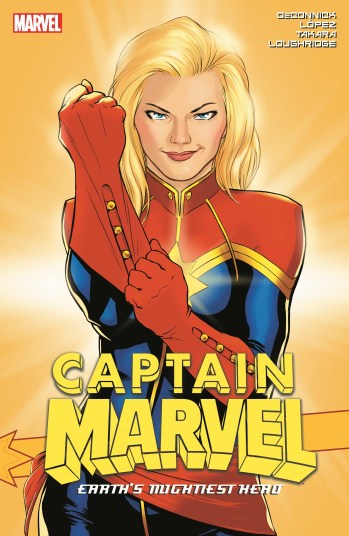
EarthsMightiestHeroCaptainMarvel

Earth’s Mightiest Hero: Captain Marvel (written by Kelly Sue DeConnick/art by various; 2012-2015)

The movie will and should draw the most inspiration from this storyline. It’s also the one where Carol Danvers gets promoted to Captain Marvel. There are so many good story arcs in this run, so I’ll do my best to show the graphic novels in the order they should be read at the end of this write-up. Trust me. It’s a mess.

The first arc in the series does a great job of grounding the reader, even if they don’t know much about Carol Danvers’ long history. Future arcs show her transitioning into an Astronomical hero—sort of Marvel’s answer to Green Lantern. Danvers evolution as a character occurs most here, and it’s a must read for people getting ready for the movie.

Here’s that reading list I promised.

  1. Captain Marvel Vol. 1: In Pursuit of Flight
  2. Captain Marvel Vol. 2: Down
  3. Avengers: The Enemy Within
  4. Captain Marvel Vol. 1: Higher, Further, Faster
  5. Captain Marvel Vol. 2: Stay Fly
  6. Captain Marvel Vol. 3: Alis Volat Propriis
  7. Captain Marvel & the Carol Corps

Background

Essential Ms Marvel Vol 1

Essential Ms. Marvel, Vol 1 Collecting issues Ms. Marvel #1-23, Marvel Super-Heroes Magazine #10-11 (written by Various/art by Various; 1968-1982)

Carol Danvers was little more than a bit character in the original Captain Marvel comic book—that’s the one that starred Mar-Vell (the Kree warrior who went against orders and defended Earth against his own kind)—and when Mar-Vell saved Carol, the Psyche-Magnitron radiation she was hit with slowly gave her super powers.

This collection goes through this origin and a lot more as it collects the first run of Ms. Marvel, which was—for the time—a feminist and progressive name because she was “Ms.” instead of Mrs. or Girl or Woman.

New readers will also see some interesting developments with the Carol Danvers character. She’ll disappear in the 1980s, or at least fade to the periphery: she’s the one whose powers Rogue stole.

Fans of the X-Men Animated Series will learn that unlike the cartoon, Danvers didn’t fall into a coma. She retained some of her powers and few of her memories, a nasty side-effect from a clumsy, young Rogue.

Since this collection spans a good two decades, it’s very uneven. Thankfully, readers are spared the infamous “Marcus” storyline, but the story’s aftermath and Chris Claremont’s attempt to clean up the mess can leave readers wanting. Still, this is a great volume for anyone who wants to know the character’s early history.

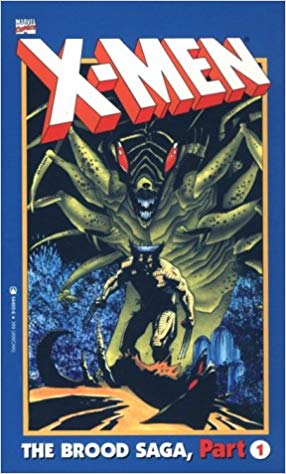
X-MenTheBroodSaga

The Brood Saga (written by Chris Claremont/art by Dave Cockrum; 1982-1983)

This story is one for the X-Men that ran during Uncanny X-Men #155-167, but an amnestic Carol Danvers gets drawn into this tale. When the Brood realize that Carol’s DNA has been infused with Kree DNA, the results are interesting.

This is the first time and best time Danvers dons her 1980s persona Binary. I’m not sure if Marvel has ever collected The Brood Saga in paperback, but this title should be available on Comixology and Marvel Unlimited.

Avengers_Warbird_LiveKreeOrDie

Live Kree or Die (written by Kurt Busiek/art by various; 1998)

I always liked Danvers (who went by Warbird) in the reformed Avengers of Heroes Return. This story jettisons Danvers’ link to her Binary powers, and that forces her to hide from her teammates. She has some fantastic character moments. If I remember correctly, she struggles with alcoholism, and Tony Stark takes an odd turn as her sponsor.

Danvers/Warbird ultimately ends up quitting the Avengers. I’m not sure if some of these moments will be explored in the Marvel Film Captain Marvel, but it could explain why Nick Fury has Danvers’ number but refuses to call it until it’s necessary.

That’s my list for beginning Captain Marvel—but specifically Carol Danvers Captain Marvel—readers. I’m sure there are some omissions. Feel free to send Rogue over to my house so she can rob me of the rest of my memories, or you could leave a comment.

Getting Started with Route or Network Building Games

We’re on a freeway of love in a pink Cadillac. We miss you, Aretha. Shine on, Queen of Soul.

Getting back to tabletop games, there are plenty of games that cast the players with setting up routes or networks or roads or even freeways of love to score points. The difficulty levels of these games vary, and route or network building games tend to have more than just that mechanism in them. That may be because building roads or a network doesn’t appeal to a lot of players, but there are some beginner games that can introduce new players to the genre.

Your uncle Geekly’s back with another Getting Started, so let’s network.

Tsuro

Tsuro

A game that’s just building a road or route. That sounds too simple. It’d be boring. Tsuro doesn’t have much more to it than that, and it’s excellent.

Players lay tiles with winding paths on them from their hand onto a 6×6 grid and move their pawns as far on those paths as they can. The last player with a pawn on the board wins. Hint: you can lead your pawn off the board or into other pawns.

It’s a simple concept, executed well, and it doesn’t hurt that the game looks gorgeous. It also doesn’t hurt that Tsuro lasts fifteen minutes at the most. Perfect for a new player.

TicketToRide

Ticket to Ride

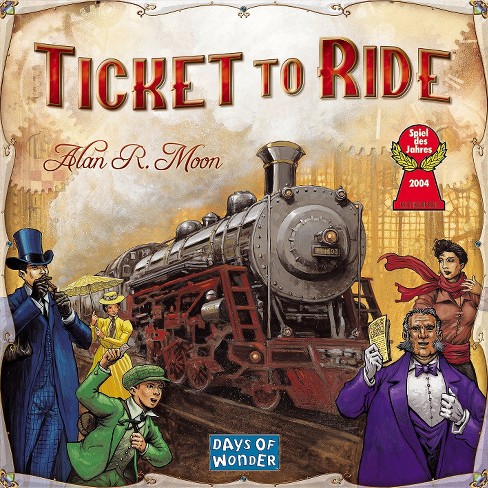
Ticket to Ride was the first game that came to my mind when thinking of starter route-network building games. It dominated the hobby when it first came out and remains popular. There are a lot of offshoots and expansions for Ticket to Ride that depict almost any region or country you could think of, but I’d start with the original United States map from 2004.

Players build railroad connections between cities, while trying to complete destination tickets that can span the length of the continent or country. Rummy-style set collection adds another layer as players collect cards with which to spend on railways between the various cities and usually, the first player to claim a route is the only one who can, so pressure builds when players decide whether to collect more cards for their hand or build a route before another player can do so. This is one of tabletop gaming’s simplest, elegant, and tense push-pulls.

Ticket to Ride may add another layer than Tsuro, but it’s still easy enough for a tabletop game newcomer to learn, and one of the best “gateway games” (easy-to-learn board game that’s great for introducing new gamers to the hobby) on the market.

Takenoko

Takenoko

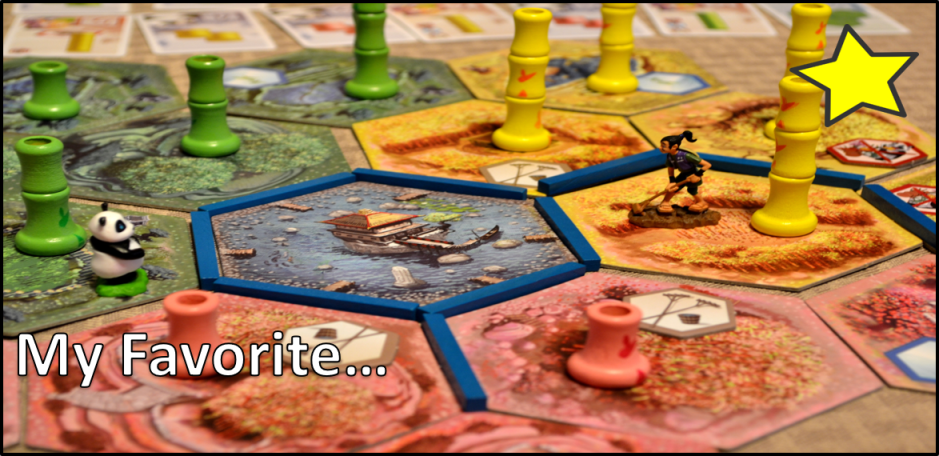
I’ve talked about Takenoko in the past. Don’t let the Chibi Panda fool you, this game has plenty of depth, but it’s still easy to teach and learn and takes a different approach to route/network building. Like Tsuro, Takenoko uses tile placement, but the network in Takenoko is in its irrigation.

The game starts with a pond tile, and in order to irrigate their bamboo players must connect tiles of various color bamboo to the starting pond tile with what the game calls an irrigation stick. I think of it as more of a trench system to get the water to where one wants it, but I may be wrong. If I am, feel free to toilet paper my house. I live in Connecticut. Yeah, totally Connecticut.

Anyway, I included Takenoko because it shows how many games will incorporate network/route building in the game, but the game won’t be about network building like the previous two entries. Yes. Players need water for irrigation, but irrigation sticks are only a fraction of what someone needs.

Saboteur.jpg

Saboteur

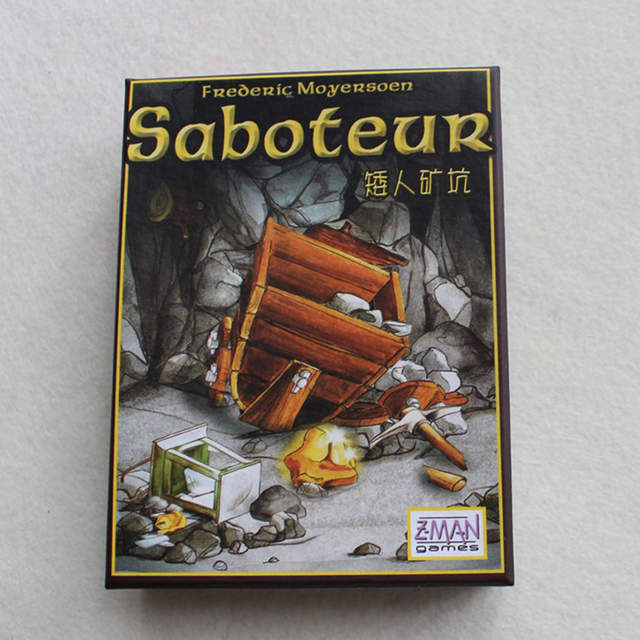
Saboteur returns this list to its classic network/route building roots, but it deviates in another direction: semi-cooperative and secret goals. The goal for the game’s mining dwarves is to build a network of caves (from hands of path cards) to reach gold. The goal for the game’s saboteurs is to prevent the mining dwarves from reaching the gold.

A good saboteur will pick the spot where they betray the team. Do they risk it and wait for the mining to team to get close to the gold and then play a U turn card? It’s very satisfying to be the saboteur, but who’s on which team is only part of the game’s hidden information. There are multiple locations for the gold to be at the beginning of the game, but no one knows where it is until they’re given a card that allows them to take a peek. Again, a good saboteur doesn’t reveal their identity because they could lead the mining team to the wrong spot.

Saboteur isn’t for everyone. There are some folks who hate traitors in cooperative games, but the runtime is so short that it had to make this list.

Final Thoughts

There are many other ways I could go with in terms of expanding this list of beginner route/network building games, but I’ll stop with these four because I miscounted them as five and if I had six I’d have to use the other hand to count.

Speaking of networking, we could use some comments about games or something else in the geek world. If you like this post, give it a like, and if you like what Geekly does, feel free to subscribe. If you subscribe, you can let your uncle Geekly know how wrong he is every day.

Getting Started with Dice Placement Games

Your uncle Geekly covered worker placement in a previous starter game segment—those are games where players place pawns on the board to gain certain abilities—and this week we’ll discuss dice placement games which are like worker placement games except that players place dice instead of pawns, or one could say that one’s dice are their pawns.

As usual, good old Geekly has some starter games for someone interested in the gaming genre. Let’s get to some of the better and simpler games of this type and work our way up in complexity.
Kingburg01

Kingsburg

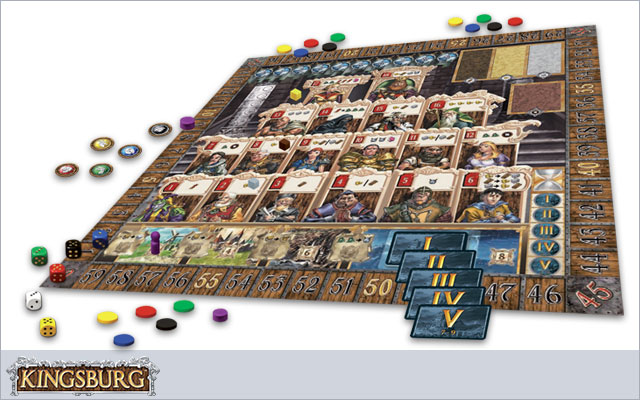
I usually try to go with more recent games in a genre, but Kingsburg is a ten-year-old game or so that deserves a mention. Players chuck dice to determine what they can do each turn. The shared board hold a king space and spaces for advisors to the king. Each one grants a different ability based on the numbers one rolls. If some rolled three 6s, they can choose the king space at 18 or a 6 and a 12. The person with the lowest roll each round picks first, and that may be the most clever way to negate a bad roll. Dice hate me. If it was possible to roll negative 18, I’d do it.
There are three phases—oh, yeah three, it’s the magic number—and each player must face an invading army on the fourth turn. The fourth phase just happens to be winter. Winter is coming.

Even though players must face something at the end of each group of four phases, it’s nice to see that a worker placement game designer isn’t obsessed with food. And Kingsburg does a good job of bad die roll mitigation. You’ll see plenty of other designs use other methods to compensate for a bad roll. Apparently, I’m not the only one dice hate.

DiceCityBoardGame.jpg

Dice City

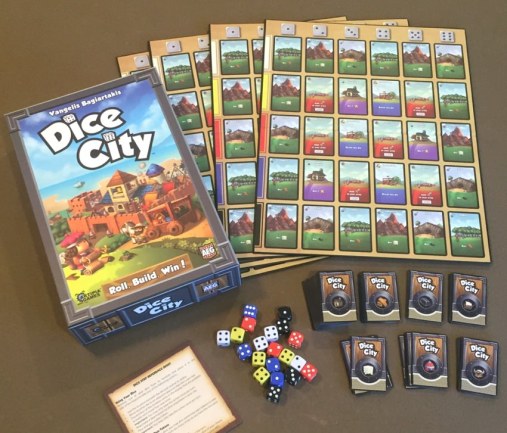
While Kingsburg has a shared board, Dice City gives each player their own board. On each turn, players roll five six-sided dice of different colors and place those dice on their board according to a chart. The columns show numbers and players must roll that number to place their dice in that row, but the rows are one of their die’s colors. So, if one rolls a three on their yellow die, they must place their yellow die on the second row (the yellow row) and the third space from the left (the column for 3s).

On each of these spaces, which are shaped like the game’s deck of cards, is an action. Players may choose to take the action they rolled (usually to get resources) or they may choose to discard one or more of their die or dice (for that round) to move another die left or right for each die discarded. You know how I said that Kingsburg does a good job with bad die roll mitigation, Dice City’s use of discarding dice allows for even more of that. Yay!

Players can upgrade their boards by purchasing cards with the resources they use and that accomplishes two great things: each player’s board is different and further strategy over luck. Dice City may look like a game that uses a ton of luck, but it’s sneakily deep. That said, it’s a step up, or at least sideways, in complexity to Kingsburg.

Discoveries01

Discoveries

Discoveries is most likely a step up in complexity to the others on this list, but a lot is added with that smidgeon of complexity. In this game, players take on the roles of explorers tasked by Thomas Jefferson to explore the western United States.

Unlike the other games on this list, Discoveries uses unique and thematic dice to represent the players journey. Horseshoes, feet, writing, and Native American die faces replace pips of 1-6. Each player receives five of these dice in their player color. They roll their dice and may take one of two actions each turn: play dice of the same type to any space on the board or get dice back from the game board.

It’s this push-pull of gaining dice from the game board—and how one does it—versus using dice that give Discoveries its depth. I’ll discuss how to get points later, but one doesn’t necessarily grab all their used dice when they take the “rest” action or the one that allows a player to retrieve dice from the board. Many of the dice used to explore go to a communal discard area. A player has the option of taking all the dice from one of the communal discard areas or taking all their personal dice (no matter who has them or where they are). It’s a wrinkle not seen in too many other dice placement games. Players must do a good job timing when they retrieve dice. You can snake someone’s die and use it before they decide to take it back. It takes a game or two to get the timing, but it’s not that difficult to learn and that’s why Discoveries is the last game on this list.

Players earn points by exploring more areas, but to explore an area one must generate enough resources (in rivers or mountains to cross) in a single turn because players cannot bank rivers and mountains from one turn to the next.

The game ends when the deck runs out of cards, and there is a scoring method that’s simple enough to understand but would make this write-up swell even more with words, so I won’t include it here, but another one of my favorite mechanisms is Discoveries use of dual-sided cards. Players may befriend Native American tribes and if a card from that offering is used, a new card is dealt Tribe side up. Players also use cards if they explore and if a card from that offering is used, a new card is dealt Exploration side up. It’s an elegant system that forces each game to play differently than the last.

Discoveries, like the other games on this list, also has bad die roll mitigation, but it may be the cheapest of all of them: trade in one die to turn another die to the face you want. Love it. This is easily the least random result dice game on this list.

Final Thoughts

Like worker placement games, it’s difficult to come up with easy to learn dice placement games with depth. Again, I had to go with slightly more complicated games than usual, but they still have some wide appeal. There’s a little more variety in terms of subject matter too. And no food. Yay!

How many times have dice hated you? You can roll shame one of your dice or let us know your favorite dice placement games in the comments.