Writing Brain Dump: March 20, 2026

Hey, hey, Geekly Gang! Kyra Kyle here. Has it really been about a month since the last Writing Brain Dump? Wow! Time flies. If you follow the board game design brain dump series, today’s topic will sound familiar. I tailored the design post toward board game design, so today’s brain dump will focus on writing. And we’re talking about the writing spectrum.

Most things in life can be expressed through a spectrum. Some people feel most comfortable on one extreme side of the spectrum, while others prefer the other. And then there are the ones like me who live somewhere in between the two extremes. In writing, those extremes are Plotters (or Planners) and Pantsers. Planners (or Plotters) create outlines for their plots and write their stories based on that outline. This may be the way most of us learned how to write. I remember my teachers preaching the importance of outlines. Several famous writers swear by plotting, and some refuse to conform. Rebels. Rebels, I say. You can’t tell them to make an outline. These are your Pantsers, nicknamed from the idiom, flying by the seat of one’s pants. And plenty of writers swear by pantsing.

Both sides make compelling arguments. JK Rowling, a famous Plotter, once suggested that without an outline, one will get lost. You wouldn’t go on a road trip without a map. That makes sense. But Stephen King, a famous Panster, once said never to outline. If you, as the writer, can’t be surprised by your work, you can’t expect your reader to be surprised. This also makes a lot of sense. So, who’s right? Both sides believe their method to be the best. Seriously, there’s a reason I made the above graphic look like a political divide. The writing divide can be just as contentious. Would it bug you if I said neither side is right? Or that both of them are right, given the proper circumstances? You can’t take me off this fence.

But context matters. A novel with numerous intricate plotlines may yearn for an outline. The writer could easily get lost. And pantsing one’s way through a story could help with suspense. Is it a coincidence that Stephen King mentions surprise in his reasoning for pantsing? Horror requires surprise. Of course, the Master of Horror would pants. Rowling’s Harry Potter series began with a school year structure. An outline for that series makes sense because she had to keep to that strict form. Until the final couple of books, where Rowling aged up the characters (to match the aging audience) and ditched the school year structure entirely with The Deathly Hollows. But enough about King and Rowling. Where a writer falls on the writing spectrum depends on the writer.

I’ve tried both of these methods. They work for various projects, like the ones I mentioned for the two famous authors. I’ve spelled out why an author may choose one extreme over the other. Pantsing adds surprise (might be good for Horror and Suspense). Plotting provides structure (great for books that follow a rigid structure). But there are two other main ways a writer can write their books/stories: Lighthousing and Blotting. I told you I live in the middle.
Typically, when I Lighthouse, I know what my initial scene will be, and I have a scene I know the story will progress toward, my Lighthouse Scene. This gives an author guide rails (sounds a little like Plotting), but allows the author to meander on their way toward the Lighthouse Scene (giving the flexibility of Pantsing). I love this method. It helps when I have a good idea of where I want to begin, and when I have a scene I’m dying to write. I’ve done this a lot with short stories. The exception for a short story is that you won’t have as many Lighthouse Scenes. You may even have one Lighthouse. If that’s the case, you may drift a little while before finding the point in the story where you’ll need to make your way to the end.

Lighthousing works best for stories where you have a good idea of how they’ll end (or perhaps a great penultimate scene), but you want some freedom to explore. But Lighthousing can get tricky. I’d begin with short stories first. Not enough writers start with short stories; short stories are a great way to explore one’s craft. Oh. I guess this is less of a writing brain dump and more of a craft talk. Whoops!
Blotting is the other main way writers can craft their stories, outside of plotting and pantsing. I always view Blotting like I’m a painter with an empty canvas. I have a sopping wet paintbrush in my hand, and I’m slinging the brush on the canvas with something I know I want in my story. This can be an element. This could be multiple scenes. The great thing about Blotting is that you can write the scenes in your story in any order, and then write the rest of the scenes that go in between those scenes. In other words, you can write the cool scenes you want to see in your story, and see what parts of the story remain.

Blotting works really well for non-linear storytelling, but that doesn’t mean it can’t work for a linear one. I blot a lot more when I write longer works. It helps me gain momentum, and writers need momentum for longer works. Get there faster.

So, which method is best? None. All. It depends on the writer and the project. Seriously, I’ve tried all of these; I’ve even used all four of these methods in a single calendar year. And just because you pants or lighthouse or blot, doesn’t mean you can’t reverse outline your book. Reverse outlining is when you take what you’ve written and retroactively place it into an outline. While Plotters could benefit from reverse outlining (you never know if you deviated from your original outline), reverse outlining is a godsend for a Panster, Lighthouser, or Blotter. If a scene doesn’t work in your overall story, why bother line editing that scene? Time is precious. Save as much time as you can.

How do you like to write? Do you have a fifth, sixth, or seventh method of getting your story on the page? Let me know in the comments. Thank you for reading, and wherever you are, I hope you’re having a great day.

Writing Brain Dump: January 23, 2026

Happy Friday, Geekly Gang! Kyra Kyle here with another writing brain dump. I’m in the middle of editing my most recent completed novel (based within the Rustbucket Riots board game universe) and had an epiphany. The specifics of the epiphany don’t matter much–two of the main characters are related for the curious folks out there–but how I came to this realization serves as a good reminder that writing ideas can come from anywhere. And you may need to step away from yourself. When the idea struck, I wasn’t at my desk writing. I didn’t have a pad of paper and a pencil at the ready. I was grocery shopping.

Since I’m a veteran, I shop at the local military base’s commissary. The commissary still employs baggers who will carry out your groceries to your car, and on this faithful day, I had a bagger whose past aligned with mine to some extent and even more so with my protagonist. My bagger was half Native American, but you wouldn’t know it by looking at him. He and his brother looked and acted nothing alike. And I have some experience with both of those aspects. It makes sense to adopt some of those elements for my protagonist. Heck. Some of those elements already existed. I just had to give them a sibling. I don’t want to get into too many details. I’m unsure if someone reading this may try and track down my bagger. But talking to others can help with your writing.

By no means am I a social butterfly. I’m happy to spend most hours of many of my days at my desk. I think most writers operate well in isolation, but when you’re stuck with a story/character/scene, stepping outside yourself can help. I may not talk that much when I’m in public, but I love to listen. You’ll never know which found stories (stories a writer finds while in the world) you’ll discover.

The next time I see “Name Redacted,” I may let him know that he helped me with a story. Or I may just listen. Have you found stories by listening to or observing others? Let me know in the comments. Thank you for reading, and wherever you are, I hope you’re having a fantastic day.

Writing Brain Dump: December 5, 2025

Happy Friday, Geekly Gang! Kyra Kyle here. I haven’t done a writing brain dump in a few weeks. I’m still going through the slog of editing the Rustbucket novel on a macro level, but I’ve hit a wall.

Truthfully, I’ve struggled to make much headway with the project. There are multiple reasons why. I distracted myself with holiday cleaning. I may not have made much progress with the Rustbucket novel, but my house looks and smells amazing. I may not have completed a single task I wanted to in November, but my study is so organized.

I feel stuck in Monty Python’s “Cheese Sketch.” My cheese shop is the best in the region. Why do you say that? It’s so clean. It’s certainly unsullied by cheese.

Distractions aside, I can’t get out of my own head, and that’s the real cause for writer’s block. So, I’m recommitting myself to my writing schedule. I may put the Rustbucket novel on hold for a short time and begin a new project. Who knows? Something I write during this project could provide the fuel I need for Rustbucket.

I’m not going to include any writing tips or tricks I’ve been using, because I hit a wall. Maybe I’ll dirty up my organized study with some writing, and I’ll have something more to share in a couple of weeks, when hopefully, I’ll post another writing brain dump.

I hope you all had a great Novel November. Thank you for reading, and keep writing.

Writing Brain Dump: November 14, 2025

Happy Friday, Geekly Gang! I haven’t shared a Writing Brain Dump in a month. Today looks like a good day for a Writing Brain Dump. I’m about halfway through my most recent edit for Rustbucket Riots (working title). And the biggest step I made was reformating the story’s arc.

The Three-Act Structure May Need Tweaking for a Novel

I found Julian Maylett’s YouTube channel a short while ago. Maylett has a great AuthorTube channel, and I like his six-pillar structure. But I adapted this structure so it works better for me. I’ll paraphrase something I said in the previous Writing Brain Dump. What works for someone else’s writing practice may not work for yours. Everyone is unique. So, it made sense that I adapt Julian Maylett’s method to better suit mine. Feel free to do the same.

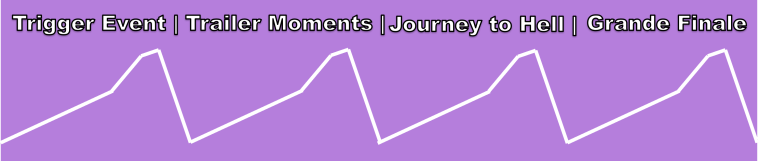
I boiled down Maylett’s method to a novel’s storyline resembling a heartbeat. The Three-Act Structure (pictured above) begins with an inciting incident, followed by rising action (complications), a crisis, a climax, and falling action (or denouement if you want to be fancy). Maylett claims that (except for a novel’s prelude, which is different from a prologue) each segment within a novel includes its own version of a Three-Act Structure. After mapping out the four segments following the prelude (Trigger Event, Trailer Moments, Journey to Hell, and the Grand Finale), the novel’s shape resembled a heartbeat.

We’re looking at four Three-Act Structures occurring consecutively.

See what I mean. Each segment contains an inciting incident, rising action, a climax, and falling action. But, paraphrasing Maylett, segments will morph what constitutes an inciting incident, rising action, etc., each time, depending on when in the story the segment occurs. One of the examples Maylett gave (for the Trigger Event) was The Hunger Games. We’re talking the first novel (or movie) here. And viewing this novel through Maylett’s lens can be eye-opening. If we view The Hunger Games in the classic three-act structure, one would most likely cite Katniss offering herself as tribute as the story’s inciting incident, but that isn’t the inciting incident when using what I’m going to call the heartbeat method.

The Reaping itself is the inciting incident for The Hunger Games’ Trigger Event (the first full segment). Prim being old enough to participate in the Reaping is a complication (rising action), as is Katniss placing her name into the Reaping multiple times to feed her family. Katniss has a brief moment of doubt when Prim’s name is drawn (the crisis), and she must choose to save her sister by offering herself as tribute or let Prim participate and most likely die. Katniss choosing to offer herself as tribute is the Trigger Event’s climax.

Then, we see the fallout of Katniss’s decision (the resolution or falling action), before the next segment (Trailer Moments) begins with another inciting incident and the process starts anew. I love Maylett’s approach. I took the bones of this approach and applied it to my manuscript.

I’ll press pause on the rest of the segments, so I can edit those and share my thoughts after editing each segment, but there is an odd segment before these four: The Prelude.

The Prelude is Not a Prologue

A prologue’s events occur separately from the rest of the novel, while the prelude sets the novel’s tone. If you’re talking about speculative fiction, the prelude introduces the reader to your novel’s world, while hopefully not inundating them in exposition. Unlike the other segments, the prelude has only three parts: an opening image, a flawed action, and the theme whispered.

Let’s go back to The Hunger Games as an example for the prelude. The novel (and movie) opens with Katniss illegally hunting game. We’re introduced to Katniss’s world through the simple act of survival. Katniss bags a kill. Her family can eat. This hunt is The Hunger Games’ opening image. It’s a concrete image. Then, The Hunger Games progresses to the Flawed Action. In the novel, Katniss shares that she spoke out against injustice, and it got her in trouble, so now, she protects herself and her family by keeping her opinions to herself. All this does is close off Katniss. It’s a flawed action Katniss needs to unlearn, but she isn’t yet ready to learn.

Finally, The Hunger Games reaches its Theme Whispered. Katniss’s friend (and love interest) Gale suggests the two of them should head to the forest, live off the grid, and effectively leave the country. Gale implies Katniss’s crime of hunting isn’t wrong. The government is wrong. By the end of three books, Katniss takes on the government head-on, but she isn’t ready to hear this yet. According to Maylett, the Theme Whispered should be spoken aloud by a character who doesn’t have too much relevance to the story (at least not yet), and the whispered theme should be memorable enough to stick in the back of the reader’s head.

The Hunger Games does this well. If you’ve read (or watched) The Hunger Games, you may not have noticed the Theme Whispered in the first chapter (or opening sequence), but now that I’ve mentioned it, you can’t help but see it. Lovely foreshadowing.

Echoing Heartbeats

And that’s why I like the heartbeat system. Since readers get repeating beats, they can’t help but notice patterns. Maylett’s system includes some specifics, the deeper into the story we journey, but I’ll save those for later.

I hope you’re having a wonderful Novel in November (formerly NaNoWriMo). Where are you with your progress this month? Are you editing or writing something new? Let me know in the comments. Thank you for reading, and wherever you are, I hope you’re having a great day.