
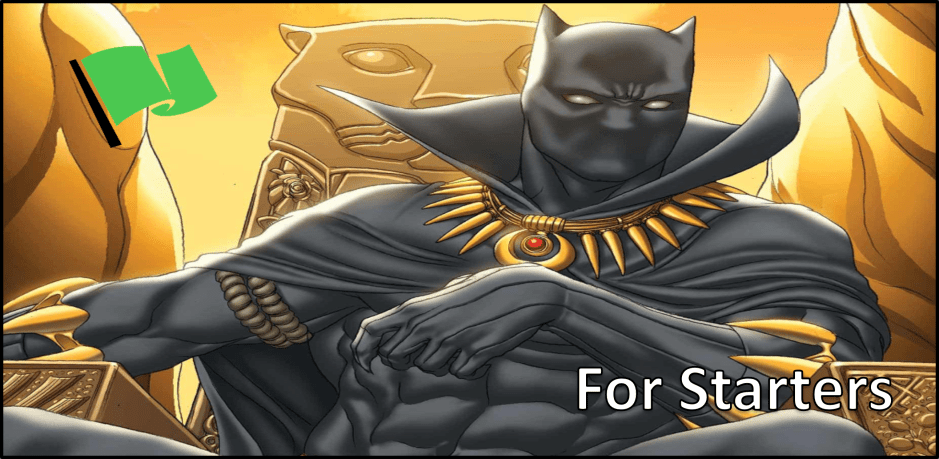
Black Panther has existed since the mid-Sixties, but Marvel produced some of the best Black Panther stories after 2000. Which Black Panther stories should you read first?
Hey, hey! Kyra Kyle here. As you can guess, we’re talking about Black Panther starter stories today. Like we’ve been doing for the past few entries in this series, we’ll split these stories into single issues and story arcs. Today, we’ll begin with single comic book issues. Enjoy!
Single Issues
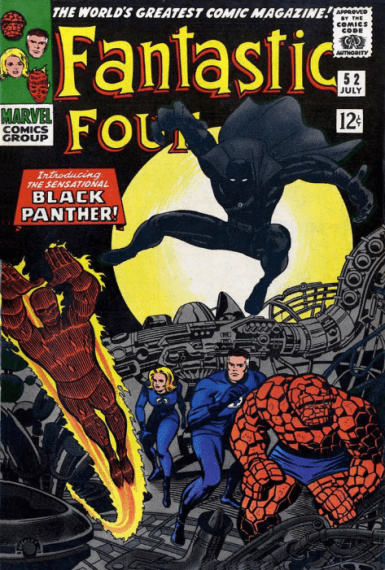
“Introducing The Sensational Black Panther” (Fantastic Four #52; written by Stan Lee/art by Jack Kirby; 1966)
I considered including this issue and a few others as part of a story arc. The next issue would include vibranium’s first mention and sets the stage for Ulysses Klaw to make his first appearance, but I chose to stick with Black Panther’s first appearance. “Introducing The Sensational Black Panther” centers around the Fantastic Four being invited to Wakanda. The enigmatic leader sends a hover car to take Marvel’s family to his homeland. The Fantastic Four agree, and when they arrive in Wakanda, they must survive a robotic jungle and the Black Panther himself. By themselves, the Fantastic Four are no match for Black Panther, but the team joins forces and unmask their assailant.
It turns out that T’Challa (Wakanda’s leader who invited the Fantastic Four to Wakanda) and Black Panther are the same. Black Panther says he only wanted to test the fours’ abilities and meant no harm by his attack. “Introducing The Sensational Black Panther” does a good job of showing Black Panther as formidable. Like I said, many key Black Panther elements are revealed in future issues, but “Introducing The Sensational Black Panther” is a great place to start reading.

“Death Calls for the Arch-Heroes” (Avengers #52; written by Roy Thomas/art by John Buscema; 1968)
“Death Calls for the Arch-Heroes” is another issue that sets up Black Panther; this time, it’s Black Panther’s first appearance as an Avenger. Until this issue, Black Panther served as an occasional Avengers ally. “Death Calls for the Arch-Heroes” begins with Black Panther visiting Avengers HQ to find the Avengers dead. They aren’t actually dead; they’re in a coma. Since Black Panther is an outsider, he gets blamed and taken into custody. Black Panther breaks out of jail, learns that the Grim Reaper (who wants revenge for the death of his brother, Wonder Man) is behind the plot. The two fight, Black Panther wins, reverses the effects of Reaper’s coma weapon, and then becomes a full-fledged member of the Avengers.
“Death Calls for the Arch-Heroes” marks an important milestone in Black Panther’s development. Prior to this issue, Black Panther seldom left Wakanda for long. This issue turned Black Panther into a global figure, and it put Wakanda on the map.
Story Arcs
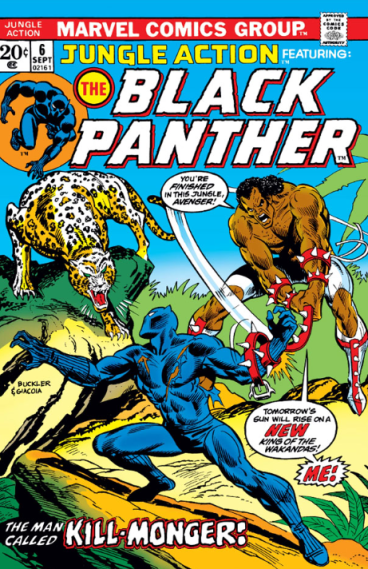
Panther’s Rage (Jungle Action #6-18; written by Don McGregor/art by Rich Buckler, Billy Graham, and various others 1973-1974)
It took a while for Marvel Comics to see potential in Black Panther. Sure, Black Panther showed up in plenty of Fantastic Four comic books. He was even a card-carrying member of the Avengers for half a decade by this point, but he was relegated to the edges of comic book stories and didn’t have his own title. At the same time, there was another Marvel comic book named Jungle Action that rubbed proofreader (at the time) Don McGregor the wrong way. Jungle Action featured white people saving Africans or white African people being threatened by black African people. McGregor demanded that Marvel feature a black African hero. He turned to the seldom-used Black Panther.
McGregor’s initial run on Jungle Action #6-18 (Panther’s Rage) is the birth of who we know as Black Panther. T’Challa returns to Wakanda to find his homeland torn by civil war. A revolutionary leader and terrorist named Erik Killmonger had returned to Wakanda and threatened T’Challa’s claim to the throne. Yes! Panther’s Rage is the first appearance of Killmonger. To say Panther’s Rage was groundbreaking is an understatement.
More than a decade before Watchmen, Panther’s Rage was the first graphic novel. It’s been collected and reprinted numerous times, and it’s worth the read. Writer Don McGregor was no stranger to pushing boundaries. Years before Panther’s Rage, he wrote a story that featured comic books’ first interracial kiss. If you want to know Black Panther better, Panther’s Rage is a great place to start.

Panther’s Quest (Marvel Comics Presents #13-37; written by Don McGregor/art by Gene Colan, and various others 1988-1989)
After his legendary run on Jungle Action, McGregor left Black Panther for over a decade. He returned to the character with Marvel Comics Presents. The Marvel Comics Presents title was an odd throw-back to early Marvel titles. Anthology series like Tales of Suspense (which featured Iron Man’s first appearance) and Journey into Mystery (which included Thor’s first appearance) had fallen out of favor. Marvel Comics Presents featured stories for multiple characters. We’re interested in the Black Panther storyline, Panther’s Quest.
Panther’s Quest is another McGregor epic. Following rumors that his mother (whom he had never known) may still be alive, T’Challa conducts a stealth mission in South Africa. What unfolds is a harrowing tale of social injustice mixed with intrigue and plenty of action. Always willing to broaden comic books’ horizons, McGregor tackled story elements like Apartheid and the discrimination someone who looks like Black Panther faces. In short, Panther’s Quest is another Black Panther must-read.

The Client (Black Panther vol 3 #1-5; written by Christopher Priest/art by Mark Texeira 1998)
The Client marks the first entry for Christopher Priest on this list. Priest is another writer synonymous with Black Panther. Priest is also the first black writer and editor in mainstream comics. He’ll show up time and time again on this list. We couldn’t include all of Priest’s works. The two series of his that didn’t quite make our list are both named Enemy of the State. You should give them a read as well. Getting back to our entry, The Client makes this list because it introduces several key Black Panther figures like Okoye, Zuri, and Nakia. And the story does a great job of balancing the odd space Black Panther occupies.
Black Panther sets up refugee camps and offers political asylum for people fleeing ethnic wars, but at the same time, he pushes for systematic change and battles street crime. T’Challa is a man attempting to do it all. But that’s why a lot of Black Panther’s key support system (like Okoye) are introduced. Within The Client’s pages, Priest develops what it means to be Wakandan.
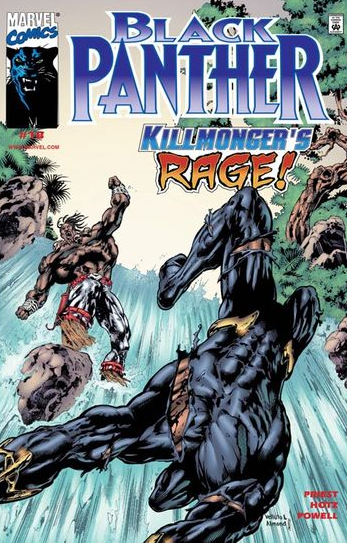
Killmonger’s Rage (Black Panther vol 3 #16-20; written by Christopher Priest/art by Sal Velluto and Bob Almond 2000)
Christopher Priest pushed the Black Panther forward, but he also paid homage to what came before. Killmonger’s Rage is a fitting spiritual successor to Panther’s Rage. Priest honors McGregor’s story by exploring T’Challa and Killmonger’s relationship. Priest’s Killmonger is a Wakandan corrupted by Western values. He’s the antithesis of T’Challa and Wakanda. Black Panther must face an intriguing mirror version of himself. Killmonger’s Rage shows what would happen if T’Challa rejected his Wakandan roots. 2018’s Black Panther uses a storyline or two from Killmonger’s Rage.
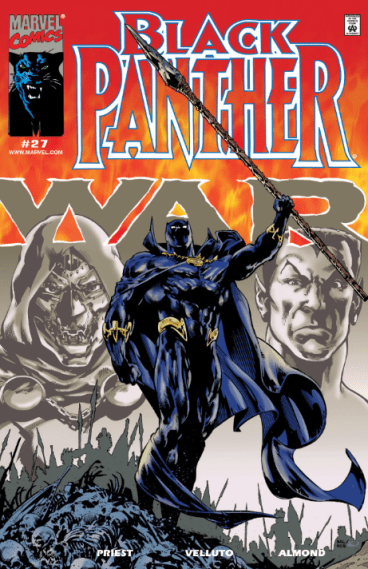
Sturm Und Drang (Black Panther vol 3 #26-29; written by Christopher Priest/art by Sal Velluto 2000-2001)
The world is on the verge of World War III, and Black Panther serves as mediator. Sturm Und Drang shows why T’Challa is different from most superheroes. He’s the leader of a country. Tension exists between the underwater nation of Lemuria and the surface world. Klaw works behind the scenes to stir up tensions among various nations; his machinations unnecessarily draw other countries into the mix. Black Panther advocates for peace, but at the same time, he refuses to back down or show any signs of weakness.
Sturm Und Drang explores Black Panther’s leadership during wartime. He must deal with group leaders like Namor, Magneto, and Doctor Doom. Sturm Und Drang is also the final Priest story arc on this list. He had an amazing run on Black Panther. You can’t go wrong if you see Black Panther and Christopher Priest. If you’re interested in reading Black Panther, Priest did more than anyone in shaping this character and showing his many facets. Priest’s run is chef’s kiss good.
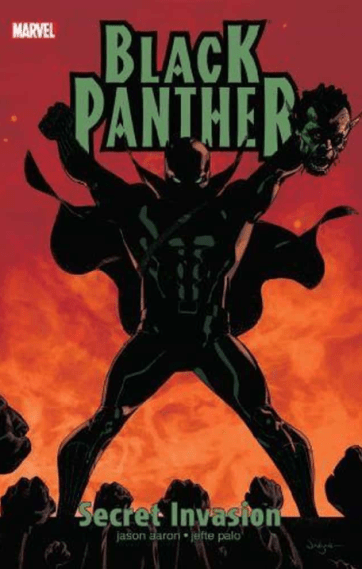
See Wakanda And Die (Black Panther vol 4 #39-41; written by Jason Aaron/art by Jefte Palo 2008)
See Wakanda And Die might be a slight understatement of a title. This story acts as a standalone story and a tie-in for Marvel’s 2008 event, Secret Invasion. I know. I know. The Secret Invasion television series almost ruined the MCU. Believe me, the comic book story was handled with more care. But we’re talking about See Wakanda and Die. An army of Skrulls has come to Wakanda to claim all the country’s vibranium. But Wakanda won’t go without a fight.
This action-packed story shows two complementary sides of the Black Panther. First, he’s a leader, shown through tactical decisions and care for his people. Second, he’s a hero, placing himself on the frontlines. These two sides merge to make a satisfying read with excellent pacing.
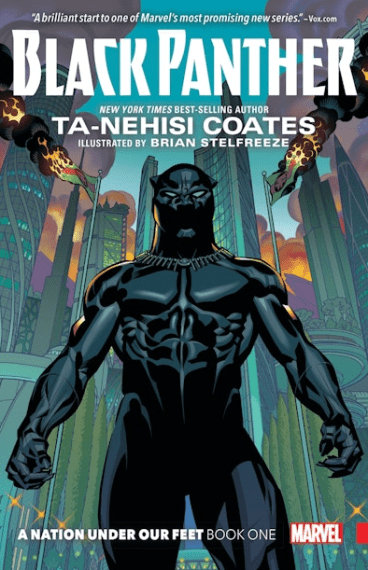
A Nation Under Our Feet (Black Panther vol 6 #1-12; written by Ta-Nehisi Coates/art by Brian Stelfreeze, Chris Sprouse, and Karl Story 2016-2017)
A Nation Under Our Feet is the most philosophical story on this list. It explores Wakanda’s identity, tensions, traditions, and where they fit in modern society while looking toward the future. This examination extends to the monarchy. Does Wakanda still need the Black Panther?
These topics make sense, considering A Nation Under Our Feet’s writer Ta-Nehisi Coates. Coates is an American journalist and activist who often writes about cultural, social, and political issues, specifically African Americans and white supremacy. Coates authored “The Case for Reparations,” so Wakandan story that examines its past while looking at how to move forward is something that Coates has immense experience.
But A Nation Under Our Feet also features the art of Stelfreeze and Sprouse, who present a brilliant Afrofuturism that has a touch of science fiction but is steeped in African art and culture. The result is A Nation Under Our Feet becoming a comic you can lose yourself in as you explore the different parts of Wakanda.
Those are the stories that made our list. Like I said, I could’ve included many more Priest Black Panther stories, and anything by Coates is a great read. Let us know which Black Panther stories you’d add to this list in the comments. Thank you for reading, and wherever you are, I hope you’re having a great day.
 jkgeekly.com