

1995 saw plenty of strong board game releases. It’s a shame we must limit this list to a Top 5, but debate is the benefit of a Top 5 versus a Top 10. A Top 10 could include many games of note from a calendar year. And 1995 had plenty of those. We also limited ourselves to one—just one—collectible card game. CCGs were going strong in 1995, too. One of our just-missed-the-list games is Marvel Overpower. I always liked Overpower’s straightforward gameplay and scalability. Star Wars Customizable Card Game is another CCG that just missed our list. Like its counterpart, the Star Trek Customizable Card Game on our previous list, it continues to be played. I’ve always liked its Dark and Light side of the Force; Star Wars Customizable Card Game is one of the rare collectible card games with a two-sided aspect.
Hey, hey! Kyra Kyle here. We’re back with another Top 5 Tabletop Games. We’ll talk about 1995’s board game list soon, but let’s recap the ground rules for which games make these lists before we start.
1: Cultural relevance plays as much of a factor as overall quality. A game might make a list that doesn’t hold up to others of its type, but you must admit the game is everywhere.
2: Only one game from a franchise makes the list. This will become more of an issue the closer we get to games with expansions.
3: Longevity plays a role, too. A game doesn’t have to fly off the shelves today, but it had to have some widespread appeal for a decent time.
5: Legend of the Five Rings (1995)
Legend of the Five Rings (L5R) collectible card game lasted for two decades, and even then, it was announced that the game would have a successor in Fantasy Flight Games’ Living Card Game line. So, in a sense, Legend of the Five Rings continues to this day. L5R shares similarities with Magic: The Gathering, but has game mechanisms with flavor and allows “passive” win conditions like the Enlightenment Victory. Games can be very long, with some matches lasting hours.

L5R features a storyline. New fiction pieces (short stories, novels, and comics) would advance the story of Rokugan (the fictional empire where Legend of the Five Rings takes place) every week. After Alderac Entertainment Group (AEG) purchased the rights outright in 2000, they reintroduced an accompanying tabletop role-playing game of the same name. Frequently, AEG would adapt Rokugan’s timeline to reflect who won specific CCG tournaments. The Spider Clan would have its own Emperor take the throne after an L5R world champion won with a Spider Clan deck. This unique and living game element has yet to be duplicated in tabletop games, making Legend of the Five Rings a singular experience.
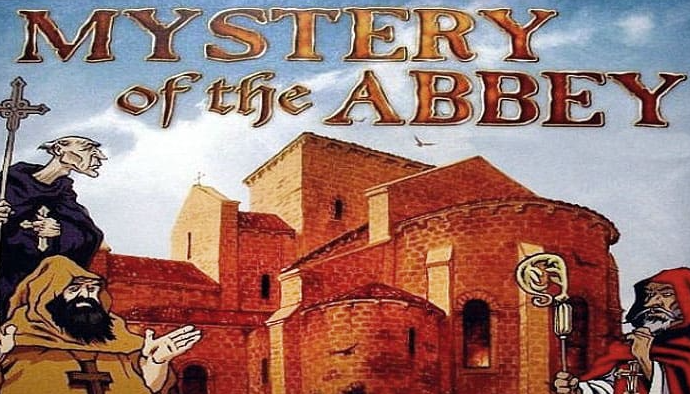
4: Mystery of the Abbey (1995)
Republished by Days of Wonder during their golden years almost a decade later, Mystery of the Abbey is a sign of what’s to come. Mystery of the Abbey is a clever update to the classic board game Cluedo (or Clue). Based on the novel The Name of the Rose, players assume the identity of a detective, trying to identify a murderer in a monastery by process of elimination, moving from room to room, and asking questions of other players to order them to reveal information that will disqualify potential suspects.
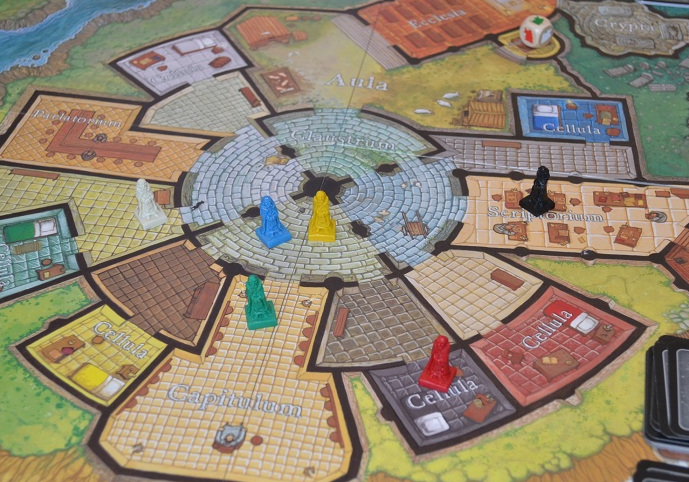
Unlike Cluedo, during their turn, a player can ask any question to any player provided the response wouldn’t include a suspect’s name. The person being asked the question may choose to answer or refuse by placing a finger to their lips (taking a vow of silence). This is so thematic and can be used strategically. All players will see the asked player’s refusal to answer. Why did they do that? If the player elects to answer the question, they then have the right to immediately ask a question of the active player. Mystery of the Abbey was one of the earliest publications for Days of Wonder, which started with interesting twists to classic games.

3: Medici (1995)
Dr. Reiner Knizia makes one of these lists again, and Knizia’s former employment as a quantitative analyst (one who manages and attempts to price risk for banks) comes in handy with Medici. Players take on the roles of the House of Medici, who were an Italian banking family and political dynasty. Medici is based on the pricing of risk. Each lot of commodities has an uncertain future based on how cards are drawn from the deck and what other players buy. To play Medici well, players must judge and price the risk attached to each lot of cards. Medici is a classic example of “buy low, sell high.”

I don’t play Medici particularly well, but I enjoy it every time I play. I downloaded it for my tablet and sneak in a few games against an AI opponent. The game takes place over three days (or rounds). Players draw random goods (units of different types and amounts) to make up lots, and then these lots are bid upon. The player who wins the bid then adds these goods to their ship. Each player’s ship can hold five goods. Once each ship has been filled, the round is over, and the ships score points in florins. The player with the most florins at the end of three days is the winner.
Medici is a simple auction game with a ton of open information. It’ll take a few playthroughs to figure out the true value of certain lots, but this clever design by Knizia is well worth the time.

2: El Grande (1995)
El Grande is Wolfang Kramer’s first entry on one of these lists. 1994’s 6 nimmit! is one of my favorite card games from this period and narrowly missed out on making our previous list, while Auf Achse won the Spiel des Jahres in 1987. It was only a matter of time before Kramer made one of these lists. El Grande combines several simple mechanisms. It’s the interlocking of these mechanisms and how they play off of each other that gives El Grande its depth.

Players begin the game with a hand of identical cards (numbered 1-13). Players bid for turn order using these cards. The person who played the highest card chooses their action card first, but each player may use each card only once during the game. Each turn, players take Caballeros and execute an action card, which includes two actions, a special action, and placing Caballeros. Scoring occurs in three of the nine rounds. Players must keep track of the many factors that determine the balance of power in the regions and the score track. If it wasn’t for another game on this list, El Grande would’ve been the runaway Spiel des Jahres winner this year.

1: Catan (1995)
Could it be any other game? Catan (originally Settlers of Catan) revitalized the board game industry. Catan shaped the modern board game. It opened doors and spawned numerous expansions and spin-offs. While many gamers have moved on from Catan, there are still plenty more who swear by Catan. The ideas this game presents are still used to this day.
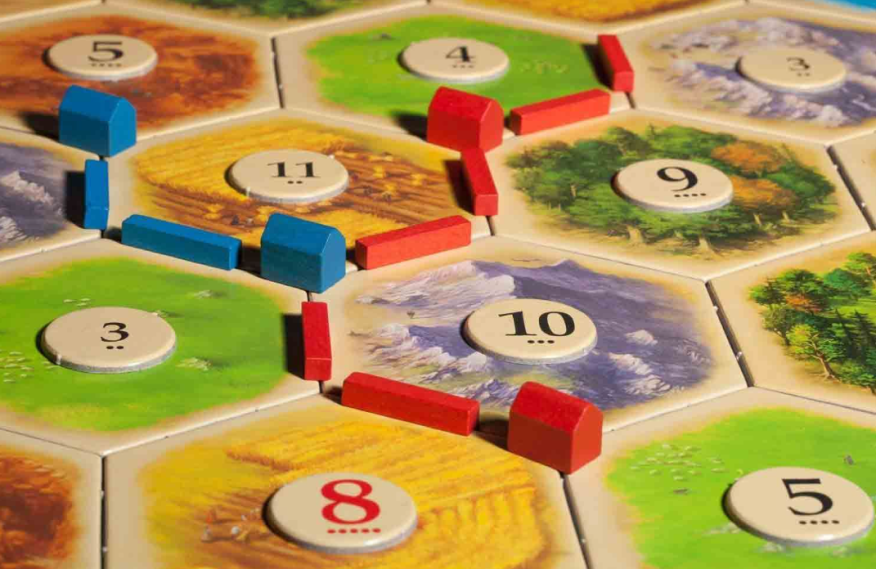
The game board is composed of hexagonal tiles of different land types, which are laid out randomly at the start of each game. Players build settlements on a fictional island of Catan. They connect their settlements with roads placed on the edges of the hexes. Each hex has a number that needs to be rolled (on two standard six-sided dice) for the hex to generate resources. Any player with a settlement touching the hex gains the resource indicated. Players gain victory points as their settlements grow, and the first to reach a set number of victory points (usually 10) wins.
I’ve played countless games of Catan in the late 90s and early 2000s. While many of the mechanisms have been improved on in some way in newer games, I haven’t found a game that scratches the same itch of bartering. Some games get close, but nothing compares to Catan. It’s deserving of the 1995 Spiel des Jahres (German game of the year).
Did we get the list mostly correct? Let us know which games you’d add in the comments. Thank you for reading, and wherever you are, I hope you’re having a great day.
Check out the other lists in this series:
Top 5 Tabletop Games Prior to the 1930s
Top 5 Tabletop Games of the 1930s
Top 5 Tabletop Games of the 1940s-50s
Top 5 Tabletop Games from the Early 1960s
Top 5 Tabletop Games from the Late 1960s
Top 5 Tabletop Games from the Early 1970s
Top 5 Tabletop Games from 1980-1981
Top 5 Tabletop Games from 1982-1983
Top 5 Tabletop Games from 1984-1985
Top 5 Tabletop Games from 1986-1987
Top 5 Tabletop Games from 1988-1989
Top 5 Tabletop Games from 1990-1991
Top 5 Tabletop Games from 1992
Top 5 Tabletop Games from 1993
Top 5 Tabletop Games from 1994
 jkgeekly.com