Hey, hey, Geekly Gang! Kyra Kyle here. I’m just checking because this is when I would typically post a board game design brain dump. I’m skipping this week, but I have a good reason. This week (and next week) are crunch time for my board board game designs. I’ll be submitting them to Great Plains Game Festival’s (GPGF) Playtest to Win event. So, if you’re in the Lincoln, Nebraska area and you’re attending GPGF, you can play Spill the Beans, No Kings, and Whirligig Pets.
I may or may not post a game design brain dump next week either, as I will be attending GPGF. If you’re attending stop by and say, hi.
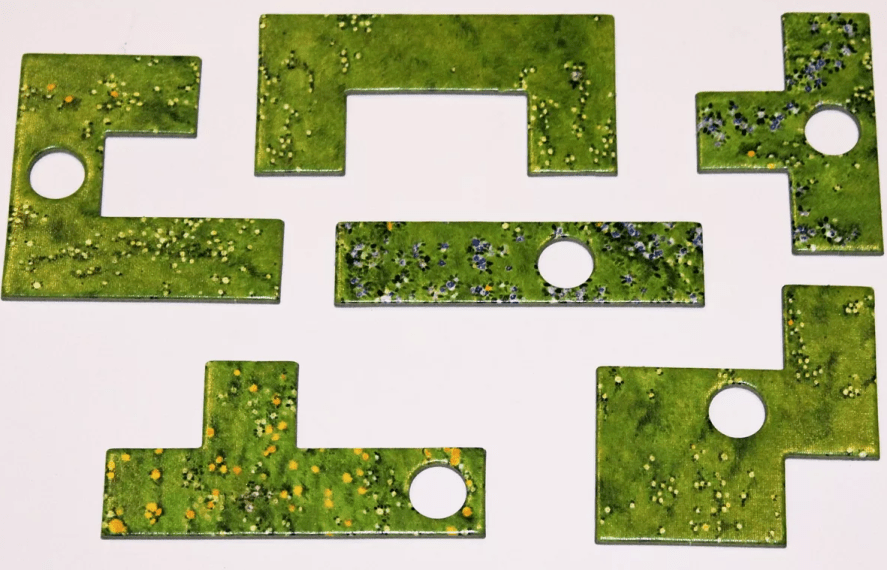
Spring Meadow is the grand finale of Uwe Rosenberg’s puzzle trilogy of games. It follows 2016’ Cottage Garden and 2017’s Indian Summer. The complexity of this game—the most interactive between the players in the trilogy—is set in between those two games. Hey, hey, Geekly Gang! Kyra Kyle here with another tabletop game review. We’ll be placing oddly shaped polyominoes on wintery player boards in today’s game review, Spring Meadow. Uwe Rosenberg’s final game of his puzzle trilogy marks the end of a harsh winter, and the first delicate flowers bloom. Can you have the lushest meadow? We’ll get to Spring Meadow’s review in a bit, but first, let’s talk about the less picturesque elements of the game and discuss Spring Meadow’s credits.
The Fiddly Bits
Designer: Uwe Rosenberg Publisher: Stronghold Games; Pegasus Spiele; Edition Spielwiese Date Released: 2018 Number of Players: 1-4 Age Range: 8 and up Setup Time: 5-10 minutes Play Time: 15-60 minutes
We’ll be paraphrasing the Spring Meadow rule book. The setup is succinct and easy enough to follow.
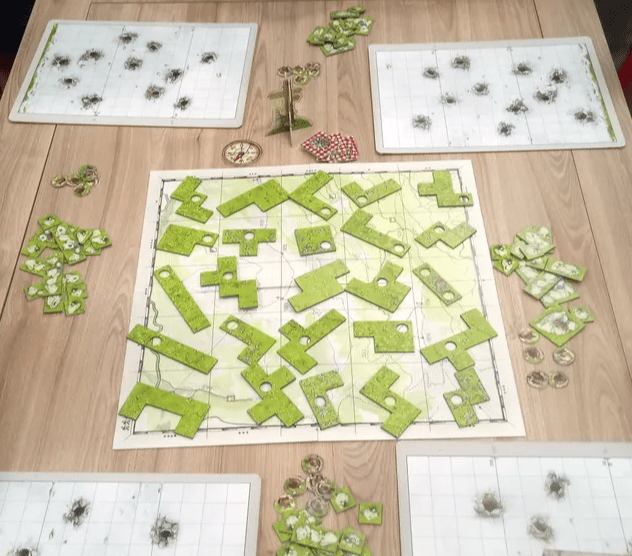
1) Place the double-sided Hiking Map (shared board featuring the offering of polyominoes) that corresponds to the number of players face up in the center of the table.
2) Shuffle all Meadow (polyomino) tiles and randomly place one on each of the 25 spaces of the Hiking Map.
3) Return the remaining Meadow tiles to the box. You will need them later to refill the Hiking Map.
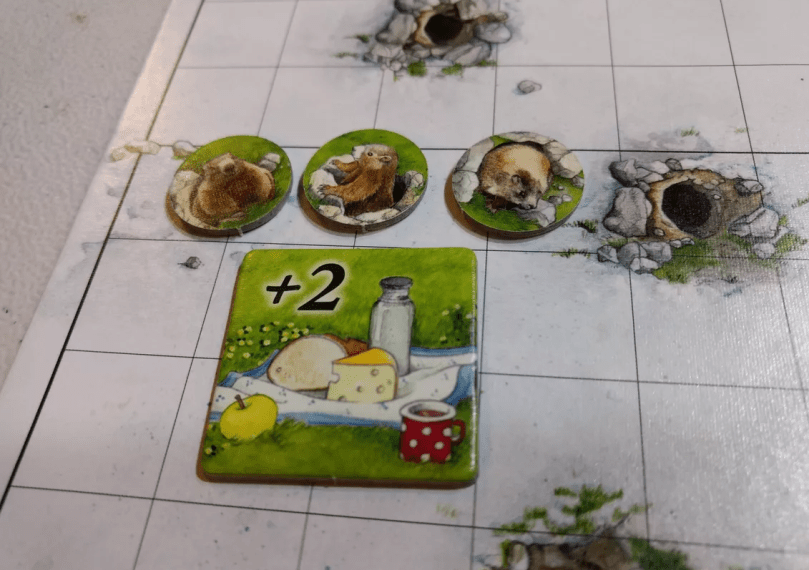
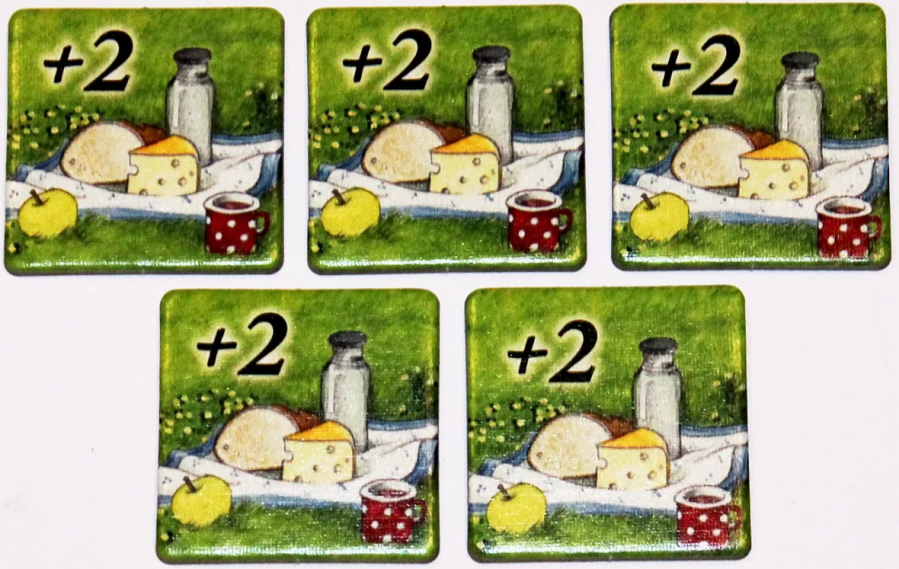
4) Place the Rock tiles, Marmots, Picnics/Hiking Pins, and Compass within reach of the players in a common supply.
5) Place the Signpost next to the player count icon on the Hiking Map.
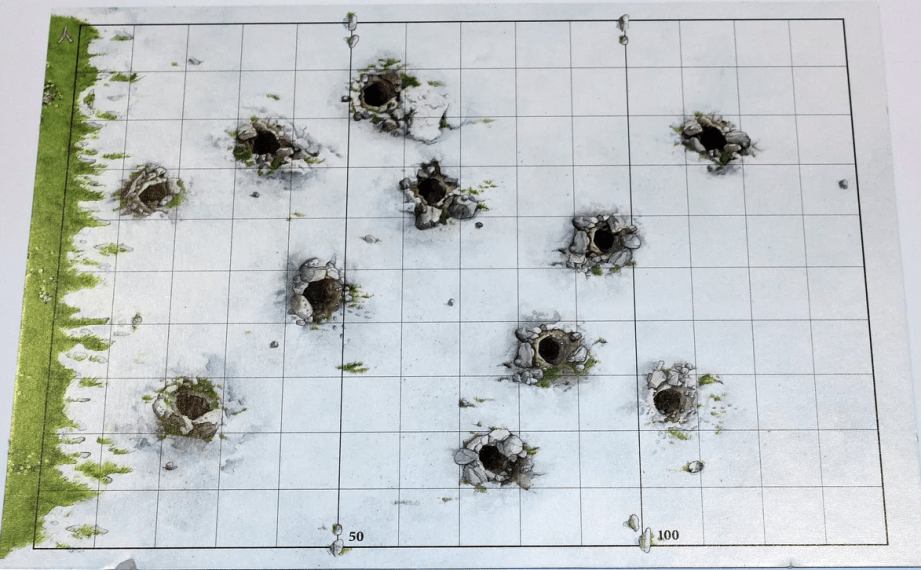
6) Shuffle the double-sided Mountain boards and give one to each player. Orient the Mountain board with the arrow pointing up.
7) Randomly select a starting player. Each successive player will take a Rock tile, the size of which will depend on the player count and the player order.
Game Flow
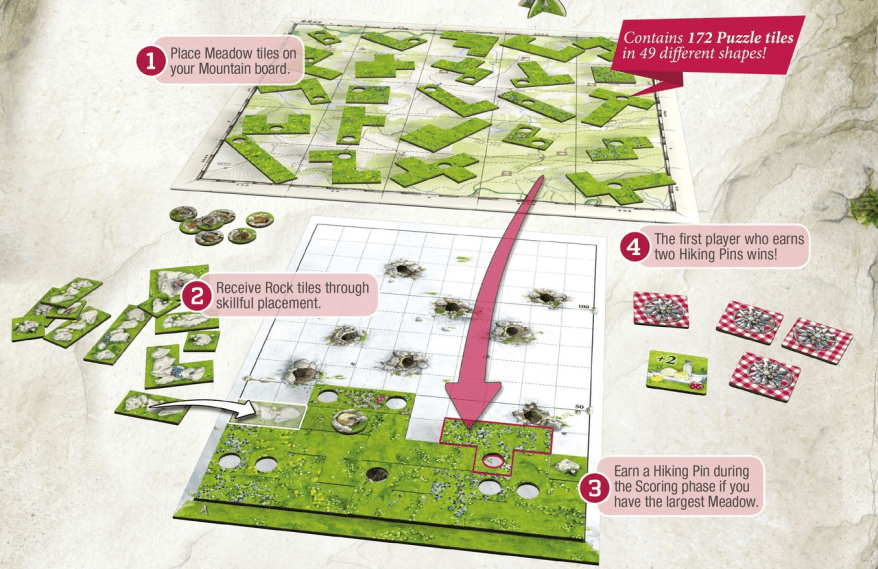
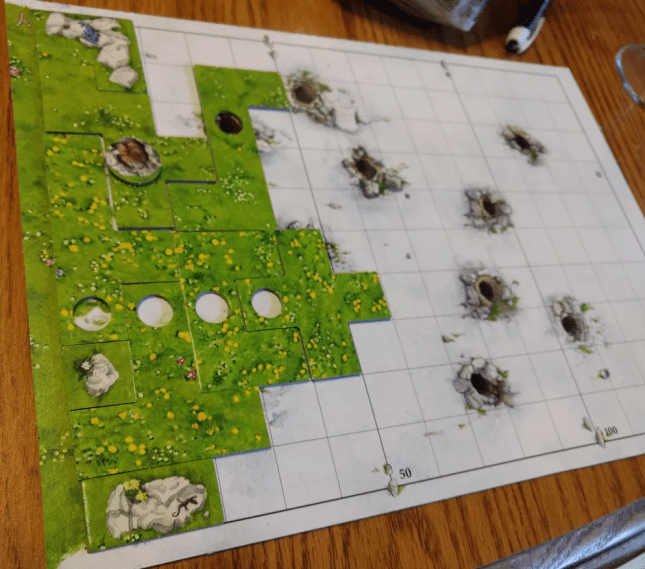
On a turn, the active player chooses 1 Meadow tile from the Signpost Path (noted by the Signpost pawn, you’ll either select from a row or column of polyominoes, depending on the Signpost’s orientation during your turn) on the Hiking Map. Place the tile on your Mountain board.
Pay attention to the Holes in the Meadow tiles and the Burrows on your Mountain board. Burrows will challenge your puzzle skills and placing adjacent Holes will allow you to place extra Rock tiles on your Mountain board.
If you wish to cover a Burrow, you must place a Marmot over a Burrow that has already been cleared.
When the Signpost stands next to a Signpost Path (column or row) on the Hiking Map containing zero or one Meadow tile(s), a Scoring phase is triggered.
Starting from the bottom of your Mountain board, count all covered spaces up to and including your first incomplete row to tally your score.
The player with the most points earns a Hiking Pin and must place Marmots over all their cleared Burrows (so they cannot score those Burrows again).
Once scoring is completed, refill the Hiking Map with randomly drawn Meadow tiles afterwards.
The first player to earn their second Hiking Pin wins the game.
Review
It took some time for me to get into Spring Meadow. I appreciated Spring Meadow’s theme. There’s something about the earth waking up from a cold winter. One of my favorite things to do during this time is to stop by the Platte River and hear the ice turn into slush and float on by. Spring Meadow gives me those vibes. And I love polyominoes in general, and Spring Meadow uses them in interesting ways. Kind of like a competitive Tetris, where you want to fill the board with as many blocks as possible. But Spring Meadow has a steep learning curve, and if you play with a new player, that can derail the game.
Sure, at one point, I was that new player. The person who taught me the game had a fun enough time, but he didn’t really find enjoyment in playing Spring Meadow until me and another player from my gaming knew had played a handful of games. He told me as much. And I found the same to be true. Spring Meadow feels unforgiving as the “new player,” but as an “experienced player,” I felt as if I was taking advantage of someone else.
While Spring Meadow’s player (Mountain) boards can be oriented in landscape or portrait, I prefer portrait. There isn’t much difference between the two orientations, but portrait clicks a little better with me. Other players in my gaming group said the opposite, so there’s a chance portrait or landscape orientation could benefit one player over another because of how different brains process information. This doesn’t lower Spring Meadow in my estimation, but I had to mention it.
I’m uncertain if Spring Meadow has a runaway leader problem. Certain plays of Spring Meadow devolve into a runaway leader, especially if you have a veteran player against noobs, but evenly skilled players can keep the game close. Still, I don’t think the Marmots covering cleared Burrows is a big enough penalty or catch-up mechanism. Player boards stay the same in between rounds, so if you’re ahead by fifteen points at the end of one round, all other players need to score fifteen more points than the leader during the second round. Good luck with that.
I could see gamers instituting an extra catch-up mechanism of handing players who are behind by more than five points, a one, two, or three rock tile. But that would be a house rule.
I also prefer Spring Meadow with fewer players. The three and four-player variants have one player selecting on the diagonal (instead of a row or column), but it’s the same player picking on the diagonal each time that happens. While picking the Meadow tile you want from a diagonal line may not add extra strategic value for that one player, it feels bad for the players who don’t get to choose from the diagonal, and choosing a tile from a diagonal line gives the illusion of more choice, because you’re literally picking your tile in a manner no one else can.
Despite any minor gripes I may have, I’ve enjoyed my time with Spring Meadow. It’ll be one of those games you’ll need to play multiple times to grasp the game’s nuanced strategy. Fortunately, games of Spring Meadow don’t take that long. Fifteen minutes per player is short. This is another reason why I like playing Spring Meadow with fewer players. A two-player game takes up to thirty minutes. Nice!
Too Long; Didn’t Read
Spring Meadow may have a runaway leader problem, and veteran players have a decided advantage over noobs. But I love the theme and the game uses polyominoes in intriguing ways. Spring Meadow is one of those games you’ll need to play more than once to grapple with its nuanced strategy. Thankfully, games of Spring Meadow don’t take long: fifteen minutes per player.
Happy Friday, Geekly Gang! Kyra Kyle here with another game design brain dump. Our first of the year. Yay! Recently, I watched Netflix’s Delicious in Dungeon. I even shared it during one of our Watcha Watching posts. And instantly, I had a new idea for a board game. Well, Dungeon Chef is a variant of an old game design idea I had years ago. Let’s dish. Great. Now, I’m hungry.
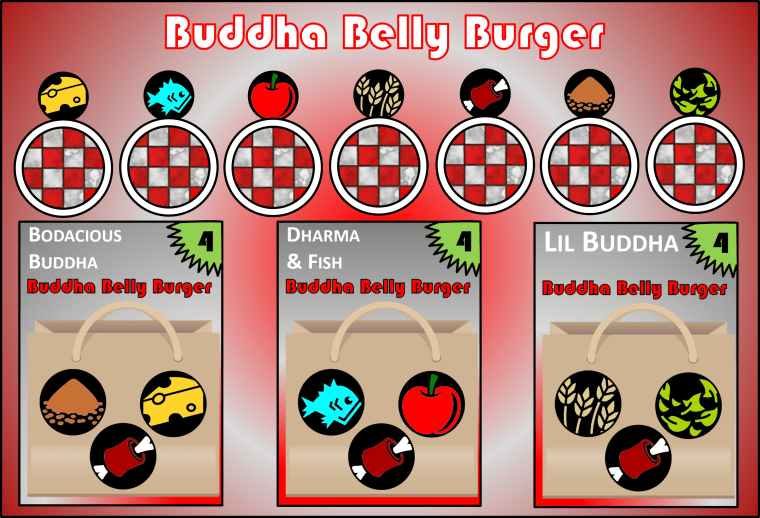
Above is an image of Food Court Hustle’s most recent iteration. Yes, Food Court Hustle was the game’s original name. Food Court Hustle was a card-drafting game where players manage restaurants in a food court. It played quickly, had plenty of Take That elements, and never took itself too seriously. I liked the concept and loved the name. But food courts are a little dated. That was the biggest complaint I heard from playtesters. The concept for Food Court Hustle’s game mechanisms was to give players more control during card drafting. Each round, players would choose one card to play (for its effect) and then choose a card to discard for its ingredients, only every player–not just you–gains the ingredient.
Like most card-drafting games, Food Court Hustle plays swiftly. Simultaneous play helps with game speed. Seriously. This was one of the few games I never felt the need to incessantly time. And that’s a good rule of thumb when designing games. Always time your games. You want to waste as little of your players’ time as possible. I’m not saying you can’t design a two-hour or longer epic board game, but the game should earn its play time. Getting back to Food Court Hustle, something beyond the theme was missing.
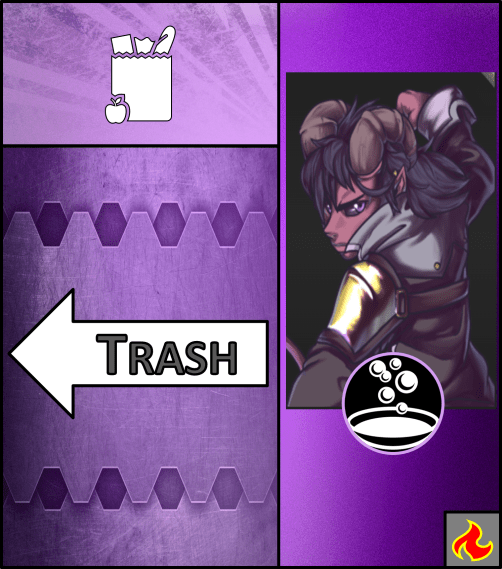
Tangent: the image above is Dungeon Chef’s player board, and the previous image was of a Food Court Hustle player board. The scale of these two images is almost what it should be, so I managed to shrink the player’s space while ditching customers. Yes. The original game included customer cards that wouldn’t always appear when players wanted to make a dish. Another gameplay gripe. You could have the ingredients and not be able to make a meal. Dungeon Chef gets rid of that layer of randomness. I also got rid of a lot of the Take That mechanisms and replaced them with global effects.
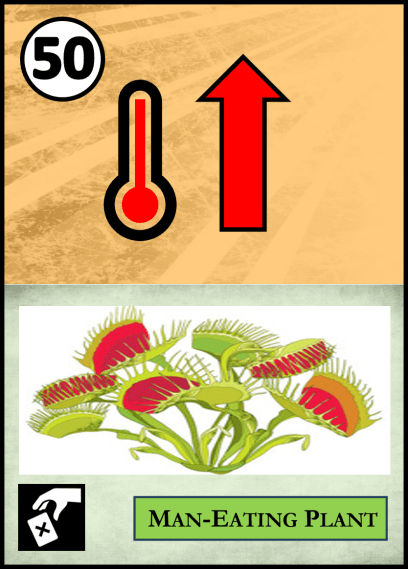
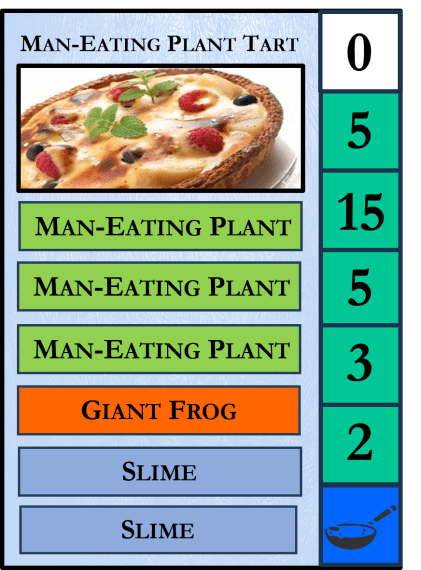
Above is a sample Dungeon Chef card. The top half is the action you may choose to play. The number indicates the player’s initiative for that turn. All cards in the three day decks are numbered 1-50. The higher the number, the quicker the action. I’ve seen players choose a card for its initiative, which is wild. The bottom half is the monster parts you may add to the communal ingredients. You wouldn’t be the only one gaining a man-eating plant. Everyone at the table gains a chunk of man-eating plant. And returning to the action on this card, you can turn up the temperature of the communal stove. That’s right. Most game elements in Dungeon Chef have global effects. Half the game is steering the game state in your direction.
Players can select a recipe by spending the ingredients on the recipe card. Then, they add the recipe to their player board, lining up the wok with the flame. And near the end of each turn, move the recipe card up the number of spaces indicated by the communal stove’s temperature. Players can take their active recipe off the stove and claim the victory points indicated on the card at any time. But beware, if a player leaves their meal on the stove too long, they could burn their meal, and it goes into the trash, costing them 10 points at the end of the game. Whoever has the most points at the end of three days wins. There’s little more to Dungeon Chef. I tried to keep it short, easy to understand, and stick to the Delicious in Dungeon theme as best I could.
We’ll see where this design goes. And who knows? Perhaps I’ll be at a gaming convention near you. Let me know which convention I should attend. If you made it this far, you’re awesome. We all know it. Thank you for reading, and wherever you are, I hope you’re having a great day.

 jkgeekly.com