

Hey, hey! Kyra Kyle here. Back with another Top 5 Tabletop Games. 1986 and 1987 have a lot more games for us to choose from. These two years may have too many games to talk about. Why couldn’t some of these games be released over the previous two years? Ugh! This is a good problem to have. I may have at least one honorable mention this year. Let’s talk board games.
But first, in case you’ve forgotten our criteria for the Top 5 Tabletop Games, let’s reiterate the ground rules again before we get started.
1: Cultural relevance plays as much of a factor as overall quality. A game might make a list that doesn’t hold up to others of its type, but you must admit the game is everywhere.
2: Only one game from a franchise makes the list. This will become more of an issue the closer we get to games with expansions.
3: Longevity plays a role, too. A game doesn’t have to fly off the shelves today, but it had to have some widespread appeal for a decent time.
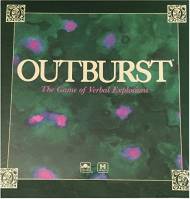
5: Outburst (1986)
Outburst plays a bit like Family Feud. Two teams compete over multiple rounds to reach 60 points by guessing items listed on a Topic Card within a time limit. Outburst’s simple concept puts it firmly in the party game category, and games like this bring people into the hobby of tabletop games. And they can just be fun.

Outburst was featured in Games magazine’s Best Games of 1988. Scott Marley praised Outburst for its clever topics and team-based gameplay. Marley concluded that “Though Outburst is easy to learn, many topics are too hard—and occasionally too spicy—for children.” This may have prompted 1989’s Outburst Junior.
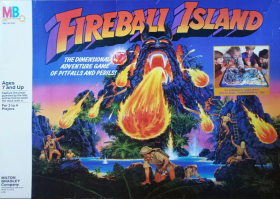
4: Fireball Island (1986)
I remember getting the original Fireball Island for Christmas in 1986. The box is ginormous. The plastic game board had undulating paths where the titular fireballs (marbles) would travel down and knock players down, causing the player to lose any items. The object of Fireball Island is to escape the island with the jewel, which players must steal from the top of the Vul-Kar’s mountain. Fireball Island only has one jewel, so once a player grabs it, they become the target of others. And boy, do they become a target.
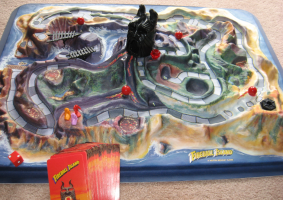
Players are incentivized to knock the jewel out of the hands of the player who possesses it. The reimagining of Fireball Island by Restoration Games in 2018 doesn’t place as much emphasis on the jewel. Players can win by other means. Unsponsored quick plug: Restoration Games does great work. They’ve brought back many games on this list and even a couple of honorable mentions like Dark Tower (from the 1980-1981 list) and Thunder Road (which just missed this list).
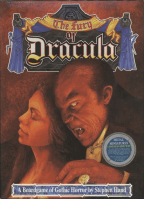
3: The Fury of Dracula (1987)
I mentioned a few lists ago (1983-1984) that Scotland Yard inspired many asymmetric games with hidden movement; The Fury of Dracula is one of the most prominent. I like the theme, but the name “Fury” is a bit of a misnomer. Dracula travels on a hidden board while the hunters move across the game board openly and try to deduce where Dracula is, all the while collecting the means with which to slay Dracula (stakes, garlic, and holy water). The Fury of Dracula ends with an epic showdown.

The Fury of Dracula has been updated multiple times. The second edition changes a lot of the gameplay, while the third edition streamlines the rules to make it easier to play and get into. 2019’s Fourth Edition of The Fury of Dracula gave the game a facelift; it didn’t change much in the way of gameplay. I recommend either the third or fourth editions.

2: Labyrinth (1986)
Not to be confused with the 1946 marble game, Labyrinth, which was originally stylized as THE aMAZEing LABYRINTH, uses a 7×7 grid where tiles get placed on one end of a column or row and displaces the tile on the opposite side of the column or row, hence the German name for the game Das verrückte Labyrinth, which is a pun on the German words “ errücken” (displace) and “verrückt” (crazy).

Players move their pieces along the ever-shifting path. Many of the tiles will have treasures printed on them. These treasures will match the cards dealt to players at the beginning of the game. The first player to obtain all the treasures in their deck wins. Labyrinth looks simple at first, but it gets puzzlely real fast. It’s a great problem-solving game for children, but when played by adults, the game can become more strategic and cutthroat. Labyrinth’s shifting tiles is one of the most unique game mechanisms from this era.
Returning to the naming, I wonder if Labyrinth avoided calling itself that in 1986 to avoid a lawsuit or confusion with Jim Henson’s Labyrinth movie that was released the same year. I remember a Labyrinth marble game variant tying into the movie that year.

1: Arkham Horror (1987)
I didn’t realize how old Arkham Horror was until I started compiling this list. Designer Richard Launius originally submitted the concept as Call of Cthulhu: The Board Game. This won’t be the first time Launius will make a game based on H.P. Lovecraft. He made a faster-pace, dice version of Arkham Horror in Elder Sign. Launius may be the person most responsible for making H.P. Lovecraft so popular in tabletop gaming. Arkham Horror is an early, thematic cooperative board game. Before Arkham Horror, I don’t recall seeing too many popular cooperative board games.

Because of this, Arkham Horror introduced a lot of staple cooperative board game concepts. Not the least of which is a “Doom Track.” Players work against the clock before the Ancient One breaks through its plane and into Arkham. Come to think of it, a game clock—of one persuasion or another—exists in most cooperative board games. Launius reinvented Arkham Horror into a Living Card Game in 2005.
Did we get the list right, for the most part? I didn’t mention Blood Bowl (1987); I’ll mention it here as another honorable mention. Let us know which games you’d add in the comments. And wherever you are, I hope you’re having a great day.
Check out the other lists in this series:
Top 5 Tabletop Games Prior to the 1930s
Top 5 Tabletop Games of the 1930s
Top 5 Tabletop Games of the 1940s-50s
Top 5 Tabletop Games from the Early 1960s
Top 5 Tabletop Games from the Late 1960s
Top 5 Tabletop Games from the Early 1970s
Top 5 Tabletop Games from 1980-1981
Top 5 Tabletop Games from 1982-1983
Top 5 Tabletop Games from 1984-1985
Top 5 Tabletop Games from 1988-1989
Top 5 Tabletop Games from 1990-1991
 jkgeekly.com
15 thoughts on “Top 5 Tabletop Games from 1986-1987”