

Hey, hey! Kyra Kyle here. We haven’t done a tabletop game review in quite some time. We’ll rectify that with a board game review of a game we began writing a guide for Marvel United. Excelsior!
Players act as iconic Marvel heroes who work together to stop the master plan of a powerful villain controlled by the game. Each villain has a unique master plan, cards that trigger various effects, and threats that make clearing locations difficult. Heroes clear missions, making the villain vulnerable, and finally take on the big bad villain before they complete their dastardly plan. Can you save the day in time? Let’s find out with Marvel United.
Before we get any further, we’ll take a side quest and discuss Marvel United’s less heroic details.
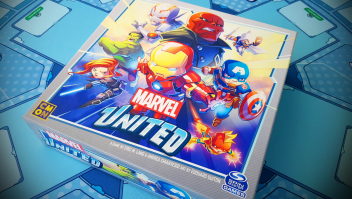
The Fiddly Bits
Designer: Andrea Chiarvesio and Eric M. Lang
Publisher: CMON Global Limited and Spin Master Ltd.
Date Released: 2020
Number of Players: 1-4
Age Range: 8 and up
Setup Time: 5-10 minutes
Play Time: 30-40 minutes
Game Mechanisms:
Cooperative Play
Hand Management
Modular Board
Solo / Solitaire Game
Variable Player Powers

Game Flow:
The villain begins the game with a turn. A villain plays their turn by drawing the top card of their master plan deck.

1) The villain moves the number of spaces indicated.
2) Resolve any BAM! Effects (if any) and these effects will be printed on a space within the villain’s dashboard and vary from villain to villain.
3) Then, place the civilian/thug tokens (if any) indicated at the bottom of the card. The target symbol signifies the location where the villain ended their move. Villains usually place tokens on their location or locations adjacent to them.
After all these effects are resolved, the heroes get their turn.
Heroes pick who goes first, and hero turns will continue around the table clockwise. At the beginning of each game, Heroes will get three turns before the villain receives another turn. During their turn, heroes play one card from their hand.
Hero cards are simple.

1) Some cards (three cards in each of the core set hero decks) may have an effect that will exist in a box overlapping the hero’s picture.
2) But all cards have an arrow-shaped box pointing to the right on the bottom. The symbols on the bottom box depict the actions the hero can take that turn.
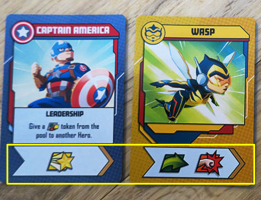
The reason the arrow points to the right is that the next player will play their card to the right of the first player and so on, and the next player gains the symbols/actions on the bottom of the card they played that turn and the previously played card. Marvel United is a cooperative game through in through.

So, what do the symbols mean? The Green Arrows are Move actions; the Hero can Move one space for each arrow.

The Yellow Stars are Heroics actions; Heroics allow Heroes to rescue civilians (if there are any in their location) or help clear Threat cards.

Red Fists give the Hero one Attack, which deals one damage and can be used against the main villain (after they become vulnerable to damage—more on that in a minute), any henchmen like “Bob Agent of Hydra,” or defeat thugs (again if there are any thugs in their location).

The final symbol with all three colors is a Wild action; Wild actions can be used for Move, Heroics, or Attack. Heroes may resolve the effect (if they played the card on their turn) and any symbols in any order they choose.

Heroes will use these actions to complete missions. The game begins with three missions in play: Defeat Thugs, Rescue Civilians, and Clear Threats. Each mission card will have spaces for the tokens they require to complete. As soon as these spaces are filled, the card is discarded, and the mission is considered complete. Mission cards can be completed in any order.
After the heroes complete the first mission, the villain panics and will act (play a card) every two hero cards instead of every three hero cards. After the heroes complete the second mission, the villain becomes vulnerable to damage. The heroes can complete the third mission, but it isn’t necessary. If the heroes do complete the third mission, each hero immediately draws 1 card, increasing each player’s hand size by one.
Play continues back and forth until either the villain wins (by completing their unique master plan or anyone, heroes or villains, runs out of cards) or the heroes win by dealing enough damage to the villain after the villain becomes vulnerable to damage.

Review:
Marvel United scratches a similar itch as a game like X-Men: Under Siege. We covered X-Men: Under Siege in a previous review a decade ago (link to the review). Unlike X-Men: Under Siege, Marvel United functions as a board game system rather than a stand-alone game. Any number of intellectual properties can use this same system, which allows for plenty of crossovers. Case in point, CMON ran a DC Heroes United campaign earlier this year. I can see Teenage Mutant Ninja Turtles, Masters of the Universe, Star Wars, and any number of other IPs in the United System’s future.
The system has intuitive rules that allow for quick teaching times. Since Marvel United is a cooperative game, it benefits from even shorter rules explanation. I always feel like I need to teach everyone everything about a competitive game, otherwise I may have an unfair advantage. Players work together in a cooperative game. New players can learn as they go. And I’ve found Marvel United simple to pick up and relearn. The relearn feature becomes more important the older I get. I have so many games that seldom make it off my shelf because I don’t want to relearn the game. Marvel United makes that easy.
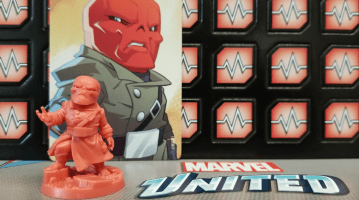
The gameplay itself can be a joy. The first time I played with my oldest daughter, she insisted that we play for hours until we defeated Red Skull. I don’t know why, but Red Skull eeked out a victory time after time. Red Skull is Marvel United’s choice for the first villain new players face first.
Marvel United’s heroes have just enough flavor to let people know who they’re playing, but Marvel United’s villains are the game’s showstoppers. Each villain has a unique flair. Kraven will actively hunt you. That makes sense, he’s a hunter. Ultron tries to win by flooding the field with civilians and thugs, putting these people’s lives in danger. That tracks for Ultron. Green Goblin will do a little bit of kidnapping, toss out dangerous henchmen, and try to throw out more Threats than the heroes can clear. Again, that feels a lot like Green Goblin. Each villain presents a unique challenge.
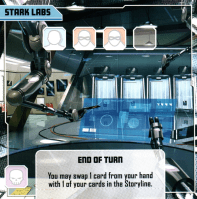
Marvel United incentivizes players to clear Threats. Doing so unlocks “End of Turn” abilities, which can further boost a hero’s power. I like this inclusion. Most expansions will add locations that can help with defeating the villains included in that expansion. Great choice.
The missions work well, too. Depending on the board state and the villain you’re facing, you may want to “Rescue Civilians” and “Clear Threats” or “Clear Threats” and “Defeat Thugs.” This adds to the puzzle of each villain. Some villains will add more civilians than thugs or vice versa and steer the gameplay in that direction. This furthers the uniqueness of each villain. Another great choice.
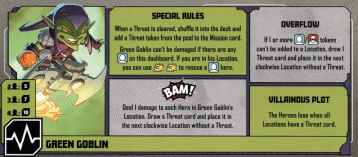
The one minor gripe I have is that not all the villains scale at every player count. Green Goblin is easier to play at 1-2 players and becomes increasingly more difficult the more heroes who join the fight. This should be expected. Marvel United boasts a massive line-up of characters. Hundreds! And even though Green Goblin becomes more difficult at higher player counts, he doesn’t break the game. You’re just less likely to defeat him.
Each Marvel United box includes challenges to spice up the gameplay if it ever becomes a little stale. The core set boxes have generic challenges, but if you pick up any expansion, you’ll find some great alternative ways to play the game. My favorite from the original launch comes from the Tales of Asgard expansion, where players deal out Loyalty Cards, with one of the cards being Traitor. Essentially, one of the players is Loki in disguise. Fantastic and very thematic.
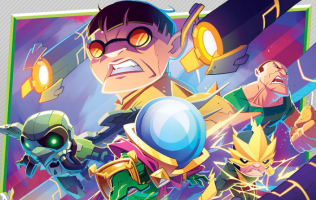
Finally, we come to the issue of expansions. This may be yet another small gripe of mine. CMON hid a lot of the better expansions within Kickstarter Exclusives. That means that you must add them to your pledge on Kickstarter instead of being able to buy the expansion via retail (Amazon, Game Nerdz, Target/Wal-Mart, or your local board game shop). Marvel United started the trend with The Return of the Sinister Six, which was easily the best expansion from the first wave. Marvel United continued that trend with Marvel United: X-Men. X-Men: First Class, Days of Future Past, and Fantastic Four were all Kickstarter Exclusives. CMON has a knack for inducing FOMO (fear of missing out).
That said, you don’t need everything to enjoy Marvel United. You could buy one of the core sets (Original, X-Men, or the newest one Multiverse) and add a few expansions that you can find at retail and have a game you can play for decades. I may or may not have started a spreadsheet of all my games. And I started a guide for Marvel United. You can check out the link here.
Verdict:
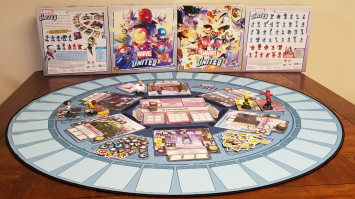
Easy to learn, teach, and recall, Marvel United introduces a board game system that will facilitate countless fantastic and future crossovers. The heroes have just enough personality, but the villains steal the show. Each villain feels unique and well worth their puzzle.
 jkgeekly.com
I don’t think I’ve seen your website before, but I came across it now as I was looking for info on Marvel United. I have a lot of questions, so this article is very helpful! I really like this site! I much prefer the written word over videos and this was great. Thanks!
LikeLike
Thank you for commenting. We appreciate it.
We’re glad you enjoy the content. Let us know if you have any questions about Marvel United.
LikeLike
At this point now, the only question I have left is will I like it? And also, how would you compare it to Unmatched? That’s the info I’m looking for right now. This feels exactly like what I went through when I was considering Unmatched. So many positive reviews everywhere, everyone loves it, etc so how could I resist? And I hated it. So simplistic it baffles me why it’s so popular. Marvel United is giving me the same vibes. I haven’t found anything that compares the two games yet, but I’d like to hear someone’s take if they know both systems.
LikeLike
Ah! I have yet to play Unmatched, but I may know someone who has a copy. I’ll ask around and follow up as soon as I can. Marvel United skews toward the simplistic side; however, the X-Men and Multiverse sets add more complexity.
I just asked my Monday game night group if any of them have a copy of Unmatched. I’ll let you know if we play it.
LikeLike
If it’s not too much trouble . . . Thanks! I hope you enjoy it more than I did.
LikeLike
I played Unmatched co-op and competitive last night and have had some time to organize my thoughts. I prefer co-op (Unmatched Adventures) to the base game, but there’s a trade-off with switching to co-op Unmatched. The movement doesn’t matter as much in co-op because the monsters don’t move that often. For comparison, I’ll add another board game series to the mix: Horrified. Unmatched, Marvel United, and Horrified are about the same level of complexity. Where the games differ is their focus on combat.
Competitive Unmatched is just a combat simulator, while co-op Unmatched adds one or two more things to worry about. This is why I prefer co-op Unmatched. Unmatched may be too focused on combat for my taste. Let’s put co-op Unmatched at 85-90% focused on combat. That’s generous. Co-op Unmatched doesn’t add that much more to the baseline gameplay.
Marvel United adds other game elements, elements like acts of heroism and random other bits you’ll have to worry about maintaining and solving while battling various villains. That said, it’s not a perfect 50-50 split between combat and non-combat gameplay. Marvel United’s focus on combat would be 65-75%, depending on which villain you’re facing. The villains vary enough that you could find some that don’t require as much combat.
Horrified’s combat is abstract. It exists, but it’s barely there. Depending on the monsters you face, Horrified is more of a puzzle. Can you figure out how to help or stop the monsters you’re playing against?
I can’t say definitively that you’ll like Horrified or Marvel United over Unmatched. The difference I found in these games is the focus on combat. Perhaps you’d like a game with less of a focus on combat.
If you’re looking for a more complex game with similar combat and one with superheroes, you could try Marvel Champions (LCG) or Sentinels of the Multiverse. I prefer Sentinels in part because I have most of the content. Sentinels has a lot of rules overhead, triggers that happen at certain times, while Marvel Champions is more streamlined.
Some local game shops have demo copies or will schedule demos. I endorse playing a game before buying whenever possible. I hope this helps.
LikeLike
Good analysis. First off, I don’t know Horrified and the theme does not appeal to me much which is probably why I never looked into it. I did not like Marvel Champions at all and I was okayish with Sentinels. MC felt so fiddly, procedural, and surprisingly abstract to me. And it was hard to learn, harder to teach. Sentinels was overwhelming with the amount of stuff to track, keeping track of card abilities, etc, so I kept that one longer because I thought the idea of it was cool, but in the end I sold both.
I only got into Unmatched after I heard about the co-op version (Adventures). I think it was the Dice Tower that sold me on it. So I got some other sets to go with it to play competitively and learn the system, etc. The rules were easy enough, but I got worried during my first game because it was just so simple it was boring. I played that set a few more times to see if I was missing anything. I thought co-op would be different so then I moved to Adventures. It did not change my mind. I did not even unwrap the other sets I had bought and sold them all as a package. Ultimately, I don’t think I like skirmish games. Unmatched was just boring to me and I don’t think it’s that it’s entirely focused on combat that bothers me (90% combat sounds right). There was nothing interesting in the gameplay. It was a battle of attrition and I did not feel I was doing anything intelligent.
I’ve tried Invincible because I like bag building, and it was all right, but I realize I don’t like scenario-based games much and setting up for scenarios. I know I sound like I’m really picky saying I don’t like this or I don’t like that. The truth is, I like a lot of different types of games, but I’m throwing all of my dislikes into this one response so it seems like I’m a negative person. Anyway, I’m considering selling Invincible and buying some more Marvel United sets if the first one clicks with me. I just ordered it and it should be arriving soon.
Thanks for going to the effort of trying out Unmatched and posting your thoughts. It didn’t seem like you fell in love with the game, but at least you have the experience to add to your perspective. I’m going to play Marvel United immediately and decide quickly if it’s a keeper or sell it for half what I paid and I won’t complain. I am hopeful I’m going to like it. Thanks!
LikeLike
Thank you!
You’re right. Unmatched didn’t really land with me either, but I’m glad I played it. I may use some of the game’s elements in a future design.
I’ve only played a little Marvel Champions and that was some time ago. Now that you mention it, it did seem fiddly and abstract. I think I gave it a try because of the Dice Tower. Eek!
I haven’t touched MC in years. I should probably sell my copy of the base game.
LikeLike
I’m not a big movie watcher so none of the films mean much to me, but I think I like X-Men more than Spiderman. After doing some digging I realized that the X-Men set is very difficult to find if it’s not already out of print. I found one retailer (out of 20?) who had a single copy left so I felt compelled to order it even though I haven’t played the base game yet. Eek. Now I really hope I like it. Thanks!
LikeLike
Oh no! Fingers crossed that you like it.
I like X-Men more than Spiderman, too. The X-Men may be the best set out of the Marvel United bunch anyway. Multiverse is the most recent set, so that might be why X-Men is harder to find. I’m glad you were able to find a copy.
I haven’t tried Invincible. I like bag building, but I don’t tend to like scenario games that are difficult to set up. I don’t blame you for not liking a lot of setup. I may have to see if I can find a copy of Invincible to demo.
You don’t sound negative at all. It can be difficult to find a game that clicks.
LikeLike