

Magic: The Gathering dominated 1993 and in 1994, dozens of new collectible card games hit the market. Even though 1994 produced more than one collectible card game on its list, we still have one honorable mention collectible card game, Illuminati: New World Order. I always loved Illuminati’s sense of humor; it’s a shame that neither the original game (released in the early 1980s) nor the CCG made the cut. That just shows these lists’ competition.
Hey, hey! Kyra Kyle here. Back with another Top 5 Tabletop Games. We’ll talk about the board games that this year’s list soon, but let’s recap the ground rules for which games make these lists before we start.
1: Cultural relevance plays as much of a factor as overall quality. A game might make a list that doesn’t hold up to others of its type, but you must admit the game is everywhere.
2: Only one game from a franchise makes the list. This will become more of an issue the closer we get to games with expansions.
3: Longevity plays a role, too. A game doesn’t have to fly off the shelves today, but it had to have some widespread appeal for a decent time.
5: Star Trek Customizable Card Game (1994)
Illuminati: New World Order’s lack of staying power contributed to its absence from this list. The Star Trek Customizable Card Game doesn’t have that issue. I never knew The Star Trek Customizable Card Game stayed in print for over a decade. The game may have gone out of print in 2007, but a group of dedicated fans still play. Peter Ludwig was crowned the 2023 Star Trek Customizable Card Game World Champion.

The Star Trek Customizable Card Game pitted players against each other to assemble a team, a ship, and equipment to complete missions. The first player to complete 100 points worth of missions/objectives wins. The 1st Edition, which ran from 1994-2001, only had the option of a two-player game, just like Magic. 2002 saw the Star Trek Customizable Card Game’s second edition. This version allowed for more players to join in the fun.
On a personal note, I knew one of the original designers of the Star Trek Customizable Card Game. Rest in peace, Rollie.

4: I’m the Boss! (1994)
I struggled with placing the 2-4 ranked games on this list. Honestly, you can shuffle these games in any order, and I wouldn’t fight you. The first game we’ll cover comes from a familiar face, Sid Sackson. We haven’t seen Sackson on one of these lists in a while, but he was productive during this period. I’m the Boss! is a negotiation game where players compete and cooperate to put together profitable business deals. Gameplaywise, I’m the Boss! splits the difference between luck and skill. One must be able to negotiate and needle their way into the best deals.

Not going to lie, I’m not the best at I’m the Boss! But if you like games where you can pull the wool over someone else’s eyes and rob them blind through a one-way deal. I’m the Boss! can give you those moments. Sackson has a knack for business games. His most famous creation was Acquire, which featured on our Top Tabletop Games from the Early Sixties. (Check out the link here.)
3: Vampire: The Eternal Struggle (1994)
Richard Garfield wasn’t done with collectible card games after 1993. Vampire: The Eternal Struggle, which was originally published as Jyhad (changed to distance the game’s name from the Islamic term jihad), puts players in the role of Methuselah (ancient) vampires, controlling lesser vampires to complete machinations and wrest control of the Camarilla, the society of vampires featured in the role-playing game Vampire: The Masquerade. Garfield wanted to show the versatility of collectible card games as a genre, and he succeeded in doing so with Vampire: The Eternal Struggle.
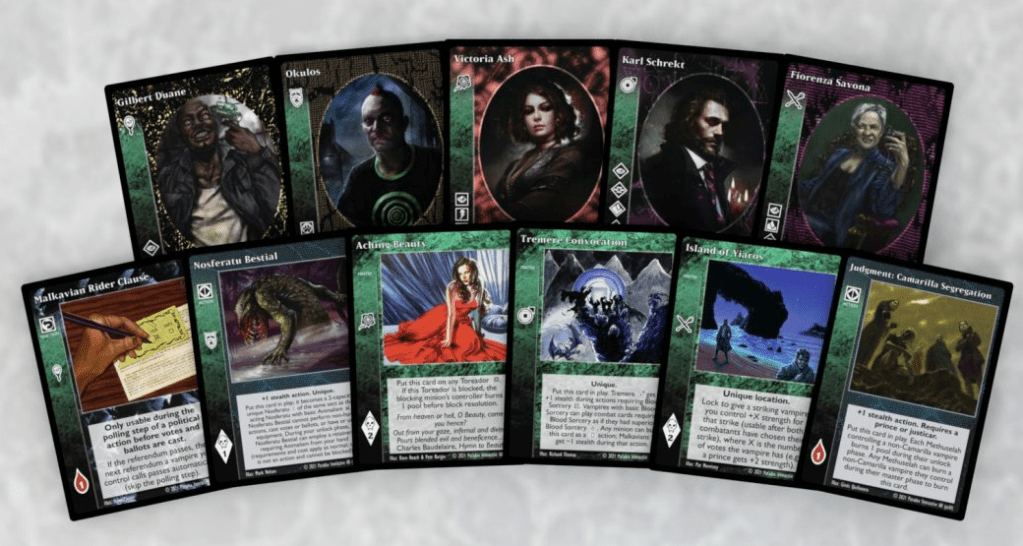
Magic games are quick. Vampire: The Eternal Struggle games can take up to two hours. Magic forces players to play lands from their deck to cast spells. Vampire: The Eternal Struggle allows players, who are Methuselah vampires, to spend their blood points to play cards, but be careful, your blood points are also your life and if you run out, you lose. Magic has players draw one card at the beginning of a player’s turn (you can have cards that allow you to draw more). Vampire allows players to draw cards as soon as they play cards. Magic started as a two-player game. Vampire was always a 2-5-player game. The two games couldn’t be more different.
Despite their differences, or maybe because of them, both games found a wide audience. Depending on how one views it, Vampire is the second longest-running CCG, only to Magic, if you include the five or so years when the game was transformed into a living card game. Or Pokémon, which (Spoiler Alert) will make a future list, takes the second spot, and Vampire takes the spot for the third longest-running CCG. Either way, Vampire: The Eternal Struggle has staying power.

2: Manhattan (1994)
Manhattan received the 1994 Spiel des Jahres award, so I gave it the nod over the previous two games. The concept is simple. Players construct and control Manhattan skyscrapers that will award points. Manhattan benefits from 3-D components. When you’re constructing skyscrapers, they will stretch vertically. This gives Manhattan table presence.
Manhattan may have a game concept based on a New York City borough, but it took Mayfair Games two years to make the game accessible to the United States. Manhattan was designed by Andreas Seyfarth. At the time, Seyfarth was an unknown game designer, but eventually, he’d add several more board game gems: Puerto Rico, San Juan, and Thurn and Taxis (which he codesigned with his Karen). This may not be the last time we’ll see Andreas Seyfarth’s name on one of these lists.
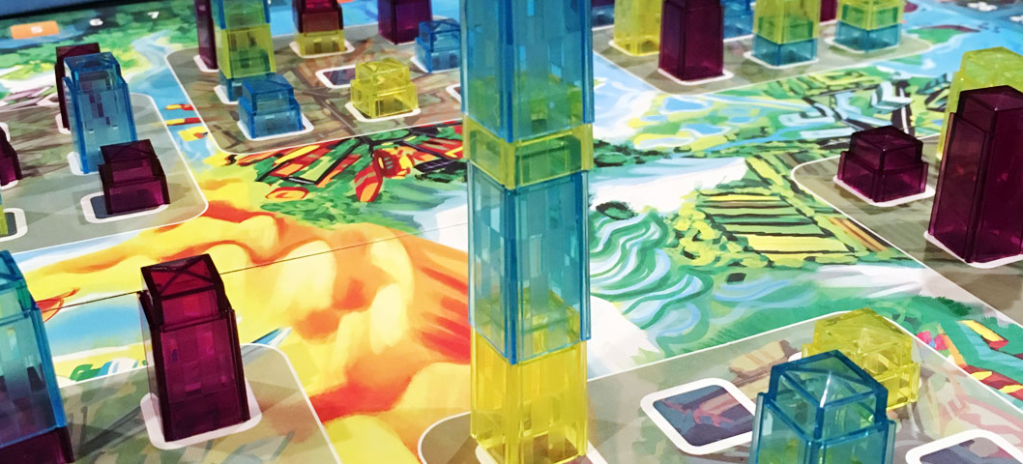
Despite earning the Spiel des Jahres, Manhattan has received mixed reviews. Previous critics have questioned the game’s components and scalability. Others claim that the game’s mechanisms are dated and too abstract, chaotic, and luck-driven. But still, others insist that Manhattan has broad appeal and praise the game’s engagement and accessibility. What does this tell us? Gamers can’t agree on anything, and one likes what one likes. If you like the idea of building skyscrapers, you may want to give Manhattan a try.
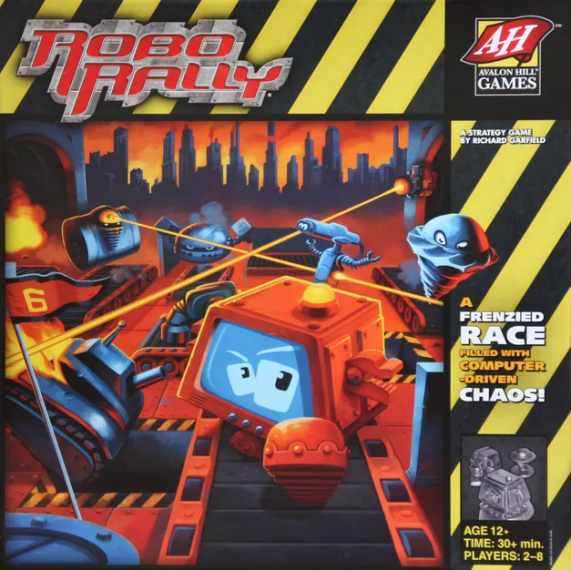
1: RoboRally (1994)
I promised that Richard Garfield would make this list again, and he claims the second number-one spot in consecutive years. Richard Garfield started a tabletop revolution with Magic: The Gathering in 1993 and kept busy in 1994. RoboRally is a robot demolition derby. Players attempt to guide their robots through a dangerous widget factory filled with moving gears, course-altering conveyor belts, metal-melting laser beams, bottomless pits, crushers, and more obstacles.

I say that players attempt to guide their robots because RoboRally is notorious for how chaotic the races get. The more players, the more mayhem ensues. The box reads that RoboRally plays for up to two hours. That’s generous. It may play longer than that, but RoboRally is another modern classic and shows Garfield, like the game type he invented (the collectible card game), is no one-trick pony. Richard Garfield has one of the most diverse board game catalogs and isn’t afraid to take chances.
Did we get the list mostly correct? Let us know which games you’d add in the comments. Thank you for reading, and wherever you are, I hope you’re having a great day.
Check out the other lists in this series:
Top 5 Tabletop Games Prior to the 1930s
Top 5 Tabletop Games of the 1930s
Top 5 Tabletop Games of the 1940s-50s
Top 5 Tabletop Games from the Early 1960s
Top 5 Tabletop Games from the Late 1960s
Top 5 Tabletop Games from the Early 1970s
Top 5 Tabletop Games from 1980-1981
Top 5 Tabletop Games from 1982-1983
Top 5 Tabletop Games from 1984-1985
Top 5 Tabletop Games from 1986-1987
Top 5 Tabletop Games from 1988-1989
Top 5 Tabletop Games from 1990-1991
Top 5 Tabletop Games from 1992
Top 5 Tabletop Games from 1993





 jkgeekly.com