

Hey, hey! Kyra Kyle here. Back with another Top 5 Tabletop Games of an era. We’re keeping the trend of breaking a decade into two halves—for now. Today’s list will be the Top 5 Tabletop Games from the Early 1970s (1970-1974)
In case you’ve forgotten our criteria for the Top 5 Tabletop Games, let’s reiterate the ground rules again before we get started.
1: Cultural relevance plays as much of a factor as overall quality. A game might make a list that doesn’t hold up to others of its type, but you must admit the game is everywhere.
2: Only one game from a franchise makes the list. This will become more of an issue the closer we get to games with expansions.
3: Longevity plays a role, too. A game doesn’t have to fly off the shelves today, but it had to have some widespread appeal for a decent time.
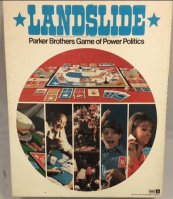
5: Landslide (1971)
Landslide has a simple premise. Each player is running for President of the United States. 2024 is a Presidential election year, so Landslide can scratch the itch for an election game. These rashes flare up every four years. We don’t have too much information about this game’s production; Landslide released when Parker Brothers (the publisher) didn’t credit their artists or designers. That will change in the coming eras.

Landslide uses “votes” as a form of money for players to bid for states. Players can even attempt to steal already “bought” states from each other. And while an actual Presidential election requires one candidate to gain more than half of the total number of electoral votes to get elected, or the vote goes to the House of Representatives, the winner of Landslide is the player with the highest number of electoral votes. There may be more than two players.
I played Landslide a lot growing up. I spotted a couple of copies at my local board game café, Mana Games, and may have to play it a handful of times real soon. The gameplay moves fast, and at the time of its publication (1971), the electoral votes for each state reflected that year’s electoral votes.
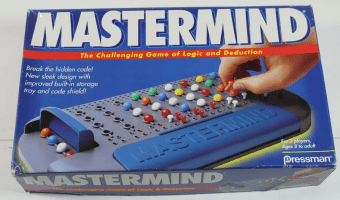
4: Mastermind (1971)
I have a love/hate relationship with Mastermind. I appreciate its simplicity, but my brain struggles with finding the solution. For the few of you who don’t know, Mastermind is the basis for Wordle. Instead of deducing a word, you use logic to deduce a sequence of colors. One player sets a secret code, while the other tries to crack the code.

Mastermind has spawned a ton of imitators: Wordle, Fiction, and many others. Not only do I struggle with these puzzles—I flail whenever I play Wordle—I find it grating that whenever a TV show or movie wants to show someone as smart, that “smart” character always has a copy of Mastermind. Big Bang Theory’s Sheldon Cooper constantly had Mastermind on a shelf in the camera’s frame behind his head. Yeah. We know he’s supposed to be smart, so Mastermind. Ugh!
Still, you can’t deny Mastermind’s cultural impact. Even if I stink as the codebreaker.
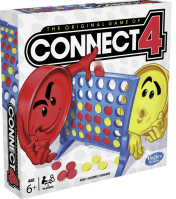
3: Connect 4 (1974)
Connect 4 (also known as Connect Four) plays a lot like Tic-Tac-Toe (connecting 4 of your pieces in a row). The board stands straight up, and players take turns dropping “checkers” game pieces into the stand’s top. The player who connects four of their pieces in a row first wins. Connect 4 is easy-to-learn and has about as much strategy as Tic-Tac-Toe.

Connect Four just may be a lot of people’s first board game. Its simple rules make it a great game for kids.
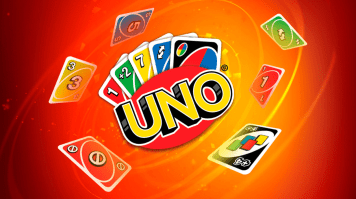
2: Uno (1971)
Uno continues two trends. The first, 1971 was a banner year for board games; four of the five games on this list released that year. The second, take an existing game and give it a spin. Connect 4 changed up Tic-Tac-Toe; Uno turned Crazy Eights into a colorful and commercial success. Who knew it could be that easy?
In Uno, players race to empty their hands and catch opposing players with cards left in theirs, which score points. Each turn, players play cards by matching the played last card’s color or number. If unable to play, players draw a card from the draw pile. If they’re still unable to play, the player passes their turn. There are several Wild and Special cards to spice up the gameplay. Oh! And you must say “Uno” whenever you have one card remaining in your hand. If anyone calls you out for not saying Uno, you’ll draw two cards.
Uno may also continue a third trend. It could be a lot of people’s first tabletop game.

1: Sleuth (1971)
Sid Sackson makes another appearance on one of these lists. 1971’s Sleuth (hey, this is another 1971 release) tasks players with deducing the location of a hidden gem.
The hidden gem is one of 36 gem cards and gets hidden before the start of the game. The remainder of this gem deck—with each card showing 1-3 diamonds, pearls, or opals in one of four colors—is distributed evenly among the players, with any remaining cards laid face up. A second deck contains 54 search cards, each showing one or two elements, such as pearls, pairs, red opals, or an element of your choice. Each player receives four face-up search cards.
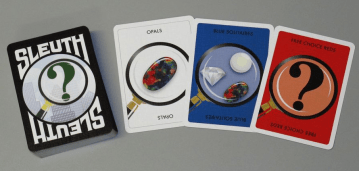
During a turn in Sleuth, players will ask other players about the cards in their hands based on the search cards they have. The asked player must show every card that matches the asking player’s question. This generates partial information in Sleuth. You may know that one player has two diamond cards in their hand, but you won’t know which color they are or how many diamonds are on the cards unless you asked the question.
Players are encouraged to keep notes for both negative and positive information. Sleuth can reach brain burning levels. It boils down a game like Clue—and Sid Sackson’s own The Case of the Elusive Assassin (1967)—to its deduction roots. It’s a simple but deep concept. Would you expect anything less from a master game designer like Sid Sackson?
Did we get the list right, for the most part? Let us know in the comments. And wherever you are, I hope you’re having a great day.
Check out the other lists in this series:
Top 5 Tabletop Games Prior to the 1930s
Top 5 Tabletop Games of the 1930s
Top 5 Tabletop Games of the 1940s-50s
Top 5 Tabletop Games from the Early 1960s
Top 5 Tabletop Games from the Late 1960s
Top 5 Tabletop Games from the Late 1970s
Top 5 Tabletop Games from 1980-1981
Top 5 Tabletop Games from 1982-1983
Top 5 Tabletop Games from 1984-1985
Top 5 Tabletop Games from 1986-1987
Top 5 Tabletop Games from 1988-1989
Top 5 Tabletop Games from 1990-1991
 jkgeekly.com