Whatcha Playing, Geekly? June 2025

Hey, hey, Geekly Gang! Kyra Kyle here. We have a new month and a new Wednesday, so it’s time for Whatcha Playing. The Geekly writers and I will share the games (video games and tabletop games) we’ve been playing over the past month. Feel free to share which games you’ve been playing, because we’re all part of the Geekly Gang.

Kyra’s Games

As always, I won’t include any of the gacha games I typically play. If I ever stop playing Wuthering Waves or Honkai: Star Rail, I’ll let you know. I also don’t include prototypes of tabletop games I’m developing, like Rustbucket Riots, Whirligig Pets, No Jack, Weeds, or Spill the Beans. Of course, I played those. With that disclaimer out of the way, let’s get to the games.

Board Games

I finally got Sky Team to the table, and it’s excellent. This two-player only game features a fast back-and-forth between one player as the pilot and the other as the co-pilot while they attempt to land a plane. Technically, players aren’t supposed to speak during rounds, but I allow minimal communication. Sky Team is a cooperative game, after all. Players simultaneously roll dice and then place them in their designated spaces, blue for the pilot and orange for the co-pilot. Both roles have specific duties.

Naturally, I chose Skye to be part of my first play of Sky Team. You can’t have a Sky Team without Skye. We played the tutorial and narrowly lost. Skye immediately wanted to play again, and we were able to land the plane on our second try. Sky Team includes numerous scenarios, and I can’t wait to try more.
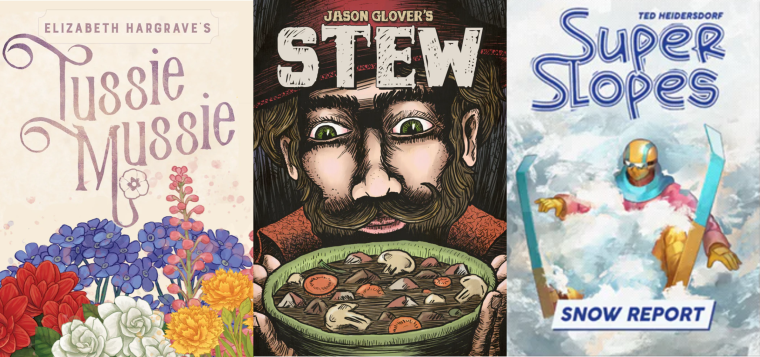
I’ve played many Button Shy Games over the last month, and the above three games are standout titles. Elizabeth Hargrave’s Tussie Mussie has a great push pull of which flower do I want to show my opponent and which to keep secret. Your opponent will choose between the two flowers: known and unknown. Jason Glover’s Stew takes a similar concept of having partial knowledge of what’s in the Stew because you know which cards you’ve played and not the ones your opponents played. If you think there are enough points in the stew, you call stew and count up points; players gain points if they guess correctly, but their opponents gain points if they guess incorrectly. And Ted Heidersdorf’s Super Slopes is a crazy game of branching slaloms down snow-capped mountains.

I’m hooked on Button Shy Games. This company packs a lot of game into a small package, a wallet to be exact. I mentioned Button Shy Games in our Stocking Stuffer Games list in December. These games are great options for that, but for $12 apiece, Button Shy Games are good any month of the year. I love their portability. I can pack twenty to thirty of these in less space than one standard board game.

Technically, I haven’t played much Cretaceous Rails over the last month; I demoed the game for countless gaming groups. Dinosaurs and trains together at last! Really? I’m surprised the combination of dinosaurs and trains hasn’t happened before Cretaceous Rails. Anyway, I’ve played plenty of this game in the past. It’s over-the-top in its production value. Who doesn’t love four different train miniatures? Seriously, the train minis aren’t just different colors, they’re different train models.
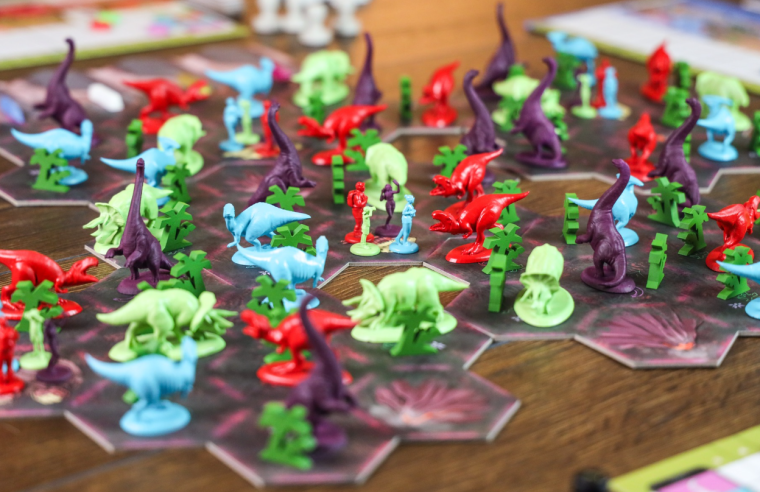
Cretaceous Rails features dinosaur miniatures. Simply put, it has table presence. You’ll hear this game roar from across the room.

Video Games

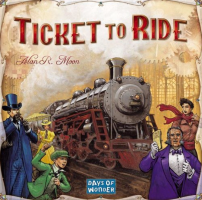
I know. I know. Ticket to Ride is another board game, but I played the version ported to the PlayStation 4, so it counts as a video game. I always loved the simplicity of Ticket to Ride. Collect enough train cards of a single color, match them to routes (between two cities), and connect cities on the ticket cards you have in your hand in a continuous route. Ticket to Ride modernized Rummy for the modern board game community. The PlayStation 4 version of Ticket to Ride is a great port of the game.
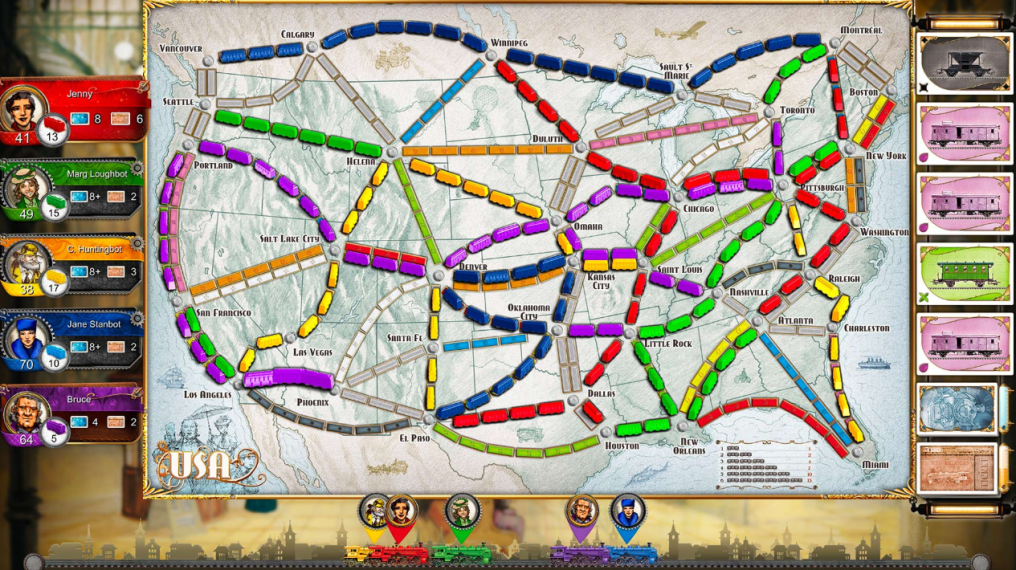
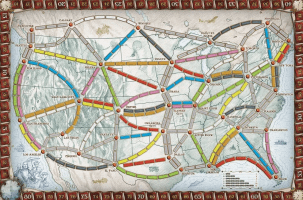
While I prefer the physical version of Ticket to Ride to a digital one, the production value is great. The base game includes the classic United States map and the Europe map. I’ve played Ticket to Ride: Europe a few times before last month, but picking up this copy (on the cheap) has led to more plays on the Europe map. I like the USA map more, but that’s because I don’t know if I quite understand how stations work. Whoops!
Akatsuki: Lord of the Dawn has a silly name. Akatsuki means dawn in Japanese, so the game’s title is Dawn: Lord of the Dawn. Tee hee! Anyway, Akatsuki: Lord of the Dawn is an army RPG. The story didn’t hold my interest. The game mechanisms were interesting–especially Akatsuki: Lord of the Dawn’s method of combining building an army and a country–but the game overstays its welcome by one island. By the time I finished the penultimate island, I had done all the game had to offer. The final island is four times the size of the previous island, and my final hour or two of gameplay was mindlessly autobattling a hundred or so territory tiles.

On a personal note, I saw a screenshot similar to the one above and thought Akatsuki: Lord of the Dawn used a card-driven combat system and got excited. The bottom left-hand corner looks like it could be a hand of cards, but no, it’s a head’s up display made to look like a hand of cards. Oh, well. Akatsuki: Lord of the Dawn was on sale for super cheap, I picked it up, and aside from the final island, I enjoyed my time with this indie game. Akatsuki: Lord of the Dawn took about twenty hours to finish.

That’s what I played this past month. Let’s check in with Season and Skye.
Skye’s Games

I have good news and bad news. The bad news is that I haven’t played many new video games this month to report to y’all. I got super addicted to Ghost of Tsushima and ended up playing non-stop. At least I have a platinum PlayStation trophy to show for it. The good news is that I spent this past weekend at Protospiel Twin Cities.

I typically don’t play board games unless I’m with my friends or family. Honestly, it doesn’t happen as often as it should. Last weekend, I had a unique opportunity to drive up to Minneapolis with our very own Kyra Kyle and play a host of different prototype board games. Behind these games were several different and talented designers.

Protospiel was an amazing experience. Kyra Kyle has been developing games of their own (which they’ve mentioned before), and I got to play them. I love playing Rustbucket Riots and Whirligig Pets. I even got to demo these games more than once. Co-op dice placement and programming adorable robot dogs and kittens. What’s not to love?

But I also had the pleasure of playtesting countless others. Most of these games have working titles or may not be ready to advertise, so most will be unnamed. Among the board game standouts were a simple and effective airline management game, a goofy cooking show contest game, an international travel game, and Spielcraft’s upcoming Primacy (a resource management/conquest game set in a dystopian future).

One of my favorite prototype games centered on becoming the “Master of the Seasons.” I liked its straightforward gameplay, fast-paced turn system, unique artistic design, and emphasis on strategy/point cultivation. If I ever see that game in stores, you bet I’ll be picking it up.

Season’s Games

board games

Woo-hoo! I was able to get some board game time under my belt. Elizabeth Hargrave’s Finspan got review-bombed before it even hit the shelves. I enjoyed Wyrmspan and have 3D printed resources I bought from someone in my hometown. I decided I’d collect everything in the Span series. Finspan is more streamlined than Wyrmspan and features an open hand mechanic. Players dive into the water, gather resources, and complete objectives. There are a finite number of turns each round (or week), so the game doesn’t drag.

One of my favorite things about Finspan is the attention to detail. The designers tried to be as scientifically accurate as possible to the real-world fish featured in the game. There are some artistic liberties, but you can find all of the fish in Finspan in our oceans today.

Video games

My Pokémon addiction returned when I spotted Pokémon Shining Pearl at my local GameStop. I don’t always keep up with the latest Pokémon games, but I’ll play a new one (well, new to me) every few years. Pokémon Shining Pearl is similar to previous games in the Pokémon franchise, but it features a location called the Grand Underground. After players complete the main game and unlock the National Pokédex, they may access a wider variety of Pokémon. There are way more legendary Pokémon to catch in Pokémon Shining Pearl than I’m used to in previous games, so that’s been a blast.

Kyra Kyle again. That does it for this month’s Whatcha Playing. What games have you been playing? Let us know in the comments. Thank you for reading, and wherever you are, I hope you’re having a great day.

3 Lists of 3 Tabletop Games for Miss Kitty

Hey, hey! Kyra Kyle here. I promised something different with this post, so let’s give it a try. Today would be my mom’s 74th birthday. Her name was Catharina Beenen Rackley, but her friends called her Kitty. I wanted to make a 3 Lists of 3 in her honor and had some trouble picking the topic. I could’ve picked music, food, or travel. But we don’t cover those topics on Geekly that often. Miss Kitty also enjoyed television and movies, and those would’ve made good choices. But I decided on tabletop games.

Geekly covers tabletop games, and Mom and I played board games together. She even got a kick out of me designing the occasional game. So, let’s do a 3 Lists of 3 Tabletop Games for Miss Kitty.

Games Miss Kitty Played

Miss Kitty played a lot of different games, and typically, she played games depending on who she had as company. She would play certain games with her children and others with her mother and siblings. And I’m sure she played even more games with her friends. I only have my perspective to go off on here and the accounts of others. Also, we may have more than a few honorable mentions. One cannot boil someone down to a handful of anything, not even board games.

Liverpool Rummy

Liverpool Rummy was a prerequisite whenever visiting Miss Kitty’s family, so this one may be more of a Beenen family pick. But I’m going with it. Miss Kitty and I played Liverpool Rummy a lot. I would go into the gameplay here, but I want to keep the entry short. Perhaps I should cover Liverpool Rummy in a post but it’s a card game using a standard deck.

Each round, players either try to collect sets of cards (at least 3 of the same number) or runs of cards (4 cards in the same suit in sequential numbers). If a player has all the requirements for a round, they can go down (which means revealing their cards with the appropriate number of sets/runs). Once down, players can play cards from their hand onto cards that are “down.” The first player out of cards wins the round and everyone else tallies their score. The lowest score at the end of the game wins.

I picked Liverpool Rummy instead of Wahoo (another Beenen family favorite and a good choice for this selection) because of a moment that happened the first time my wife Jen played with Miss Kitty. Miss Kitty kept saying that she didn’t know why I was so competitive in games. Later that same game, Miss Kitty sported a devilish grin and then bragged as she went out concealed. Jen laughed. Miss Kitty asked her why. Jen said, “I can see why they’re so competitive.”

Balderdash

Another game could’ve taken Balderdash’s place here: Scattegories. In fact, Miss Kitty and I played more Scattegories than Balderdash through the years. Both games are word games and while Miss Kitty would come up with strange answers for Scattegories (“Oreo” or “Knuckle” as forms of sandwiches), Balderdash created more memories.

Balderdash is a game of obscure words. Players must create definitions for words seldom used in the dictionary and gain points for guessing the correct definition or having other players select their invented definition. Miss Kitty worked as a surgical technician. She knew a few things about medicine and used that knowledge liberally in any game of Balderdash. If we heard a definition begin with “a medical term meaning…” or “inflammation of the…” or “a doctor’s tool for,” everyone at the table would turn to look at her. She’d turn beet red and try not to smile. And typically failed. If two “medical” definitions got read, we’d curse our bad luck. Which one’s the real one and which one’s the fake one?

Ticket to Ride

Miss Kitty had a history of set collection games, so of course she’d love Ticket to Ride. The rules are simple to learn and each different flavor of Ticket to Ride would add a wrinkle or two to the core rule set. Ticket to Ride was a perfect game for Miss Kitty. She could play a new game with a few “new rules” and not feel lost. I covered Ticket to Ride some time ago. Here’s a link to the original write-up.

The one game of Ticket to Ride I remember best with Miss Kitty involved her playing with her older brother Paul. Uncle Paul did nothing but build trains on the eastern seaboard. He didn’t complete any tickets. He didn’t do much of anything except block everyone else from building on the eastern coast of the United States. Miss Kitty growled at Uncle Paul. “You’re playing it wrong. Stop playing the game wrong!” I fell out of my seat laughing. It was a window into Miss Kitty’s childhood. This wasn’t the first time she had told off her older brother.

My family and I are currently playing a game of Ticket to Ride Legacy: Legends of the West. This version of Ticket to Ride has a story. Each player assumes the role of a railroad tycoon. The board grows as the railroad gets built from the east coast to the west coast. Hey, Uncle Paul wouldn’t have been playing the game wrong with this version. Anyway, there are four of us playing Ticket to Ride Legacy. When we finish, I intend on dealing out the fifth player stickers (you can place stickers claiming routes and cities for different players and we plan to use the fifth player) for Miss Kitty.

Games Miss Kitty Didn’t Play

This next list is of games are ones Miss Kitty never had the chance to play for one reason or another, but I know she would’ve loved to play them.

Marvel United

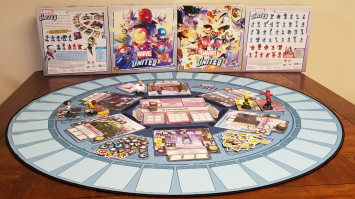
I wouldn’t have thought it possible if I didn’t hear this from her myself, but Miss Kitty was more into the Marvel Cinematic Universe than me. Marvel United is a cooperative tabletop game where players assume the role of superheroes in the Marvel universe as they try to stop a supervillain. Like Ticket to Ride, the rules are simple to learn with each hero and villain adding a small wrinkle or two. Since it’s cooperative, Marvel United eliminates competitiveness and players are encouraged to help each other. I just know Miss Kitty would’ve wanted to play out a few of her favorite movies.

And there’s some precedent for this. Miss Kitty and I played X-Men: Under Siege. My father and I played more of this game, but Miss Kitty liked this game, too. Marvel United would’ve scratched a similar itch. And it doesn’t hurt that the miniatures and art have cute designs. Miss Kitty liked cute things.

I haven’t written a review for Marvel United yet, but I started a guide. You can check out the newly posted Guide to Marvel United here.

Flamecraft

Flamecraft is the most complex game on any of these lists so far, but I’m sure Miss Kitty would’ve struggled through a difficult game or two because it’s so cute. And dragons. One of her granddaughters (my niece) is obsessed with dragons or at least she was at one point. Flamecraft uses a game element popular with recent tabletop games. Whenever you take an action that action has a global effect and can benefit your opponent on future turns. This element also makes Flamecraft feel like it’s a winnable game or at least a board game that has closer outcomes.

And did I mention the puns? I can hear Miss Kitty cackling every time I read one of the dragon shops’ names. Either that or I’m hearing my daughter’s same laugh. Critical Rolls. Bizarre Bazaar. Potable Potions. Outback Drakehouse.

Sixes

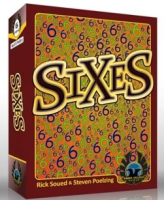
I first played Sixes recently at a party and thought of Miss Kitty. It’s a word game like Scattegories. Sixes plays out in six rounds—naturally. Each round has players making lists of six things that match a category. The twist comes from what players are trying to do each round. Some rounds, you’ll want to have unique answers like Scattegories. Other rounds, you’ll want to match other players. And the third and sixth rounds are lightning rounds where players answer 6 categories with a single answer. The person with the most points wins.

Miss Kitty would’ve loved playing Sixes. It’s a great ice breaker game or a way to reconnect. I found players saying things like “I knew I liked you” or “we think so much alike” whenever they answer a list similarly during a matching round. Of course, there’s the classic Scattegories response whenever you match during a unique round. “We think TOO much alike.” Or “Get out of my head.”

Games that Remind Me of Miss Kitty

This list is more nebulous than the last two. Some may be games Miss Kitty played at one point. Others may be games she would’ve liked to have played but never did. And there are a few games on this list that just remind me of Miss Kitty.

On Tour

During On Tour, Players assume the role of a rock band’s tour manager. Miss Kitty listened to classic rock and pop music. She would’ve loved this premise for a game. But she may have gotten frustrated with the gameplay. On Tour has simple enough rules. The amount of player choice can get overwhelming.

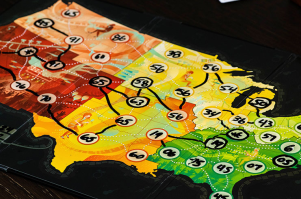
Each turn, a player rolls two ten-sided dice and then each player must simultaneously place the numbers depicted on the dice in a state (if you’re using the United States map) depicted on two of three cards (the cards will have specific states and regions and players may choose whether to use the state or the region). Players do that by drawing on their own game boards with dry erase markers. Once each player’s map is filled, players score points depending on how many states they can travel through starting from lowest to highest number value in sequential order. For example, you can go 5-9-13, but you cannot go 5-13-9.

Players must cut their losses and admit that they will not be able to visit each state (or country on the Europe map). Miss Kitty would’ve struggled with making a route that goes through as many states as possible. She may have frozen before placing each number. But whenever I play On Tour, I’ll name my band (there’s a space for that on the United States side of the map) something that has to do with Rick Springfield. Miss Kitty would listen to Springfield whenever her husband was away and would scramble to hide her teen magazine cutouts whenever he returned home. I may call my next band Working Class Dogs.

Fireball Island: The Curse of Vul-Kar

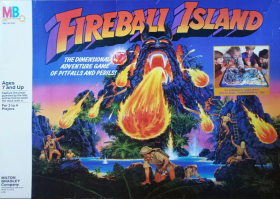
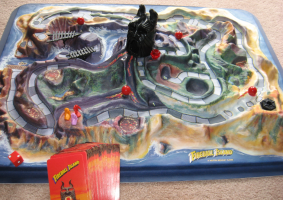
Miss Kitty bought me the original Fireball Island for Christmas one year. I don’t remember if she played the game with me, but she certainly got me the game for the holidays. The original Fireball Island had players race to pick up a gemstone and race back to the finish line with the booty. Fireball Island: The Curse of Vul-Kar improves upon the original. Players take pictures of the island for Instagram (or some other social media), but they can still snag a precious gemstone for extra points.

Fireball Island: The Curse of Vul-Kar reminds me of Miss Kitty, my mom, because I have video of the Christmas when I unwrapped the original Fireball Island. A younger me paced back and forth with the box as Christmas continued. Miss Kitty opened the gift I had bought for her (or I had picked it out for her): Hope perfume. She liked new and unique fragrances, and I had found Hope, which was supposed to change with each person’s body chemistry. It sounded unique. Modern-day Kyra recognizes Hope’s description as a marketing ploy. It was the thought that counts. Anyway, the video shows me geeking out with Fireball Island, while Miss Kitty was geeking out over Hope. Parallel geeking.

The Real Ghostbusters Game

The Real Ghostbusters Game, based on the 80s cartoon series of the same name, reimplements Ghost Castle that released in 1970. It’s a dated game; it doesn’t hold up to modern tabletop game design techniques. But The Real Ghostbusters Game holds a special place.

I brought the game to a kid’s birthday party. Miss Kitty dropped me off at the kid’s house and some time during the drive she shared that my father wondered why I hung out with a loser (the kid whose birthday party I was attending). I told Miss Kitty that even losers needed friends. This was Miss Kitty’s favorite story to share about me and my childhood.

I miss you, Mom. Happy birthday. We’ll play some games for you today.

Let me know of any games that remind you of your loved ones. Or the games you love playing with your loved ones. Or even the games you wish you could’ve played with them. And wherever you are, I hope you’re having a great day.

Getting Started with Route or Network Building Games

We’re on a freeway of love in a pink Cadillac. We miss you, Aretha. Shine on, Queen of Soul.

Getting back to tabletop games, there are plenty of games that cast the players with setting up routes or networks or roads or even freeways of love to score points. The difficulty levels of these games vary, and route or network building games tend to have more than just that mechanism in them. That may be because building roads or a network doesn’t appeal to a lot of players, but there are some beginner games that can introduce new players to the genre.

Your uncle Geekly’s back with another Getting Started, so let’s network.

Tsuro

Tsuro

A game that’s just building a road or route. That sounds too simple. It’d be boring. Tsuro doesn’t have much more to it than that, and it’s excellent.

Players lay tiles with winding paths on them from their hand onto a 6×6 grid and move their pawns as far on those paths as they can. The last player with a pawn on the board wins. Hint: you can lead your pawn off the board or into other pawns.

It’s a simple concept, executed well, and it doesn’t hurt that the game looks gorgeous. It also doesn’t hurt that Tsuro lasts fifteen minutes at the most. Perfect for a new player.

TicketToRide

Ticket to Ride

Ticket to Ride was the first game that came to my mind when thinking of starter route-network building games. It dominated the hobby when it first came out and remains popular. There are a lot of offshoots and expansions for Ticket to Ride that depict almost any region or country you could think of, but I’d start with the original United States map from 2004.

Players build railroad connections between cities, while trying to complete destination tickets that can span the length of the continent or country. Rummy-style set collection adds another layer as players collect cards with which to spend on railways between the various cities and usually, the first player to claim a route is the only one who can, so pressure builds when players decide whether to collect more cards for their hand or build a route before another player can do so. This is one of tabletop gaming’s simplest, elegant, and tense push-pulls.

Ticket to Ride may add another layer than Tsuro, but it’s still easy enough for a tabletop game newcomer to learn, and one of the best “gateway games” (easy-to-learn board game that’s great for introducing new gamers to the hobby) on the market.

Takenoko

Takenoko

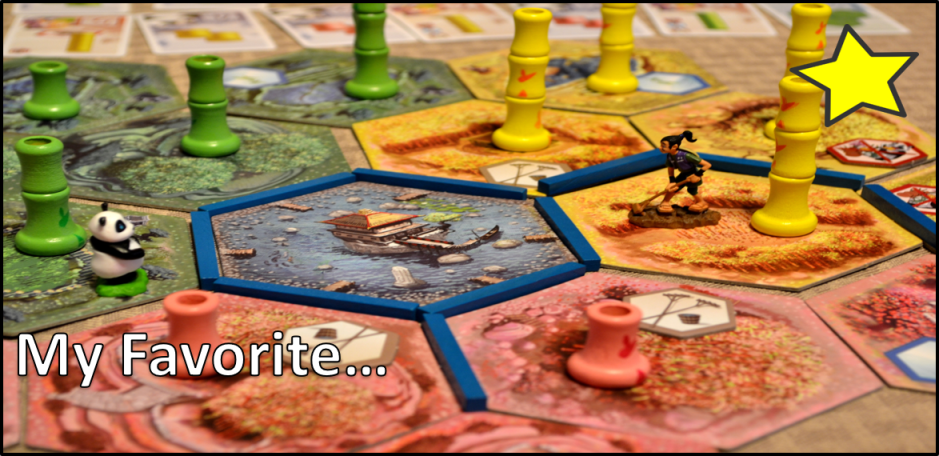
I’ve talked about Takenoko in the past. Don’t let the Chibi Panda fool you, this game has plenty of depth, but it’s still easy to teach and learn and takes a different approach to route/network building. Like Tsuro, Takenoko uses tile placement, but the network in Takenoko is in its irrigation.

The game starts with a pond tile, and in order to irrigate their bamboo players must connect tiles of various color bamboo to the starting pond tile with what the game calls an irrigation stick. I think of it as more of a trench system to get the water to where one wants it, but I may be wrong. If I am, feel free to toilet paper my house. I live in Connecticut. Yeah, totally Connecticut.

Anyway, I included Takenoko because it shows how many games will incorporate network/route building in the game, but the game won’t be about network building like the previous two entries. Yes. Players need water for irrigation, but irrigation sticks are only a fraction of what someone needs.

Saboteur.jpg

Saboteur

Saboteur returns this list to its classic network/route building roots, but it deviates in another direction: semi-cooperative and secret goals. The goal for the game’s mining dwarves is to build a network of caves (from hands of path cards) to reach gold. The goal for the game’s saboteurs is to prevent the mining dwarves from reaching the gold.

A good saboteur will pick the spot where they betray the team. Do they risk it and wait for the mining to team to get close to the gold and then play a U turn card? It’s very satisfying to be the saboteur, but who’s on which team is only part of the game’s hidden information. There are multiple locations for the gold to be at the beginning of the game, but no one knows where it is until they’re given a card that allows them to take a peek. Again, a good saboteur doesn’t reveal their identity because they could lead the mining team to the wrong spot.

Saboteur isn’t for everyone. There are some folks who hate traitors in cooperative games, but the runtime is so short that it had to make this list.

Final Thoughts

There are many other ways I could go with in terms of expanding this list of beginner route/network building games, but I’ll stop with these four because I miscounted them as five and if I had six I’d have to use the other hand to count.

Speaking of networking, we could use some comments about games or something else in the geek world. If you like this post, give it a like, and if you like what Geekly does, feel free to subscribe. If you subscribe, you can let your uncle Geekly know how wrong he is every day.