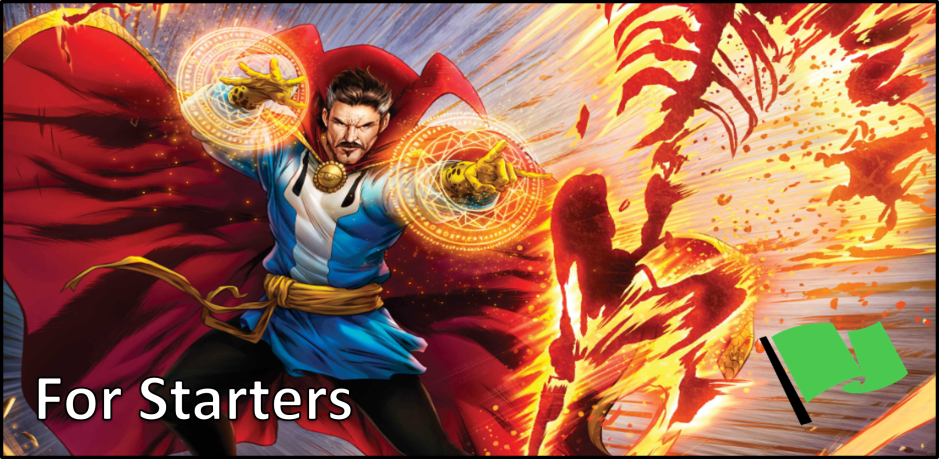
Getting Into Comics: Doctor Strange Starter Stories

Doctor Strange stories venture into the weird and psychedelic. It’s difficult to know where to begin reading Doctor Strange comics. Fortunately, Geekly has you covered.

Hey, hey! Kyra Kyle here. Marvel Comics had its renaissance in the Sixties. No other character screams the Sixties than Stephen Strange. During this decade, mysticism enjoyed a comeback. I’m sure fans attempted some of the spells depicted in Doctor Strange comics. Safety notice: don’t try the spells you find in Doctor Strange comics at home. Artists like Steve Ditko and Barry Windsor-Smith elevated Doctor Strange to another level. Within Doctor Strange, you’ll find some of the most vibrant art in Marvel.

But we’re talking about stories today, and Doctor Strange has had some of the best writers in the business write for him. Like we’ve been doing for the past few entries in this series, we’ll split these stories into single issues and story arcs. This week, we’ll begin with single comic book issues. Enjoy!

Single Issues
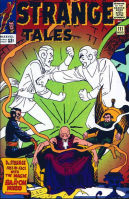
“Face to Face with the Magic of Baron Mordo!” (Strange Tales #111; written by Stan Lee/art by Steve Ditko; 1963)

The follow-up to Strange’s debut in Strange Tales #110, “Face to Face with the Magic of Baron Mordo” pits Doctor Strange against one of his most iconic enemies: Baron Mordo. Mordo is a fellow student of the Ancient One and plans to murder his master and gain the ultimate power. Doctor Strange learns of Mordo’s plan and stops him. Strange and Mordo share a sibling-like rivalry. “Face to Face with the Magic of Baron Mordo” establishes Doctor Strange, the Ancient One, and Mordo as characters. I can’t wait to see what the Marvel Cinematic Universe plans to do with Baron Mordo, portrayed by Chiwetel Ejiofor. Mordo is too good of a character not to see in Doctor Strange’s future.

“The Origin of Doctor Strange” (Strange Tales #115; written by Stan Lee/art by Steve Ditko; 1963)

Doctor Strange’s origin story isn’t the first one on this list because we’ve been listing these starter stories in the order in which they were released. Stan Lee and Steve Ditko “forgot to supply a Doctor Strange origin,” which was Lee’s note at the beginning of this issue. “The Origin of Doctor Strange” marks the first time Marvel retroactively published a backstory. Nice!

The story itself is iconic at this point and a must-read for anyone who wants to get into Doctor Strange comics. Steve Ditko is still finding his groove, but Strange Tales #115 remains a Doctor Strange and Marvel Comics classic. You can see similarities between Doctor Strange and Ditko’s other famous comic book creation, Spider-Man. Both start as selfish and turn selfless after a tragedy.

“To Steal the Sorcerer’s Soul” (Marvel Fanfare #5; written by Chris Claremont/art by Marshall Rogers and P. Craig Russell; 1982)

Chris Claremont avoids Doctor Strange’s psychedelia. Instead, Claremont is at his melodramatic best with “To Steal the Sorcerer’s Soul.” Even though Strange’s romance with sorceress Clea is in full swing, Nicodemus West is the source of drama. After Strange’s accident, West was the colleague who performed the surgery on Strange’s hands. Filled with guilt, Nicodemus tails Strange around the world, where he would obtain magical powers for medical use. “To Steal the Sorcerer’s Soul” shows Nicodemus’s descent into villainhood.

Story Arcs

The Eternity Saga (Strange Tales #130-146; written by Stan Lee/art by Steve Ditko 1965-1966)

While a seventeen-issue comic book story is normal for comics today, The Eternity Saga was one-of-a-kind for its time. Stan Lee may have penned the dialogue, but Steve Ditko’s artwork drives this sprawling epic. The Eternity Saga may appear later in this list, but it may be THE quintessential Doctor Doom story. Strange must battle Baron Mordo and Dormammu before being stripped of his power, rendered blind, and forced to search for the being named Eternity.

Steve Ditko cut his teeth with Spider-Man but kept his most ground-breaking art for Doctor Strange. The Eternity Saga solidifies Doctor Strange’s look, his archenemies, and his mythos. If you’re a fan of Doctor Strange movies, you should read The Eternity Saga. Doctor Strange films borrow from this storyline and there are a few surprises the MCU hasn’t yet introduced. The Eternity Saga is required Doctor Strange reading.

The Shuma-Gorath Saga (Marvel Premiere #3-10; written by Stan Lee and Barry Windsor-Smith/art by Barry Windsor-Smith 1972)

We had to include part of Barry Windsor-Smith’s run on Doctor Strange. After Steve Ditko left, the comic was in good hands. As the name suggests, The Shuma-Gorath Saga borrows a lot from H.P. Lovecraft and his Cthulhu myth. The title character, Shuma-Gorath, is an Elder God who has enthralled a woman Doctor Strange intends to save. Shuma-Gorath sends their minions to stop Doctor Strange, leading to an epic battle.

The Shuma-Gorath Saga is unique because Doctor Strange seldom uses his magic. Instead, he battles Shuma-Gorath with various melee weapons to include a crucifix. If you’ve seen Doctor Strange in the Multiverse of Madness, you may believe that Shuma-Gorath has made their MCU debut when a tentacle beast interrupted a wedding, but that’s not the case. Marvel doesn’t own the rights for Shuma-Gorath. That deal is in the works. There’s no way Shuma-Gorath would only get a cameo.
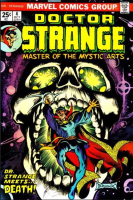
A Separate Reality (Marvel Premiere #9-10 & 12-14 and Doctor Strange #1-2 & 4-5; written by Steve Englehart/art by Frank Brunner 1972-1973)

Steve Englehart is another creative who left an indelible mark on Doctor Strange. A Separate Reality redefined Doctor Strange’s rogues from the 1960s. Dormammu and Nightmare make appearances in A Separate Reality. They challenge Strange while he attempts to save the Marvel Universe from other realms.

A Separate Reality also introduces the sorcerer Clea (played by Charlize Theron at the end of Doctor Strange in the Multiverse of Madness). Clea and Doctor Strange become lovers, which I’m sure will play a role in the Marvel movies, and the journey to save all realities leads to new heights of mind-bending moments. That’s saying something for Doctor Strange.
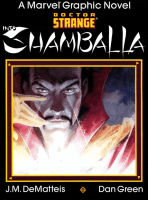
Into Shamballa (written by J.M. DeMatteis and Dan Green/art by Dan Green 1986)

Into Shamballa rids itself of superhero and villain tropes. J.M. DeMatteis and Dan Green wrote Into Shamballa as an introspective story. Doctor Strange returns to The Ancient One’s Himalayan home. Once there, the doctor finds a portal into the Shamballa dimension. Strange is tasked with bringing about an apocalypse that will allow humankind to grow to perfection. Into Shamballa is Doctor Strange at his abstract storytelling best.

Released the same month as Alan Moore and Dave Gibbons’ Watchmen, Into Shamballa asks several of the same ethical questions. But while Moore’s story ends in moral compromise, Into Shamballa finds spiritual enlightenment. If you’ve read Watchmen, you should try Into Shamballa.

Doctor Strange and Doctor Doom: Triumph and Torment (written by Roger Stern/art by Mike Mignola 1989)

Hellboy creator Mike Mignola’s art makes this unlikely pairing work. You heard that right. Doctor Strange and Doctor Doom team up to rescue the soul of Doom’s mother. Triumph and Torment is more of a Doctor Doom story. I almost didn’t include it in this list. But Triumph and Torment is an iconic mini-series and well worth reading.
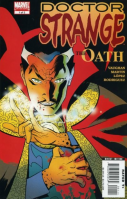
The Oath (Doctor Strange The Oath #1-5; written by Brian K. Vaughan/art by Marcos Martin; 2006-2007)

Brian K. Vaughan (Saga) pens one of the best Doctor Strange stories of the 21st century with The Oath. The miniseries showcases Strange’s patented arrogance, while his brother in Wong grounds him. The Oath is the basis for Wong and Doctor Strange’s relationship in the Marvel movies. The story itself is a mystery with a hint of the mystical.

In The Oath’s story, Wong has cancer. Aided by new love interest Night Nurse (who played a role in the Netflix Daredevil series), Strange follows a trail of clues to save his friend. The Oath has the hallmarks of some of Vaughan’s best work: nonlinear plots, nuanced characters, and thrilling twists. The Oath does a lot to modernize Doctor Strange.

We could’ve included a few other Doctor Strange stories. Let us know which Doctor Strange stories you’d add to this list in the comments. And wherever you are, I hope you’re having a great day.
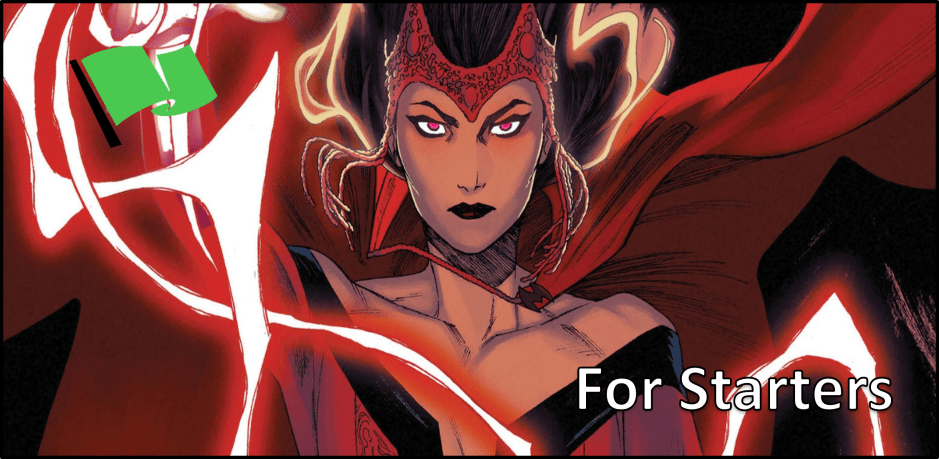
Getting Into Comics: Scarlet Witch Starter Stories

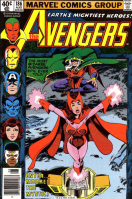
Today is Miss Kyra’s birthday. I asked her which comic book character’s history she wanted Geekly to cover today, and she picked another character with a complicated past, Scarlet Witch. Yes. Today will be covering comic books for new readers of the Scarlet Witch.

Hey, hey! Kyra Kyle here. Like many X-Men characters, Scarlet Witch has played jump rope with being a villain and a hero. Wanda Maximoff has even had moments of turning into an otherworldly being. She’s been a member of the Brotherhood of Evil Mutants, the Avengers, and Defenders. Scarlet Witch blurs the line between superpowers and magic. She has the power to bend reality.

Single Issues

We’ve split this list into single issues and longer stories. Let’s begin with single issues.

The Brotherhood of Evil Mutants (Uncanny X-Men #4, written by Stan Lee/art by Jack Kirby; March 1964)

Magneto proved a worthy adversary to the X-Men when he took on the team alone (Uncanny X-Men #1). The Brotherhood of Evil Mutants marks the team of the same name’s first appearance. Toad, Mastermind, Quicksilver, and Scarlet Witch join Magneto. But the team already shows cracks.

Quicksilver and Scarlet Witch want nothing to do with the Brotherhood. Magneto coerced them into joining. He reminds them of when he rescued the twins from an angry mob. The citizens of a small European town want to kill the Scarlet Witch for burning down a barn with her mutant powers. Magneto reminds the pair that humans would continue to hunt them for their abilities, which isn’t a complete lie.

The X-Men track down the Brotherhood to a palace in Santo Marco. The X-Men’s actions reinforce Magento’s claims that humanity will hunt down mutants. Mutants are hunting down other mutants who disagree with them. A quick battle ensues. Once the X-Men enter the palace, Magneto arms a series of bombs meant to destroy the palace and Santo Marco with it. Bystanders would be killed. Scarlet Witch and Quicksilver can’t abide by this plan, so as they escape, Quicksilver disarms the remaining bombs that would’ve taken the country. The Brotherhood of Evil Mutants shows Scarlet Witch’s tenuous relationship with Magneto.

The Old Order Changeth (Avengers #16, written by Stan Lee and Jack Kirby/art by Jack Kirby, Dick Ayers, and Carl Hubbell; March 1965)

Scarlet Witch makes good on her threat of leaving Magneto’s employ. It took her one year—almost to the day—from debuting as an X-Men villain to becoming a card-carrying member of the Avengers. The Old Order Changeth does what it says. The Master of Evil (the Avengers’ main antagonist team at the time) disbanded after burying their leader Baron “Heinrich” Zemo. (Note: the current Baron Zemo is Heinrich’s son, Helmut.) Wasp, Giant-Man/Ant-Man, Iron Man, and Thor leave the Avengers. Naturally, Hulk is missing. So, Captain America is chilling at the Avengers Mansion advertising that the team needs new members.

Hawkeye and Black Widow flip sides and join the Avengers. They had been duped into helping the Russians who wanted to disrupt the Avengers. Mission accomplished, I guess. Scarlet Witch and her twin brother Quicksilver also want to redeem their past as members of the Brotherhood of Evil Mutants and join. It may not seem like much but the Avengers changing their roster in just over a year (this issue is the sixteenth of a monthly comic) shook up the Marvel landscape.

What was Scarlet Witch’s role in this comic book issue? She doesn’t have a large role. While living in Switzerland, she learns about the Avengers needing new members. She travels by cruise ship to the U.S. and auditions for a spot with Tony Stark. The Old Order Changeth marks Wanda’s first step as a hero, and the first step is often the most important.

New Faces (The West Coast Avengers #45, written by John Byrne/art John Byrne; February 1989)

We jump a couple of decades to our next single issue New Faces. Surprise! The Avengers add a new member or two. US Agent (John Walker) joins the team which causes Hawkeye and Mockingbird to depart. This storyline has many layers and is worth the read, but we’re more interested in another storyline, the one between the Scarlet Witch and her husband Vision.

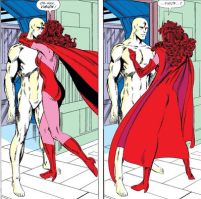
By the time of New Faces, Wanda and Vision have twin sons, Tommy and Billy. There’s a whole issue of Tommy and Billy going through a series of nannies who can’t manage to care for them. The nanny introduced in this issue, Mrs. Hunter, loses the twins in the nursery. We never see Mrs. Hunter again, so there’s a chance she got fired off-camera. The bigger issue rests with Vision. Vision needed to be reprogrammed. Unfortunately, while Vision has all the information, he lacks an emotional connection with that information. When Wanda hugs Vision, he asks her why. He no longer feels love.

Hank Pym explains that Vision misses one element, his brother Wonder Man’s brain patterns. Manipulated by Baron Zemo and then Black Talon, Wonder Man’s brain patterns had been used for Vision without his permission. Wonder Man refuses to help Vision because he had no control over his life for many years. While Wonder Man’s reason is understandable, Wanda is heartbroken when she sees the new Vision speaking monotonously, like he did when they first met. New Faces is the first time Vision wears all white. The MCU adopted a version of this costume with its current iteration of Vision.

Story Arcs

The Witch of Wundagore Mountain (The Avengers #185-187 written by Steven Grant, Mark Gruenwald, David Michelinie/art by John Byrne 1979)

The Witch of Wundagore Mountain is the first attempt at Scarlet Witch and Quicksilver’s origin story. The twins’ origin has been twisted and changed so many times, but this story marks the first real attempt at a Scarlet Witch origin. She wasn’t Magneto’s daughter. She even believed that her parents were the Whizzer (a Golden Age comic book hero with superspeed like Quicksilver) and Miss America. But the pair found that to be fiction.

A man named Django Maximoff claims to be her father, but she will soon learn that he’s her adoptive father. She was born on Mount Wundagore in the laboratory of the High Evolutionary. One of the High Evolutionary’s earliest creations, an anthropomorphic cow named Bova, cared for her. This is a bizarre story, and it takes many turns. Outside of flashbacks, Scarlet Witch becomes possessed by Chthon who, with the help of Scarlet Witch, holds the other Avengers prison.

We just scratched the surface with The Witch of Wundagore Mountain. It’s a harrowing tale.

Darker Than Scarlet (Avengers West Coast #56-57 & 60-62, written by John Byrne, Roy Thomas, and Dann Thomas/art by John Byrne and Paul Ryan; 1990)

After being a hero for most of her Marvel Comics tenure, Scarlet Witch hops over to the dark side during Darker Than Scarlet. She joins her would-be father Magneto, and at first, it seems like she isn’t the only one. The end of this storyline’s first issue shows Quicksilver joining Magento too. Toward the end of the story, we find that Quicksilver remained loyal to the Avengers, only joining his family to convince Scarlet Witch to reconsider and stop Magneto’s evil schemes.

While Scarlet Witch and Quicksilver have been on opposite sides before, Darker Than Scarlet is one of the few times that the twins have acted as enemies for a prolonged time. Typically, one of the twins would have a lapse of judgment before the other one eventually saved them, but Darker Than Scarlet shows Scarlet Witch reaching new levels of evil.

House of M #1-8 (written by Brian Michael Bendis/art by Olivier Coipel; 2005)

While Darker Than Scarlet was Scarlet Witch’s first big heel turn, House of M is her most infamous and had a profound impact on the greater Marvel Universe. Wanda becomes unhinged when she realizes that her children aren’t real. She loses control and uses her reality-altering powers, killing Vision, Hawkeye, and Scott Lang. These deaths cause the Avengers to fracture.

This new reality is unlike any other in the Marvel universe to that point. Wanda utters, “No more mutants,” which returns the world to the reality it had before, but with one significant change. Nearly all people who were mutants become normal humans. Only 198 mutants remain.

While Scarlet Witch plays a key role during House of M, Quicksilver works behind the scenes. He convinces Scarlet Witch to use her powers to reshape reality, and it is Quicksilver’s injuries at the hand of Magneto that inspire Scarlet Witch to wipe out most of mutantkind.

Avengers: Children’s Crusade #1-9 (written by Allan Heinberg/art by Jim Cheung; 2010-2012)

House of M and Avengers: Disassembled led Scarlet Witch into a dark period. Avengers: Children’s Crusade is Wanda’s first step to redemption. The story revolves around Speed and Wiccan, who believe they’re Wanda’s lost children. The Disney+ series Agatha All Along borrows aspects from Speed and Wiccan’s story here. Accompanying Speed and Wiccan is their grandfather, Magneto.

When the kids find their mother, she’s lost her memories and powers and is about to marry Victor Von Doom. When Scarlet Witch’s memories begin to return, she learns that her powers had overloaded when she worked with Doom to bring her children back from the dead. Scarlet Witch’s children redeem her. Once reunited, she seeks redemption for the chaos and destruction she had caused.

Rumors persist that Scarlet Witch may not have died during the events of Doctor Strange in the Multiverse of Madness. The MCU could reintroduce the character following the events of Agatha All Along and a subsequent series with Speed and Wiccan. If that happens, she will have a lot to atone.

Witches’ Road (Scarlet Witch #1-5 written by James Robinson/art by Vanesa Del Rey; 2016)

Witches’ Road has a simple premise: witchcraft is broken. Joined by Agatha Harkness’s spirit, Wanda travels the world to fix witchcraft. If this premise sounds familiar to MCU fans, a similar journey may be hinted at the end of Agatha All Along. Scarlet Witch had the moniker of witch but seldom associated herself with witchcraft until the events of Witches’ Road.

Thanks, Agatha All Along. Now all I hear when I say Witches’ Road is the song from the Disney+ series. Anyway. During the comic book storyline Witches’ Road, Wanda solves magical crimes and pieces witchcraft back together. She must solve the mystery of who broke magic.

I lost count of how many Scarlet Witch stories missed the cut. I added Witches’ Road at the last second or it could’ve been one more storyline. Scarlet Witch has had so many great stories. Let me know which Scarlet Witch stories you’d add to the list. Thank you for reading, and wherever you are, I hope you’re having a great day.

Getting Started with Pick-Up and Delivery Games

Howdy, folks, Uncle Geekly’s back with another group of starter board games. For those of you who are new to the site, our starter game series takes a common or popular game mechanism and picks some good games that feature that mechanism but are easy to learn. Many of these games on these lists will start easy and work their way to greater complexity.

In today’s list we’ll cover pick-up and delivery games, and this mechanism works like its name suggests: players will pick up items from one place and deliver them to another. It’s a simple mechanism that finds its way to several great games, but there are two issues that came up when compiling this list of starter games.

First, many designers don’t believe in having a straight pick-up and delivery game (it’s too boring), so you won’t find too many games with pick-up and delivery as the only mechanism and only a handful more that will include pick-up and delivery in a group of two or three mechanisms.

The second is that by adding extra game mechanisms, designers make many pick-up and delivery games more complicated, so there will be games like Firefly and Freedom: The Underground Railroad that are excellent pick-up and delivery games (a couple of my favorites) but slightly more complex than a starter game should be for newcomers.

Enough about the games that won’t be on this list. Let’s talk about the ones that made the cut.

DeepSeaAdventure01

Deep Sea Adventure

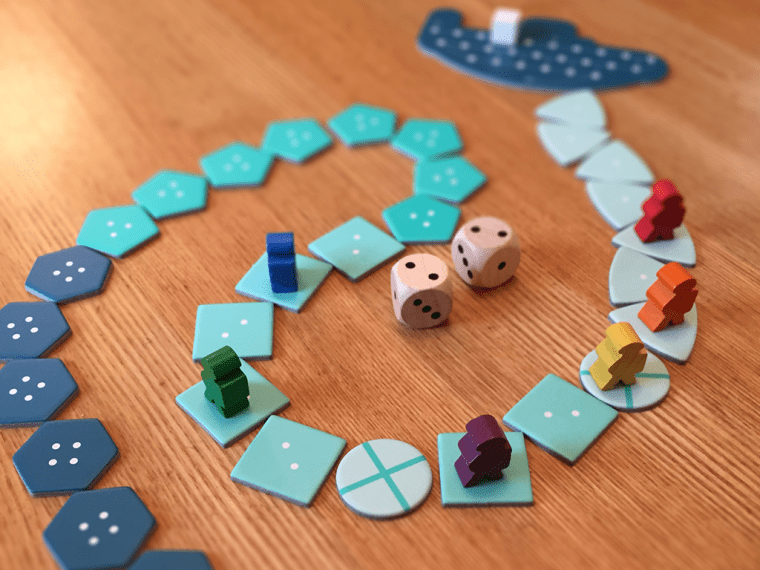
We start with the simplest game of the lot, Deep Sea Adventure. Sure, this game has a push your luck element and uses roll/spin and move, but it’s the closest game to pure pick-up and delivery. Players assume the roles of deep-sea divers. There are four levels of treasure (tokens) with a number (points one can score) printed on the front and the level denoted in dots on the back. The tokens get shuffled and placed in a wavy line protruding from the submarine (where the players pawns start), going from level 1 to level 4.

Players take turns diving into the sea (by rolling two specialty dice numbered from 1-3) and try to go as far as they can, but beware. All players share the same oxygen tank and when the oxygen level reaches zero, the round is over and only those who returned to the submarine with treasure in hand score points that round.

Deep Sea Adventure is charming. It doesn’t look like it would have much strategy, but it’s a lot deeper (pun intended) than first glance. Do you push your luck and go deeper, or do you turn back around with the treasure or two you picked up early on, so you know you’re scoring that round? There’s even a built-in catch-up mechanism where the higher scoring tiles are easier to get to in future rounds, so players who are behind early in the game can score a heap of points in round two or three. I’ve even considered picking up as many level one and two treasures as I can in the first round and since those lost treasure tokens get added to the end of the treasure path in stacks of three, I can claim them later in the game for big points.

Like I said, there are plenty of play styles and stratagems for this easy-to-learn game. Deep Sea Adventure may be marketed toward kids (if you don’t believe me, check out this adorable how to play video by Oink Games) but there’s enough going on to interest adults. You can find Deep Sea Adventure at most Barnes and Nobles but be on the look out for a small package. Oink Games come in small boxes and while I haven’t played all the Oink Game titles, most of the ones I’ve played are at least baseline good.

MyLittleScythe

My Little Scythe

I know that I said this before, but pick-up and delivery games have a knack of being very complicated. Case in point, My Little Scythe is a simplified, or child-friendly, version of Scythe, which happens to be on a lot of people’s best games of all time, but the original Scythe is far too complex for a starter pick-up and delivery game list. Heck. My Little Scythe makes the list by a skosh.

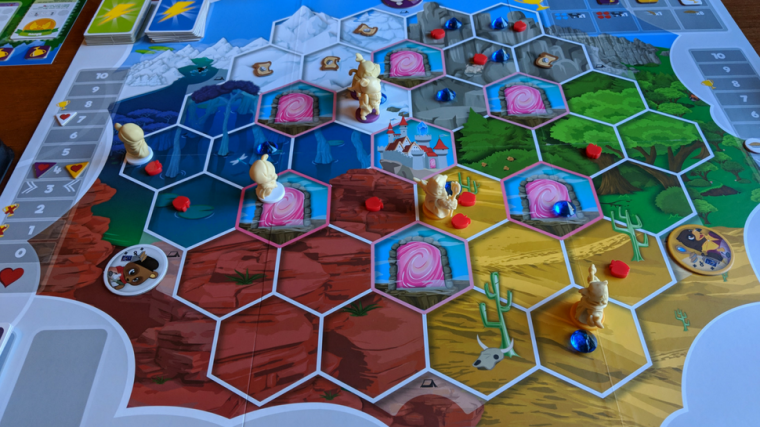
My Little Scythe was designed by a father and daughter, so that the father could play his favorite game with his young daughter, and it follows various animals of the animal kingdom as they prepare for the harvest festival. Players take turns earning trophies by earning specific accomplishments. There’s a lot going on in this game, but no single game mechanism is that complex. That said, I won’t spend too much time with how to play My Little Scythe because this isn’t a “how to play” write-up, it’s a starter game write-up. If you’d like detailed rules explanations, check out Rodney Smith’s video at Watch It Played; Rodney does excellent work. For now, let’s focus on what makes My Little Scythe a good pick-up and delivery starter game.

My Little Scythe takes an interesting look at pick-up and delivery. There’s a strong worker placement element to it—so it would make a nice addition to starter worker placement games—but two of the four trophies needed to trigger the end game (the harvest festival) requires players to pick up four of one kind of resource and drop them off at the castle (centrally located on the board). At least four of the remaining possible six trophies players can earn can be achieved by picking up resources and controlling them. In My Little Scythe, players are considered to have control of resources if their pawns occupy the same space as a resource. If the player controls the resource, they may spend it for other items. That’s a clever distinction that doesn’t show up in any of the other games on this list. So, I guess one could consider My Little Scythe a pick-up and control game.

There are so many other elements going on with My Little Scythe that I won’t mention the rest of them here, but each element works well and the whole is an easy game to learn and teach others. I wanted to include it here because of the interesting twist My Little Scythe makes with the pick-up and delivery mechanism. I know that it’s following Scythe’s lead, but we need more games that add wrinkles to well-established game mechanisms.

ForbiddenDesert08

Forbidden Desert

Forbidden Desert seems to make it on a lot of these lists, but it does fit the pick-up and delivery mechanism requirement and it’s a darn good game, perhaps the best of the Forbidden series, but that’s because I haven’t had the chance of playing Forbidden Sky as of this write-up. In Forbidden Desert players are stranded in an inhospitable desert. They must find and collect (or pick-up) the parts to a flying contraption and deliver the completed machine to the launch pad, so they can escape.

It’s been six years since Forbidden Desert’s initial release, and I still marvel at the way shifting sand is represented by drawing desert cards, shifting land tiles in the direction the cards command, and placing sand tokens atop the land tiles that moved that turn. It feels right. It plays like an unpredictable desert storm.

The way players must uncover both a vertical and horizontal tile for each object to reveal which tile one of the parts resides is brilliant; no game plays the same way twice. This also adds to the storm’s unpredictable nature and the fact that players can get buried in sand adds to the atmosphere of being lost. If the tile your pawn stands on moves, your pawn moves too, and board’s state may be far different from the end of one of your turns to the beginning of your next. Again, this adds to the players’ feeling of hopelessness—at times—or they may find the board moves in their favor and that’s wonderful.

I’ve said it before, but it remains true, Forbidden Desert is an excellent game. It also happens to be an excellent pick-up and delivery starter game. Pick-up and delivery may not play as big of a role in the turn to turn aspects of Forbidden Desert, but the only way players can win this game is by picking up and delivering the flying contraption to the launch pad.

Final Thoughts

Hopefully, we’ve covered some games you either haven’t played or haven’t considered pick-up and delivery games. Uncle Geekly tried to go with a mix of games that use predominantly pick-up and delivery (Deep Sea Adventure), implement pick-up and delivery as the only way to win but doesn’t include it with the turn to turn action (Forbidden Desert), and found one that provides a twist to a popular mechanism (My Little Scythe).

Know of any other great beginner pick-up and delivery games? You can deliver your questions, complaints, and suggestions in the comments.

Fantastic Four Starter Stories

Fantastic Four began the Marvel Age of Comics, but that doesn’t mean that it’s had as much luck with its movies as other Marvel properties. The ugliness brought on by less-than-stellar films and the fallout from contract disputes led to the comic book getting cancelled before 2015’s Fant4stic. The FF’s omission spread to other projects like Marvel: Dice Masters. I’m still waiting for the Fantastic Four set we were supposed to get shortly after launch.

Anyway. With Disney buying out Fox that should all change. Heck, the Fantastic Four comic book was relaunched in August 2018, so positive things have already happened. This is only the beginning.
Your uncle Geekly’s sure Marvel’s first family will make its Marvel Cinematic Universe debut in the not-so-distant future, and it may be a good time to catch up with some of the stories new fans will want to read to get to know Reed, Sue, Ben, and Johnny better. These are good stories for new fans.

fantastic_four_vol_1_49

The Galactus Trilogy Fantastic Four Vol. 1 #48-50 (written by Stan Lee/art by Jack Kirby; 1966)

Uncle Geekly could’ve started with the Fantastic Four’s origin story, and that would be a good enough place to begin, but it’s been covered in film and cartoon a lot. Fantastic Four Vol. 1 #1 is as good as any of the reboots and relaunches, but I talk about origins all the time with these starter stories. Let’s start with something different. Let’s begin with the ultimate in Fantastic Four required reading: Galactus.

First, the Galactus story came out in the middle of Lee and Kirby’s collaboration, so they’re at the height of their storytelling powers. You’ll see more of this in the next entry.

Second, the peerless pair didn’t hit the brakes once after this story got started. Silver Surfer arrives. Uatu warns the family. Galactus looms large above Earth, preparing to eat it. It was loud and bombastic. This story was one of the longest comic book stories at the time. The pacing worked, and it led to comic books adopting longer story arcs.

Finally, the legend of how this story came about is telling of the pair’s storytelling technique and of Galactus. Kirby asked Lee “What if the Fantastic Four met God?” I’m not sure if this conversation ever happened, but presumably Lee responded with a “yes, and.” One would get the ball rolling and the other would always add to original idea, and the original idea of Galactus was an enemy that was above good and evil: a force of nature.

The idea of a villain that was neither good or evil was novel, and “The Galactus Trilogy” remains one of the best Fantastic Four stories.

fantastic_four_this man this monster

This Man, This Monster! Fantastic Four Vol. 1 #51 (written by Stan Lee/art by Jack Kirby; June 1966)

Just in case you missed the details of the last entry and this one, you’ll notice that Galactus was followed up immediately with “This Man, This Monster!.” Like the story it followed, “This Man, This Monster!” introduced more elements to superhero storytelling: focusing on a character’s humanity and interpersonal relationships.

The Thing’s powers are a blessing and a curse and no story by Lee and Kirby does a better job of illustrating that than this one. It’s a single-issue story that explores what happens when Ben Grimm loses his powers and culminates with him making a tragic personal sacrifice. It’s one of Lee and Kirby’s best and shows the pair’s range.

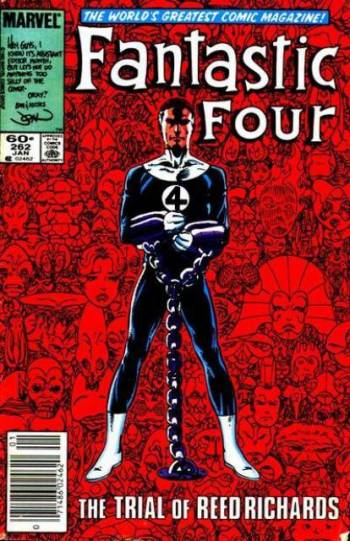
fantastic_four the trial of reed richards

The Trial of Reed Richards Fantastic Four Vol. 1 #262 (story and art by John Byrne; June 1984)

I’m not going to sugar coat this. The 1970s weren’t a good decade for Fantastic Four stories. John Byrne did a lot to reinvent and reinvigorate the team. “The Trial of Reed Richards” represents the best Byrne had to offer.

Reed must stand trial for allowing Galactus to live and devour more planets. This single-issue tale does a great job of exploring morality, catches readers up on what Galactus was doing for the past decade, and questions what the universe would be like without a force of nature that can eat entire planets. Byrne does a great job of defending Galactus’s right to exist.

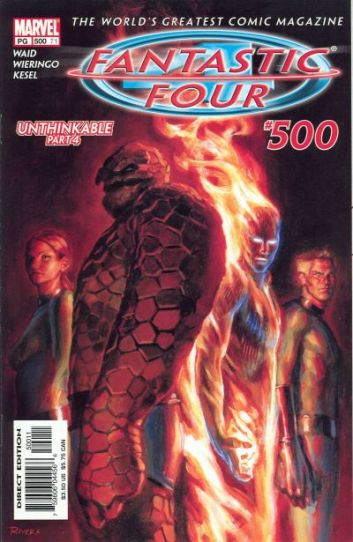
fantastic_four unthinkable

Fantastic Four: Unthinkable (written by Mark Waid/art by Mike Wieringo; 1998)

I’ve gone long enough without a Doctor Doom story, and that’s because I wanted to wait for the best Doctor Doom story “Unthinkable.”

Waid and Wieringo’s run on Fantastic Four captured the boundary pushing adventures of the FF’s past and is considered one of the best runs on the series. “Unthinkable” does a lot to solidify that claim. Unable to beat Reed as a scientist, Doom turns to the one “science” Reed was never able to comprehend: magic.

“Unthinkable” forced the Fantastic Four, and especially Reed, to stretch their capabilities. Doom reached new levels of villainy here that included dark arcane powers, a suit made of flesh. Despite Reed’s efforts, Doom still magically disfigured Reed and set him on a path that would lead to Ben’s death.

If a reader wants to know the depth of Doom’s hatred for Reed and the rest of the FF, look no further than “Unthinkable.”

fantastic_four hereafter

Fantastic Four: Hereafter (written by Mark Waid/art by Mike Wieringo; 2004)

I did it with Lee and Kirby and here I go again—sort of—with Waid and Wieringo. “Hereafter” follows “Authoritative Action” which happened because of “Unthinkable.” Let’s just say that Reed didn’t handle Ben’s death well, and it led to some ugliness in Latvaria. Reed decides to put his trust in something greater than himself in “Hereafter.” The surviving members of the Fantastic Four storm the gates of Heaven to rescue Ben. This story doesn’t question existence as much as exploring one’s consequences.

Reed, Sue, Johnny, and Ben don’t save the world in “Hereafter.” They don’t battle a huge villain or overcome a cosmic threat. This story focuses on love, friendship, and hope.

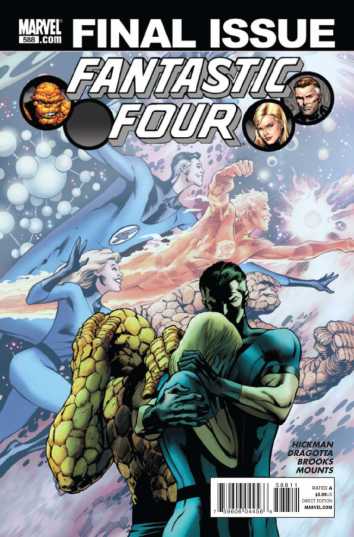
fantastic_four three

Fantastic Four: Three (written by Jonathan Hickman/art by Steve Epting; 2010-2011)

What is with the Fantastic Four and wanting to be a trio? Hickman had a great run with Fantastic Four in the 2000s, and “Three” might be the best of his stories. Annihilus—an often-overlooked FF villain—poses the threat here, but the crux of the story comes in the form of Ben losing his powers and not being able to help his best friend Johnny during an invasion from the Negative Zone.

Johnny gets overrun by the Annihilation Wave as Ben seals the portal from the outside. Ben gets his wish of being normal, but he struggles with losing Johnny. If readers want to learn more about Johnny and Ben’s unique bond, give “Three” a read.

fantastic_four 1234

Fantastic Four: 1234 (written by Grant Morrison/art by Jae Lee; 2011)

Grant Morrison likes to bend reality with his stories, so a Fantastic Four mini-series was inevitable. “1234” splits the family with four individual stories. Each member must suffer through a series of personal misfortunes and many of the team’s greatest enemies make appearances.

All the madness in “1234” leads to the team’s greatest adversary Doctor Doom. “1234” is a great showdown between two of the smartest men in the Marvel Universe. This is a battle of will, wits, and intelligence.

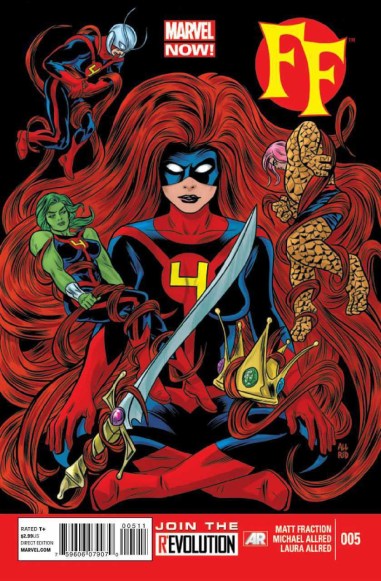
fantastic_faux

Fantastic Faux (written by Matt Fraction/art by Mike Allred; 2012-2014)

It may not look like it, but many heroes have donned the Fantastic Four uniform. The oddest group to wear Fantastic Four tights must be the team of Fantastic Faux.

Following Jonathan Hickman’s great run on Fantastic Four, Fraction took over both Fantastic Four and its sister title FF. The results were the team being sent through space and time, which left a vacancy in the Baxter Building for a substitute team to fill.

Ant-Man, Medusa, She-Hulk, and the newly introduced Ms. Thing (Johnny’s pop-star girlfriend Darla Deering who wore a mechanical Thing suit) were left in charge of the Future Foundation’s group of advanced science students. As Allred and Fraction are wont to do, they dial the sci-fi bizzarroness up to 50. A Voltron-style Doc Doom/Annihilus/Kang mash-up villain named Kang the Annihilating Conqueror, a one-eyed future Johnny, and the odd alien Foundation’s students graced this 16-issue run.

But like most great FF runs, “Fantastic Faux” challenges the idea of family. Not only are we born into a family, we have family that we choose.

That’s my list for readers who are new to Fantastic Four comics. If I didn’t get the list right, I’m sure it’s right in some alternate reality. I’ll have to ask Reed which one or you could let me know in comments.

Getting Started with Area Control or Influence Games

Uncle Geekly ran a search on a popular game type, area control, and found more results than he thought. These games range from simple who controls the most regions to more complex games where area control is an aspect of the game. We’re talking starting area control or the similar mechanism area influence games, so we’ll keep it simple and easy to learn, but most of all, an area control game at its core.

Most area control or influence games employ a great build to the game, where players begin with small gains that they hope to build upon through game play. These games, more than many others, have a natural progression to them, and gamers can see why someone won. Usually, this is a game type for players who like to see the wheels turn or have a little more agency in a game’s outcome.

As usual, good old Geekly has some starter games for someone interested in this gaming genre. Let’s get to some of these smaller games and work our way up to one’s that are more complex.

Hanamikoji

Hanamikoji

We’re starting with an odd choice: Hanamikoji. It’s classified as more area influence as players compete for the attention of geishas. Hanamikoji also happens to be a two-player game, which is a little unusual as well. A group of seven geishas is placed between both players and they range in point value from 2 to 5. The first player to gain the favor of 4 or more geishas or has 11 points or more of geishas wins. This is what makes Hanamikoji area influence instead of area control. One must gain the attention of the most geishas. The game play is fast—a typical game lasts ten to fifteen minutes which is lightning quick for an area control or influence game—and it’s intriguing.

Each player is dealt cards that correspond with each geisha (for example, green twos are used to gain the attention of the green two geisha). They’ll use these cards to gain favor. The players also have four action tokens, and this is where things get interesting. Both players alternate turns using all their actions tokens. One action locks down one card from a player’s hand. A second action removes three cards from play that turn from a player’s hand. The third and fourth actions have some combination of handing your opponent some of your cards and they choose one or two of the cards handed them, and the player using these actions keep the rest. This is an excellent way of mitigating a bad draw. It also makes for a surprising amount of choices for a short and simple game.

Carcasonne

Carcassonne

Sometimes the oldies are the goodies. 2000’s Carcassonne—along with El Grande—all but popularized area control games. The two wrinkles Carcassonne adds are tile placement and worker placement. Bear with me as a quickly discuss tile placement; it does factor into area control. Each turn a player draws a land tile and places it adjacent to a tile already in the play area. These tiles will have roads, farms, cities, and/or cloisters depicted on them. When placing a tile, it must match the pre-existing tiles in the play area. Sides of tiles that show a farm can only be placed next to another tile side with a farm. So, random tiles dictate what constitutes an area. This was revolutionary at the time.

Once a tile is placed, the player may place a follower—or worker. Players gain control of areas by placing their workers on these spaces, and these workers can perform several jobs, depending on where they’re placed. Farmers work farms, monks live in cloisters, and so forth. The player with the most followers in an area when it scores gains the most points for that area. The game ends when the last land tile is played, and the player with the most points wins.

This combination of game mechanisms works well. So many other designers have used some combination of worker placement, tile placement, and area control because of how accessible Carcassonne is and these mechanisms’ inherent strategic flexibility. Carcassonne works as a great introductory game for all three game types. I’ll try not to add it to another list. No promises.

smallworldgame

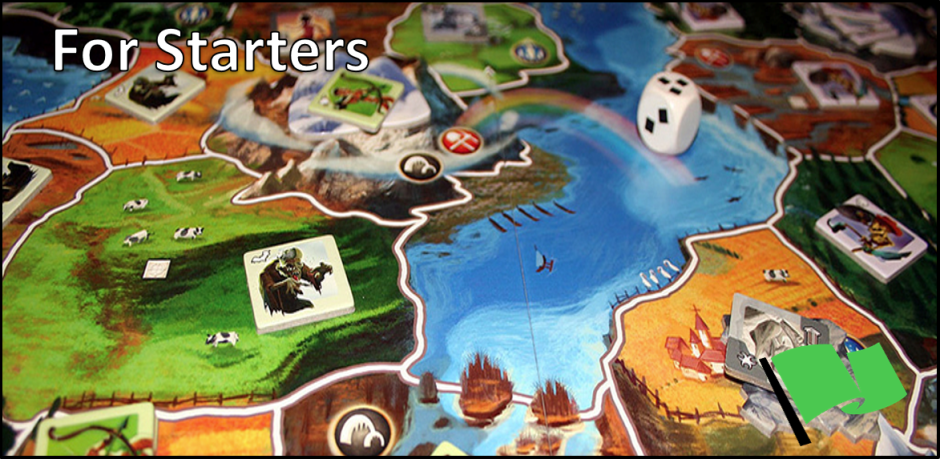
Small World

Sometimes gamers just want to conquer things. Small World takes place in a small world, where zany fantasy characters vie for control. There a lot of bells and whistles added to Small World. Each fantasy race like elves, trolls, and skeletons have their own race power, but each of these fantasy races are given one of 20 unique special powers like flying or ghostly that will make each playthrough different.

The concept is simple enough. When placing creature tokens, players start on the edge of the map. To conquer a land, they must use as many tokens as tokens in an area. If a player has enough tokens, they may conquer an adjacent land using the same method, so it’s likely that players will gain more than one area in a turn. In future turns, a player may choose to put their active race in decline (flipping their tokens upside down) and choose a new race. Players score points each turn for every area their races occupy; that’s for their active race and the race they have in decline.

At the end of the game, the player with the most points wins. That’s a common thread these games and a lot of other area control games share.

Small World does a great job of simulating combat without getting too in the weeds with it. It’s an area control game at its core with some nice window dressing, especially the use of variable player powers. Those race and special powers can be fun. Small World can also be the meanest game on this list. Players must know when to bail on a race and when to keep one. There will be a lot of hostile takeovers. It’s a small world after all.

Final Thoughts

So many of the best games on the market today use area control or area influence: Twilight Struggle, Star Wars: Rebellion, Scythe, Terra Mystica, Blood Rage, Twilight Imperium, and countless others. The games I just mentioned didn’t make this list because they get a little too complicated or they add more elements to the game than just area control.


The games I did include in this list will get new board game hobbyists the background they need to take on more complex games. Which games do you like to use as beginner area control games? You could place a worker to claim influence or it might make more sense to leave a comment.

Getting Started with Deck Building Games

I enjoy deck building games a lot. Deck builders are games with simple, identical, starter decks for each player, and players must build and customize their decks over the course of the game.

Deck builders can get convoluted fast and many of them are text heavy—we’re talking levels of text just below War and Peace. There are so many types of deck building games, so many that there are games that fall under pool building (not included here) that use dice and cubes instead of cards, that it can be overwhelming in terms of where to start.

Fortunately, your good old uncle Geekly is here to point you in the direction of less complicated deck builders to get going.

starrealms

Star Realms

I’ve talked about Star Realms in the past—for a full review check it out here—but it’s still one of the better, beginner games for a traditional deck builder. I could’ve gone with the base Dominion game, but I like the theme better with Star Realms, even though the space theme is barely there, and Dominion fans tend to want to add as many expansions as possible. Trust me. There are more expansions for Dominion than leaves on the ground.

Star Realms is balanced. If I’d have one major gripe, it may be that Star Realms is too balanced (the cost of cards are spot on, just buy the most expensive one you can afford each turn), but key elements like buying cards from the supply by paying specific costs for each card, culling (removing weak cards from your deck), forcing another player to discard a card from a future hand, and the concept of building a full deck and drawing a new hand from said deck instead of building a hand are all present in Star Realms.

It also doesn’t hurt that Star Realms has a free to download app.

Steam

Android

iOS

All someone would have to do to learn the basics for a deck building game is to download and play the tutorial. It doesn’t get much easier to learn than that.

CenturySpiceRoad

Century Spice Road

The hottest, newest game on this list may just be one of the least complicated deck building games and has the least text. Century Spice Road also has a couple of stand-alone expansions—games that can be played on their own as full games or that can be added to the original to make different combinations—so look out for Golem Edition and Eastern Wonders. Golems don’t get enough play in games. I may have to drive to the nearest adventurer’s pub and pick up a golem or two.

The base game’s theme isn’t that interesting—tabletop gamers have seen hundreds of spice trading games—but Century Spice Road not only boils down the deck builder to the point where it’s a bit of a hand builder, it adds elements like resource and space management to the genre. It also includes an interesting approach to one of my other favorite mechanisms: card drafting.

Cards in the supply are laid out from left to right, and players add action cards to their hand, starting with the card on the far left. If a player wants to skip a card in the supply, they must place a spice (or cube) on the card(s) skipped. Any player who picks up a card with a spice on it adds that spice to their supply. This simple addition adds so much strategy. Do I want to give my opponent a free spice by skipping a card? An action card I might not otherwise want may have spices I do want. Do those free spices make it worth adding the card to my hand?

All of these elements come together in a satisfying way. No wonder Century Spice Road earned the 2017 Golden Geek for best card game. Note: don’t play with real spices. That gets messy.

PaperbackCardGame

Paperback

I had to include Paperback because it has a great combination: deck building and word game. It’s a game combination that people wouldn’t think would work, but it does. A player can be adept at one of the two game types, and not the other, and still excel.

The same concepts one can find in Star Realms can be found in Paperback. There are more variants to Paperback so replay value is increased, but it’s the combination of deck builder and word game that makes this game sing.

The theme of struggling writers getting their paperback books published—to be fair, this theme may hit closer to home than I’d like to admit—also comes through. Paperback is easily the most thematic game on this list, but it’s not for everyone. If someone is dead set against word games, this game might rub them the wrong way. If someone likes word games or is willing to give a word game a shot, Paperback is excellent.

Final Thoughts

The above games are all great if you’re just getting into tabletop games and wondering how to play deck building games. Star Realms, Century Spice Road, and Paperback have a lot of replay value too.

Know of any other great starter deck builders? Let us know in the comments.

Card Drafting Starter Games

Your uncle Geekly likes card drafting games; they’re one of his favorite game types. I admit that I say this a lot, but I do like a good card drafting game. Card drafting can take many forms and some of the games that use this mechanism can get involved and not very new player friendly.

Fortunately, old Uncle Geekly is here with another group of starter games: card drafting edition.

Okay. I thought that would’ve sounded better than it did. Oh, well. These are the best games to teach someone who’s never played a card drafting game before.

Azul

Azul

Azul is a bit of a cheat. Players aren’t drafting cards, they’re drafting tiles, and that makes sense because the game’s theme is tile laying a Portuguese wall. Oddly enough, Azul has tile laying as a theme, but the tile laying or placement mechanism is downplayed. Anyway, various colored tiles are drawn from a bag and four of them are placed on 7 cardboard discs that are accessible to each player. Players take turns claiming similar tiles on each disc and adding them to their player boards. Each board has the same wall pattern and the player to finish a row of tiles initiates the end of game.

The scoring can get a little fiddly at times, but Azul is a quick game that’s easy to learn, and you’ll see plenty of set collection and chain effects (of which Azul has plenty) crop up in other games on this list and other card drafting games not on this list.

Jaipur

Jaipur

I could’ve gone with Splendor here and most of what I say about Jaipur could apply to Splendor, but Splendor gets too much press and Jaipur doesn’t get enough. Jaipur has a supply or market place with five cards. Players take turns taking cards from the market or swapping 2 to 5 cards between the market and their hand. One can also sell every card of a specific commodity (each card has a different commodity depicted on it) and when they do, they take point chips of the commodity from the bank. As soon as four pools of point chips are depleted, the game ends and the player with the most points wins.

Like Azul and Splendor, Jaipur is a quick play. It’s my representative game for the rapid market place games that use card drafting. Unlike Splendor, Jaipur doesn’t have as much of a runaway leader problem and is a little more forgiving on new players. Plus, I really like the camel card addition.

SushiGo

Sushi Go

In many respects, Sushi Go is a simplified 7 Wonders. It’s a simple game of deal so many cards to the players around the table and each player simultaneously picks the card the want to draft. They place the card they want face down on the table and pass their hand to the next player at the table. Once everyone has picked a card, everyone reveals the card they picked, and it adds it to their tableau (or scoring area). The cards have various scoring methods and picking the right combination of scoring method leads to victory.

Sushi Go’s theme is silly, the gameplay is lightning fast, and the rules are easy enough that a 7 or 8-year-old would have no issues playing. If you’re new to tableau building, simultaneous card drafting (and there’s a lot of games that fit this bill besides 7 Wonders), learn Sushi Go before tackling something more complex.

Final Thoughts

Card drafting is one of your uncle Geekly’s favorite gaming types. There are plenty more introductory card drafting games I could’ve included. If you have an issue with any of the games on my list, say JK Geekly twenty-seven times in a mirror and there’s a chance I might appear. Or you could let me know in the comments.