
Another week and another video game review of a game I’ve played a lot. It’ll be difficult to remain objective while discussing Onirim, but I’ll do my best. Usually, I delete Solitaire from my mobile devices and replace it with Onirim. You can find me in line playing a few games of Onirim. Like I said, I play Onirim a ton.
Hey, hey! Kyra Kyle here. At its core, Onirim is a solitaire game, which is why I replace Solitaire with this title. While this video game is a fun twist on classic Solitaire, Onirim remains a solitaire game, a tabletop card game converted to an app. How will it fare with our review criteria? Let’s find out.

Mechanisms: 10/10
Be honest. You saw this coming. Like I said, Onirim is an interesting twist on classic solitaire. The deck has four suits, each suit has four card types, here’s where the theme comes into play. The player is traveling the dream world (hence the name Onirim, a take on oneiric) and needs to safely escape the land of dreams by opening three doors in each suit. If you draw into a suit’s door and have a matching key, you may open the door. If you don’t have a matching key when you draw a suit’s door, you draw another card and shuffle the door back into the deck. This is where the digital version of Onirim trumps the physical version: shuffling.
During a game of Onirim, you’ll often shuffle the deck. Nightmare cards (which don’t belong to any of the four suits) may be drawn. Bad things will happen when a nightmare appears (it’ll be up to the player what happens exactly), and if the player draws extra nightmares in a turn, any nightmares beyond the first also get shuffled back into the deck. There’s a lot of shuffling, and the digital app does all that shuffling for you. Typically, I prefer a physical tabletop game over a digital version of that same game, but Onirim enhances this already stellar game.

Since the player has choices when a nightmare card gets drawn, Onirim provides player agency and adds a layer of strategy. The remaining two card types (in the base game; there are expansions that we won’t discuss here) are suns and moon cards in all four suits. Suns are the most common card type. Moons are less common. And the rest of the game is playing three cards of the same suit but with different symbols, in the top play area. When that happens, the player searches for a door card in that suit, and then reshuffles the deck. Yes. More shuffling. I love playing the Onirim video game.

Above Image from GameDesigning.Org
Gameplay Loop: 10/10
Onirim games play fast, and each game is unique. The simple premise, the colorful twist on solitaire, and the options a player has once a nightmare card is drawn grant Onirim a high gameplay loop score. I don’t mind waiting in line while playing Onirim. And like I said, I replace Solitaire with Onirim. Obviously, this game’s gameplay loop is fantastic.

Narrative and Storytelling : 3/10
We’re combining narrative and storytelling for Onirim because Solitaire doesn’t have any story. Onirim has an intriguing premise. The nightmare cards and doors needed to escape the dream world, hint at a greater story, but I can’t give Onirim top marks in either of these categories. This is partly why I combined the two. But Onirim does just enough to not get below a three.

User Interface: 8/10
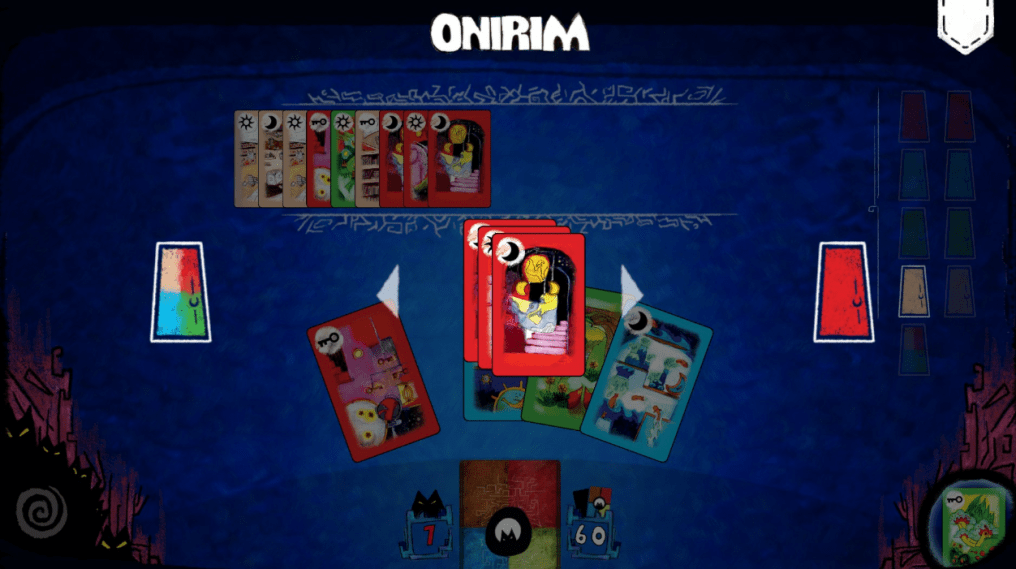
Onirim has a clean look. The play area up top is easy to see (the image above includes an expansion, so there’s a card type, the whirlpool, that I haven’t mentioned). Your hand is visible below the play area. Beneath your hand, you’ll find how many nightmare cards remain (the black demon with the red number on the left, and how many cards remain in the deck; you lose if you run out of cards before opening all twelve doors). The filled-in cards let you know which doors have been opened, and the top right corner is where you can access the main menu. Clean. Easy to read.
I lowered Onirim just a hair for the User Interface because of how difficult it can be to navigate all-time statistics. This isn’t a big deal for a lot of players, but if one becomes invested and explores that rabbit hole, one would want an easier set of menus.
Graphics: 6/10
Onirim has amazing graphics for a solitaire game. But it’s still a solitaire game. Onirim does what it can within the confines of a card game, but no matter how good the cards look, they’re still cards. That said, Onirim may be the prettiest card game I’ve seen. It has to get an above-average score.
Audio: 5/10
Onirim is another game I play with the sound off. The soundtrack is atmospheric, but kind of blends into the background. The sound effects could–and probably should–boost this score even more. But I’m going to stay as objective as I can. While the shuffling effect can be satisfying, you’ll hear it a lot, and it can also detract from the experience. There’s so much shuffling.
Replay Factor: 10/10
Since Onirim is Solitaire with a twist, you’ll find it difficult to play only one game. The app keeps track of your all-time stats, so I end up trying to beat my all-time best, and if that happens, I’ll try raising my overall win percentage or how quickly I typically beat the game. Solitaire with stats. That’s a rabbit hole. It also gives Onirim high marks in replay value.
 jkgeekly.com