Whatcha Playing, Geekly? September 2025

Happy Wednesday, Geekly Gang! Kyra Kyle here. For this week’s Whatcha, our Geekly writers will be sharing which games they’ve been playing over the past month. Let us know what games you’ve been playing, because we’re all part of the Geekly Gang. I’ll start by sharing the games I’ve been playing.

Kyra’s Games
Kyra’s Board Games

Phil Walker-Harding is known for Bärenpark, Gizmos, and Sushi Go!, and Super Mega Lucky Box is Walker-Harding’s twist on Bingo. Like many of Walker-Harding’s games, Super Mega Lucky Box is easy to learn but may take a few play-throughs to figure out the best strategy.

A deck of cards, containing two copies of numbers 1-9, is used to determine which box players may check off one of their multiple Bingo cards. (You begin the game with three.) As soon as you fill a column or row, you immediately claim the reward (if any), shown at the end of that column or row. Lightning bolts allow you to change the number on the card, so typically, you’re not stuck with a number you can’t use. Stars grant you victory points. Super Mega Lucky Box rewards players who can manage their resources (lightning bolts and rewards) and who know when to manipulate their Bingo cards and rewards to great effect.

A Mensa 2022 Select recipient, Super Mega Lucky Box encourages creative thinking. The game’s variability ensures no two games play the same.

Wazabi spelled with a “Z,” not an “S,” is–essentially–a dice version of Uno. Players begin the game with four dice, and they attempt to rid themselves of their dice. Each die has three possible results, give a die to another player, draw a card, and a W (more sides have W than the other two), which is the currency needed to play a card from your hand. During a turn, a player rolls the dice, follows the directions on the dice, and can play one card that they can afford. Cards cost 1, 2, or 3 W.

Wazabi can be fun, but it suffers from the same shortcomings as Uno, only you’re adding dice (another variation of luck) to the mix. Games of Wazabi can–and should–end in less than ten minutes, but typically, you’ll end up with a stalemate with players trading dice and cards back and forth for about twenty to thirty minutes. Still, I can see the appeal of Wazabi. It adds a little spice to Uno’s gameplay.

One of my game group members hates trick-taking games. He shall remain nameless. Anyway, this trick-taking game hater hasn’t shown up to meetings over the past month, so we’ve been playing a ton of trick-taking games: Little Devils, The Bottle Imp, Cat in the Box, and Squeeze.

I won’t go over all of these games, but I enjoyed each one. I like having a theme for game night. Quick. So-and-so isn’t here, let’s play games they hate playing. Each of these trick-taking games are nasty in their own way. The Bottle Imp requires the most replays to wrap your brain around what’s happening, although Cat in the Box isn’t too far off in that regard. Little Devils is the easiest to explain (we’ll have a review of that game in a couple of months), and it happens to be the meanest of the three non-traditional card games. But Squeeze (played with a traditional deck of cards) may be the most mean-spirited.
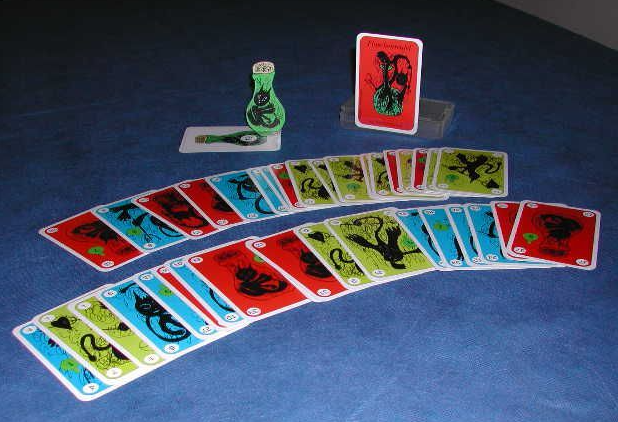
Players begin Squeeze with ten cards. The top card of the deck denotes which suit is trump for the round. The person to the dealer’s left makes their bid, and then everyone else makes a bid. When the bidding makes its way to the dealer, the dealer can only choose a number that doesn’t equal the total number of cards in hand.

For example, during the first round of a three-player game, if the first player says “3” and the second player says “4,” the dealer can say any number other than “3,” which would equal ten (3+4+3 = 10).

At least one person is guaranteed to miss their bid each round, hence the name Squeeze. “Zero” is a legal bid, so long as it wouldn’t equal the number of cards in play. Players earn ten points plus their bid if they achieve their bid, and get nothing for missing their bid. Play continues like this until a dealer deals only one card during a round. You don’t want to be the dealer during the final round. You may not have a choice of bid. Yikes!

My favorite thing about Squeeze is that you get less knowledge of what’s in players’ hands the longer you play. I may be the only one with trump for the round, but my trump cards are two and three. I’ve bid one and ended up getting a lot more tricks than one. Lol
Kyra’s Video Games

I won’t go into too much detail with Tiny Bookshop; this game will definitely make Season’s list, too. Geekly covered Tiny Bookshop during one of our Geekly News posts. In short, Tiny Bookshop is an excellent, cozy game and will probably receive a game review sometime in early 2026. I love making book suggestions for customers. Tiny Bookshop is one of the few video games that offer reading recommendations. What’s not to love?
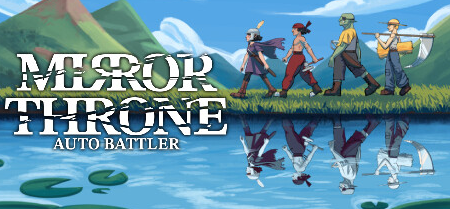
I like auto battlers. My favorite is the now-defunct Fate Arena, so I’ve been looking for a worthy replacement. I’ve put in a handful of hours with Mirror Throne, and it’s most likely not going to be my Fate Arena replacement. Mirror Throne doesn’t appear to have balanced abilities for its characters. I could be wrong. But I did run the table with one or two overly strong units during the game’s campaign. Mirror Throne only offers two factions (technically, a third that’s a mix of the other two), so gameplay styles are limited. But Mirror Throne has room for improvement.

While I’d like a more robust campaign mode, Mirror Throne needs to fix its competitive (Arena) mode. I dislike how I don’t know who I’m in a lobby with, and that I have no idea what kind of teams they’re building. That’s something Fate Arena handled beautifully. I want to know my competition. Instead, I’m given randos who may be bots.

Fate Arena also had bots, but you’d get an idea of who the bots were, and they didn’t dominate lobbies. I also wonder about leavers. Fate Arena would backfill leavers with bots; leavers were the main reason for bots in Fate Arena. Mirror Throne may suffer from leavers who only purchase one unit and duck the game. I can easily roll them.

I’ve played Mirror Throne after its first major update, and I still don’t know what’s going on during Arena mode. Hope is the currency needed to stay in the game (you begin a game with 100), and sometimes when I lose, I’ll lose 5 or 10 Hope, but other times it’s a whopping 25. What determines the amount of lost Hope? Mirror Throne is needlessly opaque.

Mirror Throne also matches me against opponents I may never see again in the lobby. I’m unable to build up a rivalry with any opponent. Mirror Throne has just been released, but it needs to iron out a lot of kinks. Fingers crossed.

That’s all I have for games this past month. Let’s see what Season and Skye have been playing.

Season’s Games
season’s board games

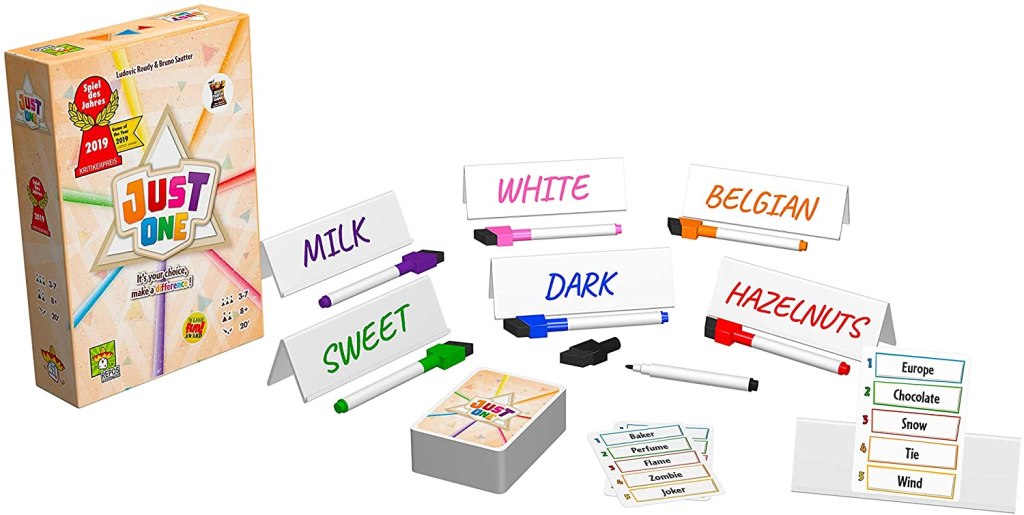
It’s been a minute since I last included a board game on this list. I originally played Just One at a going-away party with a former coworker years ago, but it’s recently hit the table again. Just One is a simple game that has the active player draw a card (without looking at the underside) and select a number (1 through 5). Each number has a word next to it. The rest of the players use their whiteboard standees to write one word that describes the word from the list the active player chose. Players reveal the descriptive words they chose to each other (without the active player looking), and if any words match, the players with matching words have to erase their whiteboards. The active player gets one chance to guess the word they picked.

I don’t remember how many rounds are supposed to be played. Whenever I play, my group plays until we burn out on guessing words.

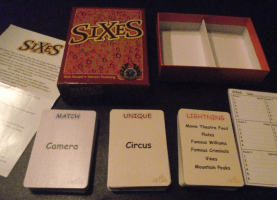
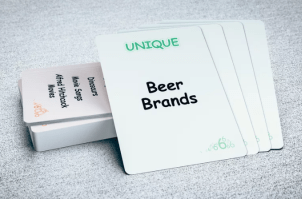
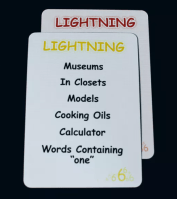
Travel-sized Scattergories makes a comeback. We’ve covered SiXeS before, so I won’t go into too much detail. The gist of SiXeS is writing thirty-six words over six rounds in six minutes. Each round has a different category (or categories for Lightning rounds that occur every third round), which players either try to match words with each other or be unique. In rounds one and four, players are trying to match every word. In rounds two and five, players are trying to have different words. In rounds three and six, players are trying to match in six different categories with one word per category (Lightning rounds). Each round is timed for a minute, and players read their lists aloud once the timer is up.

I love games that let me flex useless knowledge. I always have a good time whenever SiXeS hits the table.

season’s video games

I’ve gone with another tabletop game in video game form with this month’s Inscryption. Inscryption is a rogue-like deck-building game that combines role-playing with escape room elements. You can get up from the table and explore the room around you for clues. Some of the puzzles offer the player cards to help them progress through the game. Not much is explained about your character (player piece) in the game, other than animals randomly start following you as you trek through the woods.

Your starting deck has three cards and a squirrel deck (which players may use as sacrifices). You collect cards and build your deck as you progress across the map. Every time you fail, you must start over with the same starting deck and build your deck from the ground up. You’ll start to notice something peculiar about one of the cards in your starting deck. I won’t go into further detail.

Inscryption incorporates an ARG (Alternate Reality Game) through some of its Easter eggs. An ARG is a code, link, or something else within a piece of content that connects the consumer to go into the real world to discover more lore. In Inscryption, several binary codes are scattered throughout the game, connecting players to external sources and providing context on fictional entities within the game. It’s fun for those who like a bit of sleuthing.

That’s all I’ve for this week. What have you been playing, Skye?
Skye’s Games

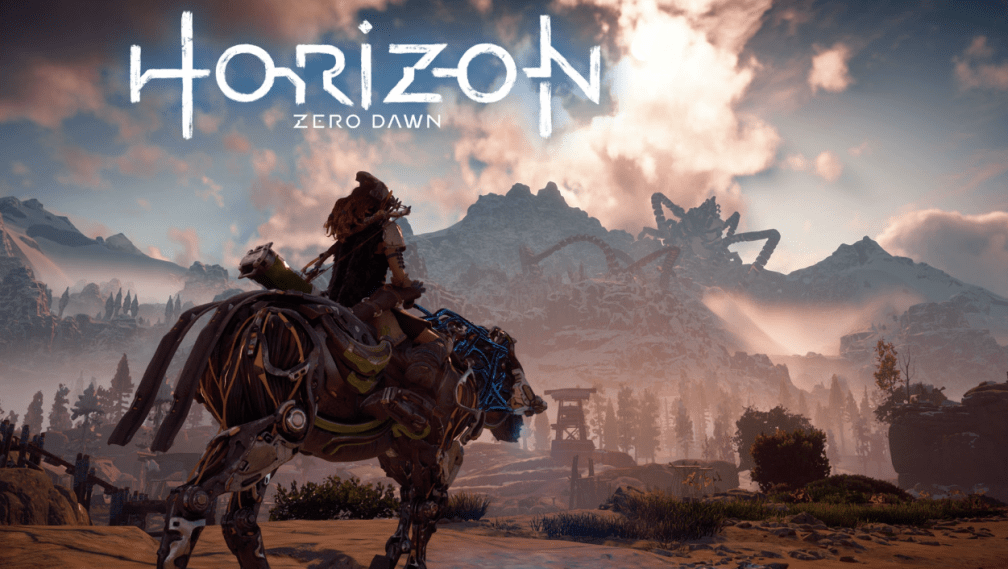
I made an important realization this month. If I get into a game, I really get into it. Case in point: Horizon: Zero Dawn. I hadn’t played Horizon: Zero Dawn before, and I was looking for another RPG. After finishing Ghost of Tsushima months ago, Horizon: Zero Dawn has filled that void. My favorite aspect of Horizon is exploration. I always love running around to the farthest reaches of an open-world game’s map and stretching the limits of what I can do. You can’t tell me what to do, game! I do what I want!
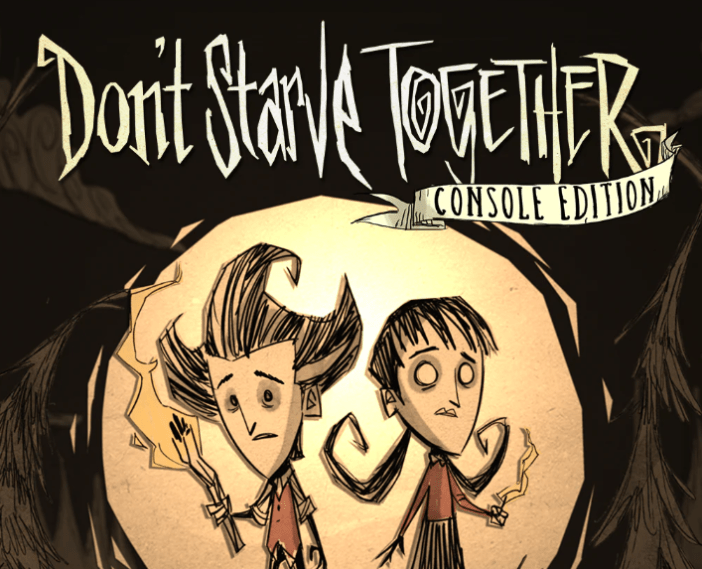
I got the random urge to play Don’t Starve again. What sets Don’t Starve apart from most other survival games is its tendency to throw random things at you without warning. You suddenly come across a new biome you’ve never seen and get killed by a subterranean tentacle. You’re barely managing to scrape by when a pack of wild dogs comes out of nowhere and mauls you to death. I still don’t have an ideal strategy, but Don’t Starve is an enigma I’m willing to spend my time. I forgot how much I love Don’t Starve.

Kyra Kyle again. Those are all the games our writers have played this past month. Let us know which games you’ve played over the past month, Geekly Gang. Thank you for reading, and wherever you are, I hope you’re having a great day.
5 Great Word Board Games

Hey, hey! Kyra Kyle here. We’re going to do something a little different with this board game list. It’s not a list of starter board games of a specific type. If you want us to continue the starter board game series, let us know. It’s not a top 5 or top 10. Nope. This is a list of 5 great board games with a specific style. Today’s list is 5 Great Word Board Games.

Seeing as this isn’t a top 5 list, the games won’t be in any order. We’re also going to try and stick to different kinds of games within the same style, so this list of great word board games won’t be five different versions of Scrabble…hopefully. Without any further ado, here are the games.

Paperback

Paperback combines the idea of a traditional word board game (like Scrabble) with a deck-building game. Players must make words with the letter cards they draw (or a combination of letters on a card like “Th” or “Qu”) and they earn money with which to purchase victory point cards or more letter cards to add to their deck for future turns. Paperback balances its two elements well. A player who can slay at word games can dominate that section, but a player who has more experience and can shift their strategy to the cards present in the deck-building array (you’ll have different cards most turns) can use that to their advantage.

Paperback allows multiple paths to victory and that sets it apart from a lot of other board games centered around words.

Sixes Tabletop Game

SiXeS

We recently reviewed SiXeS. (If you want to see that review, follow this link.) So, there’s a high probability that SiXeS would make this list. If you don’t want to read the review, that’s okay. We’ll break down the gameplay. SiXeS plays a lot like Scattergories with a twist. Players alternate turns where they want to match the answers to specific questions with their opponents with turns where they want to give unique answers. Unlike other games like Scattergories, SiXeS keeps the gameplay fresh by varying its gameplay each round.

Letter Go!

Like Paperback, Letter Go! combines a word game with another game type. But Letter Go! goes in a completely different direction. It combines a word game with a pseudo-dexterity game. While Paperback’s turns can be slow and methodical, Letter Go! is a real-time race to see who can spell a word using the cards at their disposal while following a rule on their dry-erase board. Some of these rules dictate that you must use your non-dominant hand. Others may say the word’s letters need to be wavy or look like flowers. Even more say that you must repeat all consonants you use but not the vowels.

Letter Go! shakes up the common word game. Just because you can think of a word quickly doesn’t mean that you’ll be able to also obey whatever rule card you draw. Talk about leveling the playing field.

Codenames

I know. I know. Codenames was everywhere for a few years. It’s the gamer’s word game, but there’s a good reason for that. Codenames melds several elements in a fun way. It combines the lateral thinking of TriBond. As the clue-giver, a series of cards with words printed on them stand before you. You can only give a single-word clue accompanied by a number (the number of the cards that match the clue you gave). Your teammates must guess which cards they believe match the clue you gave. But beware, there’s an assassin card. If your teammates choose that card, your team automatically loses.

Codenames has a nice push-your-luck element. As the clue-giver, do you add an extra word or two and make your clue broader? As the guessers, do you continue picking words you think fit the clue or stop after getting one correct? The other team is racing against yours to guess their words. Ultimately, the choice is yours. Choose wisely.

Say Anything

Say Anything is for those who like games like Apples to Apples or Cards Against Humanity. I don’t care for Cards Against Humanity that much, and I got as much out of Apples to Apples without needing to play it any longer. Both Apples to Apples and Cards Against Humanity use pre-printed question and answer cards. There are only so many word combinations you can come up with, but what if you could fill in the blank and provide your own answers? That’s exactly what Say Anything does. You no longer need to find the perfect joke answer for a question. You can write your own joke.

When you’re tired of the same old answers or you don’t want to buy expansion decks for Cards Against Humanity, try buying one copy of Say Anything. The only downside is that you may need to be sober—or at least coherent—to answer the questions.

Say Anything wraps up our collection of great word board games. I’m sure that there are plenty of your favorites that didn’t make the list. Be sure to let us know about them in the comments. And wherever you are, I hope you’re having a great day.
Tabletop Game Review: SiXeS

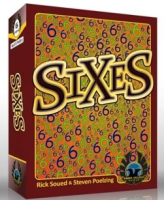
Hey, hey! Kyra Kyle here. We haven’t done too many tabletop game reviews over the past several years—before our Marvel United review last month (here’s the link for that review if you missed it). Today’s review is a much shorter game, but one that packs a punch: SiXeS.

Played over six rounds, SiXeS is a party game where players predict what their opponents will write that will match—or not match—depending on whether you’re in a “match” round or a “unique” round. The player with the most points after six rounds, wins.

Before we proceed, we’ll prep the party and discuss SiXeS’s details.

The Fiddly Bits

Designer: Steven Poelzing and Rick Soued
Publisher: Eagle-Gryphon Games and Hobby World
Date Released: 2016
Number of Players: 3-8
Age Range: 12 and up
Setup Time: Less than a minute
Play Time: 15-20 minutes

Game Mechanisms

Party Game
Card Game
Word Game

Sixes Tabletop Game

Game Setup

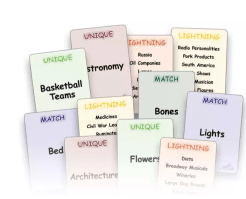
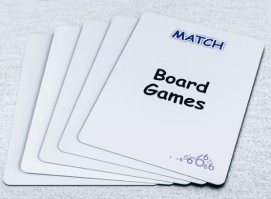
SiXeS consists of three decks of cards: “Match,” “Unique,” and “Lightning” decks and a scoring pad. Each player gets a sheet from the scoring pad and a writing utensil. Shuffle all three decks. Each card is double-sided with one side easier than the other. SiXeS’s rulebook shows which side to use for each round.

You’ll also need a means to keep time; you can use a minute-long sand timer (SiXeS doesn’t include one) or set your phone’s timer for a minute. Some of the rest of “Game Setup” can fall under “Game Flow,” so let’s continue with the next section.

Game Flow

On the scorecard, you’ll find rounds 1-6 marked. Each round has spaces for six answers. Play begins with a “Match” card. After the timer starts, players will think of things that fit the category’s criteria (this will be the word or words printed on the card). For instance, a category like “Sandwiches” can yield answers like “Peanut Butter and Jelly,” “Hero,” or even “Knuckle.” You’re going to have to match at least one other person’s answer at the table, so you may not want to get fancy with which words you use during a “Match” round.

Players find out if they matched anyone else at the table by sharing their answers. You receive a point for each answer that matches another player. If all six of your answers have at least one match, you receive a “Crooked Six.” That’s a seven. You get seven points if you match all six answers. I guess the designers wanted to maintain SiXeS’s theme by calling a seven a “Crooked Six.”

The objective changes with “Unique” rounds. “Unique” rounds play a lot like Scattergories, but you aren’t forced to begin each of your answers with the same letter. In “Unique” rounds, you receive points for each answer that matches no one at the table. You can also earn a “Crooked Six” if no one else puts down your valid answer.

The final card type, “Lightning” has six different categories. You will answer each category in the order in which they appear on the card, and players will try to match answers with at least one other player at the table.

The player with the most points at the end of six rounds wins.

Review

SiXeS resembles Scattegories but with a twist. I like how the rounds vary. As a result, I find it easier to continue playing multiple rounds of SiXeS over Scattegories.

I have yet to play a game of SiXeS that doesn’t include someone getting miffed that no one else chose their cromulent answer or at least one round ending with multiple people unable to fill in all six spots on their scorecard. SiXeS can be frustrating at times but also engages a group of gamers. It’s a great ice-breaker game. It fits into the party game category and a “getting-to-know-you” game. I can see companies using SiXeS as a morale-building tool.

SiXeS’s box says you can play 3-8 players. I wouldn’t recommend three players. Four and five players can be a lot of fun, but SiXeS’s works the best at higher player counts. There’s nothing preventing someone from playing SiXeS with more than eight players. No one’s stopping you from handing out extra scorecards and writing utensils.

That said, beyond the eight-player mark is where SiXeS either becomes super easy and super hard, depending on the round. Matching one out of ten or eleven players would be easy—too easy—but coming up with a unique answer among ten or eleven players can be nearly impossible. I’d stick to as close to eight players as I can. You could convince me into a nine or ten-player game of SiXeS, but the game begins to crumble under the weight of eleven or more players.

Verdict

Easy to learn and fast to play with great replayability, SiXeS gives Scattegories a much-needed twist. It’s also highly portable. I won’t mind taking SiXeS with me on future trips.

3 Lists of 3 Tabletop Games for Miss Kitty

Hey, hey! Kyra Kyle here. I promised something different with this post, so let’s give it a try. Today would be my mom’s 74th birthday. Her name was Catharina Beenen Rackley, but her friends called her Kitty. I wanted to make a 3 Lists of 3 in her honor and had some trouble picking the topic. I could’ve picked music, food, or travel. But we don’t cover those topics on Geekly that often. Miss Kitty also enjoyed television and movies, and those would’ve made good choices. But I decided on tabletop games.

Geekly covers tabletop games, and Mom and I played board games together. She even got a kick out of me designing the occasional game. So, let’s do a 3 Lists of 3 Tabletop Games for Miss Kitty.

Games Miss Kitty Played

Miss Kitty played a lot of different games, and typically, she played games depending on who she had as company. She would play certain games with her children and others with her mother and siblings. And I’m sure she played even more games with her friends. I only have my perspective to go off on here and the accounts of others. Also, we may have more than a few honorable mentions. One cannot boil someone down to a handful of anything, not even board games.

Liverpool Rummy

Liverpool Rummy was a prerequisite whenever visiting Miss Kitty’s family, so this one may be more of a Beenen family pick. But I’m going with it. Miss Kitty and I played Liverpool Rummy a lot. I would go into the gameplay here, but I want to keep the entry short. Perhaps I should cover Liverpool Rummy in a post but it’s a card game using a standard deck.

Each round, players either try to collect sets of cards (at least 3 of the same number) or runs of cards (4 cards in the same suit in sequential numbers). If a player has all the requirements for a round, they can go down (which means revealing their cards with the appropriate number of sets/runs). Once down, players can play cards from their hand onto cards that are “down.” The first player out of cards wins the round and everyone else tallies their score. The lowest score at the end of the game wins.

I picked Liverpool Rummy instead of Wahoo (another Beenen family favorite and a good choice for this selection) because of a moment that happened the first time my wife Jen played with Miss Kitty. Miss Kitty kept saying that she didn’t know why I was so competitive in games. Later that same game, Miss Kitty sported a devilish grin and then bragged as she went out concealed. Jen laughed. Miss Kitty asked her why. Jen said, “I can see why they’re so competitive.”

Balderdash

Another game could’ve taken Balderdash’s place here: Scattegories. In fact, Miss Kitty and I played more Scattegories than Balderdash through the years. Both games are word games and while Miss Kitty would come up with strange answers for Scattegories (“Oreo” or “Knuckle” as forms of sandwiches), Balderdash created more memories.

Balderdash is a game of obscure words. Players must create definitions for words seldom used in the dictionary and gain points for guessing the correct definition or having other players select their invented definition. Miss Kitty worked as a surgical technician. She knew a few things about medicine and used that knowledge liberally in any game of Balderdash. If we heard a definition begin with “a medical term meaning…” or “inflammation of the…” or “a doctor’s tool for,” everyone at the table would turn to look at her. She’d turn beet red and try not to smile. And typically failed. If two “medical” definitions got read, we’d curse our bad luck. Which one’s the real one and which one’s the fake one?

Ticket to Ride

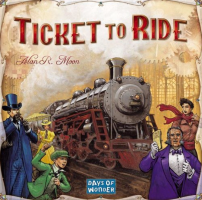
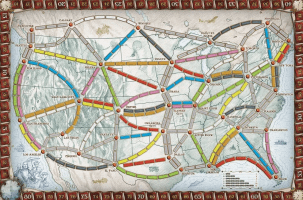
Miss Kitty had a history of set collection games, so of course she’d love Ticket to Ride. The rules are simple to learn and each different flavor of Ticket to Ride would add a wrinkle or two to the core rule set. Ticket to Ride was a perfect game for Miss Kitty. She could play a new game with a few “new rules” and not feel lost. I covered Ticket to Ride some time ago. Here’s a link to the original write-up.

The one game of Ticket to Ride I remember best with Miss Kitty involved her playing with her older brother Paul. Uncle Paul did nothing but build trains on the eastern seaboard. He didn’t complete any tickets. He didn’t do much of anything except block everyone else from building on the eastern coast of the United States. Miss Kitty growled at Uncle Paul. “You’re playing it wrong. Stop playing the game wrong!” I fell out of my seat laughing. It was a window into Miss Kitty’s childhood. This wasn’t the first time she had told off her older brother.

My family and I are currently playing a game of Ticket to Ride Legacy: Legends of the West. This version of Ticket to Ride has a story. Each player assumes the role of a railroad tycoon. The board grows as the railroad gets built from the east coast to the west coast. Hey, Uncle Paul wouldn’t have been playing the game wrong with this version. Anyway, there are four of us playing Ticket to Ride Legacy. When we finish, I intend on dealing out the fifth player stickers (you can place stickers claiming routes and cities for different players and we plan to use the fifth player) for Miss Kitty.

Games Miss Kitty Didn’t Play

This next list is of games are ones Miss Kitty never had the chance to play for one reason or another, but I know she would’ve loved to play them.

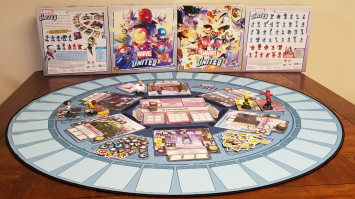
Marvel United

I wouldn’t have thought it possible if I didn’t hear this from her myself, but Miss Kitty was more into the Marvel Cinematic Universe than me. Marvel United is a cooperative tabletop game where players assume the role of superheroes in the Marvel universe as they try to stop a supervillain. Like Ticket to Ride, the rules are simple to learn with each hero and villain adding a small wrinkle or two. Since it’s cooperative, Marvel United eliminates competitiveness and players are encouraged to help each other. I just know Miss Kitty would’ve wanted to play out a few of her favorite movies.

And there’s some precedent for this. Miss Kitty and I played X-Men: Under Siege. My father and I played more of this game, but Miss Kitty liked this game, too. Marvel United would’ve scratched a similar itch. And it doesn’t hurt that the miniatures and art have cute designs. Miss Kitty liked cute things.

I haven’t written a review for Marvel United yet, but I started a guide. You can check out the newly posted Guide to Marvel United here.

Flamecraft

Flamecraft is the most complex game on any of these lists so far, but I’m sure Miss Kitty would’ve struggled through a difficult game or two because it’s so cute. And dragons. One of her granddaughters (my niece) is obsessed with dragons or at least she was at one point. Flamecraft uses a game element popular with recent tabletop games. Whenever you take an action that action has a global effect and can benefit your opponent on future turns. This element also makes Flamecraft feel like it’s a winnable game or at least a board game that has closer outcomes.

And did I mention the puns? I can hear Miss Kitty cackling every time I read one of the dragon shops’ names. Either that or I’m hearing my daughter’s same laugh. Critical Rolls. Bizarre Bazaar. Potable Potions. Outback Drakehouse.

Sixes

I first played Sixes recently at a party and thought of Miss Kitty. It’s a word game like Scattegories. Sixes plays out in six rounds—naturally. Each round has players making lists of six things that match a category. The twist comes from what players are trying to do each round. Some rounds, you’ll want to have unique answers like Scattegories. Other rounds, you’ll want to match other players. And the third and sixth rounds are lightning rounds where players answer 6 categories with a single answer. The person with the most points wins.

Miss Kitty would’ve loved playing Sixes. It’s a great ice breaker game or a way to reconnect. I found players saying things like “I knew I liked you” or “we think so much alike” whenever they answer a list similarly during a matching round. Of course, there’s the classic Scattegories response whenever you match during a unique round. “We think TOO much alike.” Or “Get out of my head.”

Games that Remind Me of Miss Kitty

This list is more nebulous than the last two. Some may be games Miss Kitty played at one point. Others may be games she would’ve liked to have played but never did. And there are a few games on this list that just remind me of Miss Kitty.

On Tour

During On Tour, Players assume the role of a rock band’s tour manager. Miss Kitty listened to classic rock and pop music. She would’ve loved this premise for a game. But she may have gotten frustrated with the gameplay. On Tour has simple enough rules. The amount of player choice can get overwhelming.

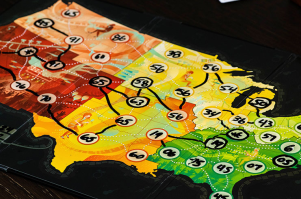
Each turn, a player rolls two ten-sided dice and then each player must simultaneously place the numbers depicted on the dice in a state (if you’re using the United States map) depicted on two of three cards (the cards will have specific states and regions and players may choose whether to use the state or the region). Players do that by drawing on their own game boards with dry erase markers. Once each player’s map is filled, players score points depending on how many states they can travel through starting from lowest to highest number value in sequential order. For example, you can go 5-9-13, but you cannot go 5-13-9.

Players must cut their losses and admit that they will not be able to visit each state (or country on the Europe map). Miss Kitty would’ve struggled with making a route that goes through as many states as possible. She may have frozen before placing each number. But whenever I play On Tour, I’ll name my band (there’s a space for that on the United States side of the map) something that has to do with Rick Springfield. Miss Kitty would listen to Springfield whenever her husband was away and would scramble to hide her teen magazine cutouts whenever he returned home. I may call my next band Working Class Dogs.

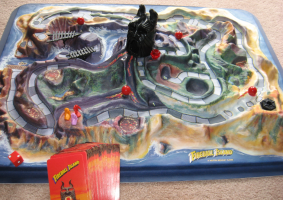
Fireball Island: The Curse of Vul-Kar

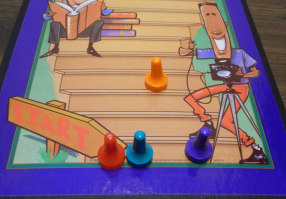
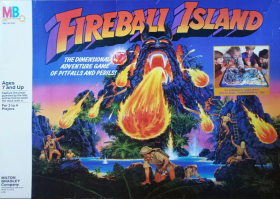
Miss Kitty bought me the original Fireball Island for Christmas one year. I don’t remember if she played the game with me, but she certainly got me the game for the holidays. The original Fireball Island had players race to pick up a gemstone and race back to the finish line with the booty. Fireball Island: The Curse of Vul-Kar improves upon the original. Players take pictures of the island for Instagram (or some other social media), but they can still snag a precious gemstone for extra points.

Fireball Island: The Curse of Vul-Kar reminds me of Miss Kitty, my mom, because I have video of the Christmas when I unwrapped the original Fireball Island. A younger me paced back and forth with the box as Christmas continued. Miss Kitty opened the gift I had bought for her (or I had picked it out for her): Hope perfume. She liked new and unique fragrances, and I had found Hope, which was supposed to change with each person’s body chemistry. It sounded unique. Modern-day Kyra recognizes Hope’s description as a marketing ploy. It was the thought that counts. Anyway, the video shows me geeking out with Fireball Island, while Miss Kitty was geeking out over Hope. Parallel geeking.

The Real Ghostbusters Game

The Real Ghostbusters Game, based on the 80s cartoon series of the same name, reimplements Ghost Castle that released in 1970. It’s a dated game; it doesn’t hold up to modern tabletop game design techniques. But The Real Ghostbusters Game holds a special place.

I brought the game to a kid’s birthday party. Miss Kitty dropped me off at the kid’s house and some time during the drive she shared that my father wondered why I hung out with a loser (the kid whose birthday party I was attending). I told Miss Kitty that even losers needed friends. This was Miss Kitty’s favorite story to share about me and my childhood.

I miss you, Mom. Happy birthday. We’ll play some games for you today.

Let me know of any games that remind you of your loved ones. Or the games you love playing with your loved ones. Or even the games you wish you could’ve played with them. And wherever you are, I hope you’re having a great day.