
Hey, hey, Geekly Gang! Kyra Kyle here. I’m writing this post months in advance (in preparation for writing/editing novels during the final months of 2025), and Geekly doesn’t yet know when Lanterns will release on HBO Max. We only have a release date of First Quarter 2026. It doesn’t matter. Lanterns will feature at least three Green Lanterns (Hal Jordan, John Stewart, and Guy Gardner), so we’re releasing Green Lantern Starter Stories for all three characters over the next few months, just in case you want to get started reading Green Lantern comics. We’re starting with Hal Jordan.
Green Lantern is somewhat of a special case. We’ll be seeing Geoff Johns’s name show up a lot on this list. Johns did a lot for Hal Jordan as a character, but other writers contributed to Jordan’s mythos, so I listed a handful of Johns’s storylines, and then did my best to show some of the other amazing writers who have worked on the character. The result is an extra-long list of Green Lantern (Hal Jordan) starter stories. If you’re lucky, you can find the 2020 Green Lantern one-shot 80th anniversary, Green Lantern: Will. It collects a lot of incredible Green Lantern stories that may or may not have made this list. Let’s get to the stories that did make this list.
Single Issue
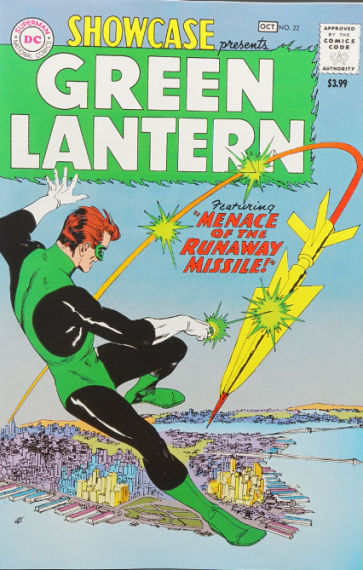
“S.O.S. Green Lantern” (Showcase #22; written by John Broome/art by Gil Kane; October 1959)
Per usual, we begin with Hal Jordan’s first appearance in “S.O.S. Green Lantern.” It’s a simple story. Abin Sur lands on Earth. As the alien lies dying, he commands his Green Lantern ring to find a worthy successor (one who is fearless and strong-willed). The ring finds Hal Jordan. It transports Hal to Abin, and Abin Sur grants Hal Jordan his power as the Green Lantern.
Not going to lie, “S.O.S. Green Lantern” could refer to Hal Jordan’s problematic relationship with Carol Ferris. She rejects his advances (because she needs to prove herself as a worthy successor to her father Carl Ferris, and that she can run Ferris Aircraft), but Hal pushes the issue. You’re coming on a little strong, Hal. Still, “S.O.S. Green Lantern” sets up Hal Jordan as a character, and this origin story has seen few tweaks over the decades. Maybe with less misogyny.
Storyline
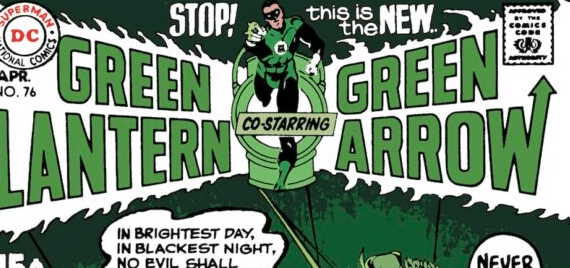
“Green Lantern/Green Arrow” (Green Lantern/Green Arrow #76-89; written by Denny O’Neal and Neal Adams; 1970-1972)
“Green Lantern/Green Arrow” was my first introduction to Hal Jordan as a character. Denny O’Neal’s team-up story revolves around Hal Jordan losing any concept of what being an Earthling is. As a Green Lantern, Hal serves as an intergalactic cop (something we’ll see with Grant Morrison’s take on the character later). Green Arrow serves as a pseudo-Robin Hood. It makes sense, both characters use a bow and arrow. “Green Lantern/Green Arrow” may have done the most to show me the world is nuanced.
The first issue in our collection shows Green Lantern stopping poor people protesting outside a slum lord’s mansion. Green Lantern breaks up the demonstration, only to have Green Arrow tell him he’s misguided. The world isn’t black and white. My favorite moment must be the iconic panel where a poor black man approaches Green Lantern. He says, “I been readin’ about you how you work for the blue skins, and how on a planet someplace you helped out the orange skins, and you done considerable for the purple skins! Only there’s skins you never bothered with, the black skins! I want to know how come? Answer me that, Mr. Green Lantern!”
Hal can’t, but he spends the rest of this series figuring out how he can help the Earth become more equitable.

“Emerald Twilight” (Green Lantern Vol 3 #48-50; written by Ron Marz/art by Bill Willingham, Fred Haynes, and Darryl Banks; 1994)
We go from one iconic Green Lantern storyline to another. “Emerald Twilight” is the storyline where Parallax possesses Hal Jordan and turns him into an ultimate super villain. Hal destroys his home, Coastal City, with a smile on his face. He single-handedly dismantles the Green Lantern Corps. Dozens of familiar faces perish in Hal’s rampage through the universe.
“Emerald Twilight” introduces us to Kyle Raynor as the new Green Lantern. Kyle picks up the pieces and brings honor to the Green Lantern name. After Hal’s actions, can you blame anyone for not trusting anyone with a Green Lantern ring? DC Comics intended to uphold Ron Marz’s vision. Hal snapped. But fan backlash forced the creative team to retcon Hal Jordan being possessed by a separate entity named Parallax, instead of naming himself Parallax. Despite losing some of the story’s original bite, “Emerald Twilight” showed a different side of Hal Jordan, and ultimately, introduced one of Green Lantern’s greatest villains, Parallax.

“Rebirth” (Green Lantern: Rebirth #1-6 and Green Lantern Vol 4 #1-4; written by Geoff Johns; art by Ethan Van Sciver, Jesus Merino, and Carlos Pacheco; 2004-2005)
“Rebirth” is where Geoff Johns made his mark on Green Lantern. The Green Lantern Corps is in a state of disrepair, but Johns fixes Hal Jordan’s backstory. Johns is the one who retconned Parallax as one of the Green Lantern Corps’ greatest enemies. Ironically, Green Lantern: Rebirth did as much to rewrite Hal’s history and keep all the remaining Green Lanterns relevant. Without this story, the Lanterns television show wouldn’t be possible.
Before “Rebirth,” only one Green Lantern was allowed to exist at one time. “Rebirth” changed that. This story turned the Green Lantern character into the Green Lantern Corps.

“Secret Origin” (Green Lantern Vol 4 #29-35; written by Geoff Johns; art by Ivan Reis; 2008)
As the name may suggest, “Secret Origin” recontextualizes Hal Jordan’s origin. You may even decide to skip reading the 1959 issue and read “Secret Origin” instead. “Secret Origins” features one of Hal Jordan’s earliest starts as a Green Lantern. Abin Sur and (modern classic Green Lantern villain) Atrocitus play a role in turning Hal Jordan into the hero we know today.
Not only does “Secret Origin” manage to say something new with Hal’s origin, it sets up the next story on our list, “Blackest Night.” Geoff Johns was on a roll with Hal Jordan and the Green Lantern Corps as characters. This almost decade-long run may be the best Green Lantern run.

“Blackest Night” (Blackest Night Vol 1 #0-8; written by Geoff Johns; art by Ivan Reis; 2009-2010)
“Blackest Night” resurrects Nekron, the Lord of the Unliving, and watches him create the Black Lantern Corps. During Johns’s run of Green Lantern, he established the Emotional Spectrum of the DC Universe. The emotional spectrum, based on colors of the rainbow, added a unique twist. The Black Lantern Corps is an extension of the Emotional Spectrum. The Black Lantern Corps resurrects heroes and villains across the galaxy and consumes their still-beating hearts.
“Blackest Night” combines zombie elements with the Green Lantern mythos. This storyline brought an underused DC Comics villain, Nekron, back into the spotlight. This DC Comics crossover event was epic. It may be one of the greatest crossover events DC Comics has ever seen, and Hal Jordan is at its center.
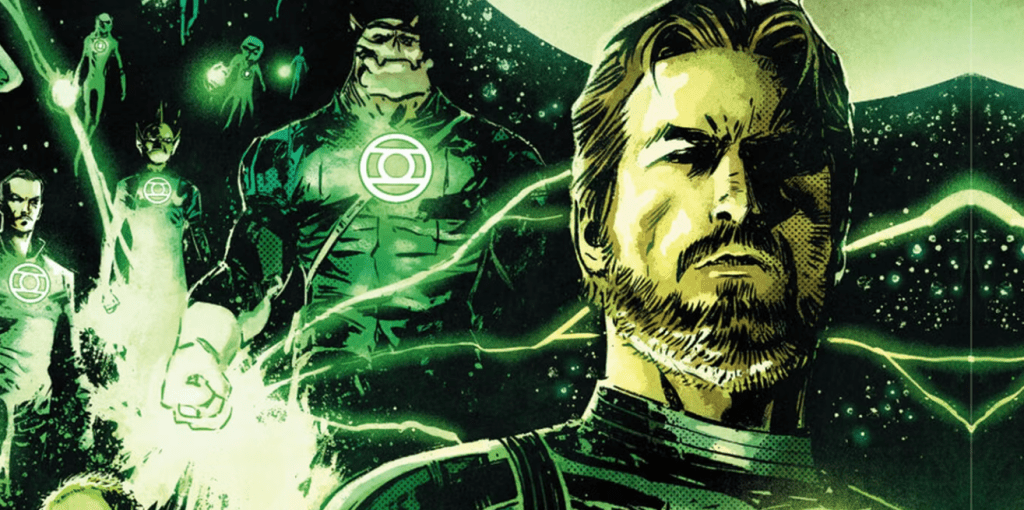
“Green Lantern: Earth One” (Green Lantern: Earth One #1-2; written by Gabriel Hardman and Corinna Bechko; art by Hardman; 2018-2020)
In a world where humans have made their way to space, Hal Jordan is a space miner for Ferris Industries when he runs across a spaceship that changes his life forever. “Green Lantern: Earth One” is a major departure from what we think of Green Lantern. I struggled with including this story in this list, but “Green Lantern: Earth One” is a phenomenal stand-alone story. DC Comics offers plenty of Elseworlds stories (stories that diverge from the main storyline), and “Green Lantern: Earth One” is a must-read. It may be one of the best.
“Green Lantern: Earth One” recasts the Green Lantern Corps in the role of freedom fighters, battling against the more powerful Manhunters (the same ones who would slaughter Atrocitus’s people, leading him to a path of mayhem). The Manhunters have all but conquered the universe. “Green Lantern: Earth One” is a gripping tale from beginning to end. While I can only see elements of this story used in the DCU, it’s worth the read, and with any luck, DC Studios will give us a version of this story.

“Intergalactic Lawmen” (The Green Lantern #1-12; written by Grant Morrison; art by Liam Sharp; 2019-2020)
Writer Grant Morrison has a knack for taking characters in bizarre directions. Handing him the reins of Green Lantern could only lead to some of the craziest Hal Jordan stories. “Intergalactic Lawmen” brings Hal Jordan back to his roots. Jordan travels from case to case (like a space cop), across the multiverse as he takes down criminals, fighting against conspiracies, and taking powerful cosmic threats head-on. Composed of two volumes and an interquel miniseries (of the main Green Lantern line of comics), “Intergalactic Lawmen” is for Green Lantern fans who want cosmic fun.
This Green Lantern universe feels strange in the best ways. “Intergalactic Lawmen” reinvents Hal’s adventures, the Green Lantern Corps, and the planet Oa. Yes, few of the storylines on this list tackle the idea of the Planet Oa (home world and base of operations of the Guardians of the Universe). “Intergalactic Lawmen” pulls away from the rigid rules of the Geoff Johns era. The Green Lantern ring was once again capable of the impossible, like storing an entire universe.
Those are the Hal Jordan Green Lantern stories that made our list. We’ll be covering John Stewart and Guy Gardner’s starter stories in the next two months. Are there any Hal Jordan Green Lantern stories you would add to this list? Let us know in the comments, Geekly Gang. Thank you for reading, and wherever you are, I hope you’re having a great day.





 jkgeekly.com