Tabletop Game Review: Marvel United

Hey, hey! Kyra Kyle here. We haven’t done a tabletop game review in quite some time. We’ll rectify that with a board game review of a game we began writing a guide for Marvel United. Excelsior!

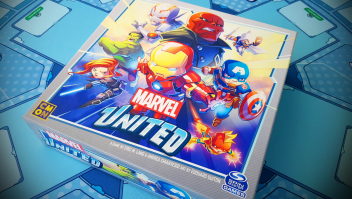
Players act as iconic Marvel heroes who work together to stop the master plan of a powerful villain controlled by the game. Each villain has a unique master plan, cards that trigger various effects, and threats that make clearing locations difficult. Heroes clear missions, making the villain vulnerable, and finally take on the big bad villain before they complete their dastardly plan. Can you save the day in time? Let’s find out with Marvel United.

Before we get any further, we’ll take a side quest and discuss Marvel United’s less heroic details.
The Fiddly Bits

Designer: Andrea Chiarvesio and Eric M. Lang
Publisher: CMON Global Limited and Spin Master Ltd.
Date Released: 2020
Number of Players: 1-4
Age Range: 8 and up
Setup Time: 5-10 minutes
Play Time: 30-40 minutes

Game Mechanisms:

Cooperative Play
Hand Management
Modular Board
Solo / Solitaire Game
Variable Player Powers

Game Flow:

The villain begins the game with a turn. A villain plays their turn by drawing the top card of their master plan deck.

1) The villain moves the number of spaces indicated.
2) Resolve any BAM! Effects (if any) and these effects will be printed on a space within the villain’s dashboard and vary from villain to villain.
3) Then, place the civilian/thug tokens (if any) indicated at the bottom of the card. The target symbol signifies the location where the villain ended their move. Villains usually place tokens on their location or locations adjacent to them.

After all these effects are resolved, the heroes get their turn.

Heroes pick who goes first, and hero turns will continue around the table clockwise. At the beginning of each game, Heroes will get three turns before the villain receives another turn. During their turn, heroes play one card from their hand.

Hero cards are simple.

1) Some cards (three cards in each of the core set hero decks) may have an effect that will exist in a box overlapping the hero’s picture.
2) But all cards have an arrow-shaped box pointing to the right on the bottom. The symbols on the bottom box depict the actions the hero can take that turn.
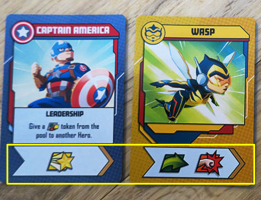
The reason the arrow points to the right is that the next player will play their card to the right of the first player and so on, and the next player gains the symbols/actions on the bottom of the card they played that turn and the previously played card. Marvel United is a cooperative game through in through.

Move Marvel United

So, what do the symbols mean? The Green Arrows are Move actions; the Hero can Move one space for each arrow.

Heroics Marvel United

The Yellow Stars are Heroics actions; Heroics allow Heroes to rescue civilians (if there are any in their location) or help clear Threat cards.

Attack Marvel United

Red Fists give the Hero one Attack, which deals one damage and can be used against the main villain (after they become vulnerable to damage—more on that in a minute), any henchmen like “Bob Agent of Hydra,” or defeat thugs (again if there are any thugs in their location).
Wild Token Marvel United

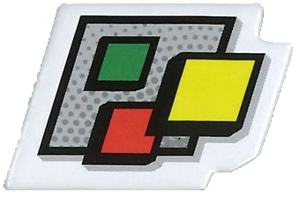
The final symbol with all three colors is a Wild action; Wild actions can be used for Move, Heroics, or Attack. Heroes may resolve the effect (if they played the card on their turn) and any symbols in any order they choose.

Heroes will use these actions to complete missions. The game begins with three missions in play: Defeat Thugs, Rescue Civilians, and Clear Threats. Each mission card will have spaces for the tokens they require to complete. As soon as these spaces are filled, the card is discarded, and the mission is considered complete. Mission cards can be completed in any order.

After the heroes complete the first mission, the villain panics and will act (play a card) every two hero cards instead of every three hero cards. After the heroes complete the second mission, the villain becomes vulnerable to damage. The heroes can complete the third mission, but it isn’t necessary. If the heroes do complete the third mission, each hero immediately draws 1 card, increasing each player’s hand size by one.

Play continues back and forth until either the villain wins (by completing their unique master plan or anyone, heroes or villains, runs out of cards) or the heroes win by dealing enough damage to the villain after the villain becomes vulnerable to damage.

Marvel United Core Set

Review:

Marvel United scratches a similar itch as a game like X-Men: Under Siege. We covered X-Men: Under Siege in a previous review a decade ago (link to the review). Unlike X-Men: Under Siege, Marvel United functions as a board game system rather than a stand-alone game. Any number of intellectual properties can use this same system, which allows for plenty of crossovers. Case in point, CMON ran a DC Heroes United campaign earlier this year. I can see Teenage Mutant Ninja Turtles, Masters of the Universe, Star Wars, and any number of other IPs in the United System’s future.

The system has intuitive rules that allow for quick teaching times. Since Marvel United is a cooperative game, it benefits from even shorter rules explanation. I always feel like I need to teach everyone everything about a competitive game, otherwise I may have an unfair advantage. Players work together in a cooperative game. New players can learn as they go. And I’ve found Marvel United simple to pick up and relearn. The relearn feature becomes more important the older I get. I have so many games that seldom make it off my shelf because I don’t want to relearn the game. Marvel United makes that easy.
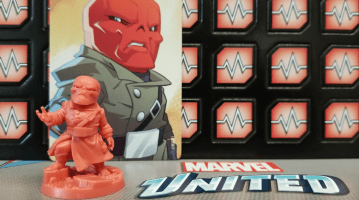
The gameplay itself can be a joy. The first time I played with my oldest daughter, she insisted that we play for hours until we defeated Red Skull. I don’t know why, but Red Skull eeked out a victory time after time. Red Skull is Marvel United’s choice for the first villain new players face first.

Marvel United’s heroes have just enough flavor to let people know who they’re playing, but Marvel United’s villains are the game’s showstoppers. Each villain has a unique flair. Kraven will actively hunt you. That makes sense, he’s a hunter. Ultron tries to win by flooding the field with civilians and thugs, putting these people’s lives in danger. That tracks for Ultron. Green Goblin will do a little bit of kidnapping, toss out dangerous henchmen, and try to throw out more Threats than the heroes can clear. Again, that feels a lot like Green Goblin. Each villain presents a unique challenge.
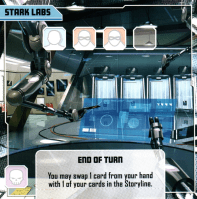
Marvel United incentivizes players to clear Threats. Doing so unlocks “End of Turn” abilities, which can further boost a hero’s power. I like this inclusion. Most expansions will add locations that can help with defeating the villains included in that expansion. Great choice.

The missions work well, too. Depending on the board state and the villain you’re facing, you may want to “Rescue Civilians” and “Clear Threats” or “Clear Threats” and “Defeat Thugs.” This adds to the puzzle of each villain. Some villains will add more civilians than thugs or vice versa and steer the gameplay in that direction. This furthers the uniqueness of each villain. Another great choice.
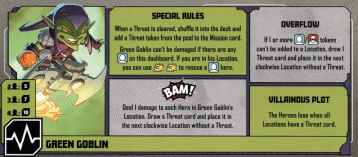
The one minor gripe I have is that not all the villains scale at every player count. Green Goblin is easier to play at 1-2 players and becomes increasingly more difficult the more heroes who join the fight. This should be expected. Marvel United boasts a massive line-up of characters. Hundreds! And even though Green Goblin becomes more difficult at higher player counts, he doesn’t break the game. You’re just less likely to defeat him.

Each Marvel United box includes challenges to spice up the gameplay if it ever becomes a little stale. The core set boxes have generic challenges, but if you pick up any expansion, you’ll find some great alternative ways to play the game. My favorite from the original launch comes from the Tales of Asgard expansion, where players deal out Loyalty Cards, with one of the cards being Traitor. Essentially, one of the players is Loki in disguise. Fantastic and very thematic.
Return of the Sinister Six Marvel United

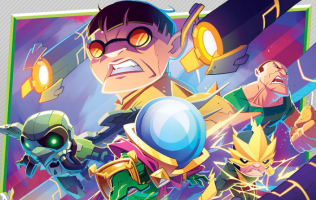
Finally, we come to the issue of expansions. This may be yet another small gripe of mine. CMON hid a lot of the better expansions within Kickstarter Exclusives. That means that you must add them to your pledge on Kickstarter instead of being able to buy the expansion via retail (Amazon, Game Nerdz, Target/Wal-Mart, or your local board game shop). Marvel United started the trend with The Return of the Sinister Six, which was easily the best expansion from the first wave. Marvel United continued that trend with Marvel United: X-Men. X-Men: First Class, Days of Future Past, and Fantastic Four were all Kickstarter Exclusives. CMON has a knack for inducing FOMO (fear of missing out).

That said, you don’t need everything to enjoy Marvel United. You could buy one of the core sets (Original, X-Men, or the newest one Multiverse) and add a few expansions that you can find at retail and have a game you can play for decades. I may or may not have started a spreadsheet of all my games. And I started a guide for Marvel United. You can check out the link here.
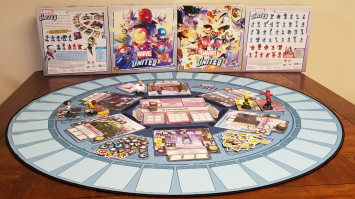
Marvel United Tabletop Game Set Up

Verdict:

Easy to learn, teach, and recall, Marvel United introduces a board game system that will facilitate countless fantastic and future crossovers. The heroes have just enough personality, but the villains steal the show. Each villain feels unique and well worth their puzzle.

3 Lists of 3 Tabletop Games for Miss Kitty

Hey, hey! Kyra Kyle here. I promised something different with this post, so let’s give it a try. Today would be my mom’s 74th birthday. Her name was Catharina Beenen Rackley, but her friends called her Kitty. I wanted to make a 3 Lists of 3 in her honor and had some trouble picking the topic. I could’ve picked music, food, or travel. But we don’t cover those topics on Geekly that often. Miss Kitty also enjoyed television and movies, and those would’ve made good choices. But I decided on tabletop games.

Geekly covers tabletop games, and Mom and I played board games together. She even got a kick out of me designing the occasional game. So, let’s do a 3 Lists of 3 Tabletop Games for Miss Kitty.

Games Miss Kitty Played

Miss Kitty played a lot of different games, and typically, she played games depending on who she had as company. She would play certain games with her children and others with her mother and siblings. And I’m sure she played even more games with her friends. I only have my perspective to go off on here and the accounts of others. Also, we may have more than a few honorable mentions. One cannot boil someone down to a handful of anything, not even board games.

Liverpool Rummy

Liverpool Rummy was a prerequisite whenever visiting Miss Kitty’s family, so this one may be more of a Beenen family pick. But I’m going with it. Miss Kitty and I played Liverpool Rummy a lot. I would go into the gameplay here, but I want to keep the entry short. Perhaps I should cover Liverpool Rummy in a post but it’s a card game using a standard deck.

Each round, players either try to collect sets of cards (at least 3 of the same number) or runs of cards (4 cards in the same suit in sequential numbers). If a player has all the requirements for a round, they can go down (which means revealing their cards with the appropriate number of sets/runs). Once down, players can play cards from their hand onto cards that are “down.” The first player out of cards wins the round and everyone else tallies their score. The lowest score at the end of the game wins.

I picked Liverpool Rummy instead of Wahoo (another Beenen family favorite and a good choice for this selection) because of a moment that happened the first time my wife Jen played with Miss Kitty. Miss Kitty kept saying that she didn’t know why I was so competitive in games. Later that same game, Miss Kitty sported a devilish grin and then bragged as she went out concealed. Jen laughed. Miss Kitty asked her why. Jen said, “I can see why they’re so competitive.”

Balderdash

Another game could’ve taken Balderdash’s place here: Scattegories. In fact, Miss Kitty and I played more Scattegories than Balderdash through the years. Both games are word games and while Miss Kitty would come up with strange answers for Scattegories (“Oreo” or “Knuckle” as forms of sandwiches), Balderdash created more memories.

Balderdash is a game of obscure words. Players must create definitions for words seldom used in the dictionary and gain points for guessing the correct definition or having other players select their invented definition. Miss Kitty worked as a surgical technician. She knew a few things about medicine and used that knowledge liberally in any game of Balderdash. If we heard a definition begin with “a medical term meaning…” or “inflammation of the…” or “a doctor’s tool for,” everyone at the table would turn to look at her. She’d turn beet red and try not to smile. And typically failed. If two “medical” definitions got read, we’d curse our bad luck. Which one’s the real one and which one’s the fake one?

Ticket to Ride

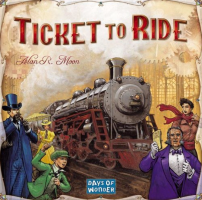
Miss Kitty had a history of set collection games, so of course she’d love Ticket to Ride. The rules are simple to learn and each different flavor of Ticket to Ride would add a wrinkle or two to the core rule set. Ticket to Ride was a perfect game for Miss Kitty. She could play a new game with a few “new rules” and not feel lost. I covered Ticket to Ride some time ago. Here’s a link to the original write-up.

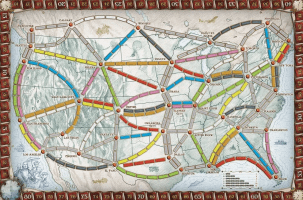
The one game of Ticket to Ride I remember best with Miss Kitty involved her playing with her older brother Paul. Uncle Paul did nothing but build trains on the eastern seaboard. He didn’t complete any tickets. He didn’t do much of anything except block everyone else from building on the eastern coast of the United States. Miss Kitty growled at Uncle Paul. “You’re playing it wrong. Stop playing the game wrong!” I fell out of my seat laughing. It was a window into Miss Kitty’s childhood. This wasn’t the first time she had told off her older brother.

My family and I are currently playing a game of Ticket to Ride Legacy: Legends of the West. This version of Ticket to Ride has a story. Each player assumes the role of a railroad tycoon. The board grows as the railroad gets built from the east coast to the west coast. Hey, Uncle Paul wouldn’t have been playing the game wrong with this version. Anyway, there are four of us playing Ticket to Ride Legacy. When we finish, I intend on dealing out the fifth player stickers (you can place stickers claiming routes and cities for different players and we plan to use the fifth player) for Miss Kitty.

Games Miss Kitty Didn’t Play

This next list is of games are ones Miss Kitty never had the chance to play for one reason or another, but I know she would’ve loved to play them.

Marvel United

I wouldn’t have thought it possible if I didn’t hear this from her myself, but Miss Kitty was more into the Marvel Cinematic Universe than me. Marvel United is a cooperative tabletop game where players assume the role of superheroes in the Marvel universe as they try to stop a supervillain. Like Ticket to Ride, the rules are simple to learn with each hero and villain adding a small wrinkle or two. Since it’s cooperative, Marvel United eliminates competitiveness and players are encouraged to help each other. I just know Miss Kitty would’ve wanted to play out a few of her favorite movies.

And there’s some precedent for this. Miss Kitty and I played X-Men: Under Siege. My father and I played more of this game, but Miss Kitty liked this game, too. Marvel United would’ve scratched a similar itch. And it doesn’t hurt that the miniatures and art have cute designs. Miss Kitty liked cute things.

I haven’t written a review for Marvel United yet, but I started a guide. You can check out the newly posted Guide to Marvel United here.

Flamecraft

Flamecraft is the most complex game on any of these lists so far, but I’m sure Miss Kitty would’ve struggled through a difficult game or two because it’s so cute. And dragons. One of her granddaughters (my niece) is obsessed with dragons or at least she was at one point. Flamecraft uses a game element popular with recent tabletop games. Whenever you take an action that action has a global effect and can benefit your opponent on future turns. This element also makes Flamecraft feel like it’s a winnable game or at least a board game that has closer outcomes.

And did I mention the puns? I can hear Miss Kitty cackling every time I read one of the dragon shops’ names. Either that or I’m hearing my daughter’s same laugh. Critical Rolls. Bizarre Bazaar. Potable Potions. Outback Drakehouse.

Sixes

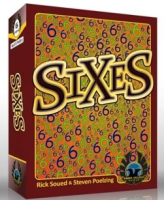
I first played Sixes recently at a party and thought of Miss Kitty. It’s a word game like Scattegories. Sixes plays out in six rounds—naturally. Each round has players making lists of six things that match a category. The twist comes from what players are trying to do each round. Some rounds, you’ll want to have unique answers like Scattegories. Other rounds, you’ll want to match other players. And the third and sixth rounds are lightning rounds where players answer 6 categories with a single answer. The person with the most points wins.

Miss Kitty would’ve loved playing Sixes. It’s a great ice breaker game or a way to reconnect. I found players saying things like “I knew I liked you” or “we think so much alike” whenever they answer a list similarly during a matching round. Of course, there’s the classic Scattegories response whenever you match during a unique round. “We think TOO much alike.” Or “Get out of my head.”

Games that Remind Me of Miss Kitty

This list is more nebulous than the last two. Some may be games Miss Kitty played at one point. Others may be games she would’ve liked to have played but never did. And there are a few games on this list that just remind me of Miss Kitty.

On Tour

During On Tour, Players assume the role of a rock band’s tour manager. Miss Kitty listened to classic rock and pop music. She would’ve loved this premise for a game. But she may have gotten frustrated with the gameplay. On Tour has simple enough rules. The amount of player choice can get overwhelming.

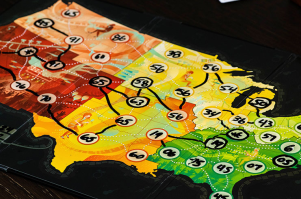
Each turn, a player rolls two ten-sided dice and then each player must simultaneously place the numbers depicted on the dice in a state (if you’re using the United States map) depicted on two of three cards (the cards will have specific states and regions and players may choose whether to use the state or the region). Players do that by drawing on their own game boards with dry erase markers. Once each player’s map is filled, players score points depending on how many states they can travel through starting from lowest to highest number value in sequential order. For example, you can go 5-9-13, but you cannot go 5-13-9.

Players must cut their losses and admit that they will not be able to visit each state (or country on the Europe map). Miss Kitty would’ve struggled with making a route that goes through as many states as possible. She may have frozen before placing each number. But whenever I play On Tour, I’ll name my band (there’s a space for that on the United States side of the map) something that has to do with Rick Springfield. Miss Kitty would listen to Springfield whenever her husband was away and would scramble to hide her teen magazine cutouts whenever he returned home. I may call my next band Working Class Dogs.

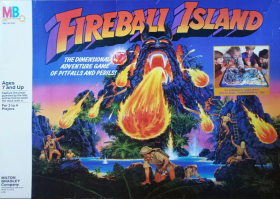
Fireball Island: The Curse of Vul-Kar

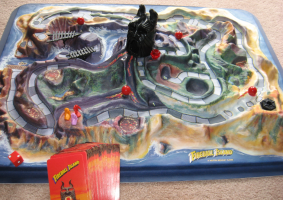
Miss Kitty bought me the original Fireball Island for Christmas one year. I don’t remember if she played the game with me, but she certainly got me the game for the holidays. The original Fireball Island had players race to pick up a gemstone and race back to the finish line with the booty. Fireball Island: The Curse of Vul-Kar improves upon the original. Players take pictures of the island for Instagram (or some other social media), but they can still snag a precious gemstone for extra points.

Fireball Island: The Curse of Vul-Kar reminds me of Miss Kitty, my mom, because I have video of the Christmas when I unwrapped the original Fireball Island. A younger me paced back and forth with the box as Christmas continued. Miss Kitty opened the gift I had bought for her (or I had picked it out for her): Hope perfume. She liked new and unique fragrances, and I had found Hope, which was supposed to change with each person’s body chemistry. It sounded unique. Modern-day Kyra recognizes Hope’s description as a marketing ploy. It was the thought that counts. Anyway, the video shows me geeking out with Fireball Island, while Miss Kitty was geeking out over Hope. Parallel geeking.

The Real Ghostbusters Game

The Real Ghostbusters Game, based on the 80s cartoon series of the same name, reimplements Ghost Castle that released in 1970. It’s a dated game; it doesn’t hold up to modern tabletop game design techniques. But The Real Ghostbusters Game holds a special place.

I brought the game to a kid’s birthday party. Miss Kitty dropped me off at the kid’s house and some time during the drive she shared that my father wondered why I hung out with a loser (the kid whose birthday party I was attending). I told Miss Kitty that even losers needed friends. This was Miss Kitty’s favorite story to share about me and my childhood.

I miss you, Mom. Happy birthday. We’ll play some games for you today.

Let me know of any games that remind you of your loved ones. Or the games you love playing with your loved ones. Or even the games you wish you could’ve played with them. And wherever you are, I hope you’re having a great day.