

Hey, hey! Kyra Kyle here. Back with another Top 5 Tabletop Games. 1988 and 1989 may not have as many top-notch games as our previous list, but there are plenty of culturally relevant games from these two years. We’ll talk about board games soon, but first, if you’ve forgotten our criteria for the Top 5 Tabletop Games, let’s reiterate the ground rules before we start.
1: Cultural relevance plays as much of a factor as overall quality. A game might make a list that doesn’t hold up to others of its type, but you must admit the game is everywhere.
2: Only one game from a franchise makes the list. This will become more of an issue the closer we get to games with expansions.
3: Longevity plays a role, too. A game doesn’t have to fly off the shelves today, but it had to have some widespread appeal for a decent time.

5: Merchant of Venus (1988)
Merchant of Venus is a pun on the Shakespeare play Merchant of Venice. Despite the name, the planet Venus doesn’t appear in the game. Merchant of Venus is set in an unexplored part of the galaxy. Players take on the roles of galactic traders. They move around the board, buying and selling goods. The game begins with players discovering the identity of the cultures in fourteen solar systems available for trade. They often find valuable artifacts from an earlier period of civilization. Once the board has been revealed, the game focuses on moving goods from cultures that build to other races that demand goods.
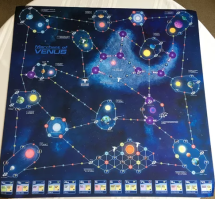
Merchant of Venus’s turn from exploration to commerce can be a satisfying volta. It reminds me of other games like 2004’s Betrayal on House on the Hill and 2007’s Galaxy Trucker. Both games might also make their year’s respective lists. While it can run a little long (2 to 6 hours), Merchant of Venus can be a lot of fun.
4: Taboo (1989)
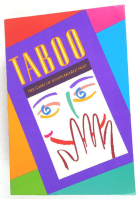
Taboo works a lot like a team-based version of the Ten Thousand Dollar Pyramid game show. It’s played by two even-numbered teams from four to ten. Players sit in alternating teams, forming a circle. One player takes the role of “giver,” who gives their teammates clue words. The “giver” attempts to get their teammates to guess the word printed on the card, but there are “taboo” words. These are words the “giver” can’t say.

While the “giver” can’t say those taboo words, their teammates can make as many guesses as they want with no penalties for wrong guesses. Once the team correctly guesses the word exactly as written on the card, the “giver” moves on to the next word. Teams try to get as many words on a card before time runs out. The playing team gets one point for each correct guess and loses a point each time the “giver” says a “taboo” word. I never liked the buzzer for Taboo. The other team hovers over the “giver” with the buzzer in hand and the obnoxious buzzer they wielded gives me nightmares. Nightmares!
3: Mall Madness (1988)
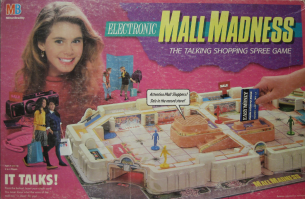
Mall Madness has a simple but fun concept: finish your shopping spree before anyone else. It doesn’t hurt that the game has a 3D board, and the original (back in 1988) had a computer that would dole out player movement and could even keep track of money. The 80s game even came with four different credit cards in addition to traditional paper money.
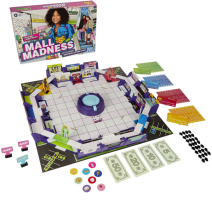
Players didn’t have to move by exact count to enter each shop, and once you bought something from a shop, you couldn’t reenter the same shop. Mark off the items on our list using plastic pegs in a punch board, and as soon as you’ve bought your six items, race to your parking space. I didn’t play too much of Mall Madness when it was first released. My parents didn’t care for the premise (they didn’t want us kids learning too soon about credit cards), but Mall Madness has left an indelible mark on the board game industry. It’s been in print steadily since its release and has had plenty of themed variants like Hannah Montana and Littlest Pet Shop.
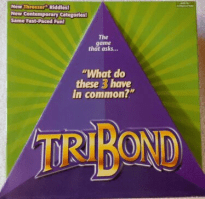
2: TriBond (1989)
We have a second word game for this list, TriBond. But TriBond does something a little different. The game’s main feature is the TriBond “Threezer,” an invented word by the producer to describe the three-word clues players must analyze and determine what all three clues have in common. So, you may get a set of three clues like “Olive, Forest, and Kelly.” They’re all shades of green. Or you may get another set of clues like “Tootsie, Hook, and Rain Man.” All Dustin Hoffman movies.
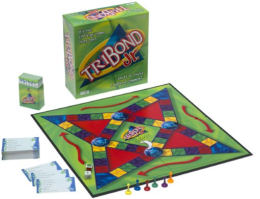
TriBond adds a little bit of lateral thinking to the classic word game. While I think the word “Threezer” is a bit much, the concept is a great one. And I like the idea that a player can “challenge” another player ahead of them in one of the board’s three tracks. TriBond uses dice, one to determine how far you’ll move on one of three tracks and another to determine your questions category (Entertainment, Sports and Recreation, Academics, and Miscellaneous). The “challenge” allows players to take some of the random luck out of the classic rolls, spin, and move.
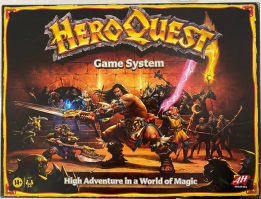
1: HeroQuest (1989)
I have so many fond memories of HeroQuest. HeroQuest plays like a stripped-down version of Dungeons & Dragons. One player assumes the role of the evil wizard Zargon/Morcar. They use the map taken from the game’s quest book to run the game. The remaining players select their character from the four available.

I was a tween when HeroQuest was first released, and since I read the rules, I ran the game as Zargon. That was my first taste of being a dungeon master and D&D. Even though I have great memories of HeroQuest, it is a game for newcomers. Its adventures are pre-programmed and lack the creative impulses of a D&D game, but HeroQuest has a massive toy factor and does an amazing job of distilling the essence of D&D into a digestible, approachable game for younger players. HeroQuest serves as a great gateway into tabletop role-playing games. Fortunately, it’s received a received a reprint.
Did we get the list right, for the most part? Let us know which games you’d add in the comments. And wherever you are, I hope you’re having a great day.
Check out the other lists in this series:
Top 5 Tabletop Games Prior to the 1930s
Top 5 Tabletop Games of the 1930s
Top 5 Tabletop Games of the 1940s-50s
Top 5 Tabletop Games from the Early 1960s
Top 5 Tabletop Games from the Late 1960s
Top 5 Tabletop Games from the Early 1970s
Top 5 Tabletop Games from 1980-1981
Top 5 Tabletop Games from 1982-1983
Top 5 Tabletop Games from 1984-1985
Top 5 Tabletop Games from 1986-1987
Top 5 Tabletop Games from 1990-1991
 jkgeekly.com