

Marvel United has copious amounts of expansions. It’s a CMON Games Kickstarter using the Marvel intellectual property. That’s bound to happen. Geekly won’t be covering every Marvel United expansion, but we will review the ones worth your time or the ones we believe people will most likely purchase. So, you could consider the Marvel United expansions we cover as ones you may want on your radar.
Hey, hey! Kyra Kyle here. In Marvel United, players act as iconic Marvel heroes who work together to stop the master plan of a powerful villain controlled by the game. Each villain has a unique master plan, cards that trigger various effects, and threats that make clearing locations difficult. Heroes clear missions, making the villain vulnerable, and finally take on the big bad villain before they complete their dastardly plan. Can you save the day in time? Enter the Spider-Verse puts players in the spandex of famous characters of the Spider-Man universe.
Before we get any further, we’ll take a side quest and discuss Enter the Spider-Verse’s less heroic details.
The Fiddly Bits
Designer: Andrea Chiarvesio and Eric M. Lang
Publisher: CMON Global Limited and Spin Master Ltd.
Date Released: 2021
Number of Players: 1-4
Age Range: 8 and up
Setup Time: 5-10 minutes
Play Time: 30-40 minutes
Game Mechanisms
Cooperative Play
Hand Management
Modular Board
Solo / Solitaire Game
Variable Player Powers
Game Setup
We already covered the Game Setup and Game Flow in our Marvel United review (here’s a link to that review), so we’ll go over the basics in the following two sections. Let’s cover an abbreviated review of the game setup and rules.
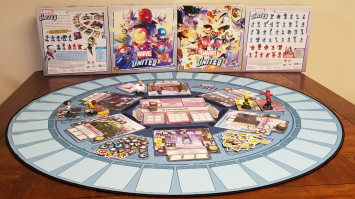
Marvel United’s setup can change depending on which Villain and Heroes you choose to play. Each game consists of six locations. Typically, core sets have eight locations. Since Enter the Spider-Verse is an expansion, it only has six. You may choose your locations or shuffle them and choose six at random. Each Location card has spaces at the top for civilians and thugs and a rectangle with a block of text that will state “End of Turn” at the top of the box.

Place civilian/thug tokens on their matching spaces. Shuffle the Villain’s Threat deck and deal out each Threat face-up so that it covers the rectangle at the bottom of each location. You must clear this threat before gaining the “End of Turn” effect printed on a Location. Place health tokens where signified on threat cards and on the Villain dashboard. Place the three mission cards (Defeat Thugs, Rescue Civilians, and Clear Threats) face up under the villain dashboard where the text reads “Unlocked.”
Each player shuffles their hero decks and then draws three cards to form their hands. Shuffle the Villain’s Master Plan deck. Leave the Master Plan deck face down. This will be the villain’s draw pile.
Players place their miniatures on one of the six location cards, usually the centralmost location for each player (easy access). Then, they place the villain on the location card opposing the heroes.

Game Flow
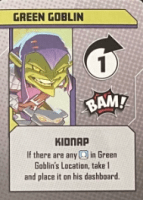
The villain(s) play first. Draw the top card of their master plan deck. The villain moves the number of spaces indicated. Resolve any BAM! Effects and these effects will be printed on a space within the villain’s dashboard. Then, place the civilian/thug tokens (if any) indicated at the bottom of the card. After all these effects are resolved, the heroes get their turn.
Heroes pick who goes first, and hero turns will continue around the table clockwise. At the beginning of each game, Heroes will get three turns before the villain receives another turn. During their turn, heroes play one card from their hand.
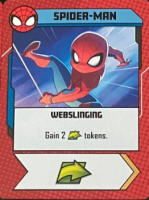
Resolve actions and the symbols printed at the bottom of the hero’s card in any order. The symbols at the bottom of a hero’s card will be shared with the next player, but any printed action will not be shared. Heroes will use these actions to complete missions. The game begins with three missions in play: Defeat Thugs, Rescue Civilians, and Clear Threats. Each mission card will have spaces for the tokens they require to complete. As soon as these spaces are filled, the card is discarded, and the mission is considered complete. Mission cards can be completed in any order.

After the heroes complete the first mission, the villain panics and will act (play a card) every two hero cards instead of every three hero cards. After the heroes complete the second mission, the villain becomes vulnerable to damage. The heroes can complete the third mission, but it isn’t necessary. If the heroes do complete the third mission, each hero immediately draws 1 card, increasing each player’s hand size by one.
Play continues back and forth until either the villain wins (by completing their unique master plan or anyone, heroes or villains, runs out of cards) or the heroes win by dealing enough damage to the villain after the villain becomes vulnerable to damage.
Review
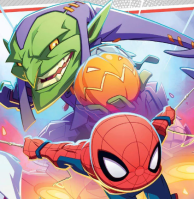
Enter the Spider-Verse features a lot of fan-favorite characters (Spider-Man, Green Goblin, and Miles Morales). Since that’s the case, it’ll be one of the first expansions players will purchase. And it’s a great choice.

Let’s begin with the heroes. Spider-Man has a lot of potential token gain. I don’t know how many times I saved the day by playing Spider-Man. Seriously, I may have completed most of the games in my guides (here’s a link to Geekly’s Marvel United guides) with Spider-Man. Frankly, he’s a broken character. Broken in the best possible way. I’ve easily played Spider-Man more than any other character in Marvel United. He’s Spider-Man. It’s great that Marvel United made him a character you can return to again and again.
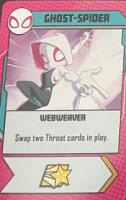

Ghost-Spider and Miles Morales may have more niche abilities, but given the right circumstances, they can be deadly. Ghost-Spider can swap in-play Threat cards (which could be nice for an ongoing ability), and she can defeat all Thugs in her location. Miles Morales’ strongest ability “Web” allows him to delay the Villain Turn by one card. “Web” is a more universal use. Miles may be my second-most played character. Then, there’s Spider-Ham. He’s a Kickstarter Exclusive and that’s okay. He stinks. Good news though. It’s okay if you purchase the retail version over the Kickstarter version. Spider-Ham’s inclusion is the only difference between the two versions, and you’re not missing much with Spider-Ham. Unless you’re a completist or you like Spider-Ham, buy the retail version of Enter the Spider-Verse.
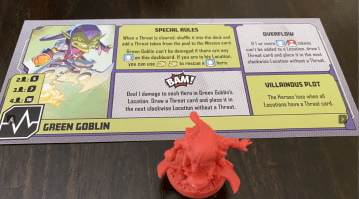
Enter the Spider-Verse’s sole villain Green Goblin is notoriously difficult to beat. I’ve only ever beaten Green Goblin by playing heroes and locations from the Enter the Spider-Verse expansion. Green Goblin has a special setup than the one above. Players don’t begin the game with threat cards in play on locations. Green Goblin will add them as he goes along, and he wins if each location has a threat card. This can lead to players clearing a particularly nasty threat card, like “Electro” or “Using Civilians as Shield,” and Green Goblin putting those cards back in play.
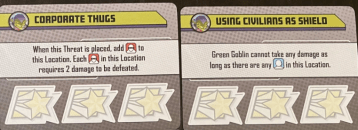
Even though Green Goblin wants to flood the field with threats, he’s just as comfortable throwing obstacles in the way to wait out the clock. “Using Civilians as Shield’s” ability is that Green Goblin will not take any damage as long as there are any Civilians at its location. “Corporate Thugs” make thugs more difficult to defeat. Green Goblin is a classic case of a villain who has multiple ways to defeat his enemies. The best way to stop Green Goblin is to load up on tokens, manipulate the villain deck, and delay the villain’s turn if you can. Fortunately, there are two heroes, and one location included in Enter the Spider-Verse expansion that do just that. Green Goblin earns his reputation as one of the initial Marvel United’s most difficult villains.

The new locations are classic Marvel New York ones. Brooklyn Bridge, Queens, the Daily Bugle, Oscorp Tower. These locations focus on extra tokens. This can be crucial in defeating certain Marvel United villains. Enter the Spider-Verse’s Green Goblin is one of these villains. The other three locations have healing (always appreciated), potentially rescuing a Civilian for free (always good for completing mission cards), and manipulating the villain deck. Couple these abilities with the heroes included in Enter the Spider-Verse, and you can see why this expansion tilts the playing field toward the heroes.

Each expansion adds a challenge card. Challenge cards add an extra layer of complexity to the game. Challenge cards may be small additions, but they can keep the game fresh with an extra rule or two added to the base game. Enter the Spider-Verse introduces the “Secret Identity Challenge.” This is a classic challenge to add to any Marvel United game. Players must balance their crime-fighting life with their lives spent outside of spandex. This challenge is thematic, easy to understand, and adds just enough additional difficulty.

Verdict
Even though I wouldn’t bother with finding the Kickstarter version unless you’re a completionist or a Spider-Ham fan, Enter the Spider-Verse is worth including in your Marvel United collection. The heroes and villain are some of the most powerful. The locations are iconic and pack a punch. And the Challenge Card adds a much-needed twist.
 jkgeekly.com