Cozy Video Game Review: Dorfromantik

Inspired by tile-laying board games, Dorfromantik offers the relaxing gameplay of creating a pastoral landscape of trees, villages, water, railroads, and fields. Designed by four German and Swiss students (Timo Falcke, Sandro Heuberger, Luca Langenberg, and Zwi Zausch) in a game design master’s program at HTW Berlin, Dorfromantik is a peaceful, minimalist game that lives up to the title, cozy. Hey, hey! Kyra Kyle here. We’re back with another cozy video game review. Even though Dorfromantik has crossed over into an award-winning board game, we’ll be discussing the equally stellar indie video game by Toukana Interactive. Get ready to build a gorgeous landscape with Dorfromantik.

Mechanisms

Game Mechanisms: 7/10

Dorfromantik takes a simple concept of tile laying and does it exceptionally well. I’d wager the idea of Dorfromantik stemmed from playing board games like Carcassonne. Dorfromantik’s game mechanisms lend themselves well to board games, so there is an excellent, cooperative board game by the same name. Sometimes, you don’t need an elaborate set of mechanisms to make a game sing. Sometimes, you just need to do a simple concept well, and Dorfromantik does just that.
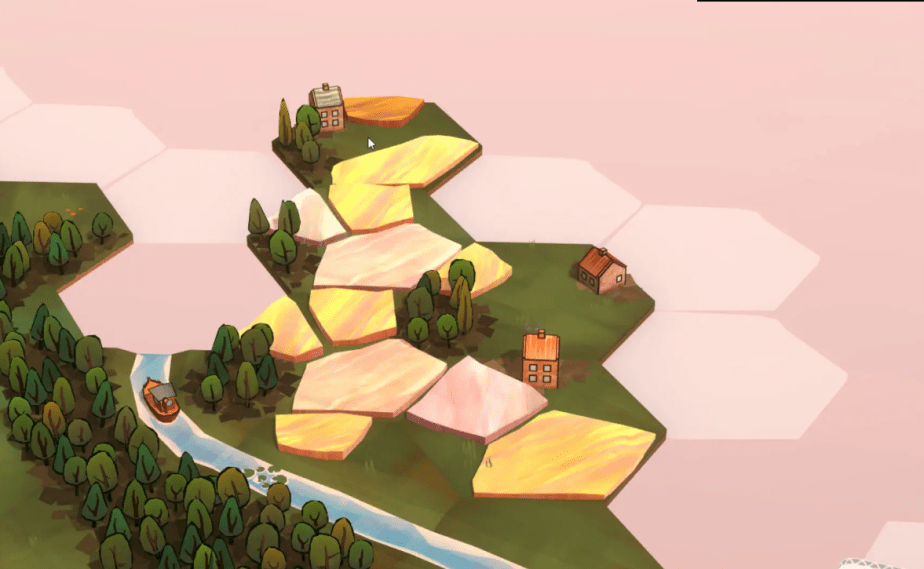
Chain similar land types with each other to gain points and finish goals (that the game presents) to score even more points and to increase the number of tiles you have to draw from. Dorfromantik can be played competitively–there is a leaderboard–or you could watch the countryside bloom as you place tiles. Dorfromantik‘s ability to make me invested in a landscape reminds me of another cozy video game we covered, Terra Nil.
Gameplay Loop: 9/10

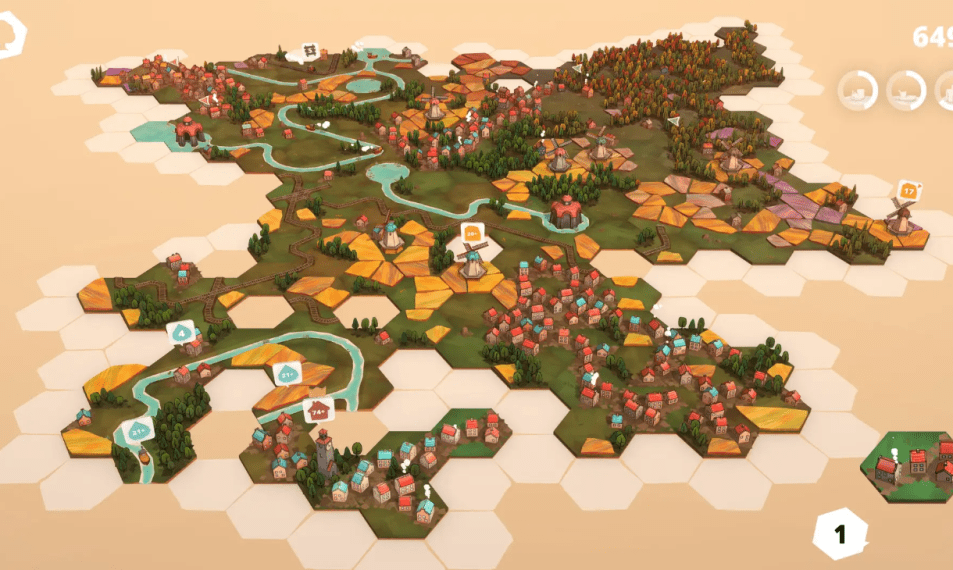
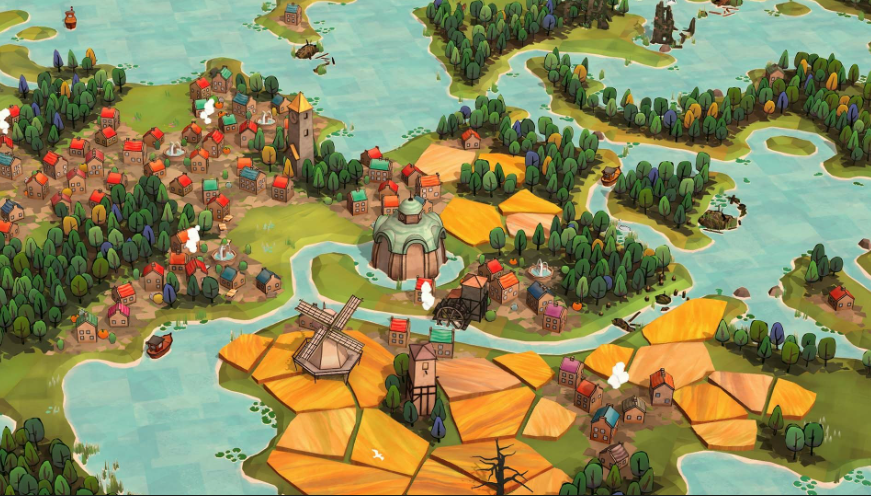
Whether you play Dorfromantik to get the highest score possible or casually place tiles and find your Zen, you can’t deny Dorfromantik’s gameplay loop. Once you get started, you won’t build just one pastoral scene. You’ll want to go farther with your next run, reveal new tiles like the windmill (pictured above), or watch your boats and trains traverse the landscape. And yes, the scene above is animated. It’s so neat watching your creation come to life.

Because the tiles can come out in different orders, no two scenes in Dorfromantik are exactly the same. This adds spice to the simplistic gameplay. Dorfromantik is an easy game to get into, but a difficult one to master if you want to climb that leaderboard. Or you could be like me. I just want to discover new tiles and watch my landscape get bigger and more diverse. I’m so glad Dorfromantik has been ported over to the Switch. It’s the perfect game to play on the go.

Story or Narrative

Narrative/Storytelling: 1/10

I should’ve excluded this element, but I didn’t with other video games that had little to no story, so narrative/storytelling is staying in the lineup. Let us know what you’d replace this element with for games that have little to no story. Dorfromantik has no story to speak of, so it receives a low mark in this category.

User Interface: 10/10

Dorfromantik has a stripped-down but effective user interface. The tiles feel great to manipulate. They almost feel like placing a board game’s tiles. The picture above shows how Dorfromantik will highlight the spaces where a tile can be placed. Gamers can only place the tile on top of the draw pile. Dorfromantik does an excellent job of not only showing where a tile can be placed, the callouts show where you can gain extra points, and whenever you hover a tile over a space and begin rotating it, Dorfromantik will make the matching tiles shimmer.

Dorfromantik’s elegant and minimalistic user interface makes it accessible. Like I said, Dorfromantik may use a familiar board game mechanism in tile placement, but every element Dorfromantik adds is handled with care and purpose. I had to give Dorfromantik top marks for user interface.
Graphics: 8/10

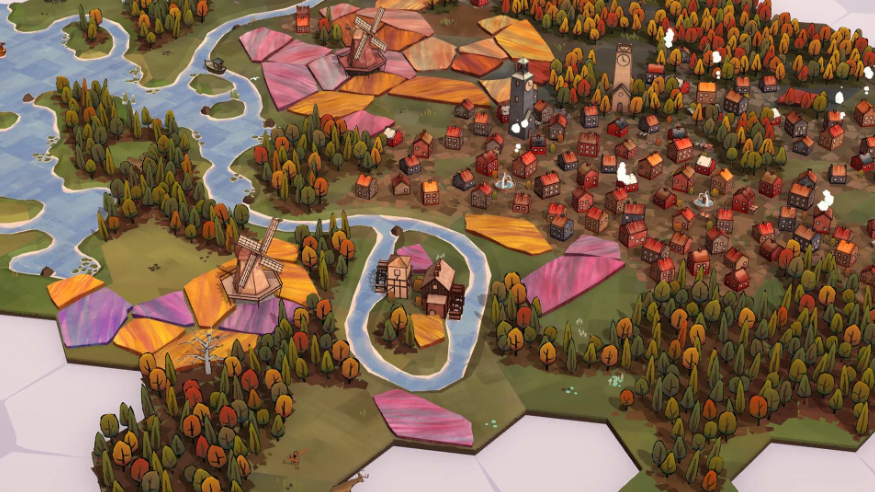
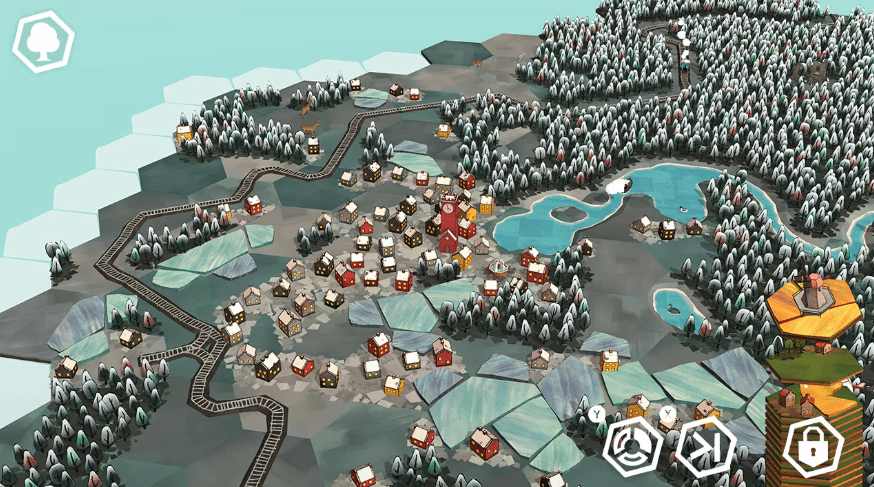
Dorfromantik has excellent graphics for a top-down isometric video game. The art style works well, and I appreciate the small details. Look at the clock towers, cottages, and windmills in the image above. Like I mentioned before, Dorfromantik uses small animations to denote movement. The boats (if you’ve unlocked the boats) move along the waterways. Smoke puffs from chimneys. While all of this is great, Dorfromantik does venture into cartoony graphics.

These cartoony graphics work well when one zooms out and sees more of the landscape, so I understand why Dorfromantik chose a minimalistic, cartoon-like art style. Players are meant to take a macro view of their village. But I dock Dorfromantik a point or two for graphics because the game doesn’t quite hold up on closer inspection.
Audio: 7/10

Dorfromantik’s music exudes the concept of a cozy game. I’ve listened to Dorfromantik’s soundtrack to fall asleep. It’s that soothing. Unfortunately, the game’s sound effects detract from this calm. The clacking and clicking of the tiles often takes me out of the game’s vibe. I would’ve preferred more pastoral sound effects accompanying the mechanical sounds of turning and placing tiles on the board. Yes, I could reduce the sound effects’ volume or turn them off altogether, but that would eliminate half of Dorfromantik’s audio. We’re grading the game’s entire audio. If we were only grading Dorfromantik’s soundtrack, its audio would score much higher.
Replay Factor: 10/10

Dorfromantik has an addictive gameplay loop, so the replay factor is through the roof. I can see myself playing Dorfromantik on my Switch while waiting in line. Heck, I’m surprised Dorfromantik hasn’t yet made it to the mobile game space. I could see plenty of people playing Dorfromantik on their phones. It may be an even better game for smartphones. The Switch tends to be a game’s first foray into mobile gaming. Fingers crossed that this cozy game classic makes it onto more mobile devices.

Aggregated Score: 8.6

Sure, I gave Dorfromantik a story/narrative score, but I’m not including that score with its aggregated score. Sometimes you need a cozy video game to find your Zen. Dorfromantik is a great game for that. I’m hoping more gamers will have the opportunity to play Dorfromantik on other platforms soon.
Cozy Video Game Review: Terra Nil

Terra Nil flips the city/civilization builder on its head. The world has been sapped of its resources, and it’s up to the player to return the world to its former lush landscapes, complete with wildlife, and then leave without a trace, allowing life to begin anew. Can you bring the world back to life Hey, hey! Kyra Kyle here. Today’s cozy video game is Terra Nil. I wish listed this one on Steam when its demo dropped, and then forgot about it. It wasn’t until Terra Nil popped up on Netflix, of all places, that I tried the full game. Terra Nil doesn’t have much of a story, so I’ll merge those two elements. Let’s see how Terra Nil rates on our review criteria.

Game Mechanisms: 9/10

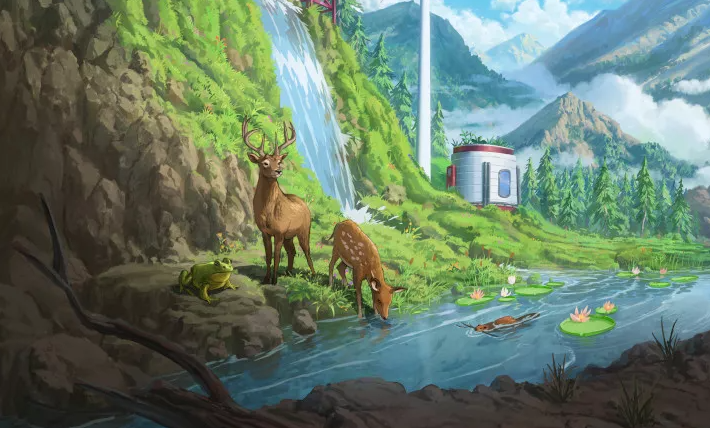
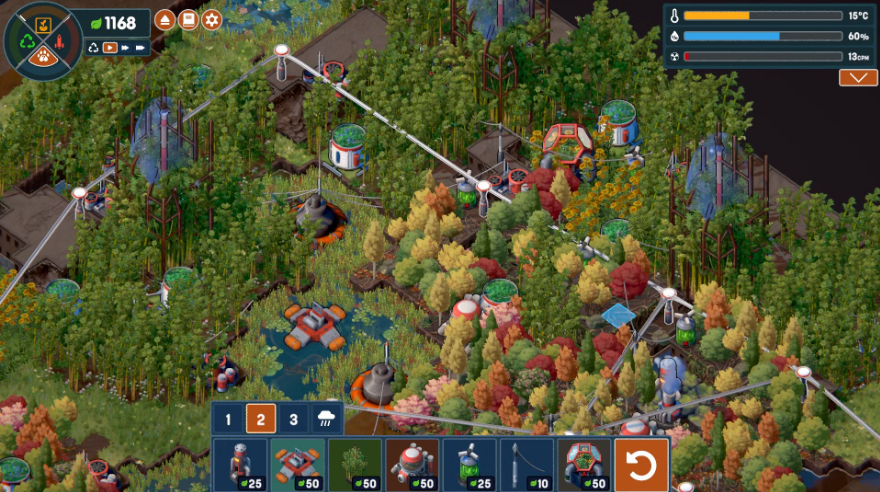
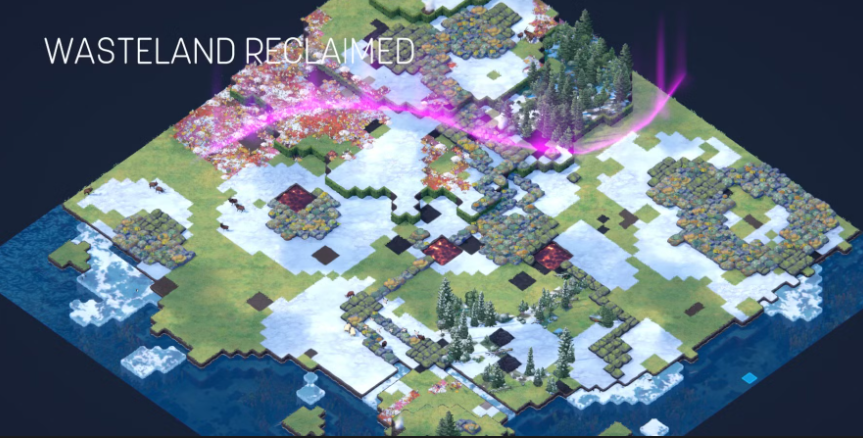
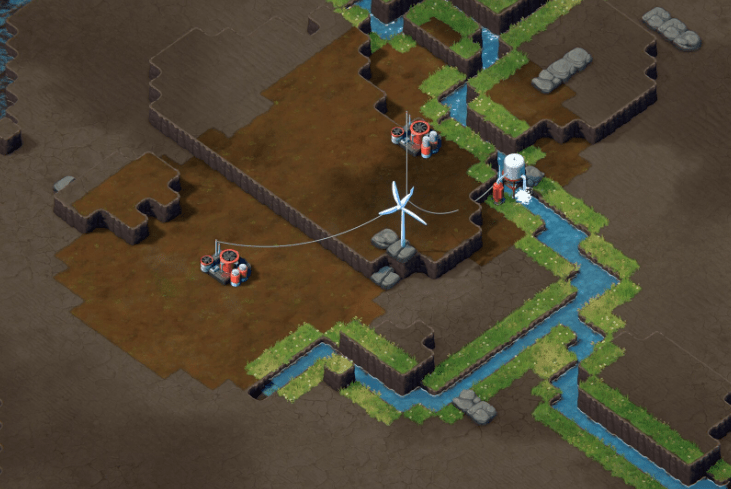
Like I said in the introduction, Terra Nil deconstructs the city/civilization builder video game genre. Players start with a barren wasteland (similar to the picture above), and they must clean the (nuclear?) waste with items like scrubbers and then replenish the Earth using various gadgets like propagators, seeders, and hydroponics. Each stage of Terra Nil plays out like an elaborate puzzle. Depending on the climate you’re trying to achieve, you may need to lower or raise the region’s temperature. Balance between biomes is crucial, and you can monitor animals and the animals’ desires when they return.

This game loop is satisfying and familiar. For being the opposite of a city builder, Terra Nil uses plenty of city builder game tropes. This makes the game easier to get into, even if what you’re doing is the exact opposite of a city builder. Finding the right balance between biomes gets tricky–Who am I kidding? It can be rage-inducing. I lost count of the number of times I was off on a certain biome and had to add an acorn to a tree to create more forest, or I had to burn more green area with a solar panel incinerator. Ugh!

And just when you’ve almost figured out how one region works, Terra Nil will add a twist like adding tundra and lava floes to the mix. I binged Terra Nil on Steam and Netflix (I still can’t get over how Netflix has a video game of Terra Nil’s caliber), and it only took about forty or fifty hours to complete the game. There was a lot of trial and error. Terra Nil’s tutorial level teaches the basics, but you’re on your own after that level, and I got stuck. A lot. But Terra Nil made getting stuck fun.

Gameplay Loop

Above Image from GameDesigning.Org

Gameplay Loop: 7/10

The frustration Terra Nil can create at higher levels keeps the Gameplay Loop score from claiming top honors, but outside of that, it’s fantastic. Terra Nil shuffles the gameplay enough to keep gamers on their toes for a good forty to fifty hours. Later levels combine elements of former levels in intriguing ways, building a super puzzle. Unlocking as many animals as you can for each region is a mini-game unto itself. I forget how many times I was rooting for a frog or otter to populate.

Terra Nil is a good, chill time. I would crank up the sound effects to hear the sounds of the forests, streams, and lakes. Perhaps Terra Nil is a new way to Netflix and chill.

Story or Narrative

Narrative/Storytelling: 3/10

Because Terra Nil doesn’t have much of a story, I’m lumping Narrative and Storytelling into one element. Despite being mostly a straightforward building a green space game, Terra Nil’s premise suggests a greater story. That keeps this score from being any lower than a three. Terra Nil gives hints to what happened to the planet and drives home the idea that humans should be stewards of the environment.

User Interface: 7/10

Terra Nil’s volume of information causes the game to falter with its user interface. Despite an easy-to-navigate heads-up display and well-crafted menus, I got lost in Terra Nil’s mountains of options and data I needed to parse. The game does a good job of easing players into its cavernous menus at first, but after the first three regions, you’re thrown to the wolves. Good luck.

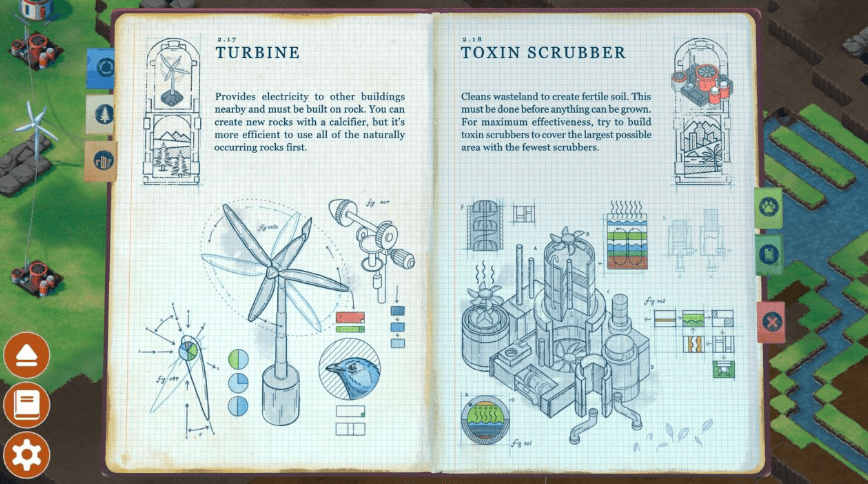
Terra Nil offers a detailed rulebook with phenomenal detail. I would flip through this rulebook even if I weren’t lost on what to do. The page above does a great job of showing and telling gamers how a turbine and a toxin scrubber work. I love Terra Nil’s attention to detail.

Graphics: 8/10

For what it is (a city builder game where you’re not building a city), Terra Nil’s graphics are on point. Despite how pretty Terra Nil can be, it still uses an isometric, top-down view of the environment. Sure, there’s an option to view your creation at the ground level, and that’s fun, but Terra Nil’s graphics stop shy of top marks.

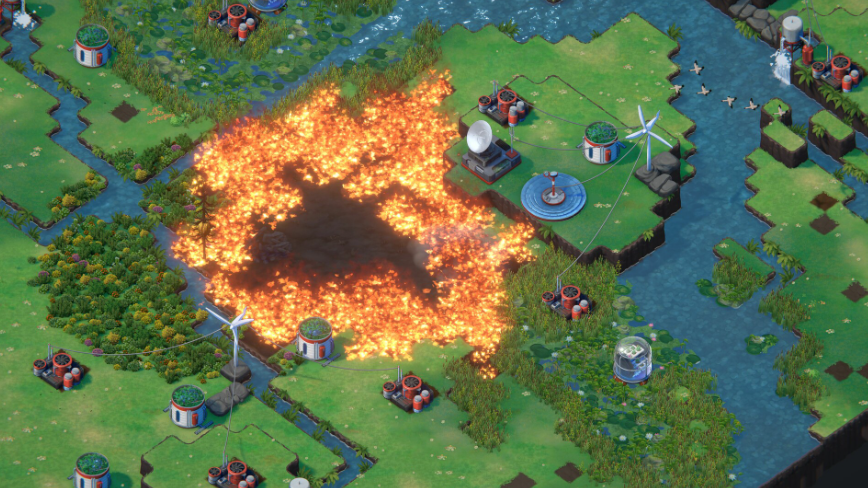
Terra Nil pours in a lot of detail. The geese in the picture above are geese who reinhabited the area. If you look closely at wetlands, you can spot a frog hopping. You can find deer, bears, and wolves roaming the forests and mountains. You don’t even need to zoom in at the ground level, even though I love doing this after I finish a region. Terra Nil works as an interactive background. It’s soothing, cozy.

Audio: 10/10

Terra Nil is one of the few games I will always play with the sound. While the game’s soundtrack is relaxing and memorable in its own way, the sound effects of the environment give Terra Nil a high score. Even the noises the gadgets (like the scrubbers and terraformers) make satisfy. Putting down a ditch borer and listening to it create a future river feels great. The crackling of fire as it makes way for new growth makes me smile.

Terra Nil spares no expense with its audio effects. From the animals to the wind and snow, I’ve spent hours listening to one of my regions, trying to pinpoint which sounds I’m hearing. In short, Terra Nil may have some of the best sound editing I’ve ever heard in a video game.

Replay Factor: 7/10

Even though Terra Nil plays like a puzzle, it’s one of those games I can see replaying after multiple months or years have passed. It won’t take long for me to forget how to complete each region. In fact, I played Terra Nil within the last couple of months, and I’m pretty sure it would take me a couple of playthroughs before remembering how each gadget works and when best to use them. Terra Nil also includes scenarios, variable difficulties, and each region is randomly generated during each playthrough. That last point alone gives Terra Nil better than average replay value. I enjoyed my time with Terra Nil and look forward to playing it again.

Aggregated Score: 8

Even though I gave Terra Nil a story/narrative score, I’m omitting that score from its aggregated score. Terra Nil offers dozens of hours of calming gameplay. It functions like an interactive desktop background. I’m shocked Netflix picked up the rights to Terra Nil. Perhaps this is a sign of things to come for the streaming giant.