

You’ll want to shed your hand of cards quicker than anyone else in L.L.A.M.A. The Card Game, but you might not be able to play what you want. Strategic quitting, which freezes the cards in your hand, may be the key to victory in this silly, engaging (German Game of the Year) Spiel des Jahres-nominated game. Don’t get stuck with a llama!
Hey, hey! Kyra Kyle here. I mentioned L.L.A.M.A. The Card Game in a previous Whatcha Playing post and figured we should cover the game with a full review. I’m unsure if we’ll continue doing this with future board game reviews, but I’ve played a lot of L.L.A.M.A. The Card Game (also known as Don’t L.L.A.M.A. The Card Game) in the past several months. Board game design legend Reiner Knizia made another rules-light, fun game, but before we discuss L.L.A.M.A., we don’t want to skip the fine print.

Above is the designer Reiner Knizia dressed as a llama.
The Fiddly Bits
Designer: Reiner Knizia
Publisher: AMIGO
Date Released: 2019
Number of Players: 2-6
Age Range: 6 and up
Setup Time: Almost none
Play Time: Less than 20 minutes
Game Mechanisms
Hand Management
Ladder Climbing
Matching
Push Your Luck
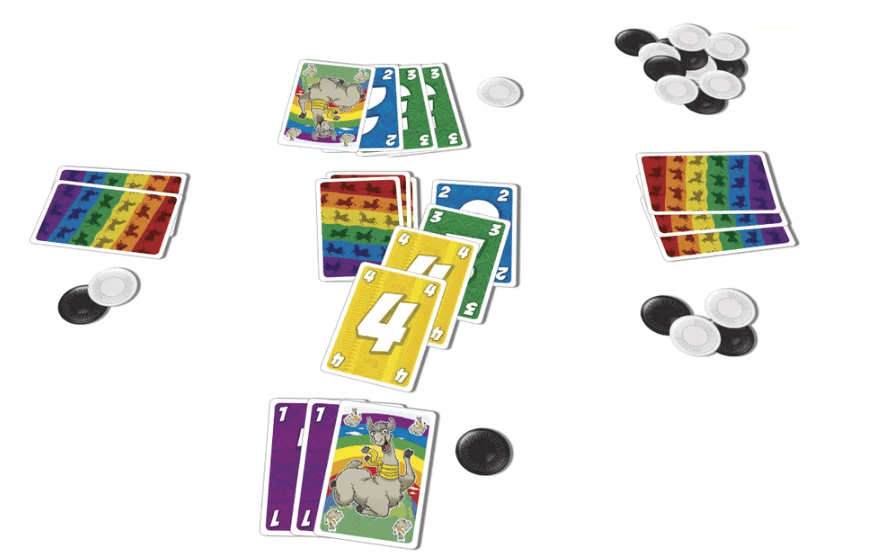
Game Setup
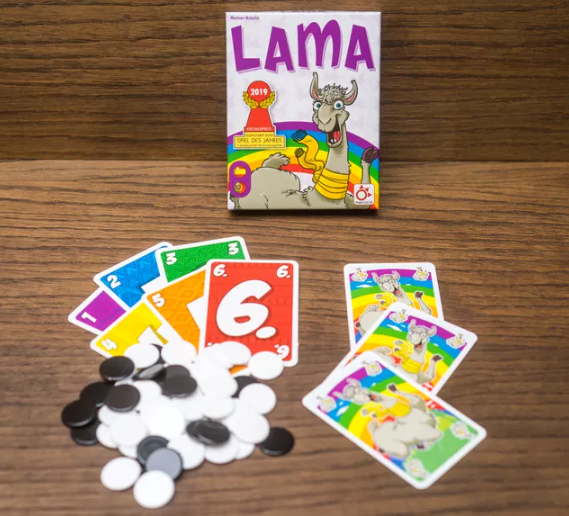
Shuffle all the cards and deal six cards to each player. The remaining cards make up the face-down draw pile. Turn over the top card to start the discard pile. Have the tokens nearby to give all players access, and you’re done.
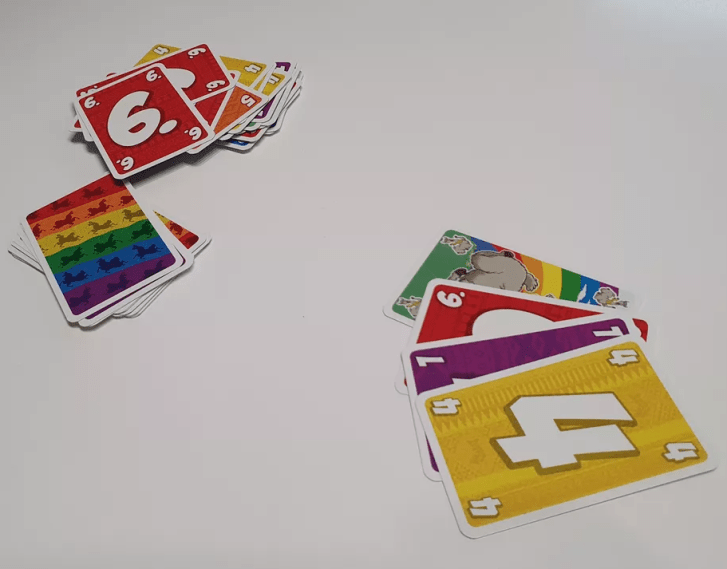
Game Flow
L.L.A.M.A. has an easy-to-read and brief rulebook, so I’ll borrow heavily from it. L.L.A.M.A. is played over several rounds. Randomly choose who goes first. During your turn, players may take one of these three actions:
* Play a card
* Draw a card
* Quit
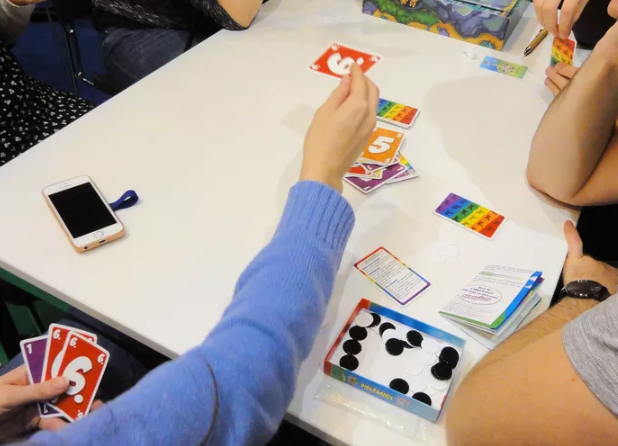
Play a Card
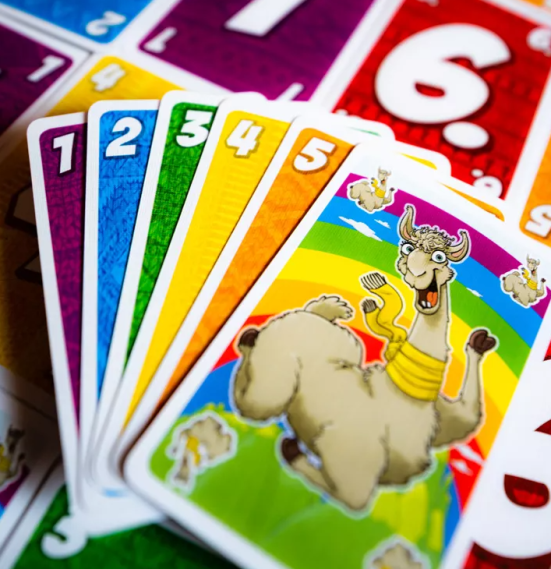
Cards are numbered 1-6, and there’s a seventh, specialty card (the Llama). The top card on the discard pile determines which cards can be played. You can play a card with the same value as the top card or a value that’s one more than the top card. Llamas can be played on 6s or other llamas. On top of a llama, you can play another llama or a 1.
Draw a Card
You may draw 1 card from the draw pile. You can’t play this card on the same turn, so the turn passes to the next player. If the draw pile runs out, don’t create a new one. From now on, you can’t choose this action.

Quit
If you can’t play a card or don’t want to, and you don’t feel like drawing a card either, you can quit for the current round. Place your cards in front of you, face down. You are no longer playing this round.
End of Round
The round ends if:
* One player has played all of their cards.
* All players have quit for the round.
If all but one player has quit the round, that player continues on their own. However, this player may no longer draw cards.

Scoring
Your remaining cards give you negative points, no matter if you have them in front of you (quitting) or in your hand. Each card is worth its value in points. Llamas are worth 10 points.
However, you count each card value only once per round, so if you have four 1s, for example, you only get one point. Likewise, all of your llamas would only give you a total of 10 points.
Taking Tokens
Tokens denote your negative points. There are white 1-point tokens and black 10-point tokens, which you may swap at any time.
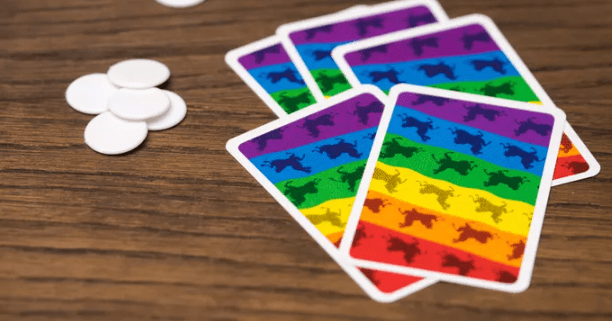
Returning Tokens
If you played all your cards during a round and you have tokens from a previous round, you may return one of them (either a 1-point or 10-point token).
Shuffle all the cards and deal another six cards to each player for the next round. Start a new discard pile with the top card from the draw pile. The last player to play a card in the previous round starts off the new round.
End of Game
Continue playing until one of you has collected 40 or more points. The player with the fewest points wins the game. If there is a tie, the players share the victory.
Review
L.L.A.M.A. The Card Game may play a touch like Uno, but it has just enough juice to hold my attention. Players need to shed the cards in their hand, much like Uno, but the option to quit for the round and discarding the right cards makes all the difference. Sure. Most games of L.L.A.M.A. revolve around the right cards showing up in the deck. In fact, the first couple of times I played L.L.A.M.A. I had either forgotten about the quitting rule or the person who taught me the rules forgot to explain the rule. L.L.A.M.A. played without the quitting rule plays like a less backstabby Uno. But after learning about (or remembering) the quitting option, I’ve experienced enough rounds where strategic quitting works.
I’ve been dealt a stellar hand at the beginning of a round (five 1s and another card). As soon as I can play the one card that isn’t a 1, I’d quit for the round and take one point. Quitting puts a ton of pressure on one’s opponents to shed cards quickly and then quit themselves. While it may seem at first like an advantage to be the final player in a round, you can no longer draw cards. If you can’t go out with what’s in your hand, you’re scoring with whatever cards remain, and you don’t want to get caught with any llamas. Hence the game’s alternate name, Don’t L.L.A.M.A..
The game’s odd theme, silly titular mascot, and bright colors add to L.L.A.M.A.’s charm. And llama is a fun word to say. Llama, llama, llama, llama. L.L.A.M.A. is a hit with multiple game group types. I’ve played with numerous demographics and ages. The game is easy enough to quickly grasp and allows for interesting choices for more serious gamers (like strategic quitting or going out one round and discarding a token of your choice). L.L.A.M.A. is light enough that many of my Monday Game Nights begin with this game, and everyone chats while they throw down a card from time to time. It’s games like this that remind us of the social aspect of board games.
Too Long; Didn’t Read
More than just a less cutthroat Uno, L.L.A.M.A. The Card Game adds strategic quitting for the round, which adds pressure to your opponents. While I can’t see myself playing too many rounds of Uno, I’ll gladly play a game or two of L.L.A.M.A. The Card Game.
 jkgeekly.com