Behind the Game: Luck, Strategy, and Tactics—Oh, My

Kyle’s Thoughts

I’m trying to make “Behind the Game” a more frequent series. I went after adult-themed tabletop games last week so I’ll dial it back with the genital jokes this time and cover luck, strategy, and tactics, and how they interact. Let’s start with an overview of these three things and how they work together.

dice

Luck and Strategy are not Opposites

There’s more than one type of luck (more on that in a bit) and depending on which type of luck a tabletop game employs, it can enhance the strategy of a game. Just because a game has strategy, doesn’t mean it doesn’t have luck. And just because a game uses luck, even large amounts of it, doesn’t mean it’s devoid of strategy. Luck can also be manipulated. The various ways luck can be altered could add to a game’s strategic and tactical value.

The tabletop game genre with the reputation as being the most strategic is war games. You calculate moves and execute planned attacks. But these games still use dice or cards to determine whether an attack, and sometimes a maneuver, works. Any game with a deck of cards or die rolls includes some degree of chance.

Strategy and Tactics are not Synonyms

Strategies are long-term goals, plans, or objectives. Tactics involve assessing a situation and planning on the fly; they’re the building blocks to achieve larger objectives. Some games are strategy-heavy, others are tactic-heavy, and still more use both. War games are usually a good blend. For example, your strategy might be to take control of a bridge but events could happen, and you may have to change the tactics you use to accomplish your goal.

So, games that are considered strategic typically have many paths to victory: numerous, potential objectives. You choose the one that works best for you. Games that are considered tactical usually have different means to achieve the same victory condition. These games don’t always have multiple objectives.

inputoutput

Input and Output Luck

Let’s talk about luck, baby.

Input luck is when the luck element occurs early in a turn, usually at the beginning, and players make decisions after the fact. Output luck is when players make a decision first and then the luck element takes effect. I’m going to stick with dice.

Most folks associate dice with luck, even though I’d argue the more dice you roll, the less random they become (dice results normalize when you’re rolling a bucket of dice), but that’s a different discussion. For this argument, Dice = Luck.
yahtzee

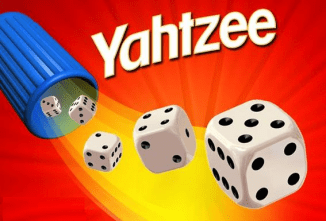
Let’s take the classic game Yahtzee. You roll five dice, keep the results you want, and re-roll the rest a grand total of twice. Players roll (the luck element) and then they determine what they’ll do with that roll: input luck.

Usually, players want to roll high, but lower numbers can be used in different ways (straights, full houses, three or four of a kind). No result is completely useless or unwanted.

dungeonsanddragons

Now let’s look at Dungeons & Dragons. Players declare what they’re going to do, for instance, sneaking passed a guard. The Dungeon Master determines what target number they need to achieve their task, and the player rolls a twenty-sided die (the luck element) to see whether their sneak was successful: output luck.

Input luck innately allows players to manipulate luck, while output luck gives more power to the die or other luck element. But that doesn’t mean a game using output luck doesn’t allow players to manipulate their fortunes. We’re not done with D&D.
dumbluck

Manipulating Luck

There are several ways to manipulate luck in a game, but let’s start with D&D. Role playing games have their players design characters with unique strengths and weaknesses. Some may be smart but feeble. Others may be strong but clumsy. And still more may be agile but dumb. We’re going back to that same example of sneaking passed a guard.

Let’s say 20 is the target number the Dungeon Master picked. To perform the action the player adds what they roll on a twenty-sided die to the value they have in an appropriate skill: Sneak. A halfling rogue character may only need to roll a 4 or higher because sneaking is the function they perform on their team. A half-orc barbarian most likely won’t have any skill in sneaking, so they’d need to a roll a perfect 20.

D&D players manipulate luck by forming well-rounded teams of adventurers, much like comic book writers construct teams of superheroes. Strong guy or gal? Check. Smarty pants? Check. Sneaky bastard? Check.

There are countless ways to manipulate luck in board games. I’ll list a few of them.

Building improvements/upgrades: Stack the deck in your favor.

A hand of cards or tiles: Keep and use what you want, discard what you don’t and draw something new.

Variable player abilities: You could dictate a die’s outcome or have more opportunities to accomplish certain tasks. The sky’s the limit with this one.

Re-rolling dice: Don’t like what you rolled, try again.

Monopoly01

Roll, Spin, and Move

Some of you cringed when you read the most dubious game mechanism: roll, spin, and move. Most—if not all—of the games that use this mechanism employ output luck and many of them don’t allow their players to manipulate chance. The game plays you instead of you playing the game.

Monopoly is the most well-known of the roll, spin, and move games. You roll the die, you do what the die tells you to do, unless you draw a card and then you do what the card says. Tabletop games have come a long way since then. Heck, even roll, spin, and move games have incorporated ways to change a player’s fate.

Careers had cards you could play to move a specific number of spaces instead of rolling the die. Colosseum, which will be reprinted later this year by Tasty Minstrel Games, allows plenty of manipulation to the classic roll, spin, and move. Any game type can add an extra layer of tactics and strategy, and any game, no matter how strategic it appears, can include luck.

I play the Tigris & Euphrates app. Most folks would classify Tigris & Euphrates as a sophisticated, heavy strategy game, and they’d be right. Players build up their civilizations. If a conflict erupts, the player with the stronger civ, built over time, usually wins. But anyone can discard the tiles from their hands to improve their strength if they happen to have the right tiles.

Quit discarding the right tiles, you damn, dirty app.

I’m heading back to the table to chuck more dice, until next we meet, thanks for reading.
Legion: “Chapter 2”

legiontvseries_01

Kyle’s Thoughts

Legion is stunning. FX has done a great job presenting the show. The acting, direction, and writing are good to great and the story gained a modicum of clarity from the show’s pilot last week but it’s by no means clear. The story has gained focus and that matches the main character’s mental state so Legion does a fantastic job of capturing the character’s essence.

Most shows with superpowers give viewers a chief antagonist for the season and/or future, and Legion does have the non-descript District 3, but David is his own antagonist. That’s something I like a lot. It forces the show to be character driven. The audience zeroes in on David’s closest friends and family. I like that a lot, too. Again, we’re given concrete characters, even if we don’t know how they fit in within the larger world. But the first season may be spent finding out how David’s powers work and that could prove problematic.

I like the breath Legion is taking with its title character. Some folks may not like a character-delving first season, but it allows the character to stretch their arms and legs. Legion has also done a great job of changing the mental illness vernacular. Multiple characters have told David that he’s not sick, his voices and visions are who he is. That’s beautiful. I don’t want the show to lose that language. And that’s where David’s power origin might prove problematic. Some of those characters say he’s not schizophrenic and in the comics, David isn’t schizophrenic, he has multiple personalities.

At the very least Legion could be setting up viewers who’ve never read the comics for a gotcha moment. I don’t care for gotcha moments. Reliance on such moments both built and destroyed M. Night Shyamalan’s career. What’s worse is Legion could lose that beautiful language, regarding mental illness. Those characters who say you’re not schizophrenic, your visions and voices are who you are could change their tune if David is diagnosed with dissociative identity disorder. I hope not. It’s a long shot that the writers of Legion would resort to this but there’s still that danger. I’m okay with a multiple personalities reveal, so long as it’s handled well (no gotcha moment) and David isn’t stigmatized. But that’s looking well into the future. Let’s get back to “Chapter 2.”

I like that the audience got a better idea on what’s real and not real. The episode ended strong, if not a little clichéd, and David has the impetus to fight his inner demons. Hopefully, we’ll discover more about District 3. They need to be more than a nebulous government agency, but I can wait. I’m enjoying the ride on the super, fun, happy, slide that is David’s mind.

Season’s Take

Legion is one of the more interesting Marvel characters. I’m not familiar with the comics so the TV show introduced me to David Haller.

Like Kyle, I too enjoy the aspect of having David as his own antagonist because that’s not something that Marvel Studios uses very often, if at all. David’s inner turmoil and his path to discover himself take center-stage, and the show reveals these things like a puzzle.

I like the image of “The Angriest Boy in the World” children’s book in David’s memory. It may give some insight into the origin of the devil with yellow eyes. He bears a lot of significance to David, especially when he starts to get irritated or confused. I’m excited for “Chapter 3” and I’m looking forward to Legion painting more of David’s picture.

Thanks for reading.

Arrow: “Spectre of the Gun”

arrowseason5

Jim’s Thoughts

I’ve been really hard on Arrow lately. Kyle and I were talking recently about how the show has never really hit the heights it did in season 2, and I was beginning to wonder if it was time to adjust my expectations. Maybe this isn’t a slump the show has been in, but a new direction the series is pursuing. With that in mind, I prepared to go easy this week, to try to evaluate the episode without comparing it to what it was three seasons ago. I went in with the best of intentions, and then I saw “Spectre of the Gun.”

This was a long, ham-fisted public service announcement at best, and a desperate attempt to use headline fodder for relevance at its worst. Regardless of what side of the gun control debate you come down on, there is no denying this episode added nothing to the dialogue. Every point made for and against tighter gun control is one you’ve heard a thousand times. No one says anything surprising or original. Even Wild Dog’s backstory is as paint-by-numbers as it gets. What could have been a good opportunity to give his character much-needed depth was spent on a cliché.

Maybe the most ridiculous element of this episode was the expectation that we’re to believe this would be the first time any member of Oliver’s team would have been faced with the problem. Five years of fighting crime in Star City, and Oliver is just now pondering gun control? Is this even the first time the mayor’s office has been shot up? It’s that very point that prevents me from seeing this as an earnest attempt to address the issue, and to consider it a shameless exploitation of the political climate.

Maybe as the show’s final insult, the plot is resolved with a heart-felt speech from Oliver to the mad gunman, and a set of ordinances drawn up by Oliver and Wild Dog (who took opposing sides) off-screen to solve the issue and make everyone happy with a compromise. This is disingenuous tripe, and I have to take The CW to task for it. It’s an attempt to cash in on gun control without actually addressing the issue.

Oh, yeah, and still no movement on Prometheus. Can you tell I’m out of patience yet?

Kyle’s Take

I wouldn’t call “Spectre of the Gun” a public service announcement. Those are designed to raise awareness or change public attitudes/behavior. Most people have heard the arguments for and against gun control. This episode regurgitated those arguments.

“Spectre of the Gun” also didn’t offer a solution to the problem. Sure, characters on opposite sides of the issue made compromises but we don’t know what those were or how we’re supposed to achieve them besides buying off someone with political favors. If the episode tried to change public behavior, it’d be how people talk, or even scream, at each other when they discuss politics or any volatile subject. Perhaps a lot of people in our country don’t do enough listening.

But that’s giving Arrow too much credit. The dialogue was so familiar I wouldn’t be surprised if the writers room plagiarized newspaper articles or television spots on the matter. No one talks like the characters in this episode, not even when they discuss the Kareem Abdul-Jabbar article they read about gun control. Put it in your own words. Better yet, say something new.

Arrow’s desire to tackle a tough subject in “Spectre of the Gun” is true to the comic book character. The Green Arrow often tackles difficult subjects in a pseudo, public service announcement fashion but the Arrow TV show has never expressed any desire to flex its social conscience muscle. Why start in the middle of season five? It’s disingenuous.

The only good thing I can say about “Spectre of the Gun” is that I’m glad there was a sensitive material warning before the episode began. If the CW starts each Arrow episode that chooses to go the public information film route with that warning, I can skip Arrow that week.

Thanks for reading.

Supergirl: “Luthors”

supergirlseason2

Kyle’s Thoughts

“Luthors” had plenty of rough spots but it did a lot to progress this season’s main antagonists Lillian Luthor and Cyborg Superman.

Dialogue for most CW shows isn’t a highlight but it must’ve looked like I had a tic with all this week’s cringe-worthy moments. Jimmy waxing poetic about his shield was particularly awful; I’m sure Cap has never expressed that much love for his shield, at least not in public. “Luthors” shoved as much background info it could multiple monologues. Winn had to tell us exactly what he was doing and how, and Lillian spoon fed us Lena’s history. It wasn’t a stellar week for dialogue.

I also didn’t care for how Metallo was handled. He’s Lillian’s stooge and I fear Cyborg Superman could go down a similar path. “Luthors” also felt like a way to stick a pin in Metallo for the near future. That’s not a bad thing but I don’t want Cyborg Superman as a stand-in for Metallo. It’s okay for Lillian to take center stage but both of those classic Superman villains need more development.

Lena’s relationship with her mother worked, despite Supergirl’s crutch of dialogue to convey their history. “Luthors” could’ve used more flashbacks to show us but there’s a danger of using too many flashbacks and the ones “Luthors” had were effective. I liked the note “Luthors” hit during Lena’s final scene.

And I hope Supergirl continues to play with Lena and Lillian’s mother-daughter relationship. “Luthors” may have been rough around the edges but I’m okay suffering a weaker episode so long as we got a dynamic that twisted. I could see—and expect to see—Lena hopscotch with her loyalties. It shouldn’t be a weekly occurrence. I’m concerned that Supergirl will abuse Lena going full Luthor and back to Kara’s friend.

I’m not hopeful for Kara and Mon-El’s romance. Supergirl has done an adequate job of keeping these two apart, but the events in “Luthors” were ridiculous and I don’t see them getting any better soon. I’ll go back to the dialogue in regards to this romance; it was manipulative and horrendous. If you’re going to couple these two, just do it. Other barriers made sense. It’s getting absurd and that’s before “Luthors” ended with Mr. Mxyzptlk.

Mxyzptlk declares his love for Kara before she can tell Mon-El how she feels about him. First, next week reeks of a filler episode. Second, it’s too convenient Mxyzptlk drops in at the exact moment Kara’s about to tell Mon-El her feelings. There is a precedent for Mxyzptlk being Superman’s fan but Supergirl had to play the romance card again. Not everything and everyone has to be drenched in romance.

Supergirl has had fewer filler episodes than Arrow and Flash—I guess it’s due one or two this season—but I’m not optimistic for next week’s episode. At least “Luthors” was a solid, if rocky, episode. I am optimistic about where Supergirl is headed.

Thanks for reading.

Codenames: Pictures

codenamespicturesbanner

Kyle’s Thoughts

The juggernaut that is 2016’s Spiel des Jahres winner Codenames (here’s my review on Codenames) was bound to spawn more than one spin-off. Codenames: Pictures takes the concept and adds plenty of trippy visuals. Before we get to the game, let’s look at some particulars.

The Fiddly Bits

Players: 2-8 (many more can play with two teams)
Play time: 15 minutes
Intended audience: 10+

Publisher: Czech Games Edition
Designer: Vlaada Chvatil
Year Published: 2016

Mechanisms:
Memory
Partnerships
Pattern Recognition
Press Your Luck

Quick rundown of gameplay

Players form teams—there is a single team variant, but usually, players split into teams—and teams are further split into one person as its clue giver and everyone else as clue decipherers. Clue givers are trying to give clues that will have their team (of clue decipherers) guess which pictures are assigned to their team, while avoiding clues that will lead to the assassin card (instant loss) or the other team’s cards. The first team to discover all its cards wins.

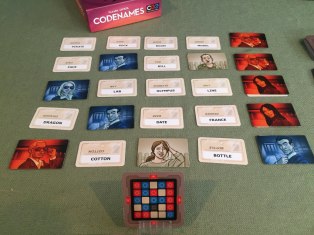
Clue givers and clue decipherers sit on either side of a table, and a 4×6 grid of cards with pictures on them rests between the givers and decipherers. It should look like this.

codenamespictureslayout

The clue givers also have a key that tells them which cards are their team’s pictures.

Each clue giver takes alternating turns, giving one word clues that tie multiple pictures of theirs together and provide a number of the cards (pictures) that fit that clue. For example, “Food 3” could be a valid clue if a clue giver is trying to get their team to guess pictures depicting “a gorilla eating grapes,” “a bagel with a space shuttle flying through it,” or “wine spilling out of a bottle and forming a topographical map of Michigan.”

Clue decipherers touch the cards they think match their clue. They keep guessing if they guess correctly or they can pass their turn to the other team if they don’t want to risk choosing an incorrect card. A team’s turn ends immediately if they pick a picture that isn’t one of theirs and play passes to the other team.

The first team to guess all their cards wins.

There are a few more twists and turns to the rules, but that’s the gist.

Review

Again, most gamers have a preference of Codenames or Codenames: Pictures. If you’re more of a word game pro or you like word play, you may like Codenames (here’s a link to its review). If you’re more of a visual person, Pictures may be for you. I didn’t like Pictures at first. It took some plays for me to grasp what was on the cards. I missed a space shuttle flying through a bagel the first time I saw the picture and I gave a clue of space or Milky Way. One of my teammates picked the bagel and I thought they were mad. No. They’re not made, the pictures can make little sense.

After I grew accustomed to the odd pictures Codenames: Pictures grew on me. The gameplay’s the same as the original Codenames. Some folks don’t like the grayscale images, but the designer couldn’t add color to them. Every game would have someone saying a color and the number of pictures their team has with that color. And even though I still don’t get some of the pictures on the cards, a few are beyond bizarre, they have an endearing quirkiness.

Codenames: Pictures is a worthy sequel to 2016’s game of the year—I’m sorry Spiel des Jahres. I just hope Czech Games Edition doesn’t crank out too many sequels.

Which version of Codenames is your favorite? Let me know in the comments. I’ll be playing some more games but until then, thanks for reading.
Codenames

 codenamesbanner

Kyle’s Thoughts

I haven’t written a straight up tabletop game review in quite some time so I’m going to do one for last year’s (2016) Spiel des Jahres winner Codenames and one of its spinoffs Codenames: Pictures. (Here’s the link for Codenames: Pictures.) But before we get to the game, let’s cover some pesky technical stuff.

The Fiddly Bits

Players: 2-8 (many more can play with two teams)
Play time: 15 minutes
Intended audience: 14+ (but you could teach someone as young as ten)

Publisher: Czech Games Edition
Designer: Vlaada Chvatil
Year Published: 2015

Mechanisms:
Memory
Partnerships
Pattern Recognition
Press Your Luck

Quick rundown of gameplay

Players form teams—there is a single team variant, but usually, players split into teams—and teams are further split into one person as its clue giver and everyone else as clue decipherers. Clue givers are trying to give clues that will have their team (of clue decipherers) guess which words are assigned to their team, while avoiding clues that will lead to the assassin card (instant loss) or the other team’s cards. The first team to discover all its cards (code words) wins.

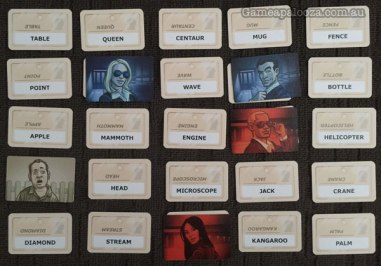
Clue givers and clue decipherers sit on either side of a table, and a 5×5 grid of cards with words printed on them rests between the givers and decipherers. It should look like this.

codenameslayout

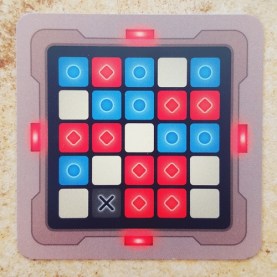
The clue givers also have a map card that tells them which word cards are their team’s words.

codenameskey

Each clue giver takes alternating turns, giving one word clues that tie multiple words of theirs together and provide a number of the cards (words) that fit that clue. For example, “Food 4” could be a valid clue if a clue giver is trying to get their team to guess the words “ham,” “orange,” “bread,” and “pie.”

Clue decipherers touch the cards they think match their clue. They keep guessing if they guess correctly or they can pass their turn to the other team if they don’t want to risk choosing an incorrect card. A team’s turn ends immediately if they pick a picture that isn’t one of theirs and play passes to the other team

The first team to guess all their cards wins.

There are a few more twists and turns to the rules, but that’s the gist.

Game Review

Most gamers have a preference of Codenames or Codenames: Pictures. If you’re more of a visual person, you may like Codenames: Pictures (here’s a link to its review). There’s even a backlash of players who don’t like all the hype Codenames has gotten over the past couple years.  As of this writeup it’s the highest rated party game on Board Game Geek. It’s one of the only party games to ever win the Spiel des Jahres. It’s the game that keeps the lights on at Czech Games Edition. And it’s a simple concept.

I like it. Codenames is a versatile party game. I’ve seen clue givers in small groups scratch their hands and contemplate each clue. I’ve seen larger groups bust out laughing at conventions. In fact, Codenames usually draws huge crowds at cons and generates clouds of noise.

codenamesplaying

Analysis paralysis (taking a long time to think about one’s turn) can be a deterrent. I’ve waited at the table for someone to come up with the perfect clue. Other folks can’t handle the pressure of being a clue giver; there’s a lot more stress on the giver than there is on the decipherers. But it’s a solid party game. It’s one of the best on the market, but if you don’t care for party or word games, you most likely won’t like Codenames.

I prefer the original Codenames to Codenames: Pictures because Pictures has some odd images and it’s difficult to make clues that differentiate one grayscale image from another. I also like play on words and the original Codenames allows for that.

I’m not sure if Codenames deserves all the praise it gets, popular opinion tends to sway people, but I can see the game selling copies decades in the future.

Do you think Codenames deserves the praise it gets? Which version of Codenames is your favorite? Let me know in the comments. I’ll be playing some more games but until then, thanks for reading.
Bob’s Burgers: “Bob Actually”

bobsburgersseason7

Kyle’s Thoughts

Bob’s Burgers came back this week. The show took a long mid-season break but “Bob Actually” was a satisfying return. As the name implies this episode’s a riff on Love Actually and each Belcher is part of a love story. Yes. Even Louise.

Bob and Linda’s romance played out as expected. There was a strange twist to Bob wanting to learn how to dance for Linda. The only dance class available was Hip Hop. Seeing Bob in baggy sweatpants was fun, and Linda’s response proves that it’s the thought that counts when it comes to any gift.

Tina had her ubiquitous love episode with Jimmy Junior. Only this time Jimmy returns her affections. Jimmy does show her occasional fits of love, but how open he was with showing his affection was unexpected. I also liked how Bob’s Burgers fit in Tina’s obsession with butts. Usually she’s grabbing behinds but in this episode, she suffers from diarrhea. Her bowels almost keep her from the one she loves. Fortunately, love finds a way.

Gene fell for the replacement cafeteria lady and led to him falling in love with dark chocolate, too. There has to be a joke there about the quickest way to a man’s heart is through his stomach. It worked and the attention Gene gave the cafeteria lady showed some genuine character growth. But Louise took the cake for character growth this week.

I didn’t think Louise was capable of loving anyone outside her family, and sometimes not even then, but she genuinely cared for Regular-Sized Rudy. True. Some of these romances felt a little forced, and Louise’s character arc played out like a lot of romantic comedies (wires getting crossed), but there was a kernel of truth with her development. Louise has cared for Rudy’s wellbeing in the past (the museum adventure and the chocolate train), she’s enough of an egomaniac to be swept up by a Rudy who doesn’t show her affection, and she likes to fight for underdogs and the downtrodden (Rudy’s being taken advantage of by another classmate in this episode). It clicked.

I don’t like going more than two months without a Bob’s Burgers episode but “Bob Actually” was worth the wait.

Thanks for reading.

Gaming After Dark

Kyle’s Thoughts

Hello, all. It’s been some time since I’ve posted something on tabletop games, so I’m taking a page from Jim and his “state of comics” to cover a current trend in tabletop games: adult themes for popular board games.

afterdarkbanner01

I’m not against adult-themed games. They’re not my thing, I most likely won’t purchase one, but I have nothing against them. Tabletop companies make mountains of cash from games that add “after dark,” “adults only,” and add an explicit content label to the box. It’s good business. It’s also a polarizing subject in the tabletop community. Let’s explore both sides of the argument of whether adult games are good for the hobby, and why they flourish. We’ll stop before we have to take a shower.

A Positive Influence

First, there’s the mountain of cash I mentioned earlier. Adult-themed games are big business. The money they earn sustains some companies. Sure, Czech Games Edition (CGE) didn’t need a Codenames: Deep Undercover for their 2016 Spiel des Jahres winner—the original Codenames is printed money—but the company has made a killing on the adult-themed version too. Tabletop gaming is a growing but still small niche. An adult game might be worth it if it means a tabletop company, maybe not CGE in particular, can stay afloat. But there are other ways adult games are beneficial.

cardsagainsthumanity

The game that popularized “adult themes” Cards Against Humanity has done a lot of good in the tabletop community; most notably it’s Tabletop Deathmatch contest, where unpublished game designers have a chance of getting their game on the market. Outside their contest, they’ve reached out to budding game designers and put them on the map. We wouldn’t have Penny Press, Discount Salmon, or the companies they spawned without the adult-themed giant.

I’m not sure if there’d be much overlap on a vin diagram between life-long tabletop gamer and introduced to the hobby through an adult-themed board game, but there must be some overlap. Who cares how someone gets into the hobby? It only matters that the person in question got into the hobby. And who cares if party games (adult-themed games are usually of the party game variety) are all that person is interested in? Most tabletop companies offer a party game in their catalogue. The party game enthusiast can enjoy their games and that can help that same tabletop company make strategy, war, deck building, or worker placement games.

It must sound like I’m an adult game apologist but it’s not all farts and sunshine.

A Negative Influence

Okay, I could go the easy route here. They’re filth. They’re cheap knockoffs of other games. They cater to the lowest, common denominator. They’re not kid friendly. That’s too easy, and those reasons aren’t why I avoid adult-themed tabletop games. The biggest reason I avoid them is that they don’t accomplish what I think they set out to accomplish: shock value.

The one time I laughed out loud from a Cards Against Humanity turn was when someone played the fill-in-the-blank card “The thing I’m most ashamed of is…” and someone else answered with “I’m Batman.” Someone being ashamed of being Batman, to me, is objectively funny. When everyone else plays some variant of penis, vagina, butt, testicle, or breast joke, “I’m Batman” becomes shocking. Vulgar jokes are the funniest when they’re unexpected. Adult games are so over-the-top they make penis jokes impotent.

That last one was a penis joke. I’m sorry. That was too easy; I took the opening.

I’m also miffed as to why some stores carry the adult version of a game and not the base game. I suggested Codenames to a friend. They went to Target, but all Target had was their exclusive Codenames: Deep Undercover. My friend picked up Codenames: Deep Undercover, played it, and got angry at me for suggesting such a lude game. If a store wants to carry an adult-version of a game, carry the original.

telestrationsafterdark

But the biggest reason I don’t prefer adult-themed versions of games is that they’re unnecessary. I seldom play with the cards that come with Telestrations. My game group picks a topic or theme and we draw pictures based on that topic. If we wanted to have a raunchy turn of Telestrations, we’d have one with the base game. Why would I play Telestrations: After Dark that has a larger print run than the base game? Why play Cards Against Humanity when you can play (the game it mimics) Apples to Apples? Someone can play the adjective “moist” and someone else can answer with “women.” I’ve even used the clue “bondage 5” in a base game of Codenames to get folks to answer with the code words “rope,” “bed,” “handcuffs,” “apple,” and “carrot.” That one round was shocking. And shock value is the element adult-themed games lose.

So why are they popular?

I’m clearly not a part of an adult-themed games’ target audience. I hear they’re great when you’re drunk. I wouldn’t know because I don’t go out and party, so the college crowd must be the target audience. But there could be a larger, psychological element at play. Let’s compare the cover of Codenames to that of Codenames: Deep Undercover.


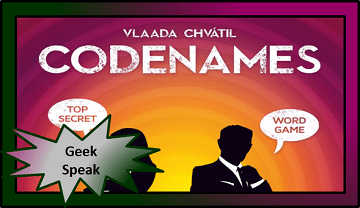
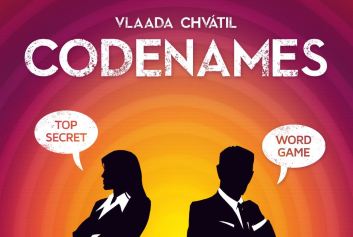
You can see the added explicit content warning on Codenames: Deep Undercover, and that has its own baggage, but let’s take a closer look at the word balloons on each box. The base game reads “Top Secret” and “Word Game.” The adult version reads “Adults Only” and “Word Game.” Adults don’t need to be told they’re adults.

Teenagers (and some young twenty-somethings) need to be told they’re adults. I ran a “Man’s Club” when I was a preteen and everyone in the neighborhood wanted to be part of the “Man’s Club” because the word “man” was in it. None of us were men, but we liked to be told we were men for being a part of the club. The same could be said of teens playing “adult-themed” games. These games may be marketed primarily toward teens. Even if they aren’t, I’m sure companies don’t mind if a teen purchased their game or got their parents to do so. So, that may be my biggest issue with adult-themed games.

Regardless of their marketer’s intent, adult-themed games comprise a healthy portion of tabletop game sales. They keep some companies afloat, bring new people to the hobby (perhaps), and it’s the parents’ responsibility to know which games their kids are playing.

What are your views on adult-themed, tabletop games? Let me know in the comments. I’ll be playing some more games and hopefully gain more topics to talk about. Until then, thanks for reading.

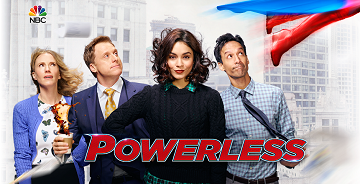
Powerless: “Wayne Dream Team”

powerless

Kyle’s Thoughts

“Wayne Dream Team” was a step up from the Powerless’s bad pilot, but the show needs to take a few more leaps of improvement for me to excited. This episode focused more on the characters. I can’t fault “Wayne or Lose” and setting up Charm City (setting), but it’s nice to see more of an emphasis on character-building, even if those characters are one-dimensional.

Emily (Vanessa Hudgens) struggles to fit in her new work place. I’m not invested in her character enough to care that she hasn’t made friends, but it makes sense that others would keep her at a distance. Ron Funches and Danny Pudi continue their buddy scientist shtick. They might be a secret handshake way from Troy and Abed (Community).

I’m not sure how Alan Tudyk (Van Wayne) factors into this workplace. Sure. He’s the owner of Wayne Defense, but he was trying to get end the company in the pilot and now he’s committed to making the company a success. Part of Van wants to be recognized as an accomplished Wayne, but a larger part of him wants to go to Gotham by any means necessary. I’m not sure how Wayne Defense’s success accomplishes Van’s main desire.

There were fleeting moments of onscreen chemistry. I liked the product Wayne Defense came up with this week: a ruble umbrella. But the main reason I like this product is that everyone in Charm City will be forced to buy one. The ruble umbrella helps those who own one. Anyone who doesn’t own one will get crushed from the ruble deflected from the ones who do own one. A charming ribbing of corporate greed.

The fantasy superhero teams were a good chuckle. In a world where superheroes are commonplace, why wouldn’t people draft fantasy superhero teams like folks draft fantasy football teams? Jim and I may have to draft our own fantasy superhero teams.

Powerless has a lot of work ahead of it. I’m not sure if it’ll warrant a second season, but it’s done enough for me to follow it another week.

Thanks for reading.

Justice League vs Teen Titans (DC Animated 2016)

justiceleaguevsteentitans

Jim’s Thoughts

I’m a bit late to the party on this one. DC’s animated film, Justice League vs Teen Titans came out last year, but I’ve only just now gotten around to seeing it. I’ll admit that at least part of what got me to hold off on it was the title, particularly the “vs” part. I’ve mentioned it before, but I’m beyond fatigued with the concept of heroes fighting heroes. In order to make it work, at least one side has to be written out of character; see Batman being an unreasonable jerk in Batman v Superman, or Tony Stark siding with government in Captain America: Civil War. I’ll admit, the Marvel Cinematic Universe did it about as well as can be done, but more often than not, I don’t like the results.

Where Justice League vs Teen Titans works is that the title is a bit of a misnomer. Yes, there’s a scene where the members of the two teams fight, but the Justice League members are possessed at that point, so there’s no sacrifice to their characters. In truth, the movie is much more a Teen Titans story. If you’re someone who misses the old Teen Titans series, and isn’t happy with the radically different direction Teen Titans Go! has taken, I think you’ll more than get your fix here. The movie feels like a step back into that universe, and it works well.

If you’re not a fan of the Titans, there isn’t much for you here, as the Justice League is much more of a plot device than something that’s fleshed out. You’re only going to get a superficial handful of moments with Batman, Superman, Wonder Woman and The Flash, and even Nightwing’s part in the story is limited to a brief car ride. Even within the Teen Titans group, it’s not all equal exposure. Blue Beetle gets some good action sequences, but is mostly in the background. Beast Boy is good for a couple gags, but disappears in spots. The real value in this movie is for fans of Damien Wayne and Raven. Their arcs carry the dramatic elements of the story. I should say, just in case you don’t expect it from a title involving the word “Teen,” that’s a big part of the target audience. Be prepared for puppy love and adolescent angst in all things relating to the Titans. You are warned.

I’ve read this movie will serve to set up the forthcoming adaptation of The Judas Contract. I doubt it’ll be a one-for-one portrayal of the comic, but if you’re not familiar with the source material, that’s a huge story arc that brings Deathstroke to the forefront of DC villains. If Justice League vs Teen Titans is any indication, I’m optimistic about how that chapter in the story will be handled. It’s definitely worth a rental for fans of the Titans, or big DC fans in general.