Writing Brain Dump: December 5, 2025

Happy Friday, Geekly Gang! Kyra Kyle here. I haven’t done a writing brain dump in a few weeks. I’m still going through the slog of editing the Rustbucket novel on a macro level, but I’ve hit a wall.

Truthfully, I’ve struggled to make much headway with the project. There are multiple reasons why. I distracted myself with holiday cleaning. I may not have made much progress with the Rustbucket novel, but my house looks and smells amazing. I may not have completed a single task I wanted to in November, but my study is so organized.

I feel stuck in Monty Python’s “Cheese Sketch.” My cheese shop is the best in the region. Why do you say that? It’s so clean. It’s certainly unsullied by cheese.

Distractions aside, I can’t get out of my own head, and that’s the real cause for writer’s block. So, I’m recommitting myself to my writing schedule. I may put the Rustbucket novel on hold for a short time and begin a new project. Who knows? Something I write during this project could provide the fuel I need for Rustbucket.

I’m not going to include any writing tips or tricks I’ve been using, because I hit a wall. Maybe I’ll dirty up my organized study with some writing, and I’ll have something more to share in a couple of weeks, when hopefully, I’ll post another writing brain dump.

I hope you all had a great Novel November. Thank you for reading, and keep writing.

Writing Brain Dump: November 14, 2025

Happy Friday, Geekly Gang! I haven’t shared a Writing Brain Dump in a month. Today looks like a good day for a Writing Brain Dump. I’m about halfway through my most recent edit for Rustbucket Riots (working title). And the biggest step I made was reformating the story’s arc.

The Three-Act Structure May Need Tweaking for a Novel

I found Julian Maylett’s YouTube channel a short while ago. Maylett has a great AuthorTube channel, and I like his six-pillar structure. But I adapted this structure so it works better for me. I’ll paraphrase something I said in the previous Writing Brain Dump. What works for someone else’s writing practice may not work for yours. Everyone is unique. So, it made sense that I adapt Julian Maylett’s method to better suit mine. Feel free to do the same.

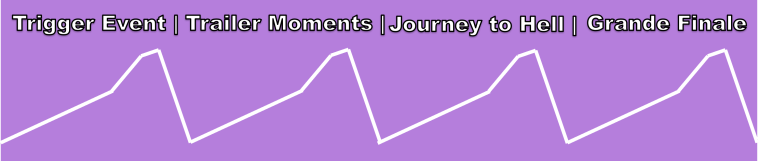
I boiled down Maylett’s method to a novel’s storyline resembling a heartbeat. The Three-Act Structure (pictured above) begins with an inciting incident, followed by rising action (complications), a crisis, a climax, and falling action (or denouement if you want to be fancy). Maylett claims that (except for a novel’s prelude, which is different from a prologue) each segment within a novel includes its own version of a Three-Act Structure. After mapping out the four segments following the prelude (Trigger Event, Trailer Moments, Journey to Hell, and the Grand Finale), the novel’s shape resembled a heartbeat.

We’re looking at four Three-Act Structures occurring consecutively.

See what I mean. Each segment contains an inciting incident, rising action, a climax, and falling action. But, paraphrasing Maylett, segments will morph what constitutes an inciting incident, rising action, etc., each time, depending on when in the story the segment occurs. One of the examples Maylett gave (for the Trigger Event) was The Hunger Games. We’re talking the first novel (or movie) here. And viewing this novel through Maylett’s lens can be eye-opening. If we view The Hunger Games in the classic three-act structure, one would most likely cite Katniss offering herself as tribute as the story’s inciting incident, but that isn’t the inciting incident when using what I’m going to call the heartbeat method.

The Reaping itself is the inciting incident for The Hunger Games’ Trigger Event (the first full segment). Prim being old enough to participate in the Reaping is a complication (rising action), as is Katniss placing her name into the Reaping multiple times to feed her family. Katniss has a brief moment of doubt when Prim’s name is drawn (the crisis), and she must choose to save her sister by offering herself as tribute or let Prim participate and most likely die. Katniss choosing to offer herself as tribute is the Trigger Event’s climax.

Then, we see the fallout of Katniss’s decision (the resolution or falling action), before the next segment (Trailer Moments) begins with another inciting incident and the process starts anew. I love Maylett’s approach. I took the bones of this approach and applied it to my manuscript.

I’ll press pause on the rest of the segments, so I can edit those and share my thoughts after editing each segment, but there is an odd segment before these four: The Prelude.

The Prelude is Not a Prologue

A prologue’s events occur separately from the rest of the novel, while the prelude sets the novel’s tone. If you’re talking about speculative fiction, the prelude introduces the reader to your novel’s world, while hopefully not inundating them in exposition. Unlike the other segments, the prelude has only three parts: an opening image, a flawed action, and the theme whispered.

Let’s go back to The Hunger Games as an example for the prelude. The novel (and movie) opens with Katniss illegally hunting game. We’re introduced to Katniss’s world through the simple act of survival. Katniss bags a kill. Her family can eat. This hunt is The Hunger Games’ opening image. It’s a concrete image. Then, The Hunger Games progresses to the Flawed Action. In the novel, Katniss shares that she spoke out against injustice, and it got her in trouble, so now, she protects herself and her family by keeping her opinions to herself. All this does is close off Katniss. It’s a flawed action Katniss needs to unlearn, but she isn’t yet ready to learn.

Finally, The Hunger Games reaches its Theme Whispered. Katniss’s friend (and love interest) Gale suggests the two of them should head to the forest, live off the grid, and effectively leave the country. Gale implies Katniss’s crime of hunting isn’t wrong. The government is wrong. By the end of three books, Katniss takes on the government head-on, but she isn’t ready to hear this yet. According to Maylett, the Theme Whispered should be spoken aloud by a character who doesn’t have too much relevance to the story (at least not yet), and the whispered theme should be memorable enough to stick in the back of the reader’s head.

The Hunger Games does this well. If you’ve read (or watched) The Hunger Games, you may not have noticed the Theme Whispered in the first chapter (or opening sequence), but now that I’ve mentioned it, you can’t help but see it. Lovely foreshadowing.

Echoing Heartbeats

And that’s why I like the heartbeat system. Since readers get repeating beats, they can’t help but notice patterns. Maylett’s system includes some specifics, the deeper into the story we journey, but I’ll save those for later.

I hope you’re having a wonderful Novel in November (formerly NaNoWriMo). Where are you with your progress this month? Are you editing or writing something new? Let me know in the comments. Thank you for reading, and wherever you are, I hope you’re having a great day.
Writing Brain Dump: October 3, 2025

Hey, hey, Geekly Gang! Kyra Kyle here. I didn’t know how to start this type of post. Heck, I don’t even know if I’m sold on the title “Writing Brain Dump.” It’s a work in progress. Hopefully, I can express how my writing has been going over the past couple of weeks. I’ll be spouting random ideas about writing/editing I’ve found in between each of these posts. Perhaps, you’ll find a cogent thought here somewhere. Buckle up for a Writing Brain Dump.

Reverse Outlining

I’m continuing to reverse outline last year’s novel, set in the same world as my board game Rustbucket Riots. I’ve struggled with this part of the editing process, but reverse outlining and the next section I’ll mention are invaluable.

I began with a spreadsheet that includes the following headings:

Scene Description
Characters
Setting
Point of Scene
Themes
Scene Length
Actionable Item

You may add or subtract a heading or two (or five), but these seven headings help me stay focused. I’m a hybrid pantser (someone who writes without a plot) and a plotter (someone who writes with a plot). My best analogy would be a lighthouse writer or lighthouser. Most stories I write have a scene or two that serve as Lighthouses; I’m building toward these scenes, and while I’m writing a first draft, I need to find the scenes that connect the Lighthouses.

The difficult part of the reverse outline was going back through my manuscript. I waited long enough to gain distance and objectivity. A month or more is a good time period to wait before diving back into a project. But I may have waited long enough to wonder if anything in the manuscript was any good. LOL.

After some emotional cutting (I’m only slightly exaggerating), I found direction, and the reverse outline helped. “Scene Description” allows me to revisit each scene. Sometimes, I need to mark scenes as incomplete. And that’s okay for now. This was an early draft.

“Characters” and “Setting” remind me of the scene’s who and where. I can glance and see when a Character is first introduced or if I’m returning to the same Setting for multiple scenes, and if that’s necessary or not. Or if a character only shows up in one scene, is that character needed? Can I combine the one-off character with another character, tightening the manuscript? I did this more than once.

“Point of Scene” and “Themes” differ subtly. Point of Scene shows whether the scene progresses the story (or plot), while Theme is more the scene’s emotional weight (What’s the scene’s takeaway?). Scene Length is another glance to make sure the pacing for the scene feels right. And during Actionable Item, I suggest something I could do to improve the scene.

Sometimes, a scene doesn’t do enough to progress the story, and I scrap it. Why line-edit a scene that doesn’t do anything for the story? Reverse outlines can be difficult—correction, reverse outlines are difficult—but I need them to keep me on task. I wouldn’t know where to begin editing without a reverse outline. After each draft, I begin a new reverse outline. Elements change.

Some of you may be plotters, but reverse outlines may be a great way to see your story from the other side. Reading your manuscript with fresh eyes may yield themes or points of a scene you didn’t know were there. While a reverse outline helps pantsers or lighthousers (or plantsers), they can still help plotters. Like I said, I begin a new reverse outline after each draft because storytelling elements change.

Timeline

While one could combine a reverse outline and a timeline, I prefer to have these as two separate documents. Chronology is important. You don’t want to say something would take a week when it takes two weeks or vice versa. Going back to “Scene Length,” the manuscript’s pacing also needs to match the timeline. A week needs to feel like a week, however that week feels for the character(s). I forget how many time warps I’ve caused. Hopefully, I will avoid time warps altogether by starting a timeline while I write the first draft. If only I’d remember to start a timeline while writing a first draft.

Always Be Escalating (ABE)

I promised a Writing Brain Dump, and here we go. I’m kinda bouncing back to the first topic (Reverse Outlines), but through a different lens or two. One of George Saunders’s 9 Rules of Thumb is “Always Be Escalating” or ABE, and a hidden benefit to the “Point of Scene” header in a reverse outline is showing that your story’s stakes increase with each scene. Escalating scenes propel the story. They’re the secret sauce to page-turners.

Causality

“Causality” is another one of Saunders’s Rules of Thumb. Saunders often links causality to Chekov’s River. Many of you may know Chekov’s Gun. Quick Recap: If a gun is shown in the first act, it must be fired by the third act. Chekov’s River follows a similar path, but in terms of causality. One character choice should directly lead to another choice by the character, like a river of character choices. Chekov’s River gives characters agency. It also minimizes coincidences.

Coincidence versus Choice

Coincidences at the beginning of a story aren’t so bad, but if a story relies too heavily on coincidences, they become a crutch, and the advancement feels unearned. Batman (1989) will always have a special place in my heart, but it relies on coincidence. Jack Napier (Jack Nickolson’s Joker) falls into a vat of chemicals; he blames Batman. This is a coincidence, but this happens at the beginning. It isn’t too bad—yet.

Then, Joker happens to read a newspaper with a picture of Vicki Vale (Batman’s love interest) and falls in love with her as well, putting the two characters at odds. Why wouldn’t Batman and Joker already be at odds because of their chosen vocations? Make it a choice, not a coincidence. But yes, let’s go with a bizarre love triangle.

Fun Factoid: Because not all parties in a typical Love Triangle are in love with each other, most Love Triangles are actually Love Bipods.

I promised a brain dump. Consider yourself brain-dumped.

Finally, Joker meets Batman (as Bruce Wayne) and threatens him with a gun while saying, “Have you ever danced with the devil by the pale moonlight?” which happens to be the phrase the Waynes’ killer used. So, Batman surmises the Joker killed his parents. Sure. As you can see, each coincidence cheapens the story.

I suppose there is causality with Joker killing Batman’s parents, and then Batman “making” The Joker, but even Joker dubs this story absurd. “You made me. I made you. How childish can you get?” Batman also leans heavily on flashbacks, which also takes away from the present story. Ground the characters with their choices in the story you’re telling, not choices during flashbacks.

And I’m saying don’t use too many flashbacks when my first novel, Crooked as a Dogwood, features a character skin-walking through their past and their relatives’ past. Ugh! I may need to rethink that novel. LOL

In short, character choice should impact the story more than coincidences. Try to minimize coincidences and flashbacks. Grant characters agency.

I’ve lost the plot. Maybe I need to reverse outline this post. Oh well. I promised a writing brain dump, and this may qualify. Thank you for reading, and wherever you are, happy writing and have a fantabulastical day.