

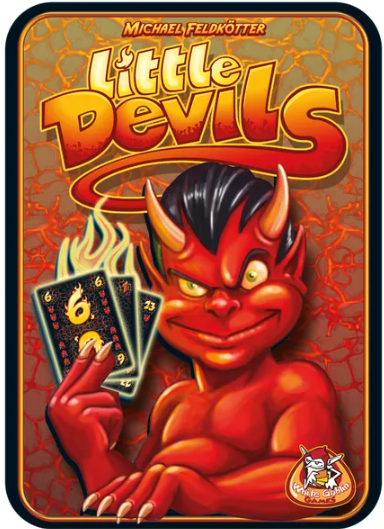
Hey, hey, Geekly Gang! Kyra Kyle here with another board game review. Today’s game is Michael Feldkötter’s Little Devils, a quick trick-taking game with a twist. Little Devils has no suits. Instead, players must follow the first card (in a series of 54 numbered cards) that’s played per round. The second card dictates which direction every other player must follow (up or down from the original number). The player who either plays in the wrong direction (up instead of down) or plays the furthest number from the original card wins the trick; you’re trying to win as few tricks as possible. Little Devils takes a simple concept and bakes in some interesting choices.
Before we get any further, we’ll get devilish with Little Devils’ details.
The Fiddly Bits
Designer: Michael Feldkötter
Publisher: Arclight Games, Stronghold Games, White Goblin Games
Date Released: 2012
Number of Players: 3-6
Age Range: 8 and up
Setup Time: Less than a minute
Play Time: About 15 minutes
Game Mechanisms
Game Setup
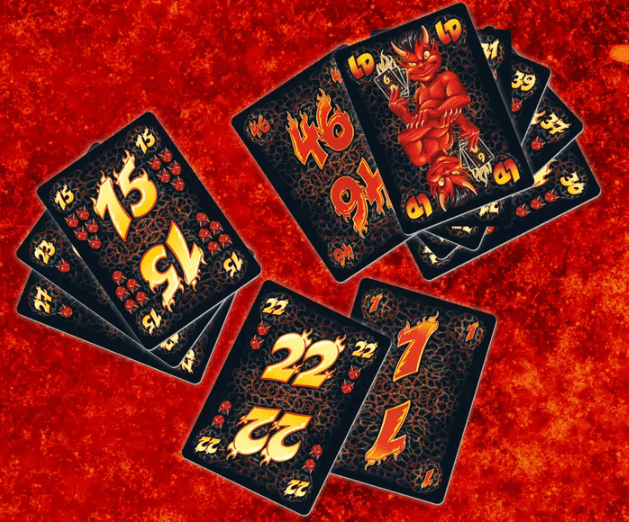
Little Devils consists of a 54-card deck. Depending on the number of players, remove a number of cards numbered between 28-54 from the game. The rulebook will state which specific cards need to be removed at each player count. Ultimately, players will be dealt 9 cards each, which should be the entire deck.
After you’ve prepared the deck, deal out all the cards.

Game Flow
For the first round, the player to the left of the dealer begins the trick; for every round after the first, whoever “won” the previous trick, begins the next trick. The first player starts the trick by playing any card from their hand that doesn’t have five little devils beneath the number. Quick note: most cards in Little Devils will have at least one little devil underneath its number. Players cannot lead a trick with a card with five little devils, unless they have no other card in their hand.
The player to the left of the starting player will play a card from their hand. If the second player plays a higher card, all other players must play cards valued higher than the first card if possible. Whoever played the highest card gets the trick, unless a player is unable to play a higher card. This player will get the trick unless more players are unable to play higher cards. If a player (or players) plays a card in the opposite direction of the second player, the player with the furthest valued card from the original card wins the trick.
After all cards have been played, a round ends. Players score the number of little devils from their tricks. As soon as someone scores 200 points, play ends, and whoever has the fewest points wins.

Review
Little Devils has a built-in catch-up mechanism: the player who wins a trick can’t possibly win the next one; they begin the next trick. I love that. It’s simple and offers plenty of strategic choices. I could play a card closer to the low or high end, thinking the players in front of me (on the scoreboard) might get stuck with a trick or two. There are even cards that have no little devils on them. Often, when I know I’m going to get stuck with a trick, I’ll play one of the one devil or no devils cards to net the fewest little devils I can.
While you could card count during Little Devils, it doesn’t matter that much. Little Devils plays quickly. It’s more fun to play a second game. Even when I’ve finished last (triggered the end game), I feel like I did something if I stiffed someone else with a bunch of points during one round. Little Devils is a great filler game. It may get overshadowed by Cat in the Box (we still need to review that game), but it requires less setup, is an easier teach, and I’ve found more gamers catch on to Little Devils a lot faster.

Too Long; Didn’t Read
Quick to pick up and easy to teach, Little Devils is an excellent trick-taking game that offers plenty of strategic choices, a brilliant built-in catch-up mechanism, and fun gotcha moments.
 jkgeekly.com