
We haven’t covered a Marvel United expansion in a couple of months. It’s about time we returned to the series. Geekly won’t be covering every Marvel United expansion, but we will review the ones worth your time or the ones we believe people will most likely purchase. So, you could consider the Marvel United expansions we cover as ones you may want on your radar.
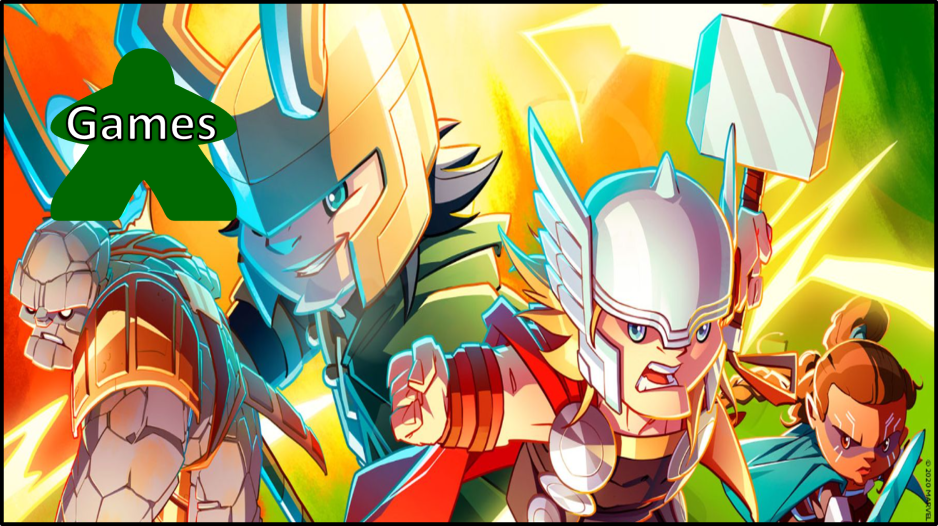
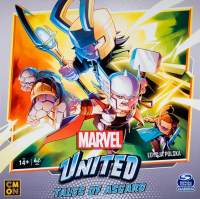
Hey, hey! Kyra Kyle here. In Marvel United, players act as iconic Marvel heroes who work together to stop the master plan of a powerful villain controlled by the game. Each villain has a unique master plan, cards that trigger various effects, and threats that make clearing locations difficult. Heroes clear missions, making the villain vulnerable, and finally take on the big bad villain before they complete their dastardly plan. Can you save the day in time? Tales of Asgard casts players as Marvel versions of Nordic mythology.
Hark, brave do-gooder. Before we doth continue further, thou must first indulge Tales of Asgard’s finest of prints.
The Fiddly Bits
Designer: Andrea Chiarvesio and Eric M. Lang
Publisher: CMON Global Limited and Spin Master Ltd.
Date Released: 2021
Number of Players: 1-4
Age Range: 8 and up
Setup Time: 5-10 minutes
Play Time: 30-40 minutes
Game Mechanisms
Cooperative Play
Hand Management
Modular Board
Solo / Solitaire Game
Variable Player Powers
Game Setup
We already covered the Game Setup and Game Flow in our Marvel United review (here’s a link to that review), so we’ll go over the basics in the following two sections. Let’s cover an abbreviated review of the game setup and rules.
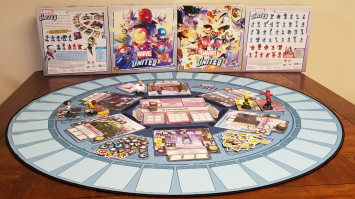
Marvel United’s setup can change depending on which Villain and Heroes you choose to play. Each game consists of six locations. Typically, core sets have eight locations. Since Tales of Asgard is an expansion, it only has six. You may choose your locations or shuffle them and choose six at random. Each Location card has spaces at the top for civilians and thugs and a rectangle with a block of text that will state “End of Turn” at the top of the box.
Place civilian/thug tokens on their matching spaces. Shuffle the Villain’s Threat deck and deal out each Threat face-up so that it covers the rectangle at the bottom of each location. You must clear this threat before gaining the “End of Turn” effect printed on a Location. Place health tokens where signified on threat cards and on the Villain dashboard. Place the three mission cards (Defeat Thugs, Rescue Civilians, and Clear Threats) face up under the villain dashboard where the text reads “Unlocked.”
Each player shuffles their hero decks and then draws three cards to form their hands. Shuffle the Villain’s Master Plan deck. Leave the Master Plan deck face down. This will be the villain’s draw pile.
Players place their miniatures on one of the six location cards, usually the centralmost location for each player (easy access). Then, they place the villain on the location card opposing the heroes.

Game Flow
The villain(s) play first. Draw the top card of their master plan deck. The villain moves the number of spaces indicated. Resolve any BAM! Effects and these effects will be printed on a space within the villain’s dashboard. Then, place the civilian/thug tokens (if any) indicated at the bottom of the card. After all these effects are resolved, the heroes get their turn.
Heroes pick who goes first, and hero turns will continue around the table clockwise. At the beginning of each game, Heroes will get three turns before the villain receives another turn. During their turn, heroes play one card from their hand.
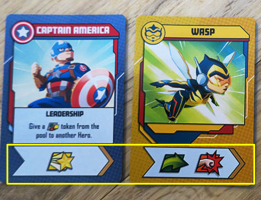
Resolve actions and the symbols printed at the bottom of the hero’s card in any order. The symbols at the bottom of a hero’s card will be shared with the next player, but any printed action will not be shared. Heroes will use these actions to complete missions. The game begins with three missions in play: Defeat Thugs, Rescue Civilians, and Clear Threats. Each mission card will have spaces for the tokens they require to complete. As soon as these spaces are filled, the card is discarded, and the mission is considered complete. Mission cards can be completed in any order.
After the heroes complete the first mission, the villain panics and will act (play a card) every two hero cards instead of every three hero cards. After the heroes complete the second mission, the villain becomes vulnerable to damage. The heroes can complete the third mission, but it isn’t necessary. If the heroes do complete the third mission, each hero immediately draws 1 card, increasing each player’s hand size by one.
Play continues back and forth until either the villain wins (by completing their unique master plan or anyone, heroes or villains, runs out of cards) or the heroes win by dealing enough damage to the villain after the villain becomes vulnerable to damage.
Review
In the comics and the MCU’s first phase, Thor is a part of the core three Avengers: Captain America, Iron Man, and Thor. We’re mostly covering the Tales of Asgard expansion because plenty of people will want to have Thor as part of their heroic line-up, especially since the original core box contains Cap and Iron Man. That said, I think the gameplay highlights for Tales of Asgard are its villain, Loki, and oddly enough the Challenge card. Let’s begin with this unique Challenge.

The Traitor Challenge is a hint of what would come in the X-Men Marvel United set. Each player gets 1 Allegiance card, 1 Suspicion Token, and a Wild Token. Three Allegiance cards show “Loyal,” while one is a “Traitor.” The Traitor card must be in play and shuffled with enough Loyal cards to hand out to every other player. Naturally, there’s a three-player minimum with this challenge. If you play a two-player game, it’s obvious who the traitor is. Players may choose to play a Hero card facedown (gaining no benefit from it) to discard their Suspicion Token. This matters because once 2 Missions are complete, all Loyal Heroes still with a Suspicion Token take damage until they’re KO’d. This leads to players who are loyal wanting to discard their Suspicion Token. A player who doesn’t care to do that may be the traitor.
Another thing that happens after 2 missions are complete is that the players guess who the Traitor is. If correct, each Loyal Hero gains 1 Wild Token. The Traitor’s hero is removed from play and now plays as the Villain, drawing 2 Master Plan cards and playing 1 each turn. This is the hint of X-Men Marvel United. Marvel United’s next set allows players to assume a villainous role. The Traitor Challenge is a precursor to this playstyle, and it still works even with future sets. If you enjoy the idea of one player being the Traitor, this challenge is perfect. And it works well with Tales of Asgard’s villain. Loki often assumes the visage of others, so the Traitor Challenge is thematic.

Loki’s a great villain whether you choose to play with the Traitor Challenge or not. Loki is a bit faster than the villains found in the original core set. That makes sense. He’ll hop around the map, making it difficult to deal damage after he’s vulnerable. He also has an “Illusion” Threat Card that makes dealing damage to Loki (while he’s at that location) impossible. While not as powerful as some villains (who have Threat Cards that make their villains impervious to damage for the card existing at all on the board), this, combined with Loki’s movement, makes him a challenge.
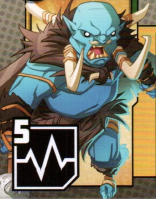
The “Master Trickster” and “Frost Giant” Threats are standard fare. Effective but nothing too special. The “Frost Giant” has more health (5) than most Henchmen, so they can be a chore to dispatch. Loki’s Master Plan deck features a lot of “Each Hero alone in their Location” or “Each Hero not alone in their Location” takes 1 damage, and if the previous statement is untrue, draw another Master Plan card and add it facedown in the Storyline. Both actions can prove fatal because Loki likes running out of cards in his deck by placing Master Plan cards facedown and dealing damage to Heroes whittles a player’s hand and feeds into Loki trying to speed up the clock.

Loki’s Overflow ability can also get annoying. If 1 or more Tokens can’t be added to a Location, Loki gains 1 additional Health (may go above his starting value). While Loki has below-average health for a main villain, his Overflow ability gives him more survivability. Loki surviving an extra round could mean that he may run out of cards and win.
I mentioned that Loki has a lot of movement. Fortunately, the Locations included in the Tales of Asgard expansion sport a lot of movement for their “End of Turn” abilities. “Heimdall’s Observatory,” “Throne Room,” and “Bifrost Bridge” have some form of mass movement. That’ll help when trying to catch up with Loki. The “Odin’s Vault” and “Valhalla” Locations have card draw which can be helpful, while “Asgardian Palace” has an underwhelming “You may add up to 2 Civilian and/or 2 Thug Tokens to any Location.” “Asgardian Palace” can help if you’re facing a Villain who doesn’t place enough Tokens, but most Marvel United villains place ample Tokens, and other Locations allow players to add a Token and clear a token in one action.
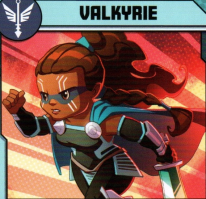
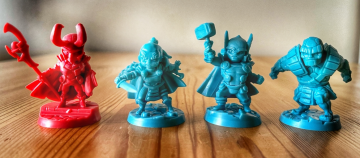
I waited long enough. Here are the Heroes. Surprisingly, Valkyrie is the most balanced character of the bunch. She has a fair amount of Heroics and plenty of movement with her “Warsong” special abilities. The other two Heroes from the base Tales of Asgard expansion, Thor and Korg, focus on Attack. While this makes sense, they do come off as one-note characters. Thor has a little more Heroics and Movement, while Korg allows players to target multiple enemies at once. Both Heroes are situational, but I’d give Thor the nod as a more universal character.
But Thor doesn’t quite claim the top spot as a Hero. If you happen to get the Kickstarter exclusive of Tales of Asgard, you’ll also get Beta Ray Bill. Bill is almost identical to Thor, but I prefer his “Stormbreaker” ability to Thor’s “Mjolnir.” I know, that’s sacrilege. Mjolnir beats Stormbreaker. But “Stormbreaker” gives players more choice with where they assign damage and grants more card draw. Both of those edge out Thor’s “Mjolnir.” Even without the Kickstarter exclusive, Tales of Asgard has some solid Heroes.
Too Long Didn’t Read
The Kickstarter version of Tales of Asgard includes one of the better characters in this expansion, Beta Ray Bill, but Thor and Bill are close enough to each other and serve a similar purpose. The Traitor Challenge Card shows where Marvel United will go in the future, while Loki serves as an interesting villain.
 jkgeekly.com