

1993 is another solid year for tabletop games. This year’s releases saw one massive title and a handful of titles for an older audience. As we dive deeper into the nineties, we’ll have a large pool of tabletop game titles with which to choose.
Hey, hey! Kyra Kyle here. Back with another Top 5 Tabletop Games. We’ll talk about the board games that this year’s list soon, but let’s recap the ground rules for which games make these lists before we start.
1: Cultural relevance plays as much of a factor as overall quality. A game might make a list that doesn’t hold up to others of its type, but you must admit the game is everywhere.
2: Only one game from a franchise makes the list. This will become more of an issue the closer we get to games with expansions.
3: Longevity plays a role, too. A game doesn’t have to fly off the shelves today, but it had to have some widespread appeal for a decent time.
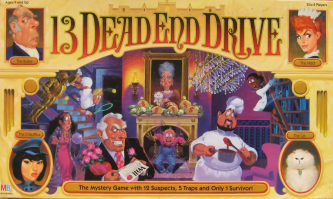
5: 13 Dead End Drive (1993)
13 Dead End Drive is the only board game on this list that could be considered a child’s game. We’re getting to the adult-themed games soon enough. 13 Dead End Drive has a murder theme. The death of a wealthy old woman triggers a feud over her will. Players use traps located on the board (the mansion), to kill characters controlled by other players to claim the estate.
Players are dealt all the “Character cards” which correspond to matching pawns on the board. Since there are 12 characters, players will control more than one character. Players don’t show which characters they were dealt. Matching “Portrait cards” determine who is the current favorite for the inheritance. The third type of cards are “Trap cards” which are used to spring traps and eliminate characters.
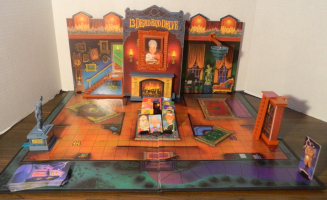
During each turn, a player rolls two dice and moves two pawns, one pawn for each die. It is legal for players to move a pawn that isn’t theirs, especially if the move places a pawn on a Trap space. Characters must end their turn on a Trap space by exact count, and a player must play a matching Trap card for the Trap to take effect. Players win by being the last character standing, escaping the Mansion while one’s character’s Portrait is displayed, or having the final character’s Portrait displayed when the Detective reaches the front door (at the end of 10 rounds).
Despite, the macabre premise, 13 Dead End Drive uses humor and goofy characters to make the game approachable. The game also marks an interesting twist to a murder-themed board game. While games like Clue (or Cluedo) has players trying to figure out who committed a murder, 13 Dead End Drive empowers players by committing a dozen murders.
No. Seriously, this is a game geared toward a younger audience.

4: Europa Universalis (1993)
Europa Universalis is a monster of a board game. The official playing time listed on the game box is six hours, but the game can last for weeks. Board Game Geek estimates the playing time to be 15 days. Europa Universalis is a geopolitical strategy game set from 1492 to 1792. Players take control of European powers during this period. Each country has unique events, objectives, and special rules, for example, Russia’s military power is limited until the arrival of Peter the Great, and England has access to powerful privateers.
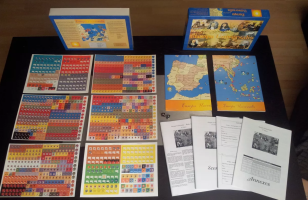
Europa Universalis has plenty of freedom of choice. It offers control over economics, military, maintenance (yes, you’ll have to maintain your country), discoveries, and colonial investment. But this leads to a major drawback, the game has a lot of calculation and management during the game for income, price changes, maintenance (of your regions), and the purchasing of military resources. Europa Universalis may work better as a video game. Fortunately, Swedish video game developer Paradox Development Studio (along with the help of the board game’s designer Philippe Thibaut) adapted Europa Universalis into a video game in 2000. This long-running video game challenges Civilization as the top civilization simulator.

3: Call My Bluff (Liar’s Dice) (1993)
Call My Bluff (Liar’s Dice) has an odd history. The Liar’s Dice class of games has existed since the 15th century (originally named Dudo from the Incan Empire). A variant of Liar’s Dice was published by Milton Bradley six years prior in 1987. Call My Bluff is a remake of the original Liar’s Dice, which was then in the public domain. Richard Borg earned the 1993 Spiel des Jahres (the German Board Game of the Year) for his adaptation of this classic game.
Five dice are used per player with dice cups used for concealment. In each round, every player rolls a “hand” of dice under their cup and looks at their hand while keeping it concealed from the other players. The first player begins bidding, announcing any face value and the minimum number of dice that the player believes are showing that value, under all of the cups in the game. Ones are often wild, always counting as the face of the current bid.

Turns rotate in clockwise order. Each player has two choices. They can make a higher bid or challenge the previous bid, typically with a call of “liar,” hence the name Liar’s Dice. Once a bid is challenged, all dice are revealed. If the bid is valid (at least as many of the face value and any wild aces as the player’s bid), the bidder wins. Otherwise, the challenger wins. The player who loses a round loses one of their dice. The last player with dice at the end of the game wins. Call My Bluff’s simplicity and entertainment value earned it the Spiel des Jahres. If the rules sound familiar, the video game series Red Dead Redemption includes a version of Call My Bluff.

2: We the People (1993)
We the People simulates the American Revolution. I’m sensing a simulation theme with 1993 board games. Published by Avalon Hill and designed by Mark Herman, We the People was the first wargame to use cards as the primary means of controlling the pace and tempo of play; the card play introduces a strong element of fog of war through hidden card information.
One player controls the British, while the other plays as the Continentals/Americans. The map has a web of cities and towns connected by lines along which armies can move. We the People marks one of the first times a designer used a point-to-point movement system, which has become standard with a lot of games. Tens of thousands of modern board games use a point-to-point movement system, and not just war games. The cooperative game about stopping a global pandemic, aptly named Pandemic, may be the most famous game to use a point-to-point movement similar to the one Mark Herman pioneered.

We the People has inspired other war games like Richard Borg’s Command and Colors series. Yes, this is the same Richard Borg who designed the previous game on this list Call My Bluff. But We the People may have influenced GMT Games the most. GMT has produced numerous games implementing Herman’s card-driven combat. Their games include The Napoleonic Wars, Here I Stand, Virgin Queen, and Twilight Struggle, which remains one of the highest-ranked board games on Board Game Geek.
1: Magic: The Gathering (1993)
Magic: The Gathering takes the top spot. No other game that was released during 1993 could’ve taken this spot from the granddaddy of all collectible card games. Magic: The Gathering beget a flurry of collectible card games in the following decade: Pokémon, Yu-Gi-Oh!, Legend of the Five Rings, and World of Warcraft (eventually rebranded as Hearthstone) to name a few. Magic: The Gathering’s designer Richard Garfield even made a few more collectible card games to add to his tally like Netrunner, BattleTech, Vampire: The Eternal Struggle, and the original Star Wars Trading Card Game.

Not going to lie. I played most of these collectible card games at one point or another. Magic: The Gathering has stood the test of time. Sure, Pokémon and Yu-Gi-Oh! have endured, but they were released years after Magic. Magic has outlived most of the games it inspired.
The greatest testament to Magic: The Gathering topping this list is that most people read Magic: The Gathering and nodded yes. Magic is the right answer. Magic is the only answer for top tabletop game for 1993.
Did we get the list right, for the most part? Let us know which games you’d add in the comments. And wherever you are, I hope you’re having a great day.
Check out the other lists in this series:
Top 5 Tabletop Games Prior to the 1930s
Top 5 Tabletop Games of the 1930s
Top 5 Tabletop Games of the 1940s-50s
Top 5 Tabletop Games from the Early 1960s
Top 5 Tabletop Games from the Late 1960s
Top 5 Tabletop Games from the Early 1970s
Top 5 Tabletop Games from 1980-1981
Top 5 Tabletop Games from 1982-1983
Top 5 Tabletop Games from 1984-1985
Top 5 Tabletop Games from 1986-1987
Top 5 Tabletop Games from 1988-1989
Top 5 Tabletop Games from 1990-1991
Top 5 Tabletop Games from 1992
 jkgeekly.com
4 thoughts on “Top 5 Tabletop Games from 1993”