

The nineties were a turning point for modern board games. 1992 has its fair share of great titles, even if many of them skew to a young audience. 1993 was another strong year. As we dive deeper into the nineties, we’ll have a large pool of tabletop game titles with which to choose.
Hey, hey! Kyra Kyle here. Back with another Top 5 Tabletop Games. We’ll talk about the board games that this year’s list soon, but let’s reiterate the ground rules for which games make these lists before we begin.
1: Cultural relevance plays as much of a factor as overall quality. A game might make a list that doesn’t hold up to others of its type, but you must admit the game is everywhere.
2: Only one game from a franchise makes the list. This will become more of an issue the closer we get to games with expansions.
3: Longevity plays a role, too. A game doesn’t have to fly off the shelves today, but it had to have some widespread appeal for a decent time.
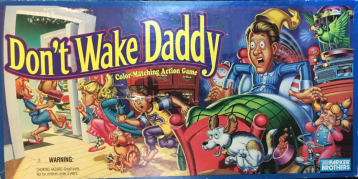
5: Don’t Wake Daddy (1992)
Don’t Wake Daddy kicks off this list and a trend you’ll see with this list. 1992 saw a lot of board games with a strong toy factor. Don’t Wake Daddy is the first of two children’s games. Players take on the role of children sneaking to the refrigerator late at night, trying not to wake their sleeping father who lies in the middle of the board on a large bed. Players move around a board based on the color they spin. If the color of a noise space matches the color of an assigned card that a player holds, they’re safe; otherwise, the player makes one of several noises. A player who makes noise must press the button on the alarm clock next to the father. Eventually, the father will jerk upright from his bed, giving the game its title Don’t Wake Daddy.
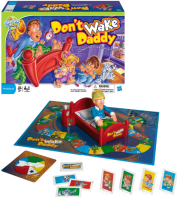
Don’t Wake Daddy has inspired spin-offs in the least likely of places. German artist Martin Kippenberger used the symbols for the different “noises” for a cycle of wood-carvings and oil-paintings. Scholastic published a children’s book based on the game Don’t Wake Daddy: Late-Night Snack, making Don’t Wake Daddy one of the few board games to inspire a book. Jumanji doesn’t count. The book came out first and then the board game. My favorite quote comes from Parker Brothers spokeswoman Ronni Heyman who described the game as “a real sleeper.” I see what you did there.

4: Forbidden Bridge (1992)
Forbidden Bridge has a lot in common with another Milton Bradley release around this time Fireball Island. The company had a board game type during this era. Players take on the role of explorers after ancient jewels, which are guarded by an angry spirit. Occasionally, the bridge guard will awaken (Forbidden Bridge is a mechanized game with a motor) and shake the bridge, which may cause players’ pieces to fall off the bridge. Players can also “steal” another player’s jewel. The first player to retrieve two jewels and return them to their boat wins.
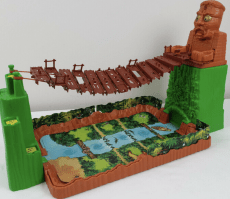
Forbidden Bridge’s premise and art resemble Fireball Island, and that’s not a bad thing. It gave the company an identity during the mid-late eighties and early nineties. Forbidden Bridge also takes the most chaotic element of Fireball Island (the bridge) and expands on it. Some of the bridge spaces have pegs, which are important because they can prevent player pieces from falling off the bridge when the bridge shakes. I’m glad that Fireball Island and Forbidden Bridge have seen remasters and reprints. Unlike the Fireball Island remaster, Forbidden Bridge leaves the original game mostly the same. Forbidden Bridge is a Target exclusive.
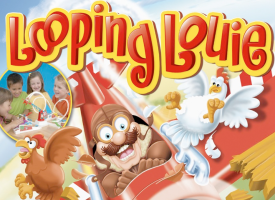
3: Loopin’ Louie (1992)
Loopin’ Louie is the second children’s game on our list. This electronic board game features a crane tower with a figure of the titular Louie in a biplane. Up to four arms (one for each player) are connected to the tower, each with a canal, a barn, three chicken tokens and a lever (paddle). Louie will spin around the board. Players press their respective levers to keep Louie in the air and stop him from knocking the chicken tokens into the canals. You’ll need to time your lever presses carefully. If Louie hits a chicken token on the barn, it falls into the canal. The winner is the last player to have at least one chicken token remaining.
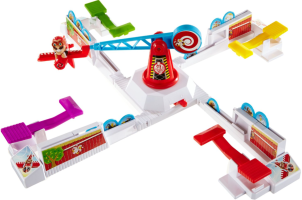
Loopin’ Louie was given the Kinderspiel des Jahres award in 1994. It’s a solid game, especially for a children’s board game. But is Loopin’ Louie solely a children’s game? In Europe, Loopin’ Louie is a drinking game. In fact, Loopin’ Louie sold more than 1.3 million copies between 2006 and 2014 because it was used as a drinking game. I may need to institute a new Oktoberfest tradition.

2: Um Reifenbreite (1992)
Um Reifenbreite translates to “By the Width of a Tire” and puts players in the role of bicyclists during a Tour de France-type race. Each player controls a four-member racing team, and the goal is to score as many points for the whole team. Players roll dice to see how far their team members move, but there is a limited card set that can replace die results. Unique rules allow players to draft one another and add multiple kinds of road surfaces. Um Reinfenbreite is a deep racing experience.
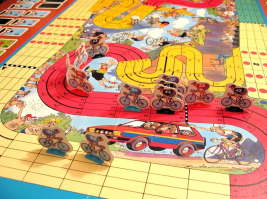
Technically, Um Reifenbreite released in 1979 as Homas Tour, but we’re including the game here because the bulk of the Homas Tour copies were lost in a warehouse fire. Um Reifenbreite would be the rerelease, and the game changed enough that it earned consideration from the Spiel des Jahres. Um Reifenbreite did more than earn consideration, it took home the award in 1992, beating our next game on this list.
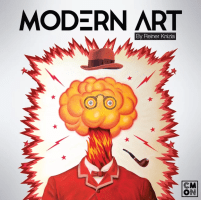
1: Modern Art (1992)
Dr. Reiner Knizia designed Modern Art so that it features numerous auction types. Heck, Modern Art may be THE game for players to learn all the various types of auctions that board games can offer. Each player is dealt a hand of cards, which represent works of art that the player may offer for sale. Players take turns putting these cards up for auction. The auction format is determined by the card offered for sale. Players sell their paintings back to the bank at the end of each round. Whoever has the most money at the end of the fourth round wins.
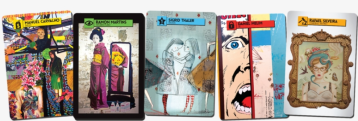
Modern Art was recommended for the 1993 Spiel des Jahres. The jury considered it for the award because “the unusual combination of different auction types makes Modern Art a challenging and varied game experience.” Reiner Knizia would be recommended for the Spiel des Jahres countless times. Knizia is the most prolific board game designer of all time. Modern Art is the first time one of his games makes one of these lists. It won’t be the last.
Did we get the list right, for the most part? Let us know which games you’d add in the comments. And wherever you are, I hope you’re having a great day.
Check out the other lists in this series:
Top 5 Tabletop Games Prior to the 1930s
Top 5 Tabletop Games of the 1930s
Top 5 Tabletop Games of the 1940s-50s
Top 5 Tabletop Games from the Early 1960s
Top 5 Tabletop Games from the Late 1960s
Top 5 Tabletop Games from the Early 1970s
Top 5 Tabletop Games from 1980-1981
Top 5 Tabletop Games from 1982-1983
Top 5 Tabletop Games from 1984-1985
Top 5 Tabletop Games from 1986-1987
Top 5 Tabletop Games from 1988-1989
Top 5 Tabletop Games from 1990-1991
 jkgeekly.com
5 thoughts on “Top 5 Tabletop Games from 1992”