

Plenty of top-notch board games were released in the nineties. This decade is the first where I could list a Top 5 Board Games for each year, and that will happen—closer to 1992 or 1994. But we will keep to 1990 and 1991 for this list of Top Tabletop Games.
Hey, hey! Kyra Kyle here. Back with another Top 5 Tabletop Games. Board games begin heating up in 1990 and 1991. We’ll talk about board games soon, but first, if you’ve forgotten our criteria for the Top 5 Tabletop Games, let’s reiterate the ground rules before we start.
1: Cultural relevance plays as much of a factor as overall quality. A game might make a list that doesn’t hold up to others of its type, but you must admit the game is everywhere.
2: Only one game from a franchise makes the list. This will become more of an issue the closer we get to games with expansions.
3: Longevity plays a role, too. A game doesn’t have to fly off the shelves today, but it had to have some widespread appeal for a decent time.

5: Crocodile Dentist (1990)
Crocodile Dentist was on and off this list. Ultimately, it makes this list of top board games of 1990 and 1991 because it was the best-selling toy of the 1991 Christmas season. Not just a bestselling game, but a bestselling toy. The toy factor for Crocodile Dentist is overwhelming.
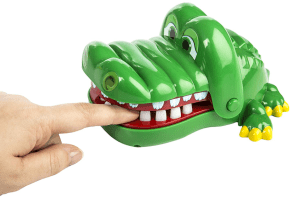
The toy factor makes sense. Crocodile Dentist is a children’s game. In early versions of Crocodile Dentist, players take turns removing a crocodile’s teeth and eventually, the crocodile would snap its jaw shut. Whoever made the titular crocodile shut its jaw was the loser. Crocodile Dentist has a simple premise that makes serious adults groan or guffaw. The York Daily Record’s Mike Argento included Crocodile Dentist in his 1992 Bizarre Toy Awards. However, twelve years later, Argento admitted that the game had “passed into classic status.” And that’s what Crocodile Dentist is, a classic.

4: Tichu (1991)
Real talk. I’ve never played Tichu. It’s the one game on this last that I’ve never played. I would like to; Tichu makes this list because so many board gamers swear by this game. Tichu has a cult following if you will. What I know of Tichu is that it’s a shedding game, meaning that you’re trying to rid your hand of its cards. But Tichu is also a team-based game, so you and your partner are trying to shed your hands before your opponents.

I’ve never had the chance to play Tichu. Tichu is a four-player-only game. If you don’t have four players, you can’t play. And from what I’ve heard, a veteran Tichu player will destroy a noob, and since Tichu is a cult card game, it becomes one of those games where people either don’t play or they’ll only find enjoyment with other accomplished Tichu players. Still, Tichu remains one of the most endearing games on this list, and this list has nothing but endearing games. I’d like to play at least one game of Tichu before long. If anyone plays and you’re going to a board game convention that I’m going to, I’d be happy to learn Tichu.

3: Vampire: The Masquerade (1991)
I can’t remember if I included Dungeons & Dragons in an earlier list. If I didn’t, that was an oversight. But while D&D dominated early tabletop roleplaying games (and still does), the Nineties saw a ton of worthy competitors. Tabletop Roleplaying games saw a boom in the Nineties. The early Nineties only had ten major TTRPG releases. Vampire: The Masquerade is the most famed of these Dungeons & Dragons competitors. In short, Vampire: The Masquerade simulates the afterlife of a vampire.

The developers deliberately didn’t read Anne Rice’s Vampire Chronicles until late in their development process but admit that Rice most likely influenced the vampire films that inspire the game. Rice’s Vampire Chronicles and Vampire: The Masquerade ushered in a new era for vampire fiction and the vampire mythos. The Underworld film series borrows a lot from Vampire: The Masquerade. And the game’s influence was felt in the Nineties. The Goth underground scene flourished with the help of Vampire: The Masquerade and Rice’s Vampire Chronicles.
I still have my original copy and will often pour over the full-page artwork. Artist Tim Bradstreet’s artwork from Vampire: The Masquerade was the concept art for the Blade film series. Vampire: The Masquerade was the height of cool in the early Nineties.

2: Formula D (1991)
Formula D is a strong second on this list. Until some recent games (games from the 2010s and 2020), Formula D does the best job of simulating a race. Heck, Formula D measures up well against newer racing games. It uses specialized dice (d4, d6, d8, d12, d20, and d30) that represent different gears of a vehicle. Formula D uses an additional d20 for collisions and other course events (like weather). With each turn, players must roll a die that simulates which gear their car is in and must move the number of spaces they roll on that die. The core concept is simple. You’re trying to reach the finish line before anyone else. It would make sense to stay in the highest gear you can. The problem comes when calculating car damage.
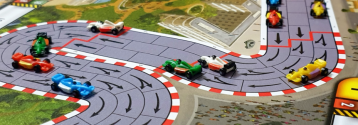
Each player takes a “dashboard” for their car. This dashboard will track damage to the various parts of their car. Each track—and there are plenty of bonus tracks you can use for Formula D—will have twists and turns that you must navigate. Taking a turn at a higher speed will most likely cause players to accept damage. A little damage is no big deal. But you could take so much damage that your vehicle crashes.
I like Formula D’s addition of “Rules for Beginners.” It allows players to learn the basics of the game and only when they get accustomed to the base rules, can they then take on more complex rules. Formula D—like the game that claims our top spot—continues to see play, even though it’s over thirty years old.
1: Hoity Toity (1990)
Hoity Toity has gone by several names. Originally, it was released in Germany by the name Adel Verpflichtet or Noblesse Oblige. It was distributed in the United Kingdom under the name Fair Means or Foul and in the United States as By Hook or Crook. It wasn’t until its 2008 reprint that it became Hoity Toity. I’ll refer to it as Hoity Toity from this point forward. Hoity Toity tasks players as members of a pretentious Antique Club who wager which one of them can acquire—by purchase or theft—the most expensive collection of objets d’art in one day.

Hoity Toity deploys a nice combination of bluffing and silent auction. The game’s movement (there is a track players must navigate) feels unique, especially for the time it was released. There shouldn’t be any wonder that Hoity Toity won the 1990 Spiel des Jahres. Klaus Teuber had a dominant early Nineties. I earned another Spiel des Jahres in 1991—back-to-back awards—for Drunter und Drüber, which just missed this list and another Spiel des Jahres in 1995 for Catan. We haven’t gotten to 1995’s list yet, but Catan will make that list. Hoity Toity gets the nod over Drunter und Drüber because it stands the test of time. Most gamers would place Hoity Toity as the second-best board game of Teuber’s career. Hoity Toity earns that distinction.
Did we get the list right, for the most part? Let us know which games you’d add in the comments. And wherever you are, I hope you’re having a great day.
Check out the other lists in this series:
Top 5 Tabletop Games Prior to the 1930s
Top 5 Tabletop Games of the 1930s
Top 5 Tabletop Games of the 1940s-50s
Top 5 Tabletop Games from the Early 1960s
Top 5 Tabletop Games from the Late 1960s
Top 5 Tabletop Games from the Early 1970s
Top 5 Tabletop Games from 1980-1981
Top 5 Tabletop Games from 1982-1983
Top 5 Tabletop Games from 1984-1985
Top 5 Tabletop Games from 1986-1987
Top 5 Tabletop Games from 1988-1989
 jkgeekly.com
15 thoughts on “Top 5 Tabletop Games from 1990-1991”