

Hey, hey! Kyra Kyle here. It might be a little early for another tabletop game review, but we’re catching up on some of the backlog. Today’s review is one with a high toy factor (a board game with plenty of toy-like features): Sushi Boat.
Sushi Boat leans into its theme; the board is a sushi conveyor belt. Each turn, players perform their choice of actions, including taking plates of sushi off the revolving belt on the board, paying staff tiles for special effects, or buying side dishes. As they eat, players stack plates in front of them. Players score points by eating off matching (color) plates and for eating a variety of sushi types (set collection). The Wasabi Challenge shakes things up by adding a memory component that can swing the victory.
Before we get any further, we’ll set the table and discuss Sushi Boat details.

The Fiddly Bits
Designer: Dario Massarenti, Francesco Testini
Publisher: Japanime Games
Date Released: 2023
Number of Players: 2-5
Age Range: 9 and up
Setup Time: 15-20 minutes
Play Time: 30-75 minutes
Game Mechanisms
Memory
Set Collection
Worker Placement
Game Setup
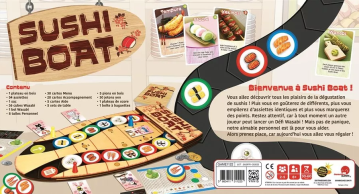
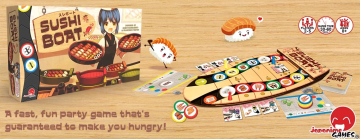
Place the wooden sushi boat board (with a built-in “conveyor belt”); this board is the central visual element and will draw a crowd when placed on the board.
Mix the Staff tiles and randomly place 1 on each Staff space (these are pictured in the rulebook). Place all of the Wasabi cubes in the Wasabi Bowl (Sushi Boat includes ceramic bowls; the production value is insane). Each player chooses a color and takes the matching pawn and player mat. Place all of the Yen in the change tray (again, a ceramic tray), this is the bank. Give each player 2 Yen; players place their Yen on their player mats.

Put all the colored Plates in the bag and mix them well, leaving the white plates to the side for now. Then, randomly draw Plates and add them to the conveyor belt area of the board one at a time until the board is full. Then, draw 3 more plates and add them to the Trash beside the board. After filling the game board, add the white Sushi Plates to the bag and mix them in.
Separate the 4 Wasabi cards from the Side Dish cards and set them aside for the moment. Shuffle the Side cards. Then, depending on the number of players in the game, you will discard cards at random from this deck. Then, set aside a number of Side Dish cards equal to the number of players. Add the Wasabi cards to the Side Dish cards and shuffle them well. Create a face-down draw deck near the game board, and finally, place the Side Dish cards you set aside (not the discarded ones) and add them to the top of the face-down draw deck.
Game Flow
Beginning with the starting player, you’ll take turns going to the left. On your turn, you do the following steps in order:
1) You must turn over the top card of the Side Dish deck and refill the Sushi Boat
2) You must move your pawn to an empty seat
3) You may perform one action (from a selection of 3)
4) You must eat sushi
Let’s talk about the different steps in detail.
1) “You must turn over the top card of the Side Dish deck and refill the Sushi Boat.”
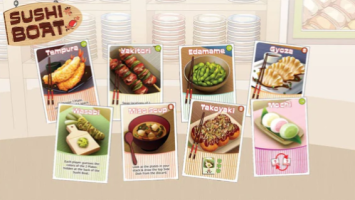
We’ll set the Wasabi card aside for the time being; they’re their own beast. Every other Side Dish card will have a symbol in the top right-hand corner. This will tell you how many sushi plates you’ll need to add to the belt. At the bottom, you’ll find effect text; this will give you a special ability if you choose to purchase the card (in a later step) and then use the card.
Wasabi Challenge:
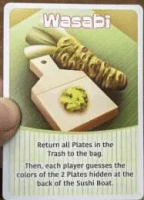
The game stops temporarily. Each player tries to guess the color of the 2 plates hidden in the tunnel at the back of the Sushi Boat. First, take all of the Plates in the Trash and return them to the bag, mixing them well.
Then, each player takes 2 Wasabi Cubes from the bowl and secretly places them on their player mat to mark the colors they think match the hidden Plates. You may place both Wasabi Cubes on the same color if you think both Plates are that color. Finally, add Plates to the board until the two hidden Plates are fully revealed (this will most likely push some Plates into the Trash).

Each player compares their guess to the 2 Plates that were revealed. For each color you guessed correctly, you keep that Wasabi Cube. Any Wasabi Cubes on incorrect guesses get returned to the Wasabi Bowl.
2) “You must move your pawn to an empty seat”
You must move your pawn every turn. You can move it to any seat on the board that isn’t already occupied. But you could pay another player 1 Yen to return their pawn to their player board, so you can claim their seat.
3) “You may perform one action” (from a selection of 3)
A) Visit the Staff: If you’re on a space with a staff member, you can pay 1 Yen to perform their special ability.
B) Buy the top Side Dish: Pay 1 Yen to buy the top card of the Side Dish deck; this will most likely be the card you revealed at the beginning of your turn. Note: Players cannot buy Wasabi Challenge cards.
C) Take 1 Yen from the bank.
4) “You must eat sushi”
Take the Plate from the conveyor belt space that is next to the seat your pawn is on. Typically, you will add these plates to the top of your stack of Sushi Plates. (Some Side Dish Cards allow you to break this rule.)

Play continues like this until the Side Dish Deck runs out. When this happens, the game ends. Players score points for the number of consecutive-colored plates in a row, minus 1. So, a stack of 4 red plates would be worth 3 points. You may have multiple stacks of colored plates. (White plates don’t count for or against a consecutive-colored plate stack.) Then, you add up the sets of sushi you claimed (the unique sushi dishes depicted on the plate; there are 7 sushi types). After that, players get bonuses for playing the most Side Dish cards and some Side Dish cards add a victory point. Finally, each Wasabi Cube is worth 1 point each.
Whoever has the most points wins.
Review
Sushi Boat is a great game with an immense toy factor. This game’s production value is over the top. It may even be too nice—if there is such a thing. Ceramic bowls? Are you kidding me? My oldest daughter just returned from Japan and had plenty of real Yen to replace the punchboard Yen included with the game. Even without that, Sushi Boat has fantastic components.
Sushi Boat balances its elements well. I didn’t think memory and worker placement would work, but it does. I’ve found that younger players (ahem, children, ahem) have an advantage during Wasabi Challenges. I tend to focus on the mechanical aspects of the game like special abilities (through the staff and Side Dish cards) and forget to keep track of which plates have slid under the tunnel. This is the one aspect I’ve found most children gravitating toward. This typically gives a child player an extra three or four points.
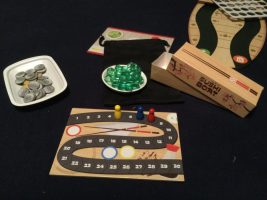
Speaking of the tunnel and the titular sushi boat, the sushi boat looks fantastic. Sliding Sushi Plates across the “conveyor belt” feels great. I’ve even visited a sushi boat restaurant since playing this game. They use colored plates to tally your bill. Ingenious. And that’s what Sushi Boat’s central board is, too. Ingenious.
The one negative I’ve found is the setup and rules explanation. I’m not lying when I cited the setup time in “Fiddly Bits” as “15-20 minutes.” That’s a little long for Sushi Boat’s weight and game length. I almost feel compelled to play more than one game at a time. The rules explanation for new players can also take a little extra time than what I’d like for a game of Sushi Boat’s length, too. But retaining the rules from one play to the next is easy. Barely an inconvenience. The actions that players perform in Sushi Boat are so thematic that it makes it easier to relearn the game, even if you haven’t played in months.
Verdict
Setup and initial rules explanation can be on the long side, but the effort is well worth it for a game this thematic. While an odd combination, the game’s mechanisms work well together and level the playing field for children. And the board. Look at the board!
 jkgeekly.com