

Hey, hey! Kyra Kyle here. Back with another Top 5 Tabletop Games. 1984 and 1985 had even fewer games for this list than the 1982-1983 list. These two years saw a lot of games that got overlooked in previous years find an audience. Axis & Allies was one such game, but it was originally produced in 1981 and made that list. Even the Spiel des Jahres winners for 1984 and 1985 were games from prior years. That said, I still found a handful of games. Let’s talk games.
But first, in case you’ve forgotten our criteria for the Top 5 Tabletop Games, let’s reiterate the ground rules again before we get started.
1: Cultural relevance plays as much of a factor as overall quality. A game might make a list that doesn’t hold up to others of its type, but you must admit the game is everywhere.
2: Only one game from a franchise makes the list. This will become more of an issue the closer we get to games with expansions.
3: Longevity plays a role, too. A game doesn’t have to fly off the shelves today, but it had to have some widespread appeal for a decent time.
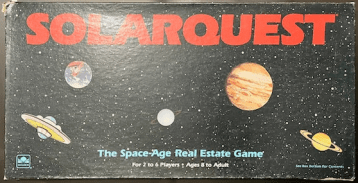
5: SolarQuest (1985)
SolarQuest is a fancy space-age version of Monopoly. Players purchase and develop planets, space stations, and moons set in our solar system. SolarQuest has found renewed interest because of eBay. So much so that it’s recently had a successful Kickstart campaign in 2016. SolarQuest makes a notable addition with fuel. Players must watch their ship’s fuel level because they automatically lose the game if they get stranded with no means to refuel.

Outside of fuel, most of SolarQuest is Monopoly set in space. It can be fun, especially when someone runs out of fuel.
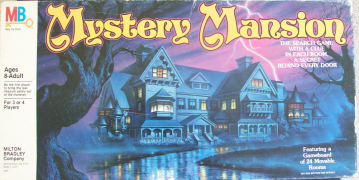
4: Mystery Mansion (1984)
I still quote the mechanical voice of the 1990s version of Mystery Mansion. The original game uses a modular board, one of the first times that a major board game company (Milton Bradley) used a modular board. Mystery Mansion came with 24 cardboard tiles representing different rooms in the mansion: 8 First Floor rooms, 8 Second Floor rooms, and 8 rooms in the cellar.
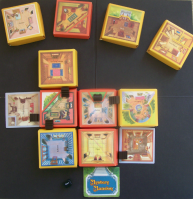
Each room has different doors and objects that come into play during the game, and players must search the items in the room to find the treasure hidden within. The electronic voice version replaces the modular board (the cardboard tiles) for a fixed layout reminiscent of Cluedo (Clue for Americans). In this version, the electronic device will tell the players which items are in the room, so the setup to the house isn’t the same each time. Other than the board and the mechanical voice, everything else remains the same from the original Mystery Mansion.
Fun Factoid: During the 2015 music competition Iron Composer, where composers have five hours to write a piece of music, finalist Ryan Keebaugh used the mechanic voice from the 1990s Mystery Mansion as his “secret ingredient” for his piece.

3: Balderdash (1984)
Balderdash is a variant of a classic parlor game, Fictionary, but it counts as a 1984 release. Seriously, there weren’t that many major games that came out these two years. Anyway, Balderdash is a game of obscure words. Players must create definitions for words seldom used in the dictionary and gain points for guessing the correct definition or having other players select their invented definition.

Balderdash can be great fun but like Trivial Pursuit, if you play the game enough, you’ll learn many of the words and their definitions. Hey! That’s a fun way to increase your vocabulary.

2: Abilene (1984)
Abilene is set in the city of Abilene during 1870. This was the time and place for the main transshipment point for the herds of Texan cattle barons. Players assume the role of ranchers who, with the help of their cowboys, drives their herds to Abilene, trying to capture parts of their opponents’ herd along the way.

Abilene has a few twists on this concept. First, players can capture their opponents’ herds as mentioned, but second, your cattle can be diseased. Players have a certain number of diseased cattle in their herd and whenever a herd makes it to Abilene, one’s opponents guess how much of the herd is diseased. Abilene received consideration for the 1985 Spiel des Jahres. Not bad for a game set in Texas. (Note: games set in the United States at this time didn’t fare well in the Spiel des Jahres.)
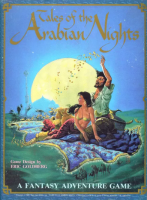
1: Tales of the Arabian Nights (1985)
Tales of the Arabian Nights is getting its 40th anniversary glow-up next year. You can sign up for the Gamefound project preview here (https://gamefound.com/en/projects/play-to-z/tales-of-arabian-nights-40th-anniversary-edition).
Tales of the Arabian Nights uses paragraphs to tell a story where each player travels through the Arabian desert and partakes in adventures from One Thousand and One Nights. Players gain and lose statuses from these adventures and collect Story and Destiny Points. Once you earn enough points to become sultan, you can return to Baghdad to win the game.

Many board game enthusiasts swear by this game as one of the best storytelling games. Every generation, we receive a new version of the game. I’m glad Play to Z has an upcoming new version.
Did we get the list right, for the most part? Let us know in the comments. And wherever you are, I hope you’re having a great day.
Check out the other lists in this series:
Top 5 Tabletop Games Prior to the 1930s
Top 5 Tabletop Games of the 1930s
Top 5 Tabletop Games of the 1940s-50s
Top 5 Tabletop Games from the Early 1960s
Top 5 Tabletop Games from the Late 1960s
Top 5 Tabletop Games from the Early 1970s
Top 5 Tabletop Games from 1980-1981
Top 5 Tabletop Games from 1982-1983
Top 5 Tabletop Games from 1986-1987
Top 5 Tabletop Games from 1988-1989
Top 5 Tabletop Games from 1990-1991
 jkgeekly.com
15 thoughts on “Top 5 Tabletop Games from 1984-1985”