

Hey, hey! Kyra Kyle here. Back with another Top 5 Tabletop Games of an era. We’re keeping the trend of breaking a decade into two halves—for now. Today’s list will be the Top 5 Tabletop Games from the Late 1970s (1975-1979)
In case you’ve forgotten our criteria for the Top 5 Tabletop Games, let’s reiterate the ground rules again before we get started.
1: Cultural relevance plays as much of a factor as overall quality. A game might make a list that doesn’t hold up to others of its type, but you must admit the game is everywhere.
2: Only one game from a franchise makes the list. This will become more of an issue the closer we get to games with expansions.
3: Longevity plays a role, too. A game doesn’t have to fly off the shelves today, but it had to have some widespread appeal for a decent time.

5: Guess Who? (1979)
Guess Who? kicks off this list with a simple guessing game. Players pick a card with a character depicted on it, and their opponent guesses who their opponent’s character is before their opponent can do the same. Guess Who’s? game board features several rows of cartoon characters, each with distinct looks. Players ask yes/no questions about their opponent’s character (typically about their opponent’s hair color, eye color, hair style, hats, etc.) and flip down the portrait of characters who don’t match the answer their opponent gave.
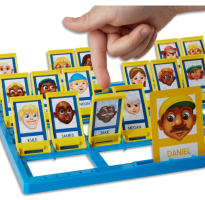
Guess Who? like many other children’s games (like Operation) has spawned a lot of brand-themed versions. Disney princesses, the Marvel Cinematic Universe, and even Cars 2 have had variants of Guess Who?. Guess Who? is a quick and easy game to learn and yet another game that has introduced many to the tabletop game hobby.

4: Ogre (1977)
Ogre is the first Steve Jackson design to make one of these lists, but we’ll most likely see more of his work in future lists. Ogre is a tactical ground combat game set in the not-so-distant future. Combat has become faster and deadlier in the year 2085. Hovercraft, tanks, and infantry dole out damage with tactical nuclear devices, but no weapon is as feared as the giant cybernetic (pretty much AI-driven) tank called the OGRE.

One player takes control of a military force with infantry and armor. They must defend a command post. The other player has only one unit, the OGRE. Ogre plays with asymmetric powers. It may even be one of the first to do so on a grand scale.

3: Dungeon! (1975)
Dungeon! plays out a lot like Dungeons & Dragons, if D&D was simplified and converted to a board game. Players explore the titular dungeon that is divided into levels of increasing difficulty. Players fight monsters for treasure. As you journey deeper into the dungeon, the monsters grow in difficulty and the more valuable treasure you’ll find. Dungeon! uses a lot of the class-types one may find in Dungeons & Dragons.
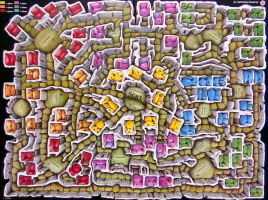
Each character’s fighting style is unique and suited for specific regions in the dungeon. The winner is the first player to bring a certain amount (value) of treasure back to the Dungeon’s entrance. Dungeon! holds a special place for me. It was my first exposure to the world of Dungeons & Dragons, sort of. While the game shares plenty of similarities, Dungeon! doesn’t follow D&D to the letter. And it plays fast and furious.

2: Rummikub (1977)
Rummikub holds the distinction of being the first recipient of the Spiel des Jahres (German Board Game of the Year) in 1980. You may notice that Rummikub was published in 1977. It didn’t become widely published until a year or two later. Rummikub plays similar to several other central European card games (like Rummy) which are played with two decks of playing cards. Ephraim Hertzano invented the tile game Rummikub in the 1940s when Communists outlawed card playing.
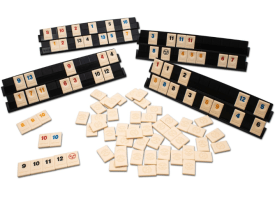
Rummikub didn’t catch on in the rest of the world until after Hertzano published his 1978 Official Rummikub Book. Like Rummy, you try to get rid of all your tiles by forming numbers into runs of 3 tiles or more, or 3 to 4 of a kind. The colors of the numbers on the tiles function like card suits.
Rummikub proves that people want to play games, especially when an over-bearing regime tells them they can’t. This act of rebellion made Rummikub the perfect first recipient of the Spiel des Jahres.

1: Cosmic Encounter (1977)
Cosmic Encounter takes the top spot because it popularized one of the most beloved game mechanisms of all time: Variable Player Powers. Each player takes control of a unique alien race with a special power. They battle each other for galaxy supremacy.
But Cosmic Encounter is far more than just combat. To win Cosmic Encounter, players spread themselves onto five foreign worlds. Players will often enlist the aid of opponents to take out another opponent or allow them to accomplish one of many challenges. Alien powers, which are unique to each race, give players ways to bend or outright break the game’s rules. The game continues until one player occupies five planets. Shared victories are possible, and a player doesn’t need to occupy their own system to win.

Like I implied, Cosmic Encounter has inspired so many modern board games. The Variable Player Powers mechanism tends to sell board games. And even games like Magic: The Gathering owes their inception to Cosmic Encounter. These alien powers allowed players to break the rules; one of the statements in Cosmic Encounter’s rulebook suggested that if an alien power deviated from the rulebook, follow the rules on the alien power. That’s like Magic’s golden rule of cards. Whenever a card’s text directly contradicts these rules, the card takes precedence. Collectible Card Games owe their existence to Cosmic Encounter. It had to take the top spot.
Did we get the list right, for the most part? Let us know in the comments. And wherever you are, I hope you’re having a great day.
Check out the other lists in this series:
Top 5 Tabletop Games prior to the 1930s
Top 5 Tabletop Games of the 1930s
Top 5 Tabletop Games of the 1940s-50s
Top 5 Tabletop Games of the Early 1960s
Top 5 Tabletop Games of the Late 1960s
Top 5 Tabletop Games of the Early 1970s
Top 5 Tabletop Games from 1980-1981
Top 5 Tabletop Games from 1982-1983
Top 5 Tabletop Games from 1984-1985
Top 5 Tabletop Games from 1986-1987
Top 5 Tabletop Games from 1988-1989
Top 5 Tabletop Games from 1990-1991
 jkgeekly.com
3 thoughts on “Top 5 Tabletop Games from the Late 1970s”