

Potion Craft by indie game developer niceplay games created a craft system you want to play. Visuals inspired by medieval manuscripts blend with unique gameplay for concocting potions to form a singular video game experience.
Hey, hey! Kyra Kyle here. We’ll get back to another free-to-play game soon enough, but in the meantime, let’s cover another paid game. You can get a good deal on the game through sites like Steam or the PlayStation store (PS4/PS5). Usually, Potion Craft sells for around $20, even without a sale. Potion Craft’s unique graphics drew me in, but its stellar gameplay kept me engaged for hours. Let’s see how well Potion Craft stands up to our rating system.

Mechanisms: 10/10
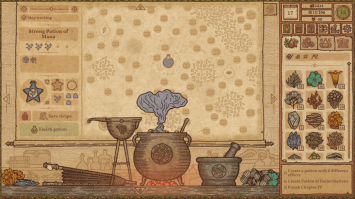
Potion Craft innovates on the tried and tired crafting game. The video game scene has seen an influx of alchemist simulator games in the last few years. Most of these alchemist simulators would have players accruing ingredients through exploration (through a dungeon mechanism separate from alchemy) and learning new potions through trial and error. Potion Craft streamlines this process. Players explore a perilous map by adding ingredients to their alchemy pot. Ingredients (that players obtain through farming or purchasing from vendors) move the player’s cursor on the map north, south, east, or west. But these ingredients seldom allow for traveling in a straight line. Spiral and zig-zag movements reign supreme. Once the bottle-shaped cursor reaches an ability, players can stoke the fire and boil their potion, so the potion gains that ability.
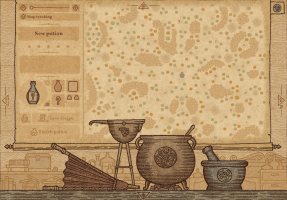
This simple, yet ingenious, twist puts the focus on alchemy. I waited for a second gameplay type where I played as my character dungeon diving for ingredients. That gameplay never came, and Potion Craft is the better for it. At times the gameplay can feel puzzly, but with the focus on what I put in my alchemy pot almost all the time, I felt more like an alchemist in Potion Craft than I’ve ever felt in any other video game of this ilk. And I’ve played a handful of alchemist simulators. If an alchemist simulator sounds intriguing to you, you owe it to yourself to play Potion Craft.

Gameplay Loop: 9/10
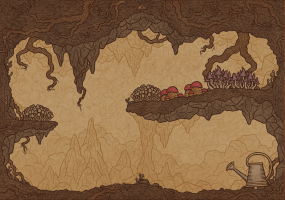
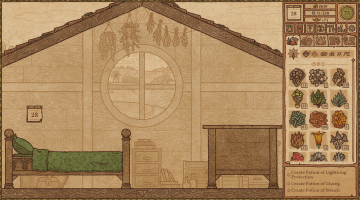
Pick ingredients from your alchemical garden. Then, tend to your garden. Serve your customers by guessing which potion would best fix their problem. You may haggle with the price if you want. Finally, explore the alchemy map to find new potion types or find better (more efficient) ways to produce potions.
Potion Craft is one of those notorious games for “just one more turn.” Everything seems as if it’s just one day (turn) or two away. Even when you know how to make a potion and save the potion’s recipe, you can create the potion, using fewer ingredients, so that you spend fewer future ingredients. That’s another great feature of Potion Craft. The ingredients you used when creating a potion recipe you saved will be used whenever you make potions from that saved recipe. There’s a reason to make the same potion twice. Let’s say that it took you three Waterblooms to make an Ice potion. But you unlocked Tangleweed and began farming that and it only takes you one of those to make an Ice potion. This can save you time, resources, and money in the long run. Brilliant!
Frequently, I’ll make a less-than-desirable recipe for a potion type just to have a means of making that potion. When I unlock the means to make that same potion on the cheap, I take it. And it feels good exploring the map through alchemy, even when I’ve already unlocked the ability I’m heading towards. Each day, experience boosts (in the form of alchemy books) reset, and players can collect them again. This allows you to level up your alchemy skills, and the skill tree, while basic, does a good job of giving players choices. Do you want to focus on selling potions, exploring the map, or farming? The choice is yours.

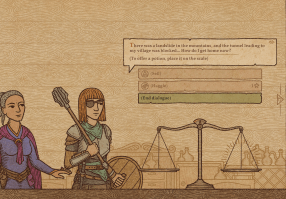
And then there are the customers. This dovetails into the Storytelling section (and less so for Narrative) but I’ll begin discussing the customers here. Customers often don’t tell you exactly what they want. Even when they do, there are often multiple ways to fix a problem. Light spoiler: a customer may say that they locked themselves out of their house; you can choose to give them an explosive potion or acid. I don’t know how many times I’ve seen Season pick a means of fixing a problem that didn’t cross my mind. And she’s said the same for ways that I’ve solved the occasional problem.
But the core element is map traversal through alchemy. I didn’t expect to like the map movement that much, but Potion Craft nails the explorative nature of throwing things in a pot and seeing what happens.
Narrative: 5/10
Potion Craft doesn’t have much in the way of a narrative, but I gave it a five because of its implied customer backstories. Sure, some customers have generic “my stomach hurts, do you have a potion for that?” But others have more sinister motives should you get to know them better. Others still have bizarre stories like why does a scuba diver exist in medieval times? Players will have to piece together scraps of story to make one that makes sense, but Potion Craft does have a loose-knit story.
Storytelling: 7/10
Like Papers, Please, which we covered last month, Potion Craft tells its story in the game’s negative space. Hidden within the string of customers who stop by for potions rests a deeper narrative for those characters and the town in which they live. I won’t spoil some of those stories here, but Potion Craft builds its world and its story through the people who stop by for magical potions. And I love this world.
Citizens solve mundane problems with magic. Why not? If magic is plentiful, why wouldn’t you solve any minor inconvenience with alchemy? Potion Craft runs with this premise. You can solve people’s issues at lower difficulty settings through multiple means. You may need a specific potion with multiple effects if you raise the difficulty. Unlocking abilities to converse with customers may yield even more backstory. And that’s where Potion Craft’s story lies: the characters’ backstories.
User Interface: 8/10
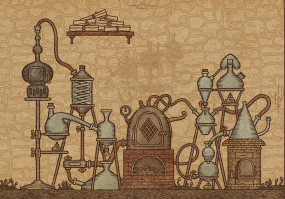
Potion Craft does a great job of showing players where their alchemical ingredients will lead them on the map. The locations are easy to navigate. The goals are easy to find and understand. In short, Potion Craft does a great job of showing its players how to play the game. But at the same time, it still gives players the freedom to come up with unique solutions to problems.
Like I said before, there’s more than one way to fix an issue, and Potion Craft gives players the time and space to explore those options. Potion Craft’s setup isn’t the hectic DMV hellscape as Papers, Please. It organizes things in a way for players to thrive. Potion Craft is a layback and chill game instead of a tense, don’t make a single mistake game like Papers, Please. While the two user interfaces work for the games that use them, I prefer Potion Craft’s interface. I’d rather a game show me exactly what I can do. Potion Craft does this better than most.

Graphics: 9/10
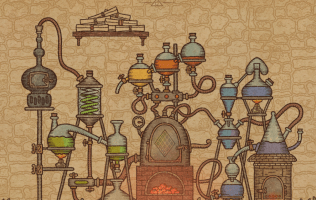
Potion Craft uses medieval documents and medical books as the basis for its graphics. While simplistic, the art amplifies Potion Craft’s subject matter. I don’t know if any other graphics would’ve worked for this game. You can tell that Potion Craft is a labor of love for the designers. The user interface and graphics merge intuitively. Part of the reason why the user interface works as well as it does is because the graphics feed into the user interface and the theme. I feel as if I’m grinding leaves, flowers, berries, and roots with a mortar and pestle. There were times when I swore, I could smell the herbs.
Audio: 6/10
I’m not going to lie. I played Potion Craft while muted most of the time, but when I did have the sound on, it worked well. I wouldn’t say that Potion Craft has the most memorable soundtrack. Its soundtrack is serviceable. Potion Craft’s sound effects are what give it an above-average audio rating. You can hear the crunch of leaves and fruit. Heating your potion is satisfying. Pouring water into your solution to thin your potion is visceral. Seriously, I had to go to the restroom after hearing pouring water on more than one occasion. Potion Craft amplifies its tactile gameplay with sound effects.
Replay Factor: 8/10
This is a difficult section to grade. Potion Craft may not offer much in terms of replays through different games. You can get by beating each difficulty setting once. As of this write-up, there are four different difficulties. This still gives you well over 100 hours of gameplay. I’m giving Potion Craft a higher replay factor score because of the replays during your initial play.
I mentioned before that you may want to optimize your potion recipes. That leads to numerous hours of gameplay. But Potion Craft has a sneaky other reason why you might play. Your alchemy shop has a reputation score. You could play an evil alchemist and only sell potions to people who have nefarious plans. I didn’t know who would order a Necromancy potion with my first play. Switching to an evil alchemist showed me who would order a Necromancy potion. It doesn’t look like it, but Potion Craft is a sandbox game.

Aggregated Score: 7.8
I enjoyed my multiple playthroughs of Potion Craft. It’s the preeminent alchemist simulator game. If you have any interest in an alchemist simulator game, give Potion Craft a try. With Potion Craft’s quirky graphics, I didn’t know what to expect. The streamlined nature of Potion Craft’s gameplay is a revelation. Developer niceplay games and publisher tinyBuild are on my radar. I can’t wait to see what this studio has planned for next.
 jkgeekly.com