Hey, hey! Kyra Kyle here. We’re going to do something a little different with this board game list. It’s not a list of starter board games of a specific type. If you want us to continue the starter board game series, let us know. It’s not a top 5 or top 10. Nope. This is a list of 5 great board games with a specific style. Today’s list is 5 Great Word Board Games.
Seeing as this isn’t a top 5 list, the games won’t be in any order. We’re also going to try and stick to different kinds of games within the same style, so this list of great word board games won’t be five different versions of Scrabble…hopefully. Without any further ado, here are the games.

Paperback
Paperback combines the idea of a traditional word board game (like Scrabble) with a deck-building game. Players must make words with the letter cards they draw (or a combination of letters on a card like “Th” or “Qu”) and they earn money with which to purchase victory point cards or more letter cards to add to their deck for future turns. Paperback balances its two elements well. A player who can slay at word games can dominate that section, but a player who has more experience and can shift their strategy to the cards present in the deck-building array (you’ll have different cards most turns) can use that to their advantage.
Paperback allows multiple paths to victory and that sets it apart from a lot of other board games centered around words.
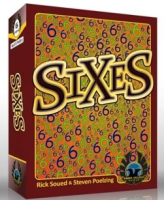
SiXeS
We recently reviewed SiXeS. (If you want to see that review, follow this link.) So, there’s a high probability that SiXeS would make this list. If you don’t want to read the review, that’s okay. We’ll break down the gameplay. SiXeS plays a lot like Scattergories with a twist. Players alternate turns where they want to match the answers to specific questions with their opponents with turns where they want to give unique answers. Unlike other games like Scattergories, SiXeS keeps the gameplay fresh by varying its gameplay each round.

Letter Go!
Like Paperback, Letter Go! combines a word game with another game type. But Letter Go! goes in a completely different direction. It combines a word game with a pseudo-dexterity game. While Paperback’s turns can be slow and methodical, Letter Go! is a real-time race to see who can spell a word using the cards at their disposal while following a rule on their dry-erase board. Some of these rules dictate that you must use your non-dominant hand. Others may say the word’s letters need to be wavy or look like flowers. Even more say that you must repeat all consonants you use but not the vowels.
Letter Go! shakes up the common word game. Just because you can think of a word quickly doesn’t mean that you’ll be able to also obey whatever rule card you draw. Talk about leveling the playing field.

Codenames
I know. I know. Codenames was everywhere for a few years. It’s the gamer’s word game, but there’s a good reason for that. Codenames melds several elements in a fun way. It combines the lateral thinking of TriBond. As the clue-giver, a series of cards with words printed on them stand before you. You can only give a single-word clue accompanied by a number (the number of the cards that match the clue you gave). Your teammates must guess which cards they believe match the clue you gave. But beware, there’s an assassin card. If your teammates choose that card, your team automatically loses.
Codenames has a nice push-your-luck element. As the clue-giver, do you add an extra word or two and make your clue broader? As the guessers, do you continue picking words you think fit the clue or stop after getting one correct? The other team is racing against yours to guess their words. Ultimately, the choice is yours. Choose wisely.
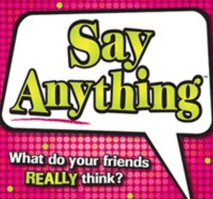
Say Anything
Say Anything is for those who like games like Apples to Apples or Cards Against Humanity. I don’t care for Cards Against Humanity that much, and I got as much out of Apples to Apples without needing to play it any longer. Both Apples to Apples and Cards Against Humanity use pre-printed question and answer cards. There are only so many word combinations you can come up with, but what if you could fill in the blank and provide your own answers? That’s exactly what Say Anything does. You no longer need to find the perfect joke answer for a question. You can write your own joke.
When you’re tired of the same old answers or you don’t want to buy expansion decks for Cards Against Humanity, try buying one copy of Say Anything. The only downside is that you may need to be sober—or at least coherent—to answer the questions.
Say Anything wraps up our collection of great word board games. I’m sure that there are plenty of your favorites that didn’t make the list. Be sure to let us know about them in the comments. And wherever you are, I hope you’re having a great day.


 jkgeekly.com