

On Tour puts you in a rock band. You’re living the dream. You must schedule the band’s stops over your 100-day tour, visiting as many states (or countries depending on the map you choose) as possible. Roll the dice and chart a course with the most concerts.
Hey, hey! Kyra Kyle here. Today’s tabletop game review is the roll-and-write game by All Play (BoardGameTables.com at the time of its original print) On Tour. We’ll set off on our tour soon, but first, let’s handle some of On Tour’s behind-the-scenes details.
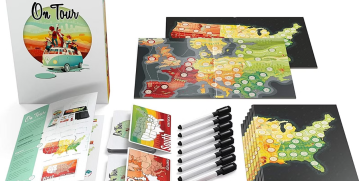
The Fiddly Bits
Designer: Chad DeShon
Publisher: BoardGameTables.com
Date Released: 2019
Number of Players: 1-8
Age Range: 8 and up
Setup Time: Less than a minute
Play Time: 20 minutes
Game Mechanisms
Bingo
Dice Rolling
Line Drawing
Network and Route Building
Push Your Luck
Simultaneous Action Selection
Solo/Solitaire Game

Game Setup
1) Give each player their own player board and a dry-erase marker.
2) Shuffle the cards and place them in the center of the table.
3) Roll the dice (2 large 10-sided dice). For setup only, re-roll doubles.
4) Combine the results to form two different 2-digit numbers (i.e. 1 & 4 combine to form 14 & 41).
5) One player draws a card. All players write the lower dice combination on that state.
6) Draw another card and all players write the higher dice combination on that state.
7) Each player circles both numbers.
8) Repeat steps 3-7.
9) Remove the four cards from the game.
Choose a player to begin the game by rolling the dice first.

Game Flow
With each turn, the rolling player draws 3 cards and reveals the cards for all players. If the deck ever empties, reshuffle the deck to form a new deck.
The rolling player rolls both dice. Combine the results to form two different 2-digit numbers (i.3. 5 & 6 combine to form 56 & 65). All players simultaneously write each of those numbers in two empty states (or countries) on their board.
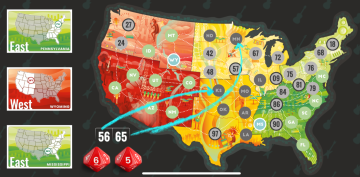
When writing numbers, players choose two of the three cards. The numbers must be written in one of the regions on the displayed cards (like North and Central). If you write a number on the same state displayed on the card, circle it. When writing numbers, a different card must be used for each number.
If all three cards display the same region OR if doubles are rolled, each player draws one star in any one empty state on their board instead of writing numbers. The state must be in the same region as shown on the card. You may still circle the star if you use an exact state from a card.
When all players have written their two numbers, discard the revealed cards and pass the dice to the next person clockwise.
When only one or two empty states remain, do not flip cards, instead roll dice. Players may freely write numbers in any remaining states, following the usual rules.

When all states are filled, the game ends. Beginning in any state, draw a continuous route for your tour. The line must continue to any adjacent state with a number equal to or greater than the previous state you started in. Stars are wild and count as any number.
You can never return to a state that you have already visited. You can never go to a state with a lower number.
Score one point for each state you visit and an additional point for each circled star or number on your route. The highest score is the winner.
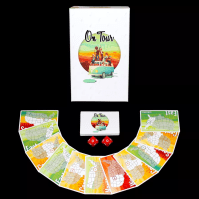
Review
First, I didn’t change much from the rulebook in the game setup and game flow sections. I always use a game’s rulebook as a point of reference when writing these sections. Typically, I need to reword or condense multiple passages in a board game’s rulebook to make it easier to read or to get the gist of how a game is played. On Tour’s rulebook, like many other All Play (formerly boardgametables.com) rulebooks, is easy to read. The company has a mission of making board games accessible to more people. Their well-written rulebooks go a long way toward that end.
I like On Tour’s twist on the roll-and-write or flip-and-write mechanism. Note: roll-and-writes have Yahtzee as a basis, where players roll dice and then fill in the results on their player boards, while flip-and-writes typically replace dice with cards. On Tour combines both mechanisms flawlessly and that leads to each game playing differently. I’ve played plenty of On Tour, mostly solo, and each game presents a different challenge. I may get the card I need, but not the right numbers or I may get the numbers I need, but not the right card. Some combination of this will happen in every game but each game feels fresh.
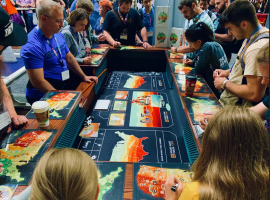
I enjoy On Tour’s solo mode, but the game plays better with multiple players. Like most roll-and-writes, players fill in their maps at the same time and this accommodates larger player counts. Playing with a full complement of eight players may only add ten or so gameplay minutes. Knowing the map helps make decisions easier. I don’t take long to fill in my map, but a new player would take a hot second to make their decision. But I wouldn’t say that knowing a map gives a player an unfair advantage. It’s an advantage but not a huge one. I’ve lost plenty of times to noobs. That may say more about my inability to play On Tour well.
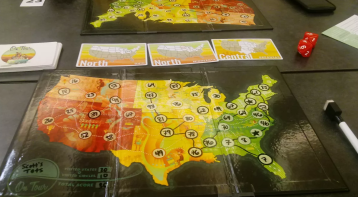
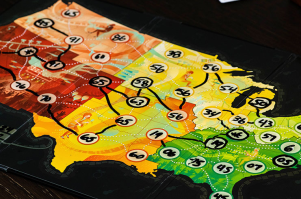
The player boards are two-sided. One side depicts the United States, while the other is a map of Europe. New players should start with the United States. The regions are easier to spot (North, South, East, West, and Central). The straight boundaries of Colorado, Wyoming, and other mid-western and western states help.
I add a rules variant and allow players to chart their route as they fill in states (countries). You can always erase a route if you choose to go in a different direction. The end game (of figuring out which route you’ll take) can take almost as long as the game itself. Filling in a tentative route as you go shortens the time you need for final scoring. It also leads to table talk where someone undoubtedly says, “Well, I guess I’m cut off from Washington (or some other state).” Since you’re using a dry-erase marker, these tentative routes can be altered.
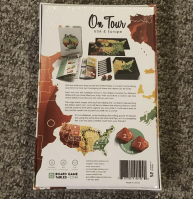
I often bring On Tour while on vacation. While On Tour is one of All Play’s standard box-size games, these boxes are still roughly 7 x 11 inches, making it easy to pack in a suitcase. And its price of $40 is nice. All Play games skew toward wider appeal (code for lighter games), but one can’t question the company’s quality of games and its commitment to cheaper price points.
Too Long, Didn’t Read
On Tour blends roll-and-write and flip-and-write mechanisms for a fresh take on both game mechanisms. While knowing one of the maps can help with making faster decisions, veteran players don’t gain too much of an advantage over newer players. The game plays well as a solo game but sings at large player counts. On Tour continues All Play games’ mission of making board games accessible to a wider audience.







 jkgeekly.com