

Hey, hey! Kyra Kyle here. I return with another Gacha game review. This week’s review will cover Hoyoverse’s Honkai: Star Rail (HSR).
HSR improves upon Genshin Impact’s graphics (if you want to read our review on Genshin Impact, follow this link) and merges elements of older Gacha games with the improved production quality found in modern Gacha games. How does Honkai: Star Rail hold up against our updated video game criteria? (If you’d like to see the Gacha game review criteria, you can follow this link.) Let’s see how Honkai: Star Rail fairs.
Mechanisms: 7/10
Honkai: Star Rail is a turn-based JRPG (Japanese Role-Playing Game) at its core. It doesn’t deviate too much from the formula set by games like classic Final Fantasy titles, Dragon Quest, Octopath Traveler, and the Pokemon series. Turn-based JRPGs inspired many of the first Gacha game titles, so again, HSR doesn’t stray too far from its roots, but it does a couple of things that elevate its Mechanisms score beyond an average five.
Like Pokemon, all enemies have an elemental Weakness. Using a character with an element that matches an enemy’s weakness will result in extra damage. Nothing out of the ordinary yet. Honkai: Star Rail shakes this up just a bit by adding a Weakness bar to each enemy. If a player lowers the Weakness bar (which functions like a second health bar), the enemy becomes vulnerable and won’t attack for at least one round.

Honkai: Star Rail characters not only have an element, but they also have a path they follow. These paths aid players in building teams. Abundance path characters heal. Preservation characters shield themselves/teammates. Path of Harmony characters buff teammates, while Nihility characters debuff enemies. The remaining three paths (Destruction, The Hunt, and Erudition) feature HSR’s main damage dealers. Honkai: Star Rail explores what each one of these paths means, so it gets more convoluted than this. Overall, the path system works.
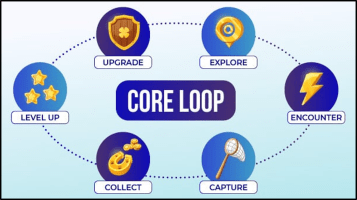
Image from GameDesigning.Org
Gameplay Loop: 7/10
Honkai: Star Rail’s region-based map (as opposed to an open-world map) does mean that players can run out of things to do faster than in Genshin Impact. But I appreciate that. I’ll go more into that in the next segment. Getting back to HSR’s gameplay loop, it uses a lot of the same tricks as classic turn-based JRPGs. You’ll need to grind, but the grinding gets time-gated, meaning that you can only do so much grinding each day. Honkai: Star Rail includes an auto-battle system, which improves the grinding experience even more. Again, I’ll discuss that in “Respecting Time.”

I enjoy the events and timed content in Honkai: Star Rail more than Genshin Impact or even Wuthering Waves. HSR reduces the element of FOMO (fear of missing out) by allowing players to play older and major timed events. You can even play an event, not finish it, and return to it months later. This is a game-changer. I can duck out from Honkai: Star Rail and return to it not feeling like I missed too much. Some older Gacha games included a catalog of older events. I don’t know why Gachas like Genshin Impact and Wuthering Waves insist that their player base will play every event or suffer the consequences.

Respecting Time: 8/10
In this first group of Gacha games I covered, Honkai: Star Rail does the most to respect a player’s time. The auto-battle system I mentioned before is a godsend. I can set up a battle and let the game play itself. There’s little to no need for me to do actual grinding. This system reminds me of auto-battling in the original Final Fantasy Tactics. I let my Playstation run overnight and ended up with a powerful team the next morning. Honkai: Star Rail’s system doesn’t allow for that, but it’s close enough.
I like the auto-battle system a lot, but I would prefer a system more like Punishing: Gray Raven’s (part of the second set of Gachas I’ll cover), which allows players to clear a domain once and then auto-clear the domain again, multiple times in seconds. But an auto-battle system is better than forcing gamers to play the same domain over and over like Genshin or Wuthering Waves. I’ll take it. But the lack of an auto-clear function lowers Honkai: Star Rail’s “Respecting Time” score.

Honkai: Star Rail also has a better character-build suggestion system than Genshin Impact or even Wuthering Waves. Gamers can see suggestions for the equipment they should use for each character at a glance. Genshin added this function years later, but HSR included this system at launch and HSR’s system is more robust. Again, I’d like to see HSR adopt another Punishing: Gray Raven function, which allows gamers to see which team compositions other players use. This wouldn’t stop me from looking up guides online, but it would immediately after picking up a new character. I like having a brief roadmap.
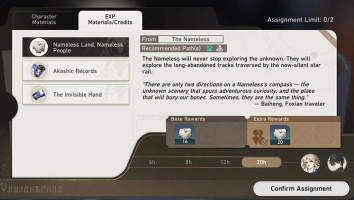
Then, there are a few smaller things that add up. Honkai: Star Rail uses an assignment system like Genshin. The assignment system has gamers sending their characters out on expeditions once daily. After the time elapses, gamers receive the items the characters went out on assignment for. Unlike, Genshin, gamers receive more items they’ll want Honkai. Things like character upgrade materials. Items from chests, breakable items, and enemies are automatically collected by the gamer. No need to run around a mountain face collecting treasure. Players can set their playable character as sprinting, so they will run faster consistently, instead of sprinting for a second and forcing the player to constantly press sprint.
While there is at least one other Gacha that respects its player’s time more, Honkai: Star Rail does a great job at minimizing the tedium. HSR deserves a high “Respecting Time” rating.
Battle Pass: 4/10
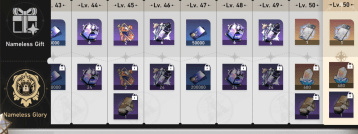
Hoyoverse, Honkai: Star Rail’s publisher, doesn’t do the best with battle passes. I gave Genshin Impact an identical score. I could’ve given HSR a five instead because they did include self-modeling resin (which allows players to craft equipment with specific main stats), but the battle pass weapons (light cones in this case) leave a lot to be desired, and Hoyoverse hasn’t changed Honkai: Star Rail’s battle pass since its launch a little over a year ago. I hold little hope that Hoyoverse will improve HSR’s battle pass.

That said, it’s far more difficult to complete HSR’s battle pass than it is Genshin’s. That’s because Genshin’s BP can be completed in a couple of weeks. Another element that lowers Honkai: Star Rail’s battle pass score is that gamers receive the same reward for the last twenty or so levels of the battle pass. Wuthering Waves does a similar thing. This does make finishing the battle pass less stressful. I don’t feel like I’m missing out if I don’t finish the battle pass because I’m just getting the same thing. But it does feel worse when you complete HSR’s battle pass. There must be a good middle ground.

True Cost: 6/10
While not as generous as other games (I’m looking at you, Wuthering Waves), Honkai: Star Rail does a great job of keeping the Gacha costs lower. HSR beats the pants off Genshin. That’s not saying much. The character banner stays mostly unchanged from Genshin to Honkai: Star Rail. I never had too much of a problem with Genshin’s character banner. A 50-50 chance of getting a banner character followed by a guaranteed banner character after failing to win the 50-50 is fair. The game needs to make money.
Genshin’s issue stems from its weapon banner. Honkai: Star Rail reduces the number of times a gamer needs to lose the featured light cone from twice to once. Furthermore, HSR increases the likelihood of gaining a featured light cone from the banner from 50-50 to 75-25. Players are almost guaranteed the banner weapon the first time. Again, Wuthering Waves ups the ante by making it a guarantee, but we’ll get to our Wuthering Waves review. I promise.

Honkai: Star Rail also provides enough stellar jade (the currency needed for Gacha turns) to get at least one five-star character or light cone. The five-star may not be the one featured on the banner, but each player is almost guaranteed one five-star each patch. Genshin players sport less. Couple the fact that Honkai: Star Rail gave away Dr. Ratio, a stellar five-star damage unit, and the rumor that they intend to do something similar on HSR’s next anniversary and can’t deny that HSR is above average for “True Cost.”
Keeping the needed Gacha turns to guarantee a five-star on a banner at 100 prevents Honkai: Star Rail from getting an even better score. I don’t see this changing. Hoyoverse is married to 100 Gacha turns.

Narrative: 6/10
I like the Genshin storyline slightly more than the Honkai: Star Rail story. That doesn’t mean that HSR’s story is horrible. It’s quite good. I may also need to play more of the story. Genshin has a few more years of storytelling on Honkai: Star Rail. What exists in the story is great. It even facilitates the flow of a Gacha better than Genshin.
In Genshin, gamers search for their missing sibling. The sibling story gets lost when exploring new regions. In HSR, the player’s character gets a mysterious object named a Stellaron placed inside their body. Stellarons function like planetary cancers. Each planet the player visits will have a Stellaron wreaking havoc on it, so each planet links the player character’s story with what’s happening during that specific planet’s story. Gachas release their stories slowly and over time, almost like serial storytelling. Honkai: Star Rail’s premise works better with a serial story.
That said, Hoyoverse doesn’t deliver the best stories in gaming. I may grade HSR harsher because it follows a turn-based JRPG lineage. Turn-base JRPGs are known for better stories.
Storytelling: 5/10
I mentioned this in the previous segment: Honkai: Star Rail has a better setup for serialized storytelling. Hoyoverse still manages the story, and Hoyoverse exhibits horrible storytelling tendencies. Honkai: Star Rail doesn’t have a single character as annoying as Paimon. A few over-the-top characters like March 7th, Bailu, and Yunli do pick up the annoying slack. And you still can’t skip any of the dialogue.
Also like Genshin, HSR does a great job with character stories. I get more out of individual characters than I do from the main storyline. And the storytelling tends to get chopped into pieces and thrown around. But not as much as Genshin’s. I can keep up with the story by watching HSR’s official YouTube channel. That’s a huge plus. Still, I’d like to have gotten more of Acheron and Black Swan’s meeting in Honkai: Star Rail’s gameplay. There are fewer places to search for HSR’s story. But I shouldn’t have to search for Honkai: Star Rail’s story.

The most recent couple of patches (2.4 and 2.5 as of me writing this) concern me in terms of HSR’s storytelling going forward. One patch started a filler storyline of a villain escaping their jail cell. Our main cast is stuck in prison with this villain at the prison’s entrance, and the story stops. To be continued flashed across the screen. I don’t like that. It took me out of the story as I could play these characters outside of the prison. There’s no way a story chopped up like that can keep gamers immersed.
The funny thing is that I don’t recall the main storyline having that hard of a break from one patch to the next. Honkai: Star Rail did a good enough job of leaving the main party in a precarious spot, keeping me wanting more, but also giving me an out for continued play until the next patch release. Why do something like this for a filler patch’s story?

Presentation; User Interface: 8/10
Honkai: Star Rail continues the example set by Genshin Impact. HSR has a clean interface that’s easy to read and comprehend. It still has a few too many sub-subcategories, but not as many Genshin Impact. HSR does a good job of showing the most pertinent information. The quick-select menu is where Honkai: Star Rail puts in the most innovation.
Full disclosure: I play HSR primarily on PlayStation 5. The quick-select menu may work a bit differently on another platform, but Honkai: Star Rail allows me to hold down one button and rotate a joystick around to select what I want from a circular menu. Genshin tries this but I prefer moving a cursor as opposed to pressing two buttons at once. With Genshin’s quick select menu, I must read what each button does. HSR’s quick select menu is far more intuitive.

Presentation; Graphics and Audio: 10/10
Honkai: Star Rail’s graphics improve upon Genshin’s graphics. But graphics aren’t the reason why HSR receives a perfect score. The audio can’t be beat. Honkai: Star Rail’s soundtrack does double duty. It’s memorable but also adds to HSR’s storytelling. I struggled with adding HSR’s soundtrack to its storytelling score. Music theory YouTuber Jonathan Barouch does a great job of breaking down what makes Jarilo VI’s soundtrack so amazing. You should check out his deep dive with this link. So good!
Spoiler alert for Jonathan’s video: he shows the viewer how Honkai: Star Rail music reflects the story’s characters. No fooling. So much thought and care went into the making of HSR’s music. This won’t be the last time you’ll hear from me that Hoyoverse invests a lot into their audio production. Also, make sure you check out Jonathan Barouch’s channel. Hoyoverse soundtracks feature a lot in his work, but he covers more than Hoyoverse games. I like his videos about the NieR series, too.

Aggregated Score: 6.78
Honkai: Star Rail suffers from many of the same shortcomings as Genshin. Storytelling and battle pass issues persist. But HSR takes several steps in the right direction (not wasting as much time) to make me think that future Hoyoverse projects can and will get better. HSR even manages to improve upon one of Genshin’s strengths, the user interface.
Hoyoverse tends to shift its assets and focus to newer projects, but Honkai: Star Rail is new enough that it’ll take some time before it begins to suffer from brain drain. I’ll enjoy the ride while HSR continues delivering the goods.
 jkgeekly.com