
Tabletop Game Review: Flip 7

Flip 7 takes the premise of Blackjack and extends it to party game proportions. Flip over cards one by one without flipping the same number twice. While the game choices are simple (hit or stay), the ramifications of your actions aren’t. Are you the type of player to play it safe and bank points before you bust, or will you risk it all for the bonus by flipping over seven unique cards in a row? Hey, hey! Kyra Kyle here. We’ll review Flip 7 in a moment, but before we draw our first card, let’s discuss Flip 7’s fine print.

The Fiddly Bits

Designer: Eric Olsen
Publisher: The Op Games; KOSMOS
Date Released: 2024
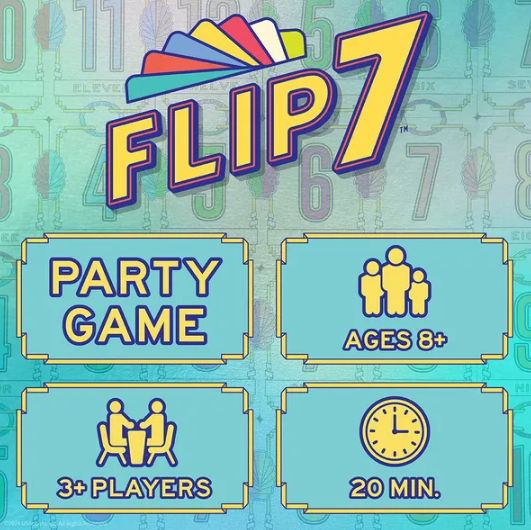
Number of Players: 3-18
Age Range: 6 and up
Setup Time: Nominal
Play Time: 10-20 minutes

Game Mechanisms

Card Game
Party Game

Push Your Luck
Game Setup

Shuffle the deck and choose a player to be the Dealer for the round.

In turn order, the Dealer deals one card face up to each player, including themselves. If an Action card is drawn, resolve it immediately (more on Action cards in the Game Flow section). Once any Action cards are resolved, continue dealing until everyone has been dealt a card. Not everyone will have a Number card (a card with a number). Some players may have multiple cards because of other Action cards.

Game Flow

The Dealer now offers each player in turn the option to “Hit” (deal them another card) or “Stay” (exit the round and bank their points). If you Hit, put the Number cards in a single row with Score Modifier cards.

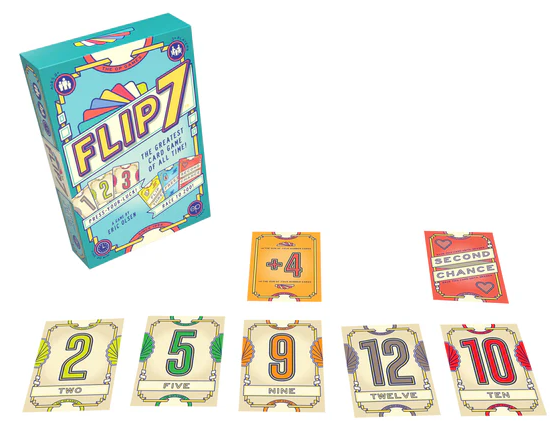
Flip 7 features a special deck of cards. It’s Number cards range from 0 to 12. There are copies of each card equal to the card’s value. For example, there are 12 copies of the 12 Number card and 5 copies of the 5 Number card. Zero is the only exception; there’s only one copy of the 0 Number card. Flip 7’s deck also contains Score Modifier cards (Times 2 which doubles your point value and the rest adding a flat number to your score). Flip 7 also has three Action cards: Freeze, Flip Three, and Second Chance. Second Chance allows you to ignore one bust (drawing the same Number card). Flip Three allows the player to choose a player (even themselves) to draw three cards in a row. Freeze cards are given to a player to force them to stay for the round (they will not be able to draw more cards).

Remember: Players bust (don’t receive points and are eliminated from the round) if they draw two of the same Number card.

The round continues until one of two criteria are met. 1) There are no active players because all players have busted or chosen to stay. 2) One player can Flip 7 number cards, ending the round immediately.

At the end of each round, players score points. Add the value of all your Number cards. Adjust your score with any Score Modifier cards. If you Flip 7 Number cards during the round, score an additional 15 points.

When starting the next round, set all cards from the previous round aside. Do not shuffle them back into the deck. Pass the remaining cards in the deck to the left, that player becomes the new Dealer. When the deck runs out, shuffle all discards to form a new deck. If you need to reshuffle mid-round, leave all cards in front of the players where they are.

At the end of the round when at least one player reaches 200 points, the player with the most points wins.
Review

Flip 7 has taken the tabletop gaming community by storm. I can see why. It has a simple premise (party game Blackjack) and easy-to-understand choices each turn and round. Flip 7 is necessary for the tabletop community. In practice, Flip 7 is the game I can play with my grandma and my four-year-old niece. It’s the most gateway of gateway games.

Since this is the case, I’ve played Flip 7 a ton over the past several months. Seriously, Flip 7 was released during the holiday season (December 2024), I’m writing this in early May (we write many of our reviews weeks, if not months, in advance), and I’ve played this game with 10 different game groups and over 150 times. That’s about 30 times every month. I’ve almost played Flip 7 once every day. One of those months was February, so I’ve definitely played Flip 7 once every day. Frankly, I’m sick of playing Flip 7. It’s a good filler game, but I haven’t seen a game with this much crossover appeal.

And that’s a strength for Flip 7. It’s one of the few games I can get everyone on board playing. That’s why it’s necessary for the tabletop community and for tabletop gaming. But does it convince non-gamers to try other games that aren’t Flip 7? I’m unsure.
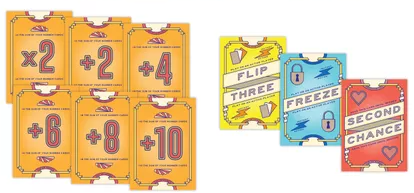
But I do like the inclusion of Action cards. There are three copies of each Action card. Freeze seems mean, but it could be pivotal in stopping someone who had an easy rise to the top of the scoring track; it’s a decent catch-up game mechanism of sorts but this can devolve into targeting the leader (like Munchkin). Players can only hold onto one Second Chance. I don’t know how many times I’ve seen a player forced to give a second copy of Second Chance to an opponent. Those cards have a way of finding the same player. But Flip Three has the most strategic value. During the early game, you may want to target yourself. Later in the game, you’ll want to choose someone else and force them to bust. Is this enough strategy? Probably not for many tabletop gamers.

I can see that people who can count cards have an advantage in Flip 7, but that takes the fun out of the game. While the rules don’t forbid someone from looking at the discard, it goes against the soul of Flip 7. The Number cards value equaling the number of copies in the deck is clever, and the game doesn’t overstay its welcome—unless you’ve played it over 150 times in a handful of months.

Flip 7’s box says 3+ players. Its entry on BoardGameGeek lists it as 3-99 players. The rulebook suggests that if you have more than a dozen players, use a second copy of Flip 7. While this may be technically true, the game plays best at 5-6 players. Flip 7 would overstay its welcome if you included over a dozen players. It would take forever for twelve people to determine whether they should hit or stay. There isn’t much else to Flip 7, but I’d be bored if I had to wait for eleven other people to make that simple choice. And forget 98 other people. I’d walk away from the table.

Too Long; Didn’t Read

While not my first or second choice of filler game, Flip 7 has enough crossover appeal to appease the masses. It doesn’t have enough strategy for hardcore tabletop gamers, but Flip 7 is the kind of game I can get my grandma or four-year-old niece to play. Therefore, Flip 7 is a good game to keep on hand for non-gamers.

Whatcha Playing, Geekly: July 2025

Happy Wednesday, Geekly Gang! The Geekly writers have another month of video games and board games to discuss, but we’d like to hear about the games you’ve been playing, too. Whatcha been playing, Geekly Gang?

Kyra’s Games

Kyra’s Video Games

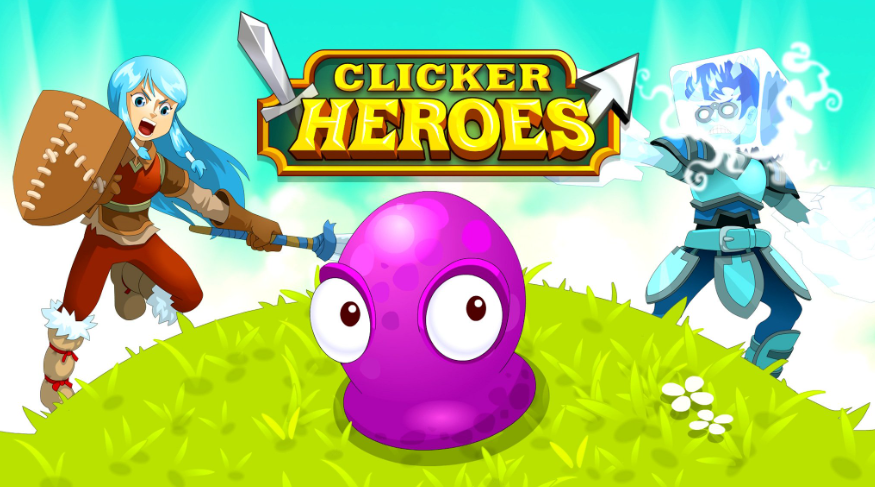
I haven’t played many new video games this past month, but I have gotten into a decade-old mobile game, Clicker Heroes. Yes, this is a hella old mobile game, but it’s new to me. The monsters remind me of the monsters from My Singing Monsters. I’m guessing that’s on purpose. Oh! I may have to redownload My Singing Monsters. Clicker Heroes is a standard idle game. The idea of the game playing itself while you’re gone isn’t new (it’s at least a ten-year-old concept at this point), but Clicker Heroes does a good job of executing the gameplay. I wonder if I can level up my heroes enough to break the game.

Just because I haven’t played many “new” video games doesn’t mean that haven’t been replaying games. Terra Nil and Dorfromantik have dominated my video game hours this past month. I’m writing reviews for both of these cozy games. These reviews should be posted in September. That let’s you in on how far into the future these reviews are. Terra Nil is an anti-city builder (you’re trying to reclaim the earth for wildlife), while Dorfromantik is tile tile-laying video game, where you’re building a pastoral landscape. Both are chill games. I love playing them for the vibes.

Kyra’s Board Games

My gaming group has played even more Flip 7 over the past several weeks. Flip 7 is one of those games we play as a warm-up or as a quick change of pace game. Essentially, Flip 7 is a large group game of Black Jack with specialty cards. The game’s easy to pick up, scales really well, and is a great way to bring in people who aren’t already board game enthusiasts. My Monday gaming group meets at the public library, so we get a lot of random people who walk up to the table. Flip 7 works as an introductory game. It combines just enough new elements with a classic card game.

Prior to joining my gaming group, I hadn’t played many Set Enterprises card games. But we’ve been playing Quiddler, which is a quick and fun word-building game, and Karma, where players try to empty their hands, but they have three cards face-down that they don’t know what they are until they’re played. I’m a bigger fan of Quiddler than Karma, but I appreciate what Karma’s trying to do. The face-down cards cause enough chaos that they even the playing field of a standard card-shedding game. Still, there’s a little too much luck involved (for my tastes) with the Set Enterprises card games I’ve played. But I do really like Quiddler. It’s short enough that I don’t mind the heightened aspect of luck.

I could talk about a handful of other board games, but I’m certain Season and Skye may mention them in their write-ups. I won’t swoop in with any of their entries. Speaking of which, let’s see which games Season and Skye have played over the last month.

Skye’s Games

Skye’s Board Games

I’ve heard good things about Cretaceous Rails for a while–mainly from Kyra and Season–but I haven’t played it until now. I had fun. Cretaceous Rails is a simple board game about creating a dinosaur tourist resort by time-traveling to the past. While I didn’t do so well my first time, I rarely do, I still enjoyed Cretaceous Rails enough to want to play again. Cretaceous Rails is one of those games that has several interesting elements that can only be properly explored across multiple playthroughs. I intend to “git gud.” Also, it’s trains and dinosaurs. Together at last! What’s not to love?

Skye’s Video Games

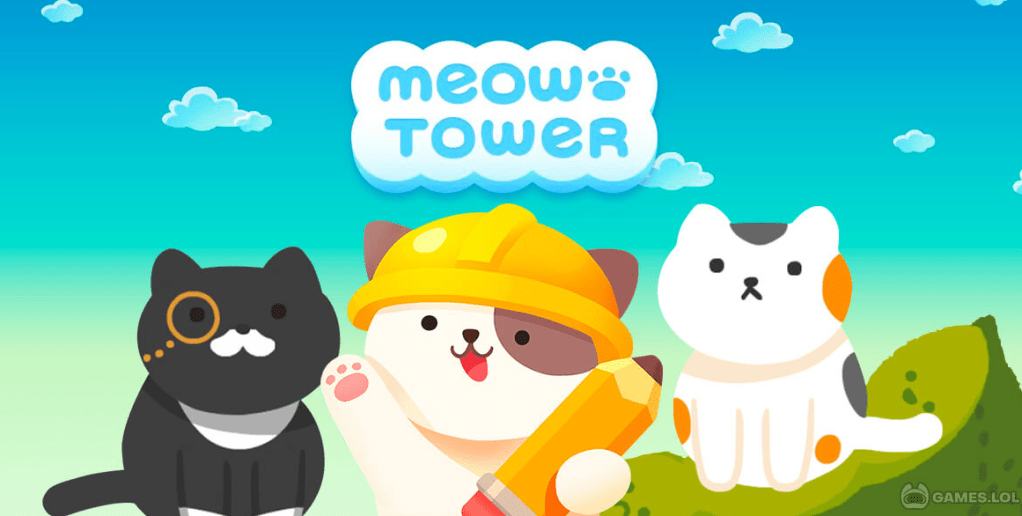
Over the past month, I’ve migrated back to mobile games. Meow Tower is one of the phone games I’ve discovered. In Meow Tower, you’re a human making an apartment building for cats. That’s pretty much it. You get to know each of the cats individually; you design each of their rooms to their liking. You progress through Meow Tower by solving puzzles, specifically Nonogram puzzles. If you’re unfamiliar, Nonograms are spatial puzzles that force you to uncover hidden images given the available clues. If you like brainteasers and cute cats, Meow Tower is a great leisure game.

Last Stronghold is another phone game. I know, I lost a good amount of gamer-cred this past month. Last Stronghold is a basic zombie survival game. What appeals to me about Last Stronghold is its focus on building up your base, exploring the world around you, saving other survivors, and shooting zombies in the face. I just described every zombie game in existence. Dang it. My favorite thing about Last Stronghold is its art style. Call me petty, but that’s pretty much it. With it being an offline phone game, Last Stronghold also has a significant element of leisure to it, which allows you to go at your own pace. Last Stronghold is by far the most benign zombie apocalypse I’ve ever seen.

Season’s Games

season’s board games

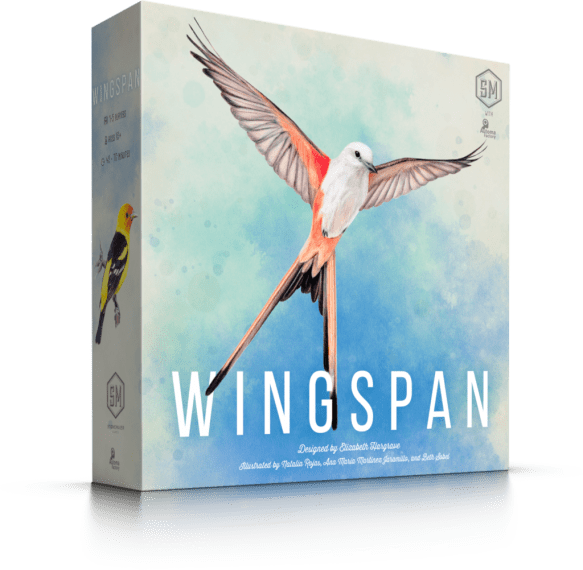
Wingspan is technically a board game, but I’ve played the Steam variant. I’m still counting it since I have physical copies of Wyrmspan and Finspan. It’s like the same thing. The interface on Wingspan is easy to follow. Players can tab between different zones, and the game will remind them in which order to take actions. It’s definitely easier to learn how to play Wingspan through the Steam version since there’s a tutorial. My only nitpick with this version is that players must remember which birds are holding eggs whenever they need to spend eggs. Players can click on the zone where said bird is, but there isn’t a separate interface.

season’s video games

I completely forgot a Persona 5 gacha game was getting released on June 26th. I got an ad for it on YouTube the other day and was like, “Oh. Yeah. I forgot that was a thing.” I’ve gotten a decent way through the story so far, and it’s definitely made me nostalgic for the original Persona 5. The combat hasn’t changed, except that it can be sped up, and they’ve included auto-battles. Some other minor differences include synergy between characters instead of confidants, and, as far as I know, there isn’t a finite amount of time to complete the story.

Persona 5 The Phantom X has players progress the story similarly to the original Persona 5. You must complete the first Palace and learn mechanics. Story-wise, it’s better than other gacha games. I wouldn’t expect anything less from a Persona game, even if it’s a free-to-play gacha game. I’m also digging the character designs. Unlike most gacha games, there are an even number of men and women characters, and they’re adequately dressed. I’m not a fan of boobs in my face. Just saying.

Side note: I pulled for Joker and got him on my first ten pulls. I’m a huge Joker simp lol.

Hey, hey, Geekly Gang! Kyra Kyle here again. Those are all the games our writers have played over the past month. Feel free to share the games you’re playing. Thank you for reading, and wherever you are, I hope you’re having a great day.