

Geekly has played quite a few roll-or-draft and write games (we’ve picked up a couple of great ones over the holidays), and we’ve yet to cover one. In Draft & Write Records players assume the role of a rock band manager. You’ll scout performers, crew, and producers to outperform your competition.
Hey, hey! Kyra Kyle here. We reviewed a new board game for this month (I don’t count expansions, no matter how awesome), so we’re back with another board game review. Draft & Write Records’ name derives from the mechanisms it uses. Players draft and pass cards (which represent band members and important events) and then they write down what the card they drafted said on a massive score sheet (like Yahtzee only way more dynamic). The player with the most points at the end of the game wins.
Before we get any further, we’ll take a quick break from the road and discuss Draft & Write Records’ fine print.
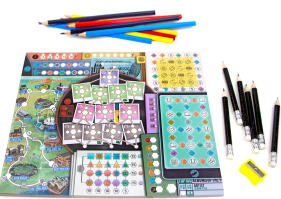
The Fiddly Bits
Designer: Bruno Maciel
Publisher: Inside Up Games
Date Released: 2024
Number of Players: 1-6
Age Range: 12 and up
Setup Time: 5-10 minutes
Play Time: 30-60 minutes
Game Mechanisms
Automatic Resource Growth
Chaining
Closed Drafting
Grid Coverage
Hidden Victory Points
Paper-and-Pencil
Pattern Building
Set Collection
Simultaneous Action Selection

Game Setup
1) Each player takes a Band (Score) Sheet and one pencil (with regular lead).
2) Place the colored pencils within reach of all players.
3) Choose and Record your Band Name. This is optional but fun. I like having players state what they named their bands before play begins.
4) Each player selects a starting color at random and fills in the circle to the left of their band name with one of the colored pencils. Multiple players can choose the same color.
5) Set up the “Play Stack” by looking at each Play Card (gold-backed cards). You’ll find a number in the bottom right-hand corner of the card’s front. This number (if there is one) will let you know how many players are needed to use that card in the game. In a 3-player game, return the cards with 4+, 5+, and 6 indicators to the box.

6) Shuffle the remaining Play Cards to form the “Play Stack.”
7) Shuffle all the Goal Cards (blue-backed cards) and place them in the middle of the table to create the “Goal Stack.”
8) From the Goal Stack, draw and place the top four cards faceup to the right of the Goal Stack to create a line of publicly available Goals.

9) Then, deal two cards from the Goal Stack to each player. Each player selects one card to keep as their personal goal, placing it facedown near their Band Sheet, and the remaining cards are shuffled back into the Goal Stack.
10) Get ready to ROCK!

Game Flow
Each round of Draft and Write Records is divided into two phases: the Week Phase and the Weekend Phase.
Week Phase
During the Week Phase, players draft cards to take actions on their Band Sheet. At the beginning of this phase, deal each player five cards from the Play Stack (the gold-backed cards). Players will select one of these cards and pass the remaining cards to the next player. Each round, the direction players pass their cards changes (to the left, then to the right, and so forth).

During the “Week,” each player will draft four cards in total and discard the last remaining card to their personal discard pile next to their Band Sheet.
1) Players will denote which card they selected by placing the card they chose facedown next to their Band Sheet.
2) Once all players have placed a card facedown, those cards are revealed. Each player takes the action corresponding to the card they chose and records it on their Band Sheet.
We won’t go into detail about all the actions a player can take (there are a lot), but these actions will be indicated by an icon and color on the top left-hand side of each card. These symbols will match symbols found on a player’s Band Sheet.

3) Once all players have taken their action (or chain of actions if they have any), they pass the remaining cards from their hand to the next player.
4) Players repeat this process until they only have two cards remaining. They then choose one of those two cards and discard the other one.
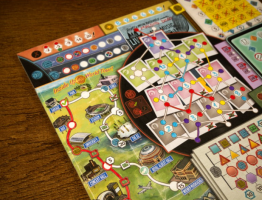
Weekend Phase
During the weekend, players can claim publicly available Goals. If anyone can claim the Goal, they do so, marking the points on their Band Sheet and taking any additional bonuses (like Money). Multiple players can claim a publicly available Goal during a round, but as soon as even one player claims a Goal, it gets scored (by all players who accomplished it), discarded, and a new goal from the Goal Stack takes its place.
Once this is done, and if no one has triggered the end game, another Week begins.
End Game
Play continues until at least one of three end-game triggers occurs.
1) A player claims their sixth Goal.
2) A player checks their fifth Fail. (While there are Fail cards in the Play Stack, a Fail can occur if a player doesn’t or can’t play one of the cards they drafted.)
3) A player fills all 12 of their Crew posts.
After this happens, end-game scoring occurs. We won’t go into detail what these sections are. There are six sections where you can score points and then you subtract the points indicated in your Fail section. Draft and Write Records does a good job of indicating where these sections are and what they mean. The scoring section uses the same icons as the rest of the Band Sheet.
Whoever has the most points at the end of the game wins.

Review
There are many ways to score in Draft and Write Records, so many that I didn’t bother to list the ways. And while it’s easy to tell where to fill in actions on your Band Sheet as you play cards, the sheer number of ways to score can be overwhelming. You won’t have more than five cards in your hand and that helps, but early hands in a round can overload players with too many choices. Draft and Write Records is a game you’ll need to play a few times to get comfortable. Conversely, it’s this same number of scoring means that gives Draft and Write Records ample replayability.
Draft and Write Records is a joy. Its rounds don’t take long. You can expect that with closed drafting games. End of the round scoring (checking to see if someone finished a Goal) doesn’t take long either. I don’t check what other players have filled into their Band Sheets. I could see some players doing that and then feeding the players to their right or left (depending on the round) cards they cannot use. But the Play Cards do that to you anyway. Draft and Write Records forces players to make the best choices they can with the information given. Outside of the time it takes to learn the rules and then the game’s nuances, the game’s biggest issue can be the inability of players to recover from a bad strategy. You may commit to a plan early that will not work and then you’re stuck with that plan.

Fortunately, Draft and Write Records doesn’t take that long to play. The box reads that the game can take up to 60 minutes, but I’ve played it at max player counts and it took about an hour with rules explanation. The fewer players, the less time it will take to play. Lower player count games take closer to thirty minutes. I could see someone take a wrong turn and redeem themselves in round two. There’s a good chance of a round two.
Draft and Write Records’ use of colored pencils is a nice touch. The harmony game mechanism tied to the colored pencils proves crucial. The game didn’t add colored pencils for the sake of adding them. It matters if colors match, creating harmonies, and leading to more chain effects. And chain effects reign supreme. If you like making one good play that sets up another, Draft and Write Records has you covered. I’ve lost count of how many times I’d create a harmony, take the bonus, and that bonus (like producing a record or single) would lead to another bonus and another. Lather, rinse, repeat. And it’s this combotastic gameplay that makes Draft and Write Records shine.

Not going to lie. Draft and Write Records is one of those games where I’ll talk to myself while filling in a long play, and I relish the time it takes for me to go from one bonus to the next, and everyone must watch me fill in blanks until I’m done. The longer it takes for me to fill in my play, the more potential points I just earned. In short, this draft and write game has many combos, and those combos are satisfying.
Verdict
While it may take a couple of playthroughs to understand the rules enough to exploit its numerous ways to score, Draft and Write Records takes little time to play, even at higher player counts. Its harmony game mechanism shines and headlines a series of chain reaction scoring. Draft and Write Records is combotastic.
 jkgeekly.com