

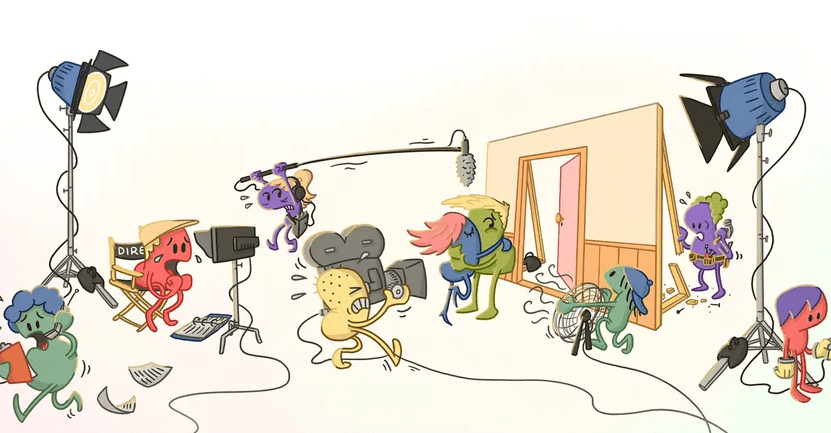
Get ready to make a cinematic masterpiece by rolling dice and placing them in Roll Camera!. Players work for a struggling film production company. The company’s on the verge of bankruptcy and one successful film can turn around the company’s fortunes. It’s up to you to make the best movie you possibly can before time—and money—run out. We’ll get into Roll Camera! in just a bit, but let’s cover some of Roll Camera!’s details.
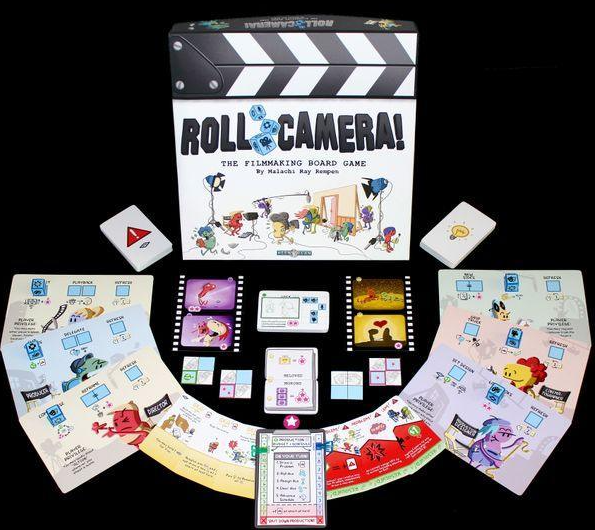
The Fiddly Bits
Designer: Malachi Ray Rempen
Publisher: Keen Bean Studio
Date Released: 2021
Number of Players: 1-6
Age Range: 10 and up
Setup Time: 5-10 minutes
Play Time: 45-90 minutes
Game Mechanisms
Cooperative Game
Dice Placement
Events
Open Drafting
Pattern Building
Set Collection
Solo/Solitaire Game
Variable Player Powers
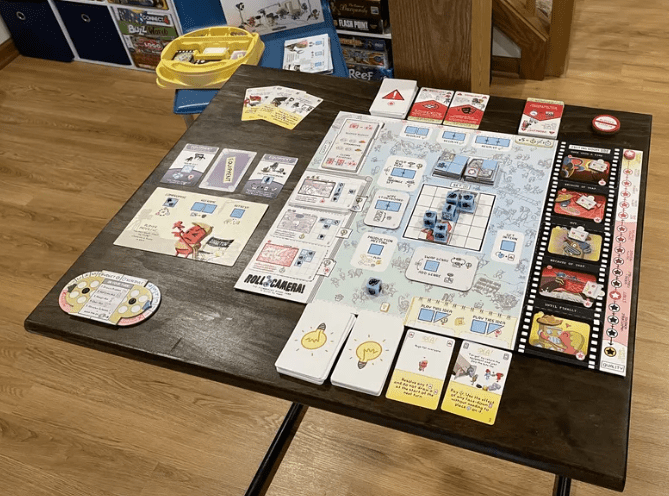
Game Setup
Roll Camera! doesn’t have the best rulebook; it’s a little cluttered. I’ll mention this again in the review section. Fortunately, the game board is easy to navigate, and the company (Keen Bean Studio) produced How-to-play and Turn-by-Turn Walkthrough videos. These videos help a lot. I’ll do my best to convey the information contained within the rulebook.

1) Place the main game board in the middle of the table.
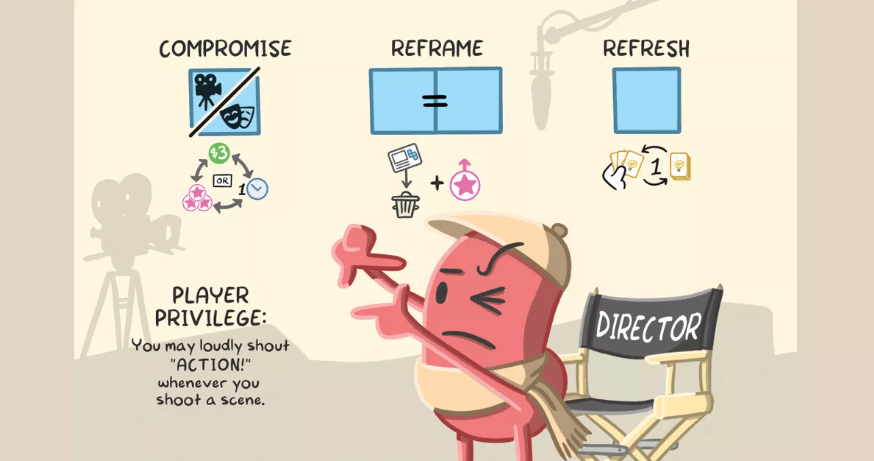
2) Choose or randomly assign one player board to each player. You may use either side. Give each player the Player Aid card that corresponds to their player board.
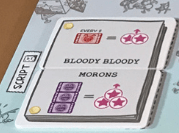
3) Shuffle the top and bottom script cards separately, then randomly select five of each to form two Script decks. Place each deck face-up in the corresponding spots on the board. Return the remaining Script cards to the box; they will not be needed.

4) Shuffle the Problem deck and then place it in its space above the board (the space marked with a red triangle and exclamation point).
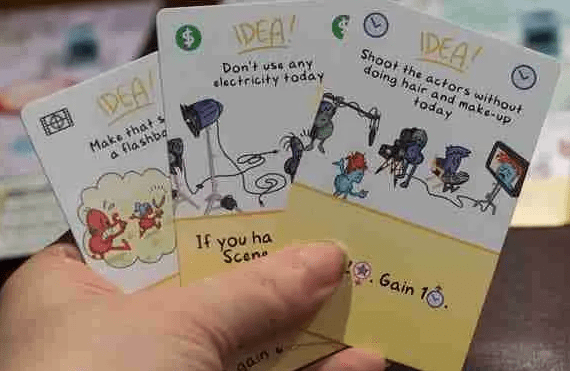
5) Shuffle the Idea deck and then place it in its space below the board (the space marked with a yellow lightbulb).
6) Shuffle the Scene deck and then place it on the topmost Storyboard space on the board with the “sketch” side up. Draw two Scenes from the top of this deck and place them in the two empty Storyboard slots below the Scene deck.
7) Deal each player three Idea cards. Even though Roll Camera! is a cooperative game, keep these cards hidden. You will always have three Idea cards in your hand.
8) Mix up the Set Piece titles and place them face-up in two even stacks on their designated grey spaces on the main board, above the Set.
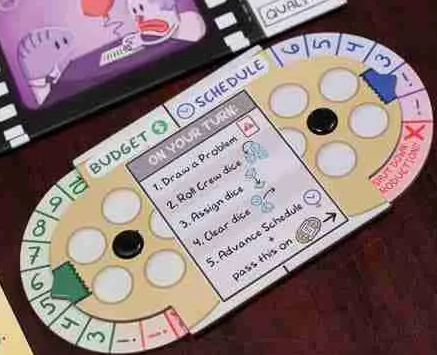
9) Adjust the Budget and Schedule dials according to the difficulty setting and number of players. The Difficulty settings are printed on the reverse side of the dials.

10) Place the pink Quality marker on the START space on the Quality track.
11) Place the “Blocked” tokens next to the Problem deck within reach. 12) Choose someone to be the starting player, giving them the six Crew dice and the Budget/Schedule dials.

Game Flow
Player turns in Roll Camera! consists of five simple steps:
1) Draw a Problem Card
2) Roll the Crew dice
3) Assign the Crew dice and take actions
4) Clear the Crew dice
5) Advance the Schedule and pass the dials
1) Draw a Problem Card
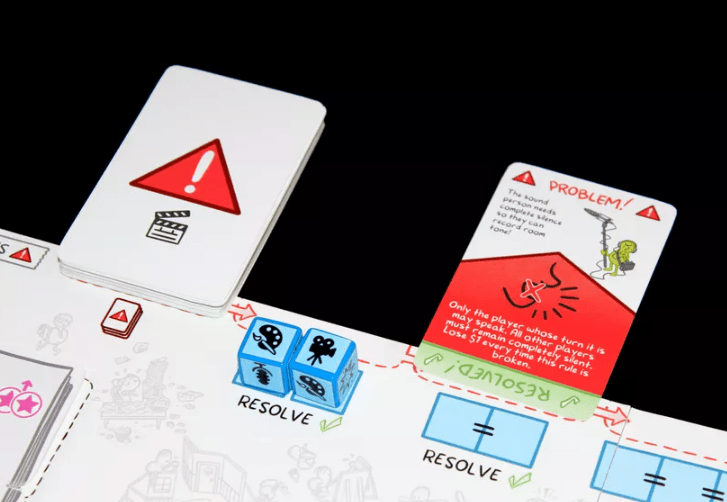
Draw one card from the Problem deck and put it in the slot immediately to the right of the Problem deck.
The Problem Queue has three slots. New Problems are added to the leftmost slot. Any existing Problems are pushed to the right. Problems never move back to the left, even if others are resolved to create a gap in the left or middle space.
If the Problem queue is filled with three problems, you don’t need to draw another one at the start of the next turn. However, you also cannot take actions, play Idea cards or gain bonuses that require drawing a Problem card if the queue is full.
2) Roll the Crew dice
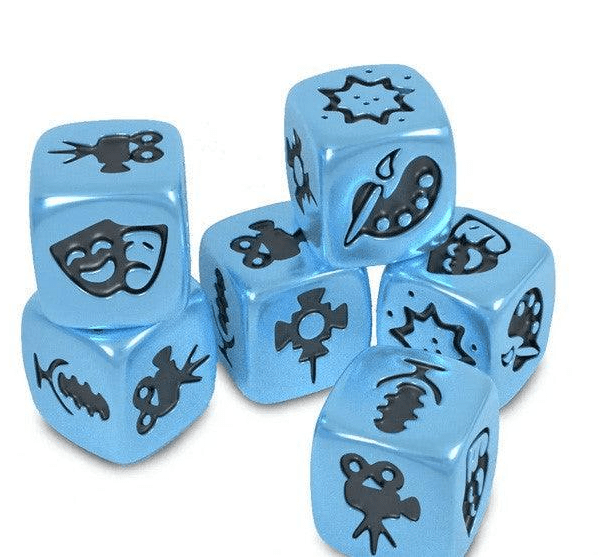
Roll the Crew dice, which determine what cast and crew you’ll have available this turn.
Usually, you’ll roll all six Crew dice, but it is possible that some Crew dice have been “locked in” onto a Set Piece during a previous player’s turn. If so, you’ll roll fewer dice. At any point, you may choose to re-roll and reassign dice that were locked in on a previous turn.
Each Crew die has six faces: Camera, Light, Sound, Actors, Art Department, and Visual Effects (or VFX, whose symbols are white to denote that it’s considered a “Wild” die face).
3) Assign the Crew dice and take actions
Take as many actions as you have dice to assign for available spaces. You can use the blue action spaces on the main board, on Set Pieces (tiles), and on your player board. You cannot use the actions on another player’s board, nor can you use an action again if its space(s) are already filled with dice.
Actions will require specific dice. Refer to the following pictures, keeping in mind that the VFX die face is wild and can be used as any die face.






You don’t have to use all the Crew dice on your turn if you can’t or don’t want to; however, the next player will still re-roll any unused dice on their turn.
Locking In Dice)
You may also choose to “Lock in” any of the dice you place if you aren’t able to complete an action’s requirements. Another player could then complete those requirements on a future turn.
If you do this, the next player will roll fewer dice.

4) Clear the Crew dice
Once you’ve taken all the actions you want, clear the dice, leaving any locked-in dice on their spaces, and hand the dice to the next player.

5) Advance the Schedule and pass the dials
Turn the Schedule dial to lower your remaining time by one and hand the dials to the player to your left. Your turn is over; it’s now the next player’s turn, and they begin with Step 1).
Ending the Game
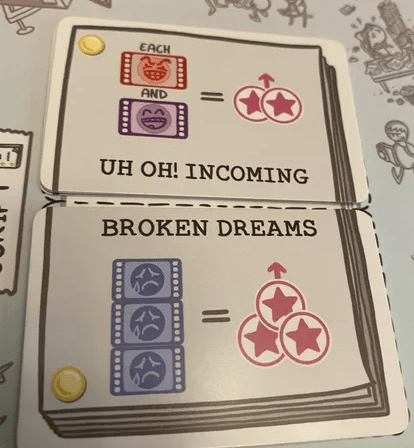
Play continues as above until players finish five scenes in the Editing Rooms and the movie is in one of the white sections on the Quality track. It is possible to create a “So Bad, It’s Good” movie. The game can also end if you run out of time on the dial. If this happens, you don’t get to finish your movie. Sad times.
Review
I’ll begin by reiterating that Roll Camera!’s rulebook is—at best—confusing. Thank goodness there are multiple videos explaining how to play the game. I recommend watching the rules video at least before attempting to play the game or even reading the rules as written.
The cluttered rulebook runs counter to Roll Camera!’s game board. One could almost figure out how to play by the symbols on the board. That’s the mark of great graphic design. I’m shocked this didn’t carry over to the rulebook. I get it. Writing a rulebook is my least favorite part of designing and developing a board game, but Roll Camera!’s rulebook is borderline unreadable.
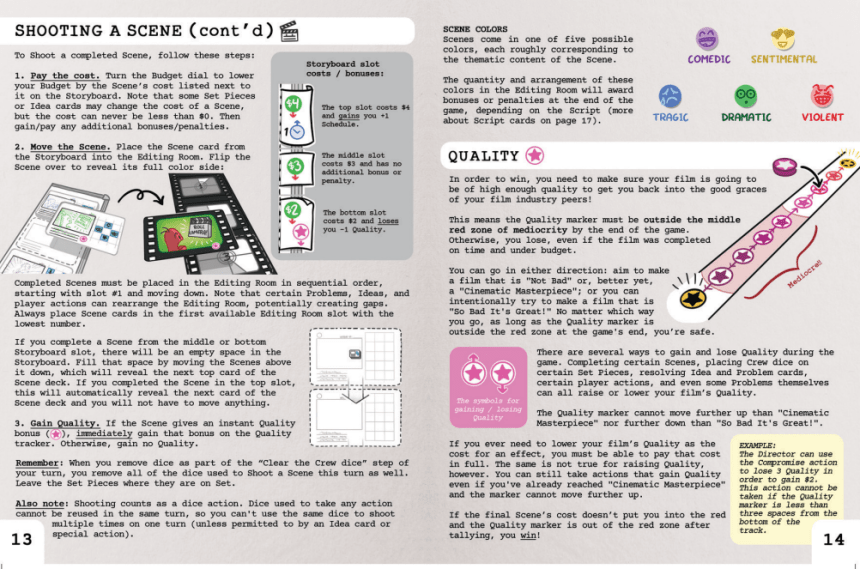
That’s a lot of text for a few images. Yikes!
There are a lot of individual mechanisms contained within Roll Camera!’s gameplay, but they all work together toward a cohesive whole. Player boards (with their unique abilities) make sense for player roles. Production design can improve the movie’s quality by expending an art department die face, the editor can move scenes around after they’re shot to meet requirements set by the script, and the producer can cut corners, generating money and an extra problem. Since the player abilities are tied neatly within Roll Camera!’s theme, it makes the abilities intuitive.
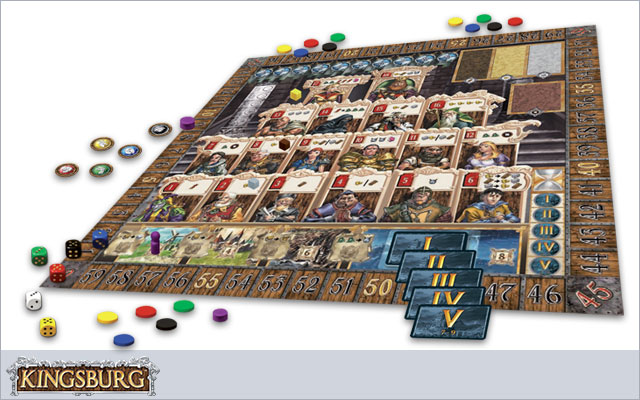
The requirements for placing dice are similar to those used in numerous dice placement games (like Alien Frontiers). That’s a strength. Similar symbols added with me learning how to play Roll Camera!. The Set Pieces made for an interesting puzzle the group must solve. Do we build a Set Piece with more blue, but specific blue spaces (like only actors can be placed on a space), or do we go for limited spaces with which to place dice, but when we do place dice on those spaces, you gain a bonus (like more money or more time)? These may seem like small choices, but these small choices add up to plenty of variables.
Roll Camera! even includes bad die roll mitigation. A player may choose the “Get Intern” action, setting a die to any die face but gaining a problem. Ah! The dangers of hiring interns. Roll Camera! uses its theme with most—if not every—design decision.
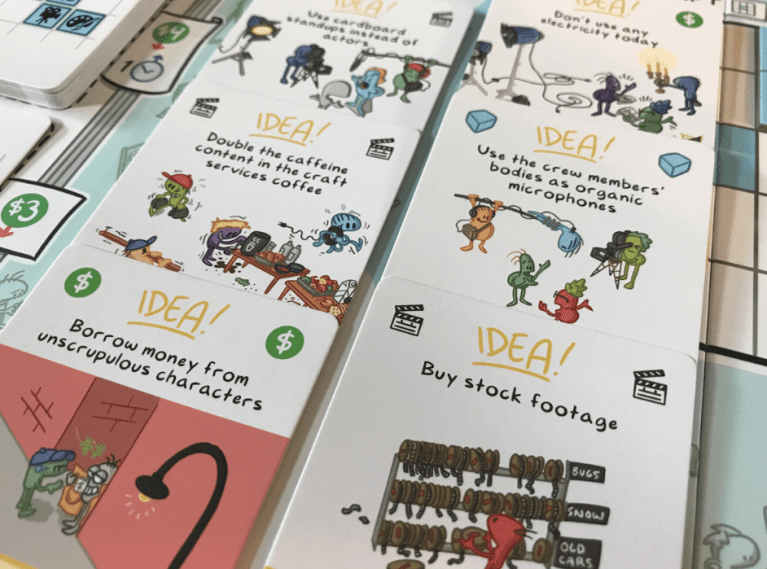
The most interesting action a player can choose during a turn may be “Production Meeting.” Players (including the active player) donate one idea card each to the active player. The active player will then choose which idea card to play, which one to save for later (you can replace another saved idea card if needed), and which idea card to discard. This is an interesting way to keep players engaged even when it’s not their turn as the active player. I may have to steal this game mechanism for a future game. Lol. Technically, the active player could play more than one idea card in a single turn. Saved idea cards can be played by placing dice on the spaces above their save space. The concept that you can play one die at a penalty versus playing an idea card for no penalty if you place two dice is brilliant.
Idea and problem cards uphold the theme. I don’t know how many times I chuckled when an editing-specific problem occurred while I played as the Editor or a directing-specific problem happened during the Director’s turn. Roll Camera! does what it sets out to do. It takes the world of cinematography and applies it to a fast-paced dice placement game.
I don’t even mind when my team and I fail, and we make a “So Bad, It’s Good” movie. In fact, those may be the best games of Roll Camera!.

Too Long; Didn’t Read
Dreadful rulebook aside (watch the how-to-play video instead), Roll Camera! takes the world of movies and turns it into a fast-paced dice placement game. Roll Camera! incorporates a lot of mechanisms, but each one works to form a cohesive whole that captures the essence of the game’s theme. Roll Camera! may be one of the few games I don’t mind losing. Heck! I like making a movie that’s “So Bad, It’s Good.”


 jkgeekly.com