
Hi, everybody. Kyra’s back with another older write-up that never got posted. This week’s post is a beginner tabletop games. I may add a game or two because there have been countless games that have been published in the six or so years since this write-up was written, but so many people cover newer games. Let’s stick with the older games.
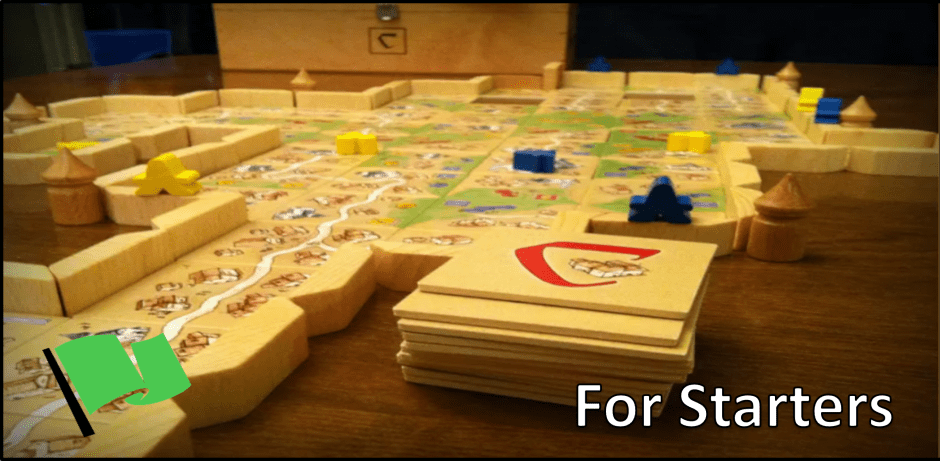
Today we’ll cover tile placement games. A tile placement game is one where players lay or place tiles in groups or patterns to achieve various effects. Usually, but not always, where players lay their tiles will earn them victory points (or just points) needed to win the game.
Okay. The boring part’s over. Let’s get to the games.
Kingdomino
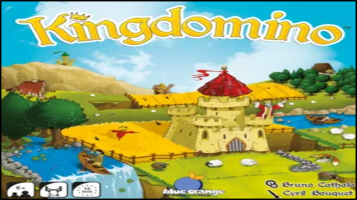
Kingdomino and not its sister game Queendomino makes this list because Kingdomino is more streamlined and easier to learn. It’s not that Queendomino is all that more difficult to play. If you know how to play Kingdomino, it’s easy to learn how to play Queendomino and progressing from King to Queendomino works with my idea of learning tabletop games with a scaffolding approach. One game that builds on another.
Anyway, in Kingdomino players take on the role of a lord or lady as they try to gain the most land—or the most value tracts of land—by collecting dominos. The dominos in question have numbers on their back denoting how valuable they are and two sections of landscapes on the front (that can be forests, deserts, mines, wastelands, or swamps). Dominos equal to the number of lords or ladies (the players pawns) are placed in number order with the lowest number on top and players take turns selecting dominos and placing them in their kingdom.
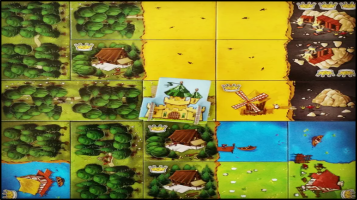
I won’t go into much more detail with how Kingdomino balances who picks first each turn, but it’s well done (as one can expect from designer Bruno Cathala). Instead, let’s focus on the tile placement aspect. Players start with a 1×1 tile, their castle tile. All the dominos are 2×1 tiles and when they’re claimed and added to a player’s kingdom, they must share a side with a section of land that shares their type (forests with forests, deserts with deserts and so on); castle tiles count as all land types. Players also can’t exceed a 5×5 kingdom, but their castle doesn’t have to be in their kingdom’s center.

This all makes for some interesting maneuvering, but the scoring mechanism further complicates tile placement. Players count their scores for each region they have in their kingdom. A region is every continuous area of the same land type and there can be more than one region for a land type. Someone could have a forest region of five and another forest region of three. For each of these regions multiply the number of spaces by the region’s number of crowns. Pictures of crowns show up, usually, in higher value tiles. If the forest region with five space has one crown, it’s worth five points, but if there are two crowns in the five-space forest region, it’s worth 10. A region with no crowns yields no points, no matter how big it is, so it’s ideal to get at least one crown in each region.
Kingdomino received the 2017 Spiel des Jahres; it deserved the game of the year.

Tsuro
I know I’ve included Tsuro in a previous starter games list (route/network building games), but Tsuro pulls double duty as a great starter tile placement game. Each player has a pawn and their pawns begin the game on the edge of the board (a 6×6 grid). On a player’s turn, they place a tile from their hand—these tiles will have paths on them—on the board continuing the path (or route) their pawn is taking. As soon as a new tile is placed, the player moves their pawn further on the path. The aim is to be the last player with their token on the board.
Players are not only building a route or network in Tsuro, they’re placing tiles to do so, and this simple, elegant game makes for a great introduction to both game mechanisms.
Patchwork
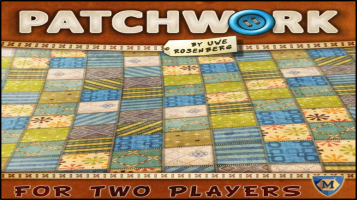
Patchwork remains one of my go to two-player only games to teach people. Sure, the designer Uwe Rosenberg has plenty of games the reimplement the same game mechanisms as Patchwork and other designers have followed suit, but the original Tetris-like tabletop competitive game about making a quilt retains its power.
On a turn, players may spend buttons to buy one of three available polyomino tiles (that are patches shaped like a Tetris piece) and add it to their quilt or pass. It takes time to stitch new patches into a quilt, so players will move their time token closer to the center and when a player’s time token reaches the center, they may take a final turn and the game ends.

There are a few more rules to Patchwork, but it’s a simple, streamlined game that works well with its theme. Who’d think that making a quilt would make a great game? Patchwork’s simplicity masks deep strategies. Do you go for larger patches for more points, but leaving you fewer options with which to place future tiles, or do you go for slow and steady points throughout the game, making sure you fill up as many spaces as possible? The options are endless.
I had to include a polyomino tile placement game on this list. Patchwork may not be as hot of a game as it once was and other games may have taken its place (Bärenpark and even Rosenberg’s own Cottage Garden and A Feast for Odin have even taken Patchwork’s place) for a lot of gamers, but it’s still a great starter tile placement game.

Azul
Azul is another game that I included in a previous list of great starter games (Card Drafting Games), but it works for tile laying as well. In fact, Azul’s theme is tile laying a Portuguese wall. Players draw tiles from a bag and four of them are placed on 7 cardboard discs that are accessible to each player. Then, players take turns claiming similar tiles on each disc and adding them to their player boards (that represent the walls the players are tiling). Each board has the same wall pattern and the player to finish a row of tiles initiates the game’s end.

Again, Azul can be classified as card (or tile) drafting and that’s a core ingredient to the game as well as set collection and chain effects, but the combination found is Azul is so unique for a tile placement game that I had to include it on this list.
Chomp
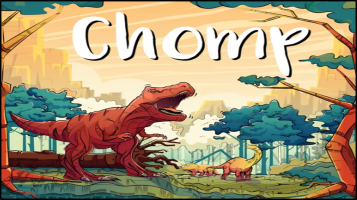
This is the newest game of the list and the only one I added to the original post. I played Chomp a week ago for the first time. Chomp refers to the 2023 Allplay title, not the 2000 food chain card game Chomp! from Gamewright. In Chomp (without the exclamation point), players build a dinosaur biome by laying tiles with dinos, plants, tar pits, and other things you may find in the age of the dinosaurs.
Players must build their land so that herbivores have plants to eat, and carnivores have herbivores their size that they can eat. Dinos of the same type that are placed adjacent to other dinos of their type form a herd. Players can chain as many of these dinos together as they can to form massive herds and potentially earn big points.

Any dinos placed next to tar pits automatically die at the end of nine rounds (I played with 3-players, there may be more or fewer rounds at different player counts), so be careful where you place tar pits. But you may want your dinos to perish. Each tile is double-sided. One side depicts the land you’re placing, while the other gives the player a scoring option. Each game, players must balance whether they want to play or score the tile they pick up that round. Such a great twist.
Final Thoughts
We had a couple more games in this starter board game list than usual, so I hope there’s something here you’ll enjoy.
Know of any other great beginner tile placement games? Are there any games on this list you disagree with? You can place your suggestions and complaints in the comments.



 jkgeekly.com