Spotlight: Bunker

First Appearance: Sentinels of the Multiverse: Base GameBunker03
Who he is: The Ironman of the Sentinels of the Multiverse’s main superhero team, the Freedom Five
Innate Power: Initialize: Draw a card.
Primary Damage Type: Projectile
Secondary Damage Types: Energy and Fire
Nemesis: Iron Legacy and Fright Train


Deck Concept: Draw a lot of cards and deal copious amounts of damage based on the fact that you’re drawing a lot of cards.
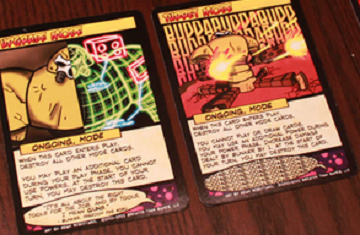
Deck Strength: Card draw and a lot of it. Bunker can even take himself out of the game—so to speak—with mode cards—you can find loop holes for these modes—so he can draw even more cards and charge up his bigger weapons. He can also negate a lot of damage as well.

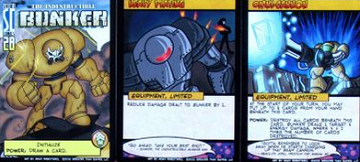
Bunker04Best Team Support Card: Adhesive Foam Grenade: The environment deck cannot play cards on its next turn.
Best Personal Support Card: Ammo Drop: Whenever a villain card is destroyed, you may draw a card, even if a mode card says you cannot.
Bunker05Best Attack: Omni-Cannon: At the start of your turn, you may put up to 3 cards from your hand beneath this card. Destroy all cards beneath this card. Bunker deals 1 target X energy damage, where X = 2 times the number of cards destroyed. Although you could make a case for External Combustion or even Gatling Gun.
Deck Weakness: More so than most, Bunker needs equipment. Any villain or environment deck that targets equipment cards gums up Bunker’s mojo. And like most other heroes that use equipment cards, Bunker needs time to get set up, or else his attacks fall short of their potential. Even though he has energy and fire damage attacks, Bunker leans heavily on projectile damage. If you encounter a villain that’s immune to that damage type, he’ll be less than effective.
Bunker06Worst Card: Maintenance Unit: Bunker regains 2 HP.
Ultimate Team-up: Anybody who can give Bunker card draw and damage buffs works just fine with the Freedom Five’s answer to Ironman. Regardless of who he plays with Bunker needs to go last in the turn order, so he can benefit from his teammates and has plenty of time to prepare.
Bunker01


Spotlight: Absolute Zero

AbsoluteZero03First Appearance: Sentinels of the Multiverse: Base Game
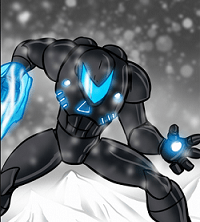
Who he is: The Iceman—sort of—of the Sentinels of the Multiverse’s main superhero group The Freedom Five
Innate Power: Thermodynamics: Absolute Zero deals himself 1 fire damage or 1 cold damage
Primary Damage Type: Cold
Secondary Damage Type: Fire
Nemesis: Iron Legacy and Proletariat

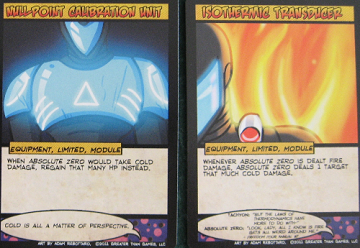
Deck Concept: This is a slow build deck. You need to start by playing Isothermic Transducer, so Absolute Zero can deal cold damage to a second target whenever he receives damage, and then get Null-Point Calibration Unit in play, so Absolute Zero can get the occasional heal. Finally, you concentrate on playing other cards that boost Absolute Zero’s cold damage, deal cold damage, and try to pull off Thermal Shockwave at least once.

AbsoluteZero02Deck Strength: Once it gets going Absolute Zero’s deck controls the board. Whenever villain cards deal him damage, he heals or redirects the damage to another non-hero target. As for the majority of the other cards, Absolute Zero has plenty of ways to deal consistent low cold damage with his permanent cards, and his innate power, Thermodynamics, serves as a great way to keep him in the game with a built in healing power.
Best Team Support Card: Sub-Zero Atmosphere: Any villain card which would act at the end of the villain turn instead acts at the start of the villain turn.
Best Personal Support Card: Nullpoint Calibration Unit: When Absolute Zero would take cold damage, regain that many HP instead.
AbsoluteZero01Best Attack: Thermal Shockwave: Absolute Zero deals up to 3 targets 1 cold damage each. Absolute Zero deals himself X fire damage, where X = the total amount of cold damage dealt by Absolute Zero this turn.
Deck Weakness: Absolute Zero needs at least two equipment cards—Nullpoint Calibration Unit and Isothermic Transducer—in play to work at all, so any villain or environment deck that focuses on discarding equipment cards would cripple Absolute Zero’s deck. He’s also attack type dependent as well. If anyone or thing changes the global or hero’s attack type, that could hose Absolute Zero. And he takes a while to set up, and you don’t always have the time to wait for Absolute Zero to get the right cards in play.
Worst Card: Glacial Structure: Draw 3 cards. Destroy this card.
AbsoluteZero04Ultimate Team-up: Absolute Zero needs help—a lot of help. Players should consider Absolute Zero as the target for most damage buffs in the game. Here’s looking at you, Legacy or even Argent Adept if he concentrates most of his buffs on Absolute Zero. Early card draw is nice to help Absolute Zero get set up, so Visionary’s a natural choice too. And The Might Ra’s an interesting choice. He boosts Absolute Zero’s damage by a ton, but Zero’s more likely to take damage himself.

Geekly TV: October 24, 2014

TheFlash

The Flash

Kyle’s Review

Let’s face it. The CW shows have it going on right now. Their shows may not hit all the time, but they have more hits than misses. And I had my doubts for The Flash series before it debuted.

I wasn’t sure how good the production value (CGI and other effects) would be because the CW doesn’t have as large a budget as the bigger networks, and The Flash with all its meta-humans could go over the top quickly. But neither of those things has happened so far. The effects look slick, and more importantly, the grounded characters—at least the main cast: Barry, Detective West, and Harrison Wells—make a man running several times the speed of sound look natural.

Like Ollie from Arrow—learning how not to kill—before him, Barry Allen struggles with what’s right in the latest episode of The Flash. This isn’t the first time Barry has questioned how he should use his powers or even if he should use his powers, and this makes Barry a believable character; take notes, Gotham’s Batboy. You can’t be the hero you will become after three episodes, and while The Flash could be on the fast track to superherodom, he still stumbles.

The flashbacks in this episode stumble, too, but I don’t think the execution of the flashbacks was the main reason. Sure, the transitions are clunky, but the chief problem with these flashbacks rest with who’s having them. I haven’t bought into Caitlin Snow and Cisco Ramon as characters yet, so their back stories fall a little short. Heck, Diggle didn’t have a flashback until much later in the Arrow series. The Flash needs to develop these two characters further before they delve into their past. But the one flashback at the end—I won’t say who, but you can probably guess—makes up for the previous flashbacks.

I enjoyed this episode’s villain. He had a good back story, a great power, and the reasoning behind his abilities made sense. The only problem is that The Mist is the appetizer for a larger meal. We’re getting some nice build up. Let’s hope the payoff is worth it. But I’ve learned my lesson with CW shows. I expect a wallop of a payoff.

Verdict: The Flash continues its strong start.

Jim’s Take

The show continues with some clunky character interaction, and the flashbacks to the night the particle accelerator blew up weren’t handled as well as they should have been, slowing down the pace of the episode, but this show continues to hit far more than it misses. I really enjoyed seeing Barry struggle with the knowledge that he could simply bust his father out of prison, and seeing a character ponder an ethical question like that is a great example of how to develop a character. In short, The Flash is not yet the person he will become, and that makes it interesting. The Mist was the villain of the week, and while I feel we didn’t get enough of the character, I was impressed with the presentation. I knew a show like The Flash would test the limits of The CW’s production budget, and this episode in particular shows they’re doing pretty well.

Arrow

Arrow

Kyle’s Review

This week’s episode of Arrow was enjoyable, but I found myself having to suspend disbelief quite a bit which is something I’ve had to do a lot of this season. Is it just me or are we going to see someone pull their League of Assassins training out of a Cracker Jack?

We’ve had too many characters with world-class combat training in this show already, and now we get Thea and a fledgling Laurel. It takes longer than six months to pull off Deathstroke moves, people. That said. The Laurel storyline was at least somewhat believable. She did get her behind handed to her, and her motivation makes sense. I just don’t care for the actor’s portrayal of the character up to this point. But I have to admit that she’s showing some range this season, so I’ll hold some of my judgment until later in the season. It does look like we traded watching Roy Harper’s (Arsenal’s) training—something I’m glad we didn’t have to see in its entirety—for Laurel Lance’s (Black Canary Mark II’s).

But surely Laurel’s training will last longer than Thea’s. She’s already a card carrying assassin. And didn’t she shoot her dad in last season’s finale? She should have herself checked for a personality disorder, because she swings over to Camp Merlyn in half a heartbeat with some half-baked idea that she no longer wants to feel pain and that Merlyn’s the chap to teach how not to feel. Hunh?

Despite the odd Merlyn-Thea relationship, I liked Ollie’s and Thea’s interactions in this episode. It’s nice to see how Ollie connects with Thea. It felt like a genuine moment, and I’m interested to see how Thea balance her brother’s and her biological father’s relationship. Or if she even chooses one over the other. I have my suspicions as to which side she’ll choose, but I think the show does a good job sewing ambiguity in the character.

And speaking of ambiguity, I like what Arrow’s done with A.R.G.U.S. in this episode. Up until now they’ve given us enough to know that they aren’t the kind of group you want to play patty cake with—and that continues in this episode—but they haven’t completely shown their hand. I do have to say that I don’t buy that Lyla would send Diggle to do her dirty work unless she wanted Diggle to get her out of A.R.G.U.S. which remains to be seen.

Still, this episode of Arrow kept me entertained, and I’m glad they didn’t hide The Flash Easter eggs dotted throughout the episode. I won’t spoil anything for you, but you’ll like the two cliffhangers.

Verdict: It has its flaws, but it’s still fun to watch.

Gotham01

Gotham

Kyle’s Review

The can of mixed nuts that is Gotham continues. The creative team shakes the can every week, dumps out ten nuts at a time, and the fans have to hope for a good variety. We got the same nut this week. You’ll begin to see a pattern with what’s working and what needs work in this fifth episode.

Bruce makes another appearance. His inclusion makes more sense with the story’s arc, and this is a great thing. But he’s already Batman. As I’ve said in weeks past I don’t want to see Batboy. Bruce Wayne has no place to grow as a character. He’s already Batman at age 12, and not only is that unbelievable, it also makes Batboy not interesting. We all know how Bruce Wayne ends up, and you do have to give service to Bruce’s proclivities, but show us his path of becoming Batman. He can’t be Batboy sans cape and cowl less than a month after his parents’ death.

Gotham City continues to feel like a modern city from an alternate reality, and it doesn’t look like a New York City clone. This is another great thing. But the rampant crime and mob war screams a Batman era Gotham instead of a Lieutenant Gordon Gotham. The city’s corruption should exist but should be difficult to see at first like the oil on a teenager’s skin. The pimple shouldn’t be ready to pop.

Minor spoiler: the drug of choice in this episode, Viper, is the predecessor of the Venom Bane uses in the comics. While the two drugs are similar, they don’t work the same way. This is another great choice. But, through dialogue, we learn that a group of scientists have already perfected Venom. You can’t have Venom without Bane, and I don’t see them introducing this character any time soon. Gotham wastes yet another chance to let the world that will become Batman’s to develop.

And the only development worth watching on a nightly basis is the Penguin. Let’s call this nut a cashew: the nut I try to eat the most of before my wife gets to the can. I like Robin Lord Taylor’s portrayal of the Penguin a lot. I might be a little biased because I also wondered why the Nolan Batman movies didn’t include the Penguin. He’s a Batman character grounded in reality, rooted in the mob, and you can count on Taylor’s performance most nights. Taylor gives another great performance this week. The only problem with the Penguin is that his story intertwines with Fish Mooney’s.

Fish’s accent continues to baffle me. What is her nationality anyway? Most of Europe may share a common currency, but they don’t all speak the same language let alone the same dialect. Furthermore, Fish’s cockamamie ideas make no sense. The only positive thing I can say is that at least Gotham didn’t wait a few months to show how a teenage songbird could take down a crime boss. The only problem is that there’s no way this plan should work. And I fear that it might.

Verdict: A can of mixed nuts where most of the good nuts are taken.

Jim’s Take

I’m glad that Bruce’s part of the plot felt less tacked-on this week, but I’m still not convinced he should have been in the episode. I’m also annoyed that he’s already displaying so many of the characteristics that will make him Batman. I’ve said it before, but the character should be allowed to develop with the show. Also on that note, I’m troubled that Venom exists so far before Batman comes into being. Frankly, I think “Viper” was pretty obviously a precursor to Venom, and I think they could have left it at the prototype, and that would have been a good thing. Fish Mooney’s acting continues to annoy, and the idea that her protégé could take down a mob boss with a song is unbelievable and silly. The show still isn’t terrible, it’s just that I can’t shake the feeling that it should be getting better.

Comic Book Reviews: October 22, 2014

Jim our comic book guy is unable to post comic book reviews this week (the week of October 22, 2014), but we trust he’ll be back soon and better than ever.

Timeline: Vlaada Chvatil

The gaming world knows Vlaada Chvatil for his innovative gaming mechanics. Can you name these cutting-edge board games by Chvatil in the order they were released?

Pictomania01  ThroughTheAges01  MageKnight01

GalaxyTrucker01  DungeonLords01  SpaceAlert01

GeeklyAnswers

Gloom

Designer: Keith Baker
Publisher: Atlas Games
Date Released: 2005

Number of Players: 2-4
Age Range: 8 and up
Setup Time: minimal
Play Time: 45 minutes or less

Game Mechanics:
Hand Management

Game Flow and Review:
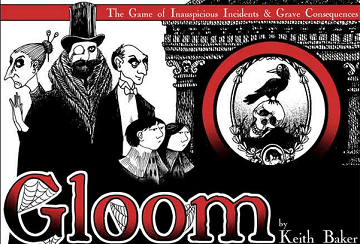
Most people choose happiness over sadness, but that isn’t the case for the families of Gloom. You assume control of one of four miserable families, making each family member as unhappy as possible before they die. An interesting and morbid concept for a game; perfect for Halloween.

Gloom01

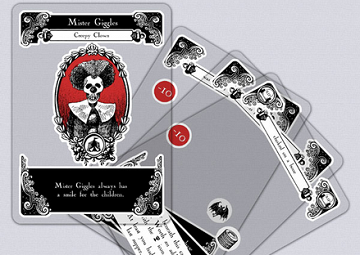
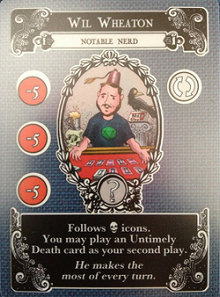
Gloom has four main card types: characters, modifiers, untimely deaths, and events. The character cards have no special effects. They’re just quirky misfits. But the core game mechanic of Gloom lies with the most abundant card type in the deck, the modifiers. In fact, modifier cards are played directly on top of character cards, and that’s the reason why all Gloom cards are printed on transparent plastic.

Gloom03

Each modifier gives a character a negative or positive score. You’ll want to play negative cards on your family and positive cards on your opponents’ families. Remember: the most miserable family wins. Think of it like a game of golf. The most miserable person, who also has the lowest score, wins.

When you have a good, negative score on your character, you can off them with an untimely death card. Now you get two cards that you can play on your turn, but you can’t play an untimely death card as your second card, otherwise you’d just play a negative modifier for your first card, and then kill your character with the very next card. That wouldn’t be very sporting. It might make you feel good, but feeling good goes against the tenor of Gloom.

Gloom02

The final card type differs from the previous three. While every other card type stays in play (they’re permanent cards), event cards are played once and then discarded. There are some event cards that you can play on an opponent’s turn as a response to a card they want to play which further separates event cards from the other three.

Play ends when one player runs out of family members. However many points you accumulated on your dead family members when this happens count toward your score. It don’t mean a thing if it ain’t rotting.

Gloom is easy to pick up and play, and its use of alliteration calls for copious chuckles. I’m not sure if there’s a lot of replayability, and you have to have luck on your side to win.

Gloom04

Verdict: A fun, fascinating, and award-winning card game with a sick sense of slapstick. Gloom will smack a smile on your face, while it puts frowns on your family. But don’t look for too many strong strategic elements.

Quiz Answers: Vlaada Chvatil

ThroughTheAges02   GalaxyTrucker02   SpaceAlert02

DungeonLords02  MageKnight02  Pictomania02

Let’s see how we did.

All 6 correct) From miniatures to board games you know your stuff, Mage Knight.

4-5 correct) You’re a wiz at making something out of space garbage. Your next intergalactic shipment awaits, trucker.

2-3 correct) You may have enemies on all sides, but your shields and blasters still work. Stay alert.

0-1 correct) You can’t draw, but you love to party with these games. Sounds like you’ve caught Pictomania.

Hanabi

Designer: Antoine Bauza
Publisher: ABACUSSPIELE
Date Released: 2010

Number of Players: 2-5
Age Range: 8 and up (14+ on the box; 10 for a family game)
Setup Time: minimal
Play Time: 25 minutes or less

Game Mechanics:
Cooperative Play
Hand Management
Memory
Set Collection

Game Flow and Review:
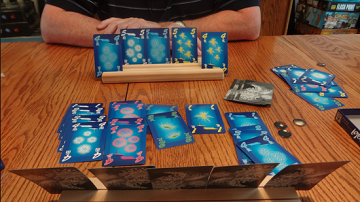
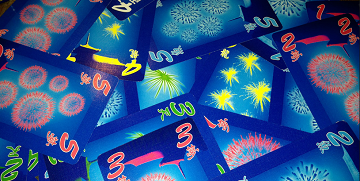
Hanabi is the Japanese word for fireworks, and the game Hanabi revolves around a team of fireworks experts trying to give spectators the most memorable display of their lives.

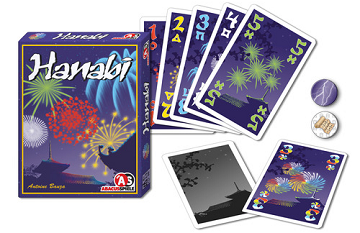
Hanabi01You and your team are trying to set off fireworks in the proper order, and there are five different colors of cards—depicting the various colors of fireworks—with numbers on each card—illustrating the number of colorful blasts at the moment you play the card—ranging from 1-5. Your goal is to place the different colored cards in ascending order. When was the last time a fireworks display started with the big finish?

It sounds easy enough. In fact, you get to see all of your teammates’ cards so you can help them play their cards in the right order. But there’s a catch. You’re not allowed to see your own hand. You’re playing this game blind.

Hanabi04You get three options during your turn: give a teammate a clue, play a card, and discard a card to earn another clue. It gets even more difficult. When you give a teammate a clue, you have to tell them where all their numbers of one type are or where all their same colored cards are. This proves problematic when you’re dealing with a hand with three ones but only one plays and there just so happens to be another card of the same color as the one “one” that plays. Suddenly, Hanabi turns deceptively complex.

You have to feed your teammates plays—while keeping a Poker face—and not leading them to a wrong conclusion about their hand. If you make a wrong play, the firework explodes in your face and you lose a fuse chip.

Hanabi05And of course you could always forget which cards are in your hand. You are allowed to shift cards around so you can keep track, and you’ll see players holding their cards between various fingers, grasping multiple sets of cards in their two hands, or staggering how they hold their cards to remember which group of cards are their ones and fives as well as their blues and reds.

Hanabi03The above picture of people playing with card racks instead of holding their cards is cheating in my book. Hold your hand, people.

Hanabi comes with an optional sixth suit of cards: the rainbow or wild cards. You have to determine how you’ll play the cards. If you want to make things easier, you can choose to play them as wild cards. But if you choose to play them as rainbow cards, you just gained another group of fireworks to play in the correct order. The second option is perfect for a group of people who need a bigger challenge.

Hanabi02Leave it Antoine Bauza to create yet another game with wildly different game mechanics and one that also attracts a different kind of gamer. Hanabi starts out easy enough but increases in difficulty and tension as the game progresses.

Verdict: A simple game with a mean streak, Hanabi spells cooperative fun for a group of friends and/or family. And it doesn’t hurt that it only takes twenty minutes or so to play.

Memory

Games that use the memory game mechanic require players to recall previous game events or information in order to complete an objective. The classic children’s game Memory is the perfect example of a game that uses the memory game mechanic.

Catch Phrase: Week of October 20, 2014

Ever notice how comic book characters are always calling on a higher power or at least some feature of a higher power? By Batman’s pointy ears, we did. Can you match the following phrases with the characters who said them?

Phrases:

1) By Odin’s Beard

2) By the Goddess

3) By the White Wolf

4) By Oprah’s chins

5) By Toutatis

6) By the Hoary Hosts of Hoggoth

Characters:

A) Doctor Strange

B) Asterix the Gaul

C) Thor

D) Storm

E) Colossus

F) Deadpool

GeeklyAnswers