
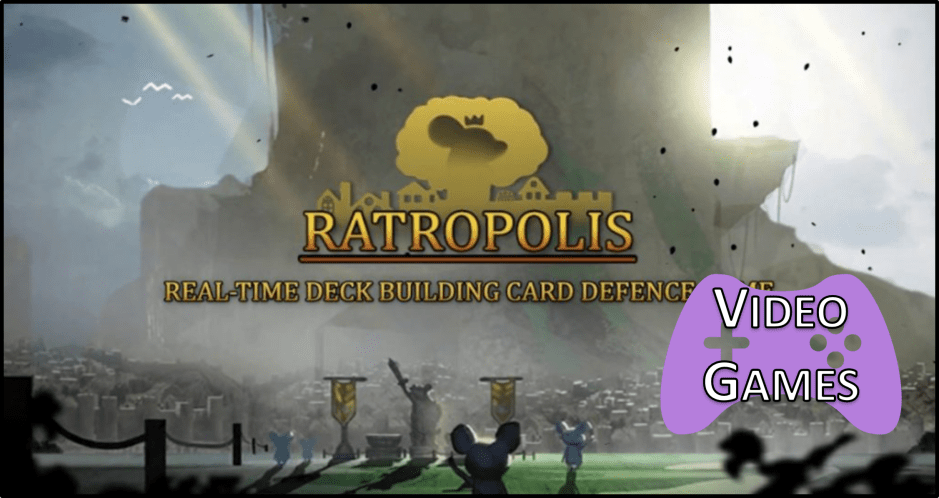
Happy Spooky Season, Geekly Gang! Kyra Kyle here, and while Ratropolis doesn’t exactly fit the horror aesthetic for this month’s theme, it is an interesting blend of deck building, tower defense, and real-time strategy. That’s right, it’s time for another quirky video game review. Relatively new, Korean video game design group, Cassel Games, combines so many disparate themes and mechanisms that they couldn’t possibly work together. Could they? Let’s put Ratropolis against our video game review criteria.

Game Mechanisms: 9/10
Ratropolis does manage to merge its separate parts into a cohesive whole, but I don’t imagine players unfamiliar with deck building to fare well. Sure, Ratropolis begins with slow waves of enemies. The deck-building is somewhat pared down, but this game retains most of a deck-building game’s complexity, and the time constraint can be intimidating. The real-time strategy meets tower defense work well together. They’re almost seamless.

The deck-building does get streamlined to a point. Ratropolis splits cards into specific leader types: Builder, General, Merchant, Navigator, Scientist, and Shaman. Each leader type has a male and female variant with their own special powers, so this specializes each potential deck even further. You begin the game with the Builder, which allows for upgraded buildings and extra building cards that provide sustained benefits, even resources over time. Ratropolis has addictive gameplay and since it offers so many avenues to customize your deck, once you get hooked, you’ll lose several hours and not even notice.

I can’t believe how well Ratropolis blends its various game mechanisms. Each leader takes advantage of different design spaces, and I love that. Different avenues for victory make a great deck-builder, and Ratropolis is a great deck-building game without the added wrinkles of an RTS and tower defense.
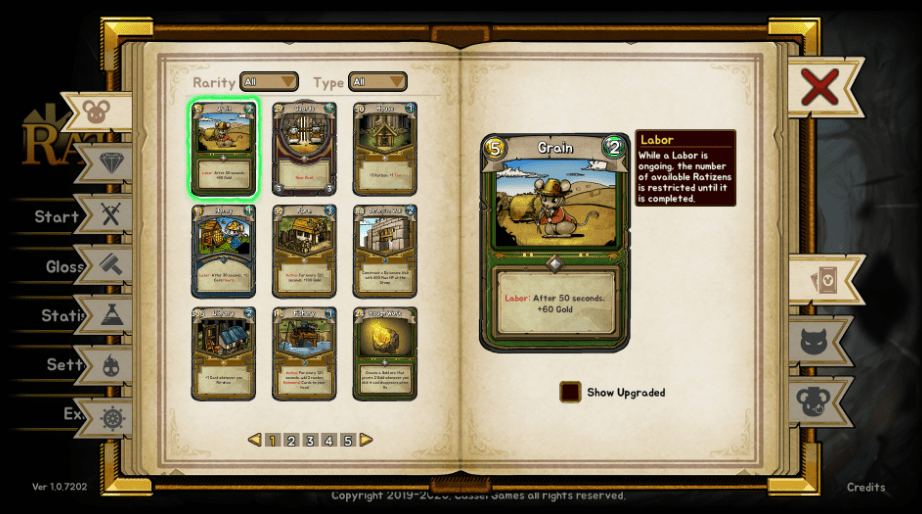
Speaking of tower defense, Ratropolis does an excellent job of ramping up its difficulty from one wave to the next. Gameplay balance like that is difficult to find. Each city run lasts up to 30 waves of enemies. The furthest I’ve ever gone has been level 25 or 27. Each new enemy type adds a new threat for the player to manage, and while these new challenges can feel unfair when first introduced, runs don’t take too long (players can even send in a new wave early to earn extra in-game money), and a quick look at Ratropolis’s card library should reveal a strategy to deal with each one. The only reason Ratropolis doesn’t get top marks in game mechanisms is that the deck-building can–at first–be overwhelming.

Gameplay Loop: 10/10
I spoiled this entry in the last one. Yes! Ratropolis has an addictive gameplay loop. I spent hours playing the game, not knowing I had spent hours playing the game. Not only does Ratropolis start players with one leader type, but you can unlock other leaders and extra cards for each deck by gaining experience. Ratropolis manages to add a little bit of Pokémon to its gameplay. Gotta catch ’em all! These new cards tend to be more complex, but they also break the game in fun ways. Ratropolis is one of those video games where you’ll be arguing to play one more game.

Narrative/Storytelling: 6/10
One wouldn’t think a deck-builder, real-time strategy, tower defense video game would have much of a story, but that’s not the case with Ratropolis. The game has a loose story that adapts to the events of your game. Did you recently have a lot of rat citizens die during an enemy raid? You may get approached by grieving parents who want burials for their children. You decide how your rat leader reacts. Do you give them a proper burial? Do you ask the parents for a death tax? Yikes! That got dark, but so does Ratropolis’s story. This game paints its story in its liminal spaces, but there isn’t much in the way of an overarching narrative.
User Interface: 7/10
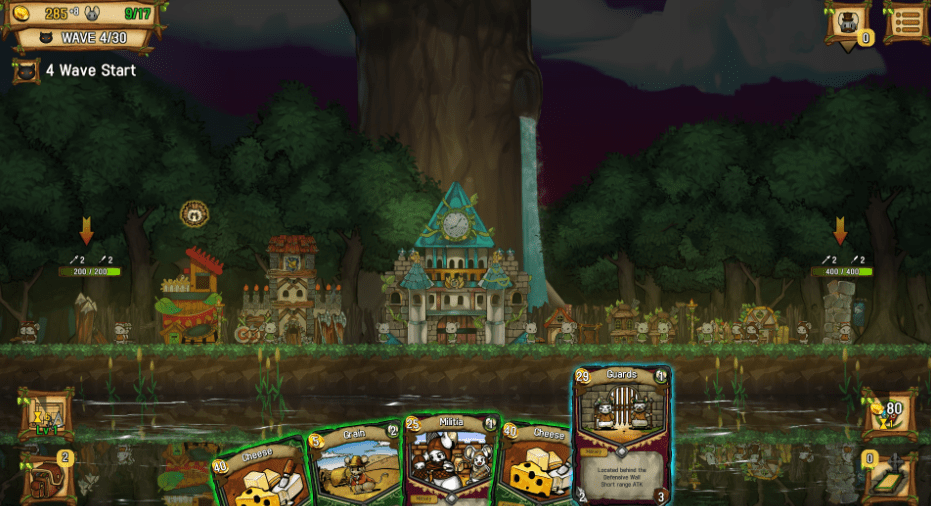
Ratropolis’s user interface is well designed, but a lot is going on in this game. Too much. I don’t know how Ratropolis could fix this issue, but it is an issue and drags down the game’s user interface score a hair. Currently (I’m writing this review in June 2025), Ratropolis is only available on Windows (and by extension, Steam). I can’t imagine Ratropolis on a console or mobile device, despite deck-building games running well on smartphones. Information pockets form in all four corners. The screen is cut into two sections: the top is the city (which players can scroll from side to side, making this space even larger and unwieldy), and the bottom center shows the player’s hand. Many cards have extensive text, so that adds even more cognitive load (how much information one’s brain must compute at one time).
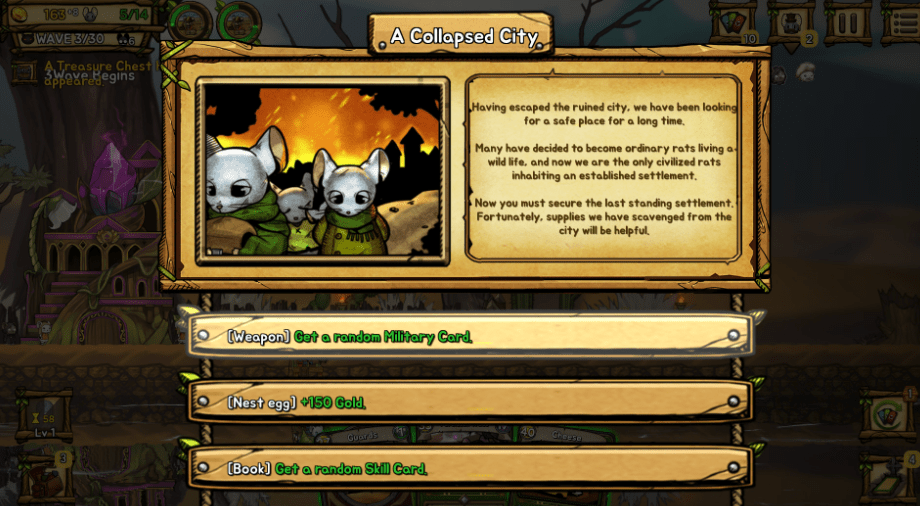
Throw in the random story elements, and Ratropolis can get overwhelming. Still, Ratropolis has a space for everything. It offers a clean interface for players to find most information. I don’t know how the game could improve on its UI design, but it’s missing something.
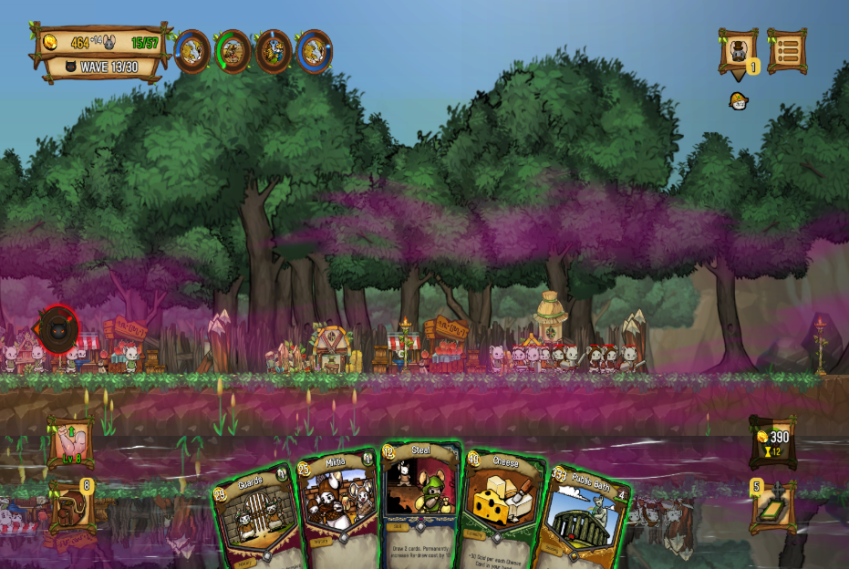
Graphics: 8/10
Ratropolis’s graphical details are fantastic. The images on the cards are cartoonish but have a well-defined style. Ratropolis is a pretty game. I may have lowered it to average if it wasn’t for the city, slowly building in the space above the cards. Look at the reflection effects in the water. You can see your entire ratropolis reflected in the river. Depending on the location you build your city (Ratropolis offers a handful of places, which can vary gameplay), you’ll be given flourishes that make every rat city unique.

Audio: 7/10
Typically, I play most video games with the sound off. That makes grading a game’s audio difficult. But I have heard plenty of Ratropolis’s audio, and it’s well above average. While the soundtrack does its job (it doesn’t stand out, but it serves the game well), the sound effects, especially the jingling of merchants entering your city or the growls and grumbles of various enemies invading your rat city raise this score. In fact, it’s these unique sounds–that I grew accustomed to–that made managing my city a lot easier. I won’t go as far as to say that you need to play Ratropolis with the sound on, but the sound mixing immerses me in the game’s world. And that’s what you want from a game’s audio.

Replay Factor: 10/10
Unlocking all the leader types, the cards, and the random city generator that makes each playthrough different gives Ratropolis an infinite replay factor. Not since Civilization have I felt this strong of an urge for “just one more turn” or game or unlock one card in my journey of mastering the Merchant leadership style. Ratropolis combines several game mechanisms that lend themselves to replay (deck-building, tower defense, and a varied enemy and environment for a real-time strategy). These mechanisms work together to form a game you won’t put down for hours.
Aggregated Score: 8.14
Ratropolis does the unthinkable and combines deck-building, tower defense, and real-time strategy into one addictive indie game package. This game may not appeal to everyone, but if you’re interested in two or more of the game’s three main mechanisms, you should try Ratropolis.
 jkgeekly.com